
India’s e-commerce market is expected to hit $111 billion by 2026, with an additional 85 million individuals joining the digital economy. Yet over 50% of new startups fail in the first two years, not because they built bad products, but because they couldn’t figure out distribution.
Here’s the uncomfortable truth: Distribution makes or breaks Indian startups.
You can have the best product, perfect pricing, and strong product-market fit. But if customers can’t discover, access, or buy your product easily, none of it matters.
In 2026, effective go-to-market strategies in India blend multiple channels: performance marketing, marketplace distribution, partner-led sales, conversational platforms like WhatsApp, and field sales for high-consideration products.
This guide will help you choose the right mix for your startup and avoid the costly mistakes we’ve seen founders make.
Understanding Your ICP in India’s Diverse Market
Before choosing distribution channels, you must define your Ideal Customer Profile with precision. India isn’t one market, it’s dozens of markets segmented by:
Geography: Metro cities (Delhi, Mumbai, Bangalore) vs tier-2 cities (Jaipur, Kochi, Chandigarh) vs tier-3 towns. Tier 2 and tier 3 cities now account for over 45% of e-commerce growth, but require different acquisition strategies than metros.
Language: English-first vs vernacular-first customers. If your product doesn’t support Hindi, Tamil, Bengali, or other regional languages, you’re cutting off massive addressable markets.
Income Bracket: Premium customers (top 10%) vs mass market (next 40%) vs aspirational users (bottom 50%). Each segment requires different messaging, pricing, and channels.
Digital Maturity: Early adopters comfortable with apps vs late adopters who need hand-holding. WhatsApp is now a primary sales channel for over 50 million Indian SMEs because it meets customers where they already are.
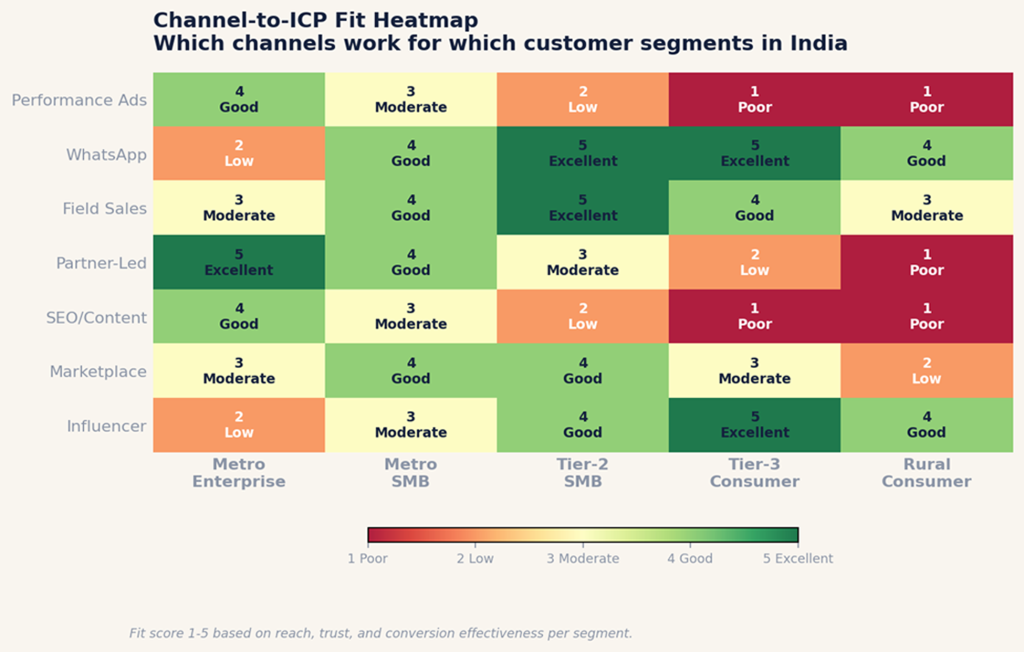
Get specific. “SMBs in India” isn’t an ICP. “10-50 employee NBFC branches in tier-2 cities using legacy accounting software” is.
B2B Channels: Direct Sales, Partnerships, Marketplaces
For B2B startups, the right channel mix depends on deal size, sales complexity, and buyer sophistication.
Direct Sales (Outbound + Inbound)
Best for: ACV above ₹5 lakhs, complex products requiring demos, enterprise customers
Direct sales gives you control and deep customer relationships, but scales slowly. In India, B2B buyers expect relationship-building, don’t just send cold emails. Get warm intros through investors, industry groups, or LinkedIn.
Typical metrics for B2B SMB SaaS in India:
- 10-15% activation rate from free trial or demo
- 12-18% trial-to-paid conversion
- ₹15K-50K CAC for SMB deals
Partner-Led Distribution
Best for: Products that integrate with existing workflows, need local presence, benefit from co-selling
Partner with banks, NBFCs, consulting firms, system integrators, or industry associations to access their customer base. This is particularly effective in fintech, where banks can distribute your product as white-label or co-branded solutions.
The trade-off: Partners take margin (20-40%) and you lose direct customer relationships. But they provide instant credibility and distribution at scale.
Marketplace/Platform Distribution
Best for: Horizontal SaaS tools, products needing quick trust-building
Listing on platforms like AWS Marketplace, Shopify App Store, or Zoho Marketplace can accelerate trust and discovery. Indian SMBs often discover software through these platforms rather than Google search.
B2C Channels: Digital Marketing, Offline, Community-Led Growth
For B2C startups targeting Indian consumers, you need a phygital (physical + digital) approach.
Performance Marketing: The Sequencing Matters
Start with Google Search ads. If users aren’t actively searching for your solution, you likely have a product-market fit problem, not a channel problem. Search validates demand.
Once search is saturated and showing strong ROAS (Return on Ad Spend), layer in Meta (Facebook/Instagram) and social ads to drive awareness. Social ads trigger “branded search”, users see your ad on Instagram, then Google your brand name later. This significantly lowers your blended CAC over time.
For tier-2 and tier-3 cities, consider regional social platforms and YouTube in vernacular languages. Video content performs exceptionally well for product education in markets with lower text literacy.
Offline and Phygital Strategies
Don’t underestimate offline channels in India:
- Field sales and feet-on-street: For products requiring trust or education, having salespeople visit customers in person still works. This is common in fintech, insurance, and healthcare.
- Pop-up stores and kiosks: Temporary physical presence in malls or markets can drive app downloads and brand awareness.
- QR code distribution: Print QR codes on flyers, posters, or product packaging. QR adoption exploded post-COVID and remains a low-friction way to drive downloads.
WhatsApp as a Sales Channel
Over 50 million Indian SMEs use WhatsApp as their primary sales channel. For B2C brands, WhatsApp Business API enables:
- Abandoned cart recovery
- Customer support
- Order updates and delivery notifications
- Personalized offers
Customers in India prefer WhatsApp over email for brand communication. Meet them there.
Community-Led Growth
Building communities around your product, through Telegram groups, Discord servers, or in-person meetups, creates organic advocates. This works particularly well for:
- Developer tools (foster open-source communities)
- Creator economy products (build creator communities)
- Health and fitness apps (local workout groups)
Community-led growth has high upfront effort but creates defensible, low-CAC acquisition over time.
Hybrid Approaches for India: Phygital Strategies
The most successful Indian startups blend digital and physical:
Swiggy and Zomato combine app-based ordering with hyperlocal delivery infrastructure and offline restaurant partnerships.
Urban Company uses digital booking with on-ground service providers.
Meesho enables social commerce through WhatsApp combined with logistics partnerships.
Think about how your product can bridge online and offline experiences. Can sales happen online but delivery offline? Can discovery happen through influencers but purchase through retail partners?
Channel Economics: Which Channels Scale Profitably
Not all channels are created equal. Track these metrics by channel:
CAC (Customer Acquisition Cost): How much does it cost to acquire one customer through this channel?
Payback Period: How long until customer revenue covers CAC?
LTV:CAC Ratio: Is this channel generating customers worth 3x+ their acquisition cost?
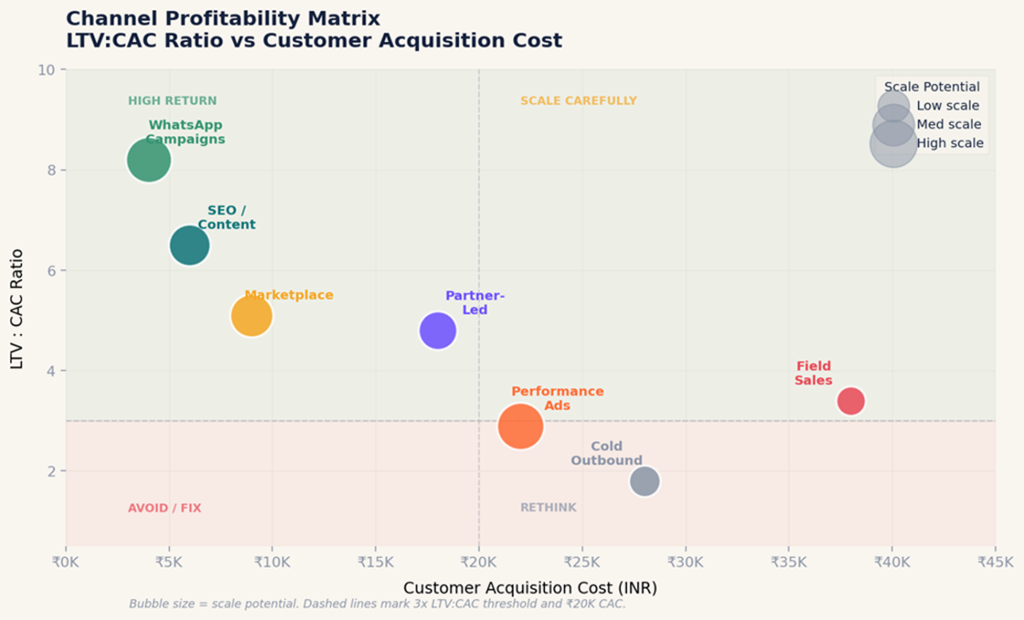
Scale Potential: Can this channel deliver 100 customers? 1,000? 10,000?
In our experience, Indian founders often make two mistakes:
- Sticking with high-CAC channels too long because they were the first to work. If digital ads worked early, don’t assume they’ll scale profitably forever. Test constantly.
- Abandoning channels too quickly. Some channels (SEO, content marketing, partnerships) take 6-12 months to show ROI. Don’t kill them after 30 days.
Common GTM Mistakes in Indian Context
1. Going Multi-Channel Too Early
Focus beats spread. Pick 1-2 channels, master them, then expand. Spreading thin across 5 channels simultaneously means you’ll be mediocre at all of them.
2. Ignoring Regional and Language Differences
A campaign that works in Bangalore won’t necessarily work in Lucknow. Localize messaging, creative, and language. Generic, English-only campaigns miss 80% of India.
3. Optimizing for Vanity Metrics
App downloads mean nothing if users don’t activate. Website traffic means nothing if it doesn’t convert. Optimize for revenue and retention, not top-of-funnel metrics.
4.Underestimating Friction
Every form field, every app permission request, every additional step in checkout increases drop-off. Indian consumers are particularly sensitive to friction. Simplify relentlessly.
5. Copying Western Playbooks
What works in the US won’t always work in India. The buyer behavior, price sensitivity, trust dynamics, and infrastructure are fundamentally different. Adapt, don’t copy.
90-Day GTM Experiment Framework
If you’re unsure which channels will work, run structured experiments:
Weeks 1-2: Research and Hypothesis
- Define your ICP with precision
- Research where they spend time (platforms, communities, media)
- Hypothesize 3-4 channels worth testing
Weeks 3-6: Small-Budget Tests
- Allocate ₹25-50K per channel for initial testing
- Run ads, partnerships, or campaigns
- Track CAC, conversion rate, activation rate
Weeks 7-10: Double Down or Kill
- Kill underperforming channels ruthlessly
- Double budget on channels showing positive unit economics
- Optimize creative, messaging, targeting
Weeks 11-12: Scaling Playbook
- Document what’s working (ICP, messaging, creative, budget allocation)
- Build repeatable systems to scale the winning channel
- Prepare to layer in secondary channels
When to Double Down vs Diversify Channels
Double down on a single channel when:
- You’re seeing consistent ROAS of 3x+ and the channel isn’t saturated
- CAC is stable or declining as you scale spend
- You haven’t yet maximized the addressable market in that channel
Diversify to multiple channels when:
- Your primary channel is saturating (CAC rising, ROAS declining)
- You want to reduce dependency risk (platform policy changes, competition)
- You have proven unit economics and can afford to experiment
- Different customer segments require different channels
The Bottom Line
In 2026, successful Indian startups don’t choose between digital and offline, paid and organic, direct and partner-led. They orchestrate a channel mix optimized for their specific ICP and market. Start narrow. Test rigorously. Scale what works. Kill what doesn’t.
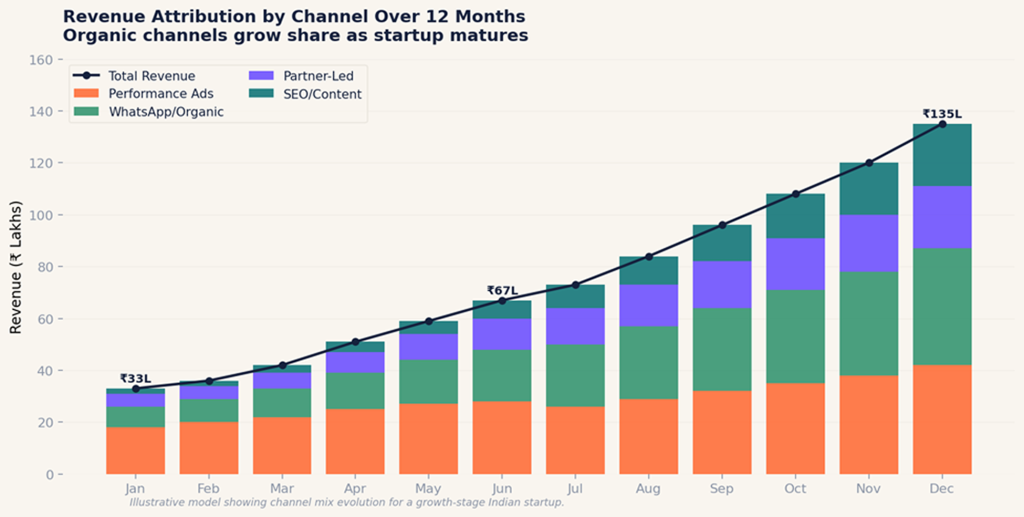
The right distribution channel can turn a mediocre product into a market leader. The wrong channel strategy can kill a great product.
Distribution isn’t just about getting customers, it’s about getting the right customers, cost-effectively, repeatably.
Build the product. Then build the distribution machine. In India’s crowded, competitive market, the better distribution system wins.