
Every few years, a consumer category in India crosses a threshold where the demographics, the money, and the policy all point in the same direction at once. Kids products, spanning apparel, toys, and baby care, are at that point right now. The market is large, growing across every sub-segment, and still structurally underserved in the exact price bands where most Indian families actually shop. This piece lays out why, using the data, and where the real openings are for anyone thinking about building here.
The scale of the opportunity
Start with the size of the prize. Kids apparel alone is a USD 22.57 billion market in 2025, on track for USD 27.17 billion by 2034. The organised, branded slice of that is smaller in absolute terms but growing far faster, from USD 10.60 billion in 2024 to a projected USD 16.60 billion by 2033 at a 5.11% CAGR, more than double the pace of the overall category. North India leads with a 28% share, propelled by urbanisation and the spread of organised retail.
Baby care is the standout. At USD 8.42 billion in 2025, it is set to more than quadruple to USD 34.96 billion by 2035, growing at 15.30% a year. Baby toiletries hold 40% of that market today, while baby food is the fastest-growing slice within it. Supermarkets and hypermarkets still move the most volume at 36.4% share, but online is growing fastest at 12.6% CAGR, a sign of where future share will come from.
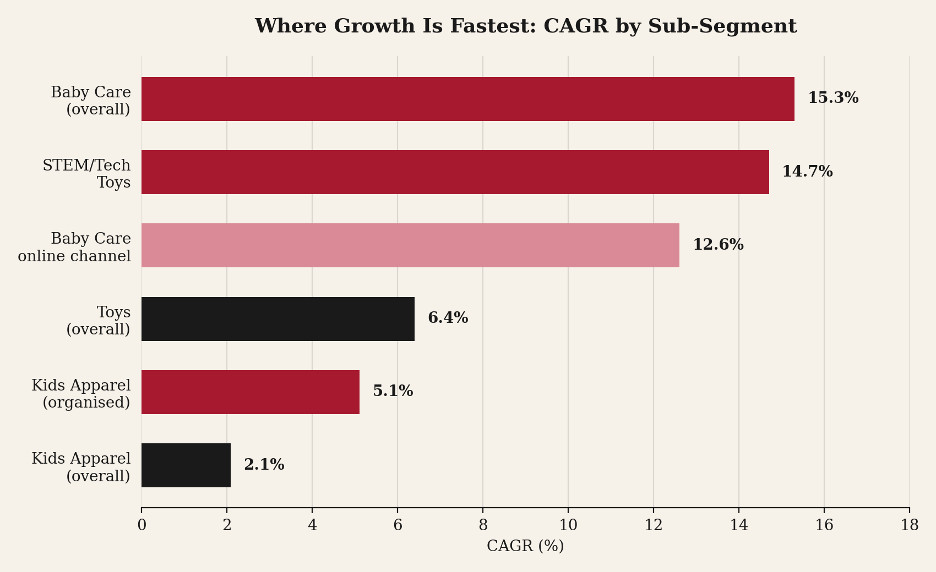
Toys are the smallest of the three categories at USD 2.77 billion in 2025, but within toys, the tech and STEM sub-segment is the one to watch: USD 1.6 billion in 2024, expanding at 14.7% CAGR through 2030. Add it up and India’s kids products market spans a combined addressable opportunity north of USD 33 billion in 2025, expanding on every front, with baby care premiumisation and STEM toys moving fastest.
Why now, specifically
Market size alone doesn’t make timing right. What makes 2026 a genuinely good moment to build in this space is a stack of structural tailwinds arriving together.
India’s fertility rate sits at 2.12, close to replacement level, which means the child population stays large and stable for at least the next decade. Layered on top of that is a rapidly expanding middle class, projected to grow from 432 million people in 2019 to 715 million by 2031. That is the single biggest driver of spending on branded, rather than unbranded, kids products.
Working women are changing the demand curve too. Women’s enrolment in STEM programmes rose from 38.4% in 2014-15 to 42.6% in 2021-22, a proxy for the broader rise in female workforce participation, which in turn drives demand for time-saving, premium products that a two-income household is more willing to pay for.
Distribution has caught up as well. India now has 270 million online shoppers, enough to overtake the United States as the world’s second-largest e-retail market by shopper count. And the growth isn’t confined to metros: rural internet users climbed from 358 million to 398 million by March 2024, opening markets that branded kids products have historically struggled to reach.
How Indian parents actually shop
The demographic and distribution story only matters if it changes buying behaviour, and it clearly has. Brand consciousness is rising even in Tier II and Tier III cities, with parents becoming noticeably more aspirational about what they buy for their children. But that aspiration has a price ceiling on decision-making: below roughly Rs 1,500, design is the primary purchase driver, and it is only above that threshold that brand identity and values start to decide the sale. That single data point is arguably the most important one in this entire market, because it defines exactly where a challenger brand needs to compete on design first and brand story second.
Safety has become its own purchase filter. Parents are increasingly choosing dermatologically tested, toxin-free, organic products, reflecting a broader anxiety about what touches their children’s skin or goes into their bodies. Quick commerce is reshaping how baby essentials get bought, with curated assortments and fast delivery now acting as real differentiators rather than nice-to-haves. Demand is also sharply seasonal: sales of kids products nearly double during festive periods and the back-to-school window, which has direct implications for inventory and marketing planning. Licensed IP, think Disney, Marvel, Chhota Bheem, Motu Patlu, continues to command premium pricing and drive impulse purchases in a category that is otherwise fairly considered.
Policy has quietly rewritten the rules
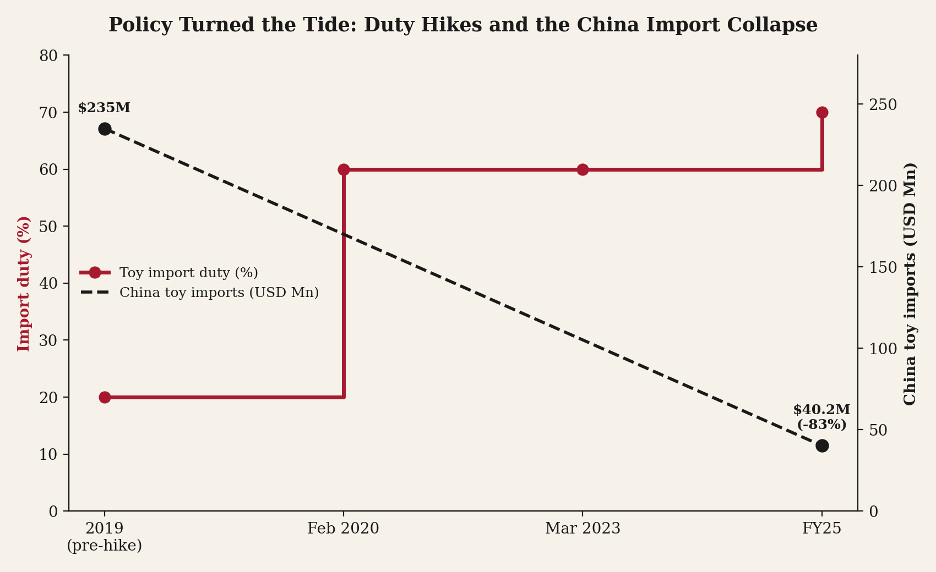
Government policy over the last five years has done more to reshape this category than most people realise. Toy import duty was raised from 20% to 60% in February 2020, then again to 70% in March 2023, and the effect on trade flows has been dramatic: Indian toy imports from China collapsed from USD 235 million in FY20 to just USD 40.2 million in FY25, an 83% decline. Over the same stretch, India has been building an export business, with toy exports growing 239% over a decade, from USD 96 million in FY15 to USD 326 million in FY23.
Since 2025, every toy sold in India, whether made locally or imported, must carry BIS certification and an ISI mark. That single rule raises the quality floor across the industry and structurally favours brands with the compliance discipline to meet it, at the expense of the low-cost, low-trust imports that used to flood the market. The government has backed this shift with real capital too: a proposed INR 3,489 crore PLI scheme for domestic toy manufacturing, a ‘Toy Hub of the World’ scheme announced in the FY25 Budget for cluster development and skilling, and 19 toy manufacturing clusters now operating across Karnataka, Uttar Pradesh, Maharashtra, and the NCR with shared testing labs and tooling support. Taken together, this is a structurally better environment for a domestic kids brand to launch in than it was five years ago.
What the market leader’s stumble teaches us
FirstCry remains the category’s dominant player, with Rs 8,548 crore in FY26 revenue and more than 1,136 stores, making it India’s largest baby and kids omnichannel platform. Its India multi-channel business, Rs 1,490 crore and 69% of revenue, turned both profit and free cash flow positive in FY25, and home brands now contribute more than 55% of that segment’s GMV, giving it a real structural margin advantage. GlobalBees, its brand aggregator arm holding D2C labels like Frootle, Wellspire, and The Clownfish, added Rs 460 crore with 28% growth in core categories.
But growth and the stock have both slowed, and the reasons are instructive for anyone entering the space. Diapers, roughly 15% of FirstCry’s GMV, are exactly the kind of high-frequency replenishment category that Blinkit, Zepto, and Instamart are now capturing through quick commerce. Amazon and Flipkart’s cross-category scale lets them compress fulfilment costs below what a specialist retailer can match. GlobalBees has been a drag operationally, with a 2025 insolvency petition and leadership churn. And compliance is no longer a paperwork exercise: BIS seized Rs 1.4 crore of non-certified product from a Bengaluru warehouse in May 2025. The lesson is that even the category leader is vulnerable at the replenishment end and in aggregator sprawl, which is precisely where a focused, compliant, design-led challenger can take share.
Who else is already building here
The competitive set is more crowded than it looks at first glance, but crowded in ways that reveal the gaps rather than close them. R for Rabbit has built a near-breakeven business on strollers and car seats, Rs 251 crore in FY25 revenue, growing 47.6% year on year, and recently raised a USD 27 million Series B. Mamaearth and Himalaya BabyCare own the toxin-free and ayurvedic baby care narrative. On the international side, Smiggle is trending hard as a back-to-school brand for 2026, Hamleys under Reliance Brands has made India its largest market at USD 44 million in 2024, and LEGO still dominates STEM toys through wholesale distribution.
The startup layer is where the real signal is. Kidbea has hit Rs 100 crore ARR in sustainable bamboo kidswear and closed a Series A in 2026. Includ crossed Rs 72 crore in revenue in under two years as a kidswear marketplace. PlayShifu has built a Rs 99.8 crore AR and STEM toy business on USD 35.8 million raised, proof that an Indian-built, culturally relevant toy brand can compete directly with LEGO and Mattel. Loopie, founded in 2025, is a design-led India-first stroller and car seat brand still early in its rise. Slurrp Farm has built a Zepto-partnered millet snacks business on USD 18.3 million raised. Each of these is a proof point that a specific, well-defined niche in this market can scale fast, even against much larger global incumbents.
Where the actual whitespace is
Four gaps stand out clearly once you line the data up.
The Rs 500 to 1,500 kidswear band sits above the unorganised mass market and below the saturated premium, western-style brands, and it is currently underserved despite the early traction Includ and Kidbea have both shown. Indian STEM and educational toys are dominated by LEGO, Mattel, and Hasbro, yet almost no domestic player has combined STEM education with Indian cultural content, even as Flipkart saw 150% year-on-year growth in STEM toy sales as far back as 2021. Functional, stylish school bags remain an open category: no Indian brand has paired genuine functional design with strong aesthetics in the highest-volume bag sub-category, and style-led girls’ school bags are a small but sharply growing niche within it. And organic, natural baby care is being pulled by eco-conscious parenting demand, but the space is fragmented, with no single dominant Indian-origin brand having claimed it yet.
The verdict
Put the pieces together and two theses stand out as the highest conviction bets. Affordable-premium kidswear in the Rs 500 to 1,500 band and India-built baby gear both combine a validated pricing gap, early profitable comparables in Includ, Kidbea, and R for Rabbit, and policy tailwinds that are unlikely to reverse. The fertility base is stable, the middle class is expanding, e-commerce and quick commerce have solved distribution, and the government has made it structurally harder for cheap imports to compete on price alone. For anyone weighing whether to build a kids products company in India, the data says this is less a question of if, and more a question of which specific gap to fill first.