
Part one of the Kae “What To Build” series. We are starting with consumer AI because that is where the anxiety is loudest and the opportunity, counterintuitively, is largest.
The anxiety is real. It is also wrong.
You have probably seen some version of this tweet:
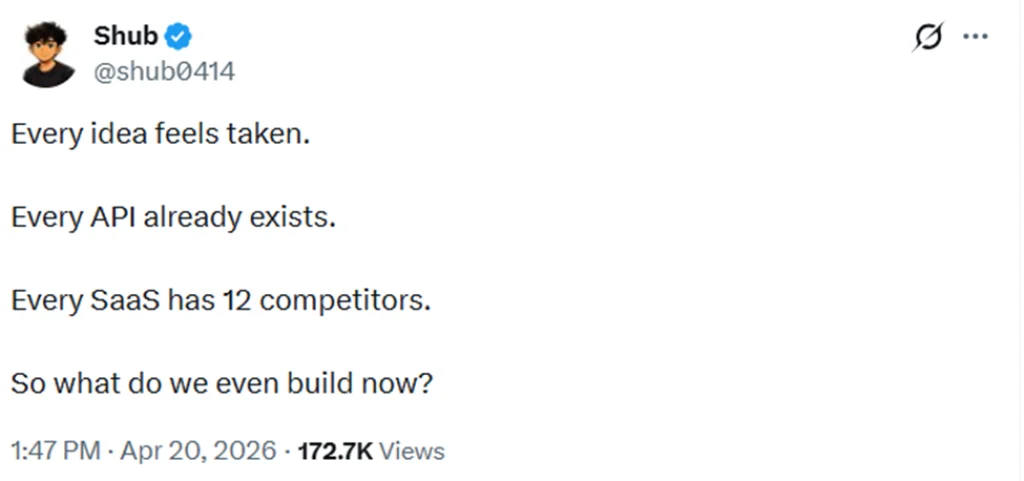
A generation of builders has been handed the most powerful creation tool in history and cannot decide what to point it at.
Here is the reframe. In January 2026, ChatGPT crossed 180 million monthly users in India. Google Gemini hit 118 million. Perplexity briefly overtook ChatGPT on the Indian App Store. a16z’s Top 100 Consumer AI list is dominated by horizontal assistants and global creative tools built for an American median user. The largest AI consumer market in the world is being served by products that speak to it in the wrong accent.
This is what the tweet misses. “Everything is taken” is only true if you think the game is still model quality or clever prompts. It is not. The remaining game is distribution, trust, data that no one else has, and cultural fluency. India has nine hundred million smartphone users, five hundred million internet users who do not use English as their first language, UPI on every phone, WhatsApp as the operating system, and a service economy that runs on relationships rather than software. None of this shows up in the training data of a frontier model.
The products below are not speculative. For each one, the wedge exists in 2026, the underlying behaviour is already measurable, and the reason no one has nailed it yet is specific. We have tried to be precise about who wins, why now, and where the body is buried. None of these are easy. All of them are legible.
A quick note on what this list is not. It is not twenty ChatGPT wrappers. It is not twenty “AI for X” ideas where X is a vertical. It is a set of products that each require a real insight about an Indian user, a real loop that gets stronger with use, and a real reason to exist after the novelty of generative AI wears off. Consumer AI in India will be won by teams that understand one user cohort deeply, not by teams with the best fine-tuning budget.
If you are deciding what to build, read this with a highlighter. If you ship one of these, come talk to us.
1. The Bharat voice assistant
Text-first chat is a product built for English speakers with keyboards. It is not how the next three hundred million Indians will interact with AI. The winner of Indian consumer AI will look more like a phone call than a chat window.
Build a voice-native assistant that speaks Hindi, Tamil, Telugu, Marathi, Bengali, and six other languages at native fluency. It should listen more than it talks, hold multi-turn conversations, remember who the user is across calls, and cost less than three rupees per session to run. BharatGPT already powers IRCTC’s voice assistant in twelve languages; Sarvam, Krutrim, and a handful of others are building foundation models that can handle dialect and code-switching. The real product work is the layer on top: latency under 800ms, intent stitching across topics, and a product shape that works for someone whose first interaction with AI is a missed call.
Why now: voice LLM inference costs dropped roughly 80 percent between early 2024 and early 2026. Feature phones running KaiOS have gotten good enough. Jio, Airtel, and Vi are all piloting voice-first bundles.
Who wins: a team with one foot in speech ML and one foot in rural distribution. Think a Shaip or Karya co-founder paired with someone who has actually spent time selling to tier 3 India.
Watch-outs: do not confuse multilingual with multi-dialect. Haryanvi is not Hindi. Malayali English is not English. The product either understands this from day one or it does not ship in Bharat.
2. The AI tutor that actually replaces tuition
Byju’s and Unacademy built the first wave of Indian edtech on content plus celebrity teachers. The next wave has to build on something those companies could never deliver at unit economics: true one-on-one tutoring. There are roughly 250 million Indian students and fewer than 10 million qualified tutors. The math has never worked. Now it can.
Build an AI tutor that solves a specific board and grade combination end to end. CBSE Class 10 math is the sharpest wedge because the syllabus is finite, the exam is high stakes, and parents are already paying eight to twenty thousand rupees a month per subject for tuition. The product should teach in the student’s language of comfort, diagnose the exact misconception in real time, drill weak spots, and generate infinite practice questions aligned to NCERT patterns. It should feel less like Khan Academy and more like the best tuition didi in the neighbourhood.
Why now: voice mode plus image input means the tutor can watch a student solve a problem on paper, spot the error at the step level, and explain the fix. That was not possible even in mid-2025.
Who wins: someone who has taught the exact cohort in person for five years, paired with a strong ML engineer. Not someone who thought of education as a TAM slide.
Watch-outs: parents buy education, kids use it. The product has to delight the kid and make the parent feel in control. Homework streaks are not enough; the parent needs a weekly diagnostic that feels like a real tutor’s report.
3. The study abroad coach
Close to one million Indians apply to study abroad every year. The typical family spends between two and five lakh rupees on a consultant before the student has even written a personal statement. The category is a mixed bag: a handful of excellent boutique advisors and a long tail of opaque, templated-essay shops charging premium rates for median work. The entire process (GRE, GMAT, SAT, IELTS, TOEFL prep, university shortlisting, essay coaching, application management, visa prep, financial aid strategy) is ripe for a real AI co-pilot.
Build an end-to-end study abroad product for a single destination. Start with the United States because it is the largest outbound market, the application is the most complex (Common App, multiple essays, recommendation wrangling, financial aid, I-20, F1 visa interview), and the willingness to pay is highest. The product is a companion from junior year of undergrad through visa stamping. It shortlists universities against profile, budget, and aid probability. It writes essay drafts with genuine feedback on voice, not just grammar. It simulates the visa interview in the officer’s actual cadence. It tracks deadlines for the student and the parent in parallel.
Why now: generative models are finally good enough to produce real essay feedback, not just surface edits. Voice simulation for the visa interview has crossed a useful fidelity bar. Two years ago this would have been a toy.
Who wins: a founder who has been through the process themselves (ideally as both a student and a sibling-mentor) or spent real time inside a foreign admissions office. The pattern recognition is the product.
Watch-outs: do not compete with the high-end boutique consultants at their price point. Compete with the messy middle. The student whose family cannot afford a three-lakh consultant but will pay twenty thousand for a product that feels like one.
4. The mental health companion for India
India has roughly one psychiatrist per 100,000 people. The WHO recommends three. The gap is not going to close with human therapists. The current anxiety, depression, and burnout load in urban India is catastrophic and mostly unspoken. ChatGPT and Character.ai are already being used as de facto therapists by tens of millions of Indians, except neither is designed for it, neither is clinically informed, and neither has Indian cultural context.
Build a voice and text mental health companion that does three things no general model does: it uses evidence-based CBT and ACT frameworks, it is trained on the specific texture of Indian stressors (joint family dynamics, arranged marriage pressure, hostel culture, job-market anxiety, caste and class overhang), and it knows when to escalate to a human. The business model is a low monthly subscription plus optional human therapist access for crisis moments.
Why now: Character.ai’s second-largest source of traffic after the US is India (about 9 percent of global). The behaviour already exists. The product that formalises it, adds clinical guardrails, and earns the trust of family members is open.
Who wins: a clinical psychologist and a product founder, ideally co-founded. One without the other ships either a toy or a form.
Watch-outs: this is a product where the safety layer is the product. One high-profile failure of a suicidal user being failed by the bot and the category is set back five years. The team that takes this seriously wins; the team that treats it like growth hacking does not.
5. The chronic disease concierge
Seventy-seven million Indians are diabetic. Roughly two hundred million are hypertensive. One in five Indian women of reproductive age has PCOS. These are lifelong conditions that require daily management, and they are not well served by episodic visits to a doctor once a quarter. The job to be done is someone who knows you, knows your numbers, and guides you through three hundred and sixty five days of decisions.
Build a condition-specific AI concierge. Start with PCOS because the patient cohort is young, digitally native, underserved by existing clinical pathways, and already self-organising on Reddit and Instagram. The product is a companion app that reads the user’s CGM or glucometer, tracks cycle and symptoms, generates a personalised diet and movement plan, prepares her for the quarterly endocrinologist visit with the exact questions to ask, and has an always-on voice mode for the 2 am panic about a missed period. Pharmacy and supplements are the revenue layer, not the product.
Why now: CGMs like Abbott FreeStyle Libre dropped below 3,000 rupees per sensor in India in 2025. Continuous data is now consumer-affordable. Hormone tests can be done at home. This was not true two years ago.
Who wins: an endocrinologist or gynaecologist who has seen 5,000 patients, paired with a founder who can build a retention-first product.
Watch-outs: “AI health” regulation is tightening globally. Get the clinical governance right on day one or you will be rebuilding it on day 800 under pressure.
6. Astrology, built as a codified expert system
One in three urban Indians and two in three rural Indians consult an astrologer at least once a year. AstroTalk does roughly 1,500 crore in annual revenue and is growing twenty percent year on year. The behaviour is not going away. What is changing is that the median customer is now a 25-year-old woman in Bengaluru who will pay 300 rupees for a voice note from a real astrologer at 1 am.
The naive AI version of this is a GPT wrapper that hallucinates. The actual product is hybrid. You take a panel of senior astrologers with twenty years of practice, you codify their decision trees into a structured reasoning engine of about two hundred expert rules, and you wrap it in an LLM for natural conversation. The LLM handles language; the expert system handles the logic. This flips the product from “AI astrologer you cannot trust” to “trusted companion with astrological reasoning.”
Why now: astrology usage peaks between 9 pm and 2 am, exactly when human astrologers are asleep or expensive. AI has the unit economics to serve this window at scale for the first time.
Who wins: a founder who is either culturally fluent or deeply sceptical. The worst version is a founder who looks down on the user.
Watch-outs: astrology is not fortune telling, it is anxiety management in disguise. Build it as a wellness product with astrological framing and you compound. Build it as prediction and you end up in the same credibility trap as the current Instagram scammers.
7. AI matchmaking for Indian realities
Shaadi.com has existed for close to thirty years. It is still essentially a search engine. Bumble and Tinder have less than 10 percent penetration in the arranged marriage middle class. The real job to be done here is complicated: understand the user, understand the family, filter for the thousand soft constraints that no one will write into a profile (sect, sub-caste, family income bracket, dietary preference, eldest-daughter dynamics), and produce five genuinely promising matches a week.
Build an AI matchmaker that spends the first two weeks interviewing the user (and optionally a parent) via voice. It builds a private, deep profile including attachment style, values, and deal-breakers. It then searches a pool of similarly-interviewed users and proposes matches based on compatibility, not filters. The interaction model is like a trusted aunty who has already vetted the other side.
Why now: the post-2020 cohort is exhausted by both swiping and by aunties. They want curation with warmth. Voice interviewing plus deep user modelling is finally technically viable at consumer cost.
Who wins: a founder with either strong diaspora credibility or a real matrimonial insider. Ideally both.
Watch-outs: the two-sided cold start problem is brutal. Start in a single narrow vertical (Tamil Brahmins in the US, Marwari business families in Mumbai, queer Indians anywhere) and expand from there. Horizontal at day one kills the product.
8. The AI companion built for the Indian emotional texture
This is distinct from mental health. Mental health is clinical. Companionship is everything else: loneliness, ambient conversation, the specific ache of being the first in your family to move to a Tier 1 city, the ache of being the NRI who calls home less than you should. Character.ai and Replika are massive globally precisely because they serve this need. Neither is built for the Indian user.
Build a companion that is voice-native, remembers everything across months and years, speaks the user’s first language, understands Indian family dynamics (joint family vs nuclear, the guilt economy, festival cycles), and knows when to be quiet. The personality is not a fictional anime character. It is a warm, specific human archetype the user can actually relate to: the elder cousin, the college roommate, the co-worker who also moved from Patna.
Why now: audio companions cross fifty million monthly users globally in 2026. Revenue run rates have crossed two hundred million dollars. India has both the population and the loneliness. What is missing is the product.
Who wins: a founder who has themselves felt the loneliness they are solving. This cannot be built as a pattern match from a New York office.
Watch-outs: the line between companionship and emotional dependency is thin. Build in healthy friction, encourage real-world connection, and do not optimise purely for session time. The next wave of regulatory scrutiny on companion apps will reward the careful and punish the rest.
9. The WhatsApp commerce agent
Eighty five percent of Indian internet users are on WhatsApp. A meaningful share of transactions in India already happen through WhatsApp: small business ordering, B2B distribution, creator commerce, local services. The app is the interface. But the commerce experience on WhatsApp today is a mess of manual back-and-forth, broken order flows, and unstructured catalogs.
Build an AI agent that lives inside a WhatsApp Business account, handles the entire customer conversation, understands the catalog, negotiates price within set bounds, confirms orders, triggers payment, and schedules delivery. The primary customer is not the shopper; it is the one million small businesses and D2C brands currently running WhatsApp commerce manually. Charge a monthly subscription plus a thin take on transactions.
Why now: Meta opened up WhatsApp Business API pricing substantially in 2025, and voice notes on WhatsApp now exceed text messages in volume. An AI agent that can both read and listen is finally credible on the platform.
Who wins: a founder who has actually run a D2C business on WhatsApp at some point. The edge cases only become obvious after you have dealt with a thousand of them.
Watch-outs: Meta is both the platform and the potential competitor. Build something they cannot easily clone, which means owning the last-mile integrations: payment reconciliation, inventory sync with Unicommerce, and logistics handoff with Delhivery or Shadowfax.
10. The AI legal co-counsel for the Indian household and MSME
Sixty two million MSMEs in India. Forty million rental agreements signed every year. Ninety percent of personal legal issues (property disputes, rental, labour, family, consumer complaints) are solved without a lawyer because lawyers cost too much and move too slowly. The addressable market is not the corporate legal team; it is everyone else.
Build a focused legal assistant for two cohorts. One, the small business owner who needs help with GST notices, vendor agreements, employee offer letters, and shop and establishment licensing. Two, the urban household that needs help with rental agreements, society disputes, consumer complaints, and property paperwork. The product generates the document, explains it in plain Hindi or English, flags the three specific things to worry about, and connects to a human lawyer only when escalation is actually warranted.
Why now: the Digital Personal Data Protection Act, the new labour codes, and the GST reconciliation regime have collectively added more compliance load to the small-business owner in the last twenty four months than the previous decade. The need has gone from latent to urgent.
Who wins: a lawyer who has practised in the actual trenches (district courts, consumer forums, MSME tribunals), not a top-tier firm partner. Their pattern recognition is the product.
Watch-outs: do not get seduced by the enterprise legal ops opportunity. It is a different product, a different customer, a different sales motion. Stay on the consumer and MSME side.
11. AI fashion try-on and personal styling
Myntra and Ajio have spent a decade trying to solve the return rate problem on apparel. Returns are still 30 to 40 percent. The core reason: Indians cannot try on before buying, Indian body types are not well represented in the imagery, and the stylists are all optimised for American body standards from two years ago.
Build a personal stylist that does two jobs. First, a try-on engine that actually works for Indian body types, skin tones, and the specific garments that matter (kurtas, lehengas, sarees, which are not well handled by current Western try-on tools). Second, a stylist that understands the user’s wardrobe, the occasion (office, wedding, karwachauth, first date), and the budget, and curates six to ten items from the catalogue that actually work.
Why now: image-to-image diffusion for garment fitting crossed a quality bar in mid-2025 that makes try-on stop feeling uncanny. Major Indian marketplaces have opened up product feeds via affiliate APIs.
Who wins: a fashion insider plus a technical founder with a computer vision background. This is not a generalist consumer play.
Watch-outs: the moat is not the tech; it is the data flywheel from what actually converted. Instrument every try-on and every purchase, and compound the styling recommendations from that feedback loop. Without the flywheel, Myntra clones it in a quarter.
12. The parenting and child-development companion
Indian parents over-invest in education and under-invest in early childhood development. The gap between ages zero and six is where most of the long-term child outcomes are shaped. The current resources are a patchwork: BabyCenter, WhatsApp groups, a pediatrician they see once every three months, and Instagram reels from foreign influencers that do not map to the Indian context.
Build an AI companion for the parent. It tracks milestones by age, flags concerns early (speech delay, motor delay, anxiety, nutrition), generates week-by-week activities calibrated to the child’s stage, answers the 2 am question about a fever, and maintains a developmental diary. The target user is the first-time parent aged 28 to 38 in tier 1 and tier 2 cities who is willing to pay for their child’s edge.
Why now: the Indian middle class has shrunk family size (now averaging 1.9 children) and doubled per-child investment. Willingness to pay for “best for my child” has never been higher. Generative AI is the first technology that can personalise the answer rather than offer generic content.
Who wins: a pediatrician or child psychologist plus a strong mobile product team. The credibility of the founding team is 40 percent of the sell.
Watch-outs: be careful with health claims. Build as a supportive companion, not a diagnostic tool. The product that gets this tone right is trusted for twenty years. The one that gets it wrong gets taken down in a quarter.
13. AI kitchen and meal intelligence
The Indian kitchen has not had a real software layer. Zomato and Swiggy serve the outside-the-home meal. Blinkit and Zepto serve grocery supply. Nobody serves the decision: what to cook today, with what is in the fridge, for which family member, at which budget. This is a daily problem for India’s roughly three hundred million households.
Build a product that lives in the kitchen. It knows what is in the fridge (via a barcode scan at purchase or a quick camera check), knows each family member’s preferences and dietary restrictions, and generates the week’s meal plan in under two minutes. It auto-generates the Blinkit or Zepto cart for the week, surfaces recipes from the grandmother’s cookbook that match the pantry, and voices back instructions in the cook’s language as she cooks. Monetisation via grocery affiliate plus a modest subscription.
Why now: one in four urban Indian households now orders groceries online weekly. The friction is not discovery; it is planning. Generative AI is the first planning layer that can actually personalise.
Who wins: a founder with deep roots in an Indian kitchen (this is not a throwaway line; generic food tech founders get this wrong) plus strong consumer product chops.
Watch-outs: the temptation is to pivot to cloud kitchens or to compete with Swiggy. Resist. This is a planning and personalisation business, not a logistics business.
14. The career and interview coach
Seventy million Indians change jobs every year. Naukri and LinkedIn are distribution platforms. Neither helps you actually prepare for the interview, negotiate the offer, or decide between two offers. The individual who can afford a professional career coach pays between 10,000 and 50,000 rupees a session. Nobody else gets coached.
Build an always-on career AI. It reviews the resume against a specific job description, runs mock interviews with domain-relevant questions (product manager at a startup vs. product manager at a bank are different interviews), negotiates the offer by walking the user through compensation benchmarks and scripts, and maintains a long-term career map. Pricing is a low monthly subscription with a one-time surge for the “I have an offer, help me negotiate” moment.
Why now: interview coaching via voice AI crossed a realism threshold in late 2025. The simulation is now good enough to genuinely prepare someone. Two years ago this would have been a toy.
Who wins: a founder with either strong recruiter DNA or strong top-of-funnel talent brand. Distribution is the hard part; the product is increasingly table stakes.
Watch-outs: LinkedIn is building this. Your edge has to be depth on a specific job family (data science, product, design, sales) and brand that the cohort trusts more than they trust LinkedIn’s generic coach.
15. The home-services concierge with memory
UrbanCompany is a transactional marketplace. You book a cleaner, a plumber, a beautician. It has no memory of who worked well in your home, which partner remembers your preferences, or which service you need to book three weeks from now. The actual job Indians want done is “run my home for me” and no product does it.
Build a home-services agent that runs proactively. It remembers that the AC servicing is due every six months, that the water purifier filter needs changing every three, that the maid took a week off last Diwali and the replacement was unreliable. It proactively books, confirms with the user, handles the scheduling, and maintains the trust graph of which service provider worked well. It can be marketplace-led (booking UC, Sulekha, Justdial) or direct.
Why now: memory as a primitive in AI products is where a16z believes the next competitive advantage lies. Home services is the cleanest consumer use case for it in India.
Who wins: an operator who has lived the service economy pain of running a household with kids, aging parents, and two working adults. Not a twenty-three-year-old engineer.
Watch-outs: do not try to be a supply-side aggregator. UrbanCompany owns the supply. You win by being the demand-side memory layer and routing to whichever supply is best.
16. The AI co-pilot for India’s online sellers
Roughly four million Indians sell on Amazon, Meesho, Flipkart, and Shopify. Most are two-person operations. They spend disproportionate time on listing optimisation, image creation, ad campaigns, customer service, and returns management. None of them can afford a growth team. All of them are the perfect customer for an AI co-pilot.
Build a seller co-pilot that does the whole operational stack. It writes listings optimised for each platform’s algorithm, generates product imagery (including the specific format and background that converts on Meesho vs. Amazon), runs the ad budget dynamically, answers customer queries in regional languages, and flags returns patterns before they become reviews-destroying trends. Pricing is a percentage of GMV or a per-listing subscription.
Why now: Meesho and Flipkart are both pushing regional sellers hard in 2026, which has expanded the long tail of sellers by an order of magnitude. None of them can handle the operational load alone.
Who wins: someone who has sold on these platforms themselves. The specific pain points are deeply non-obvious from the outside.
Watch-outs: the platforms will build their own version. Your window is two to three years. Use it to build the data moat (which listings actually convert, which returns cluster where) and a cross-platform dashboard the native platforms will never offer.
17. The AI accountant for freelancers and creators
India has roughly 15 million freelancers, creators, and solo consultants. None of them can afford a CA. All of them struggle with GST registration, quarterly filings, income tax returns, TDS on client payments, and the seventy tiny decisions that determine whether they owe money or get a refund. The current “AI accountant” products are receipt scanners. The actual product is a full agent.
Build an always-on AI accountant. It connects to the user’s bank, UPI, and client payment platforms. It categorises every transaction, suggests deductions, generates GST invoices on request, prepares ITR returns, and files them with a human CA reviewing in the background. Priced at 999 rupees a month or 9,999 a year. Economics work because the AI does 90 percent of the work and the human CA does the last mile at scale.
Why now: the government’s Account Aggregator framework matured in 2025 and consent-based bank data aggregation is now routine for consumer products. Tax filing APIs are open. Two years ago the data was trapped; it is not anymore.
Who wins: a chartered accountant who has run a small practice, plus a strong product founder. Not a generic fintech founder.
Watch-outs: Zoho and Cleartax are going to compete. Your wedge is being a delight-first, solo-user product rather than a feature-heavy tool built for the tax professional. Do not let your roadmap drift into small-business accounting; the buyer and product are different.
18. The AI elder-care companion
Roughly 150 million Indians are over the age of sixty, and the cohort is growing faster than any other age group. A significant share live alone or with adult children who work long hours. The current options are underwhelming: a paid caretaker the family cannot afford, or family WhatsApp groups that do not scale. The older Indian is lonely, under-monitored medically, and often a fall away from a crisis.
Build an elder-care companion that works through a simple voice interface on a tablet or a dedicated device. It chats daily, flags mood or cognition changes, reminds about medication and appointments, detects a fall or distress via ambient audio, and loops in the adult children only when something warrants it. The family pays. The older user is the user.
Why now: two things changed in 2025. Voice LLMs became fluent enough to hold a real conversation with someone who does not want to talk to a machine. And the Indian diaspora, particularly in the US and the UK, is aging their parents alone at a rate that has created a real willingness-to-pay cohort. Subscription of 1,500 to 3,000 rupees a month is easily achievable.
Who wins: a founder whose own parents live alone. The product decisions are empathy-driven, and empathy has to be real.
Watch-outs: safety and privacy are the product. An ambient listening device in an older person’s room has to be bulletproof on data, and the family dynamic around surveillance has to be handled delicately.
19. The AI dubbing and creator suite
India’s regional content market grew 25 percent in 2025 on the back of Tamil, Telugu, Malayalam, and Marathi microdrama. Creators producing in one language are leaving three other languages of audience on the table. Dubbing is currently either expensive and slow (studio-based) or cheap and terrible (auto-dubbed). Neither works at creator scale.
Build a creator suite for Indian vernacular content. Voice-clone the creator across languages (with consent and control), sync lip movement, localise idioms and jokes, and push out in one click. Monetise per minute of dubbed output. The larger product is not just dubbing; it is a full regional-content creator stack including thumbnail generation, title testing, and multi-platform distribution.
Why now: voice cloning quality crossed the “indistinguishable” threshold in 2025 for Indian languages. Lip-sync with character-consistent video is now reliable. The creator market is large enough (three million active creators earning above 10,000 rupees a month) to support a paid tool.
Who wins: a founder with deep creator-economy instincts and a real AI team. You cannot win this with a generic wrapper.
Watch-outs: ElevenLabs and Runway will both target this. Your wedge is regional language quality and the local creator relationships. Both take time to build.
20. The gig worker companion
Roughly eight million Indians drive for Ola and Uber, deliver for Swiggy, Zomato, Blinkit, and Zepto, or run shifts for UrbanCompany and Porter. They are the economic backbone of urban India and the single most under-served consumer software cohort in the country. The platforms they work for optimise for the platform. Nobody builds for them.
Build a companion app for the gig worker that does four things honestly. One, earnings optimisation: tell the driver whether to log into Ola or Uber at 9 am given current surge, trip density, and cancellation history, and nudge the delivery partner toward the evening rush in the zone with the best tip pattern. Two, financial care: calculate the true hourly net of fuel, EMI, taxes, and platform commission, and auto-route weekly savings into a micro-SIP. Three, tax and compliance: generate the GST and ITR filings from platform earnings without the worker needing to touch a form. Four, a voice-first support layer for the thousand moments the worker needs a real human but cannot reach one. Account frozen. Fare disputed. Medical emergency mid-shift.
Why now: Account Aggregator makes consent-based access to bank and earnings data routine. Platform APIs increasingly expose worker earnings back to the worker. Voice LLMs in Hindi, Kannada, Tamil, and Bengali are finally fluent enough to be the primary interface for someone who does not read English comfortably.
Who wins: a founder who has spent real time alongside the worker. Ride-alongs, driver canteens, delivery partner WhatsApp groups. The product is empathy-driven and the pain points are not visible from a corporate office.
Watch-outs: do not position as adversarial to the platforms. The best version of this product is one the platforms eventually want to partner with, not sue. Keep the worker as the paying customer and the moat is the trust, not the data.
Picking one
Twenty ideas is a menu, not a plan. If we are sitting across from a founder next Tuesday, here is how we would think about narrowing.
First, pick the cohort, not the category. Most of the ideas above work because they serve a specific Indian cohort with a sharpness that a global product cannot match. Founders who pick the cohort first and then choose the product almost always win over founders who pick the tech first and then hunt for a cohort.
Second, find the wedge where trust is the moat. AI gets cheaper every quarter. Model quality converges. What does not converge is a user’s willingness to trust you with their health data, their child’s education, their tax filing, their loneliness. Trust compounds, and trust is what turns an AI product from a chat wrapper into a consumer franchise.
Third, build for retention from day zero, not growth. We wrote in January about what failed in 2025. Consumer AI is full of products that hit 50,000 users in a month and then watched 85 percent of them leave by month three. The winners in this list will be the ones where day-30 retention at launch is above 40 percent. If you cannot hit that in a small cohort, do not raise. Fix the product.
Fourth, pick a distribution you actually own. Paid acquisition on Meta and Google has become unviable for consumer AI in India unless you have a real monetisation moat. The winners will acquire through WhatsApp, through community, through a creator-led channel, through a parent company or distribution partner, or through a very specific organic wedge. If your GTM is “we will run ads”, reconsider.
Finally, assume the frontier model will catch up on capability and will never catch up on context. Your edge is the context. The Bharat user, the Tier 3 cook, the Kota aspirant, the diaspora son calling his mother in Pune. That is not in the training data. That is the opportunity.
We will follow this up with the next in the series: what to build in Indian fintech, then vertical SaaS, then AI infra. If you are building one of the twenty above, or a sharper version of it, we want to hear from you.