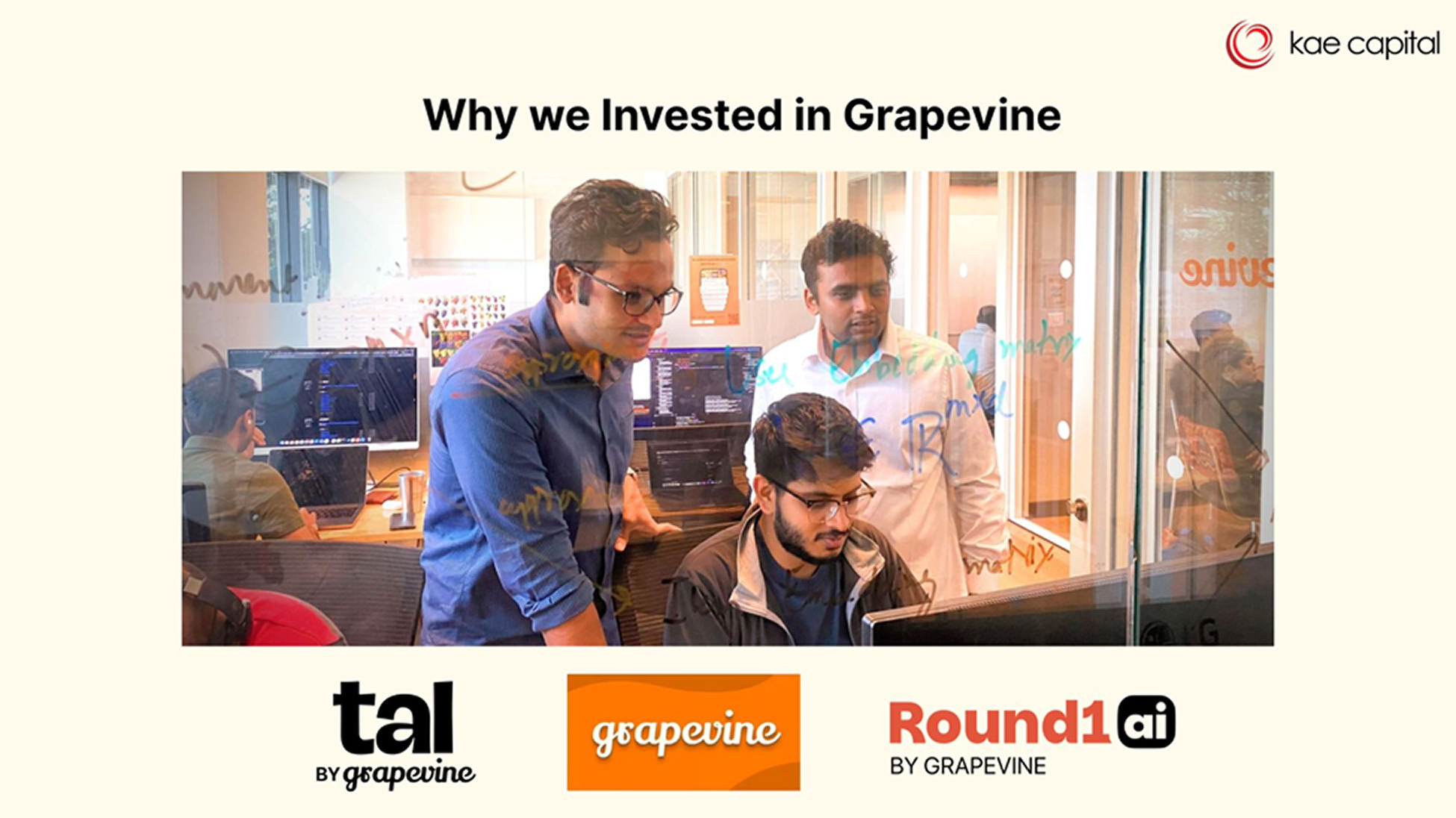

When we first met Saumil, Jainam, and Shreeyash, they weren’t just pitching us one product. They had a clear thesis: careers, and employment in India are all about to be rebuilt by AI, and they wanted to build the ecosystem for it. They already had Grapevine, a pseudonymous professional community where 200,000 white-collar workers talk openly about salaries, workplace culture, and career decisions. The users were real (verified through work emails), and the conversations were the kind people have in private Slack channels but never post publicly. They had clarity on Round1, their AI voice interview platform, and a broader vision for a suite of AI-first products that would sit on top of this community.
We led Grapevine’s $4.1 million round alongside Peak XV and Unilazer Ventures. Here’s what convinced us.
The problem is older than it looks
Recruitment in India hasn’t changed much in almost three decades. The core loop is the same: candidates upload resumes, recruiters keyword-search through databases, and everyone hopes the right people surface. The incumbents added social layers and premium tiers, but still run on text profiles and search queries.
The real issue is that resumes are bad at capturing what matters. They flatten years of work into bullet points. They reward people who are good at writing resumes, not people who are good at their jobs. On the other side, job descriptions are just as lossy. A recruiter’s mental model of what they need rarely matches the JD they publish.
Staffing agencies exist precisely because of this gap. A human recruiter picks up the phone, has a conversation, and figures out things a resume never reveals. But that doesn’t scale. A recruiter can make maybe 15-20 screening calls a day. India’s professional search segment alone is projected to reach INR 8,200 Cr by 2030, with 200,000-250,000 jobs closed annually just through agencies. There’s an enormous amount of manual labor holding this market together.
Where Round1 and TAL Come in
Round1 is an AI-powered voice interview platform. When a company posts a role, candidates don’t submit a resume and wait. They have a conversation. The AI interviewer asks technical and behavioral questions, follows up based on answers, and generates a detailed assessment. The output is a ranked shortlist of the strongest candidates, built from interview transcripts, resumes, and pre-screening data. Profiles are stack-ranked using a chess-style tournament where each candidate is rated relative to the others.
The product works. Companies that have used Round1 tell us the technical pre-screening catches things traditional agencies miss, where candidates who look great on paper get filtered out in a voice conversation. Round1 now conducts over 500 AI-led interviews daily, with about 90% of candidates progressing from the Round1 screen to a company’s next stage.
Then there’s Tal, which launched days ago. Tal is an AI talent agent for Indian professionals. It talks to candidates the way a good recruiter would: understanding their career goals, what they’re actually looking for, what matters to them beyond compensation. From there, it finds matching roles, helps build resumes, identifies the right people to reach out to, and figures out how to approach them.
Round1 solves the employer’s problem: finding the right candidates fast. Tal solves the candidate’s problem: navigating the job market without drowning in noise. Together, they form two sides of a marketplace that incumbents haven’t built because they are fundamentally database businesses, not curation businesses.
Why the timing works
Voice AI has only recently become good enough for production use at this level. Six months before Round1 launched, you couldn’t have built it the way it works today. The latency, the comprehension, the ability to follow up on nuanced answers, all of that required infrastructure that wasn’t commercially viable until very recently.
But here’s the part most people miss: AI isn’t shrinking the hiring market. It’s expanding. Saumil wrote about this recently, and his framing stuck with us: “When software becomes cheaper and easier to build, the world usually doesn’t want less software. It wants more of it.” The Jevons paradox applied to software development. In the old world, maybe a thousand companies could justify building serious software. In the new world, tens of thousands of businesses can, even if each only needs a handful of engineers. As Saumil put it: “More startups, more SMBs, more products, more experiments, more teams. Even if each team is smaller, the number of teams can grow enough that demand for strong engineers still rises.”
This is already playing out in India. A wave of new AI product companies are being built here, with early traction in the US, and the volume of hiring activity Grapevine is seeing from these companies is a signal. The old India IT story of huge teams and giant benches may shrink. But a different, stronger model is growing in its place: smaller teams, better engineers, more product ownership. India’s entrepreneurial base is massive even before the current AI wave. What happens to that number when building software gets 10x cheaper?
The broader staffing and recruitment market in India is projected at INR 15,770 Cr by 2030. Within the professional search segment (people with 3-5 years of experience, Grapevine’s sweet spot), the opportunity is close to $1 billion. Every company that adds AI to its stack, every new AI-native startup that gets funded, every business that can now justify building custom software, all of them need to hire. And as the talent bar goes up, the need for better screening, not just more screening, goes up with it. That is exactly what Round1 and Tal are built for.
Why this team
What stood out about this team was how deeply they understand the Indian white-collar professional. They didn’t start with Round1 or Tal. They started with Corporate Chat India, a Discord server where 15,000 employees talked anonymously about their companies. That evolved into Grapevine. And Grapevine’s community is what gives them something no other AI recruiting startup has: a living, engaged user base of verified professionals. Employees at some of India’s fastest-growing startups show above 50% adoption rates on the platform.
Saumil was previously at Google and worked on YouTube India marketing. In our conversations, what came through was an obsessive focus on user experience and a product instinct that people around him at Google noticed very early in his career. Shreeyash spent four years at InMobi in product management across gaming, weather, and shopping verticals, and the product work he shipped there still underpins parts of Glance’s US operations. In our conversations, people who worked closely with him described someone they’d back before an idea even had traction. Jainam came from InMobi and Porter’s consumer growth team. Everyone we spoke with flagged the same thing: creative product instincts and an entrepreneurial itch they’d been expecting him to act on for years. Saumil doesn’t just run an AI hiring company. He has a view on where the market is going, and he’s willing to stake the business on it. As he wrote recently: “From close to the hiring market, this doesn’t feel like the beginning of a collapse. It feels like the beginning of something great.” That kind of clarity matters when you’re building in a space where most investors see only risk.
Beyond individual backgrounds, what won us over is how fast this team ships. They went from launching Round1 to seeing serious company interest in weeks. They built voice interview technology that we found to be better than most dedicated voice AI companies we’ve spoken to. And then they shipped Tal, which wasn’t even a concept when we wrote our investment memo a few months earlier. In AI right now, the teams that iterate fastest tend to win. This team iterates very fast.
Their vision
Grapevine already has the retention layer that every other AI recruiting startup is missing. Users come to the app to check salary data, discuss workplace culture, and stay plugged into their professional network. When they’re ready for a new role, Tal is there. When employers need candidates, Round1 delivers.
But the team isn’t stopping at hiring. As previously mentioned, their vision is an ecosystem of AI-first products for the Indian professional: careers, and employment. Grapevine is the community. Round1 is how companies find talent. Tal is how professionals navigate their careers. And what comes next, whether it’s skilling, upskilling, or something we haven’t discussed yet, will sit on the same foundation of verified professionals and AI-native interactions.
The incumbents aren’t well positioned to respond. They have massive resume databases and sales models built around access to those databases. Even if they layered on voice AI, they’d be bolting it onto a fundamentally different product architecture. A curation product would eat into their existing business lines.
Most VCs are skeptical of recruitment startups in India. Fair enough. A lot of startups have tried to disrupt the incumbents over the past decade and ended up becoming agencies themselves. But those companies didn’t have a new technology layer to build on. AI changes what information is available to make hiring decisions. When the information changes, the market structure follows.
We think Grapevine, through Round1 and Tal, is the team best positioned to build the AI-native career ecosystem India needs. We’re backing them to do it.