Wabi just raised $20M on a thesis that sounds deceptively clean: YouTube democratized video creation; Wabi will democratize software creation.
It’s a compelling analogy, and one that deserves to be interrogated carefully.
Eugenia Kuyda, who called AI companionship years before it felt obvious with Replika, is now making a bigger bet: that apps themselves are about to become a creative medium, not just tools built by professionals.
If she’s right, software stops being something you buy and starts becoming something you make; casually, personally, and often.
That’s a massive shift. But it’s far from inevitable.
Why Would Anyone Actually Use This?
1. Hyper-personalized utilities
Last weekend, I built a Superhuman clone. Five minutes. Zero code. It actually works.
I use it every day, not because it’s revolutionary, but because the real Superhuman costs $25/month and I only needed three specific features.
This is the strongest immediate case for Wabi: tools shaped precisely to one person’s quirks, constraints, and preferences. No roadmap debates. No feature bloat. No subscriptions for things you don’t use.
But the uncomfortable questions linger:
- Is there enough volume of these hyper-specific needs across millions of people?
- Will people bother creating when the pain is mild, not acute?
- And if there are no ads, what are people paying for—the platform, or individual apps?
Personal utility is powerful. Whether it’s massively powerful is still unclear.
2. Self-expression and identity
YouTube didn’t just make video easier. It created a new identity: creator.
You weren’t uploading home videos, you were building a channel, an audience, a presence.
The question is whether software can follow the same arc.
Signals exist. GitHub stars. Figma plugins. Roblox worlds. Minecraft mods. These aren’t just utilities; they’re expressions of taste, competence, and imagination.
But there’s a key tension here. Video is inherently consumable as entertainment. Apps usually aren’t. Most software is meant to disappear into the background once it works.
So how many people want to browse apps the way they browse videos?
How many want to engage with software as culture, not just infrastructure?
That distinction matters enormously for scale.
3. Creator economics (the hard part)
The moment you build for others, things get messy.
- There are no ads.
- Anyone can fork your work.
- Creation takes minutes, not months.
- Differentiation is fragile.
So what are you charging for?
The deeper issue is whether the long tail of utility needs is deep enough to sustain a creator ecosystem. Utility demand tends to plateau; entertainment demand doesn’t.
It’s possible the most successful Wabi apps won’t be productivity tools at all, but creative, playful, or social experiences where imagination, not efficiency, is the constraint.
If that’s true, Wabi may look less like an app store and more like a creative platform.
Early Signals Worth Watching
Multiplayer use cases feel like the obvious early strength:
community tools, lightweight games, shared utilities.
Another promising signal is people rebuilding awful Play Store apps—overpriced, bloated, or poorly designed, and offering cleaner, cheaper alternatives.
The fork in the road is clear:
- Does Wabi skew toward community and gaming (high engagement, social gravity)?
- Or toward single-player utilities (deeply useful, but finite)?
Is this a utility layer, a community platform, or an entertainment network?
That answer likely determines everything about scale, retention, and monetization.
The Maintenance Problem
Content ages gracefully. Software doesn’t.
Your favorite YouTube video from 2015 still plays perfectly.
That Wabi app from 2026? APIs change. Auth breaks. OS updates roll out. Databases fill up. Something fails, and the creator moved on months ago.
GitHub has over 100 million repositories. Most are digital graveyards.
Here’s the intriguing counterpoint: if AI can build software, it should be able to maintain it too.
Imagine autopilot maintenance, AI fixes triggered by error logs, user complaints, or platform changes. This only works if complexity stays manageable, but if it does, it fundamentally alters the abandonment problem that has plagued software forever.
That may be one of Wabi’s most underappreciated bets.
The Distribution Risk
There’s a brutal reality here.
OpenAI, Google, or Anthropic could ship this as a feature.
“Build mini-apps in your sidebar” shows up inside ChatGPT or Gemini tomorrow. Two hundred million users already have distribution, trust, and habit.
Why would they switch?
The same risk exists with other AI-native builders entering mobile with social hooks. In consumer software, first-mover advantage matters far less than distribution—especially when the underlying technology is becoming commoditized.
Wabi’s differentiation has to be experiential, not technical.
Nobody Asked for YouTube Either
In 2005, if you asked people whether they wanted to make videos online, most would have said no.
Once friction disappeared, a latent desire revealed itself. Millions discovered they did want to create, they just hadn’t known it was possible.
Maybe software is similar.
Maybe millions would create apps if it were truly effortless. Maybe we’re about to uncover a form of creative expression we haven’t named yet.
That’s the real bet.
What Feels Solid
Wabi is one of the best interfaces to emerge in the AI era.
The social layer, the zero-jargon approach, the creation flow, the integrations—it’s all thoughtfully designed.
At the very least, this feels like the end of garbage mini-apps cluttering app stores. Even if nothing else works, Wabi raises the floor for what basic utility software can be.
The open question is whether it raises the ceiling too.
I built my Superhuman clone because it saved me $25 a month.
That’s one person, one need, one weekend.
Does that scale to millions of people, with thousands of needs, creating continuously?
Or does it plateau once everyone scratches their personal itch?
If Wabi is right, software creation is about to explode in ways that fundamentally reshape how we think about apps.
If it’s wrong, we’ll learn something important about the limits of creative democratization.
Either way, it’s worth watching closely.
What people are already building on Wabi
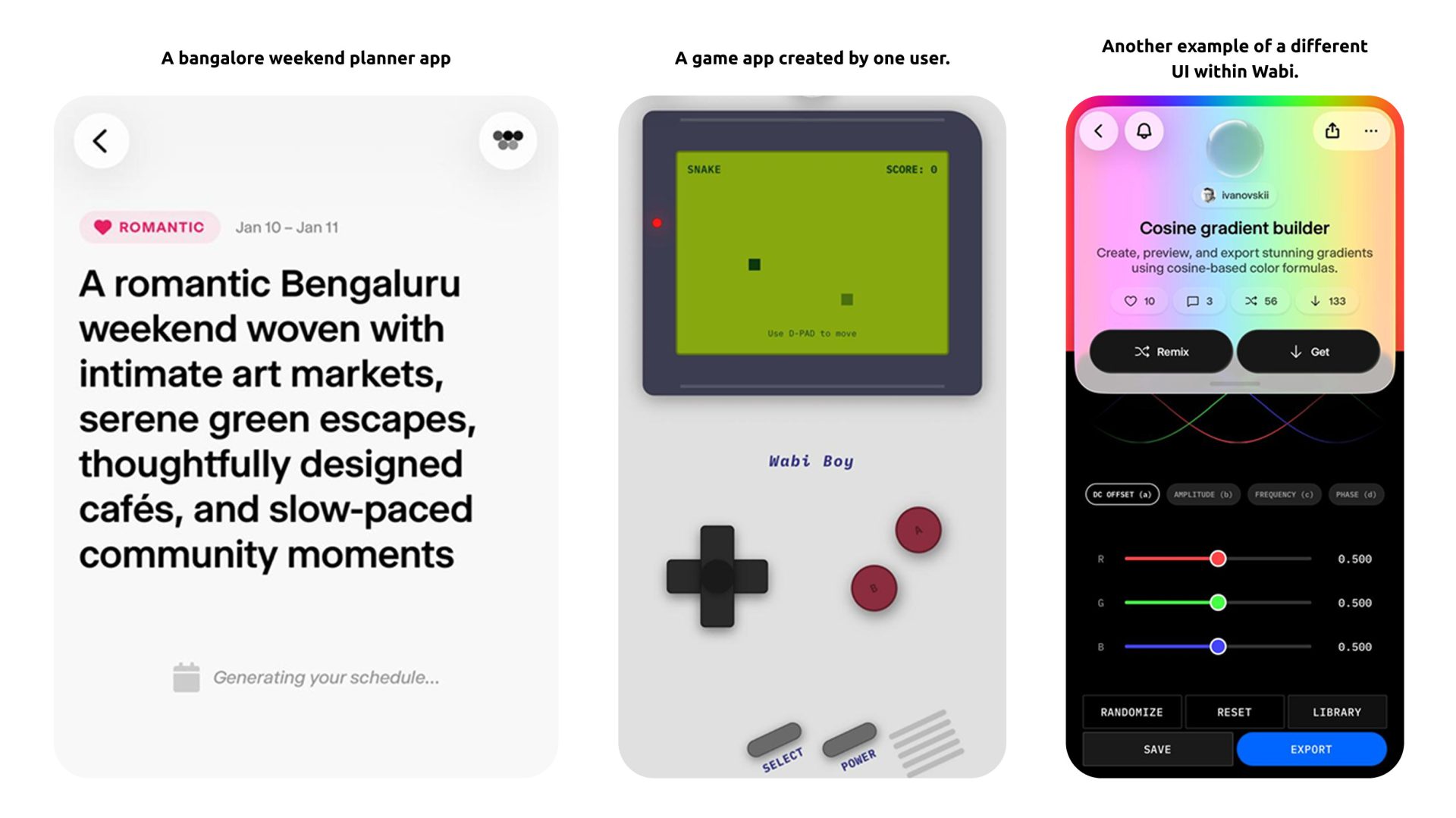
A Bangalore weekend planner, a game built by a single user, wildly different UI styles within Wabi, and a Superhuman-style email client; created in minutes, not months.
If you’ve been experimenting with Wabi, or have a strong take on where this breaks, I’d genuinely love to hear it.