

Product-market fit is the most talked-about, least understood milestone in a startup’s journey.
Founders claim they have it when they see their first spike in signups. Investors doubt it until they see retention curves flatten. And everyone agrees it’s critical, but few can articulate exactly what it looks and feels like.
Here’s the truth: In 2026, retention is the ultimate validator of product-market fit. In a product with PMF, the retention curve flattens out at 20%, 30%, or 50%, meaning you have a “stable base” of users who find recurring value, month after month.
This guide will help you understand what PMF actually means in the Indian context, how to measure it, and what to do once you’ve found it.
What PMF Actually Means (Beyond Vanity Metrics)
Product-market fit means being in a good market with a product that can satisfy that market.
More specifically, it’s when:
- Customers actively seek out your product (pull, not push)
- They keep using it without constant nudging (retention)
- They tell others about it organically (word-of-mouth)
- They’d be very disappointed if it disappeared tomorrow
PMF is not:
- 10,000 signups from a viral campaign that churns within a month
- High engagement that doesn’t translate to paying customers
- Great press coverage that doesn’t drive sustainable growth
- One customer segment loving you while others churn
In India’s diverse market, PMF often looks different across customer segments, geographies, and use cases. You might have PMF with SMBs in Bangalore but not with enterprises in Mumbai. You might have it for one use case but not adjacent ones. This nuance matters.
Quantitative Signals: The Metrics That Matter
1. The 40% Benchmark
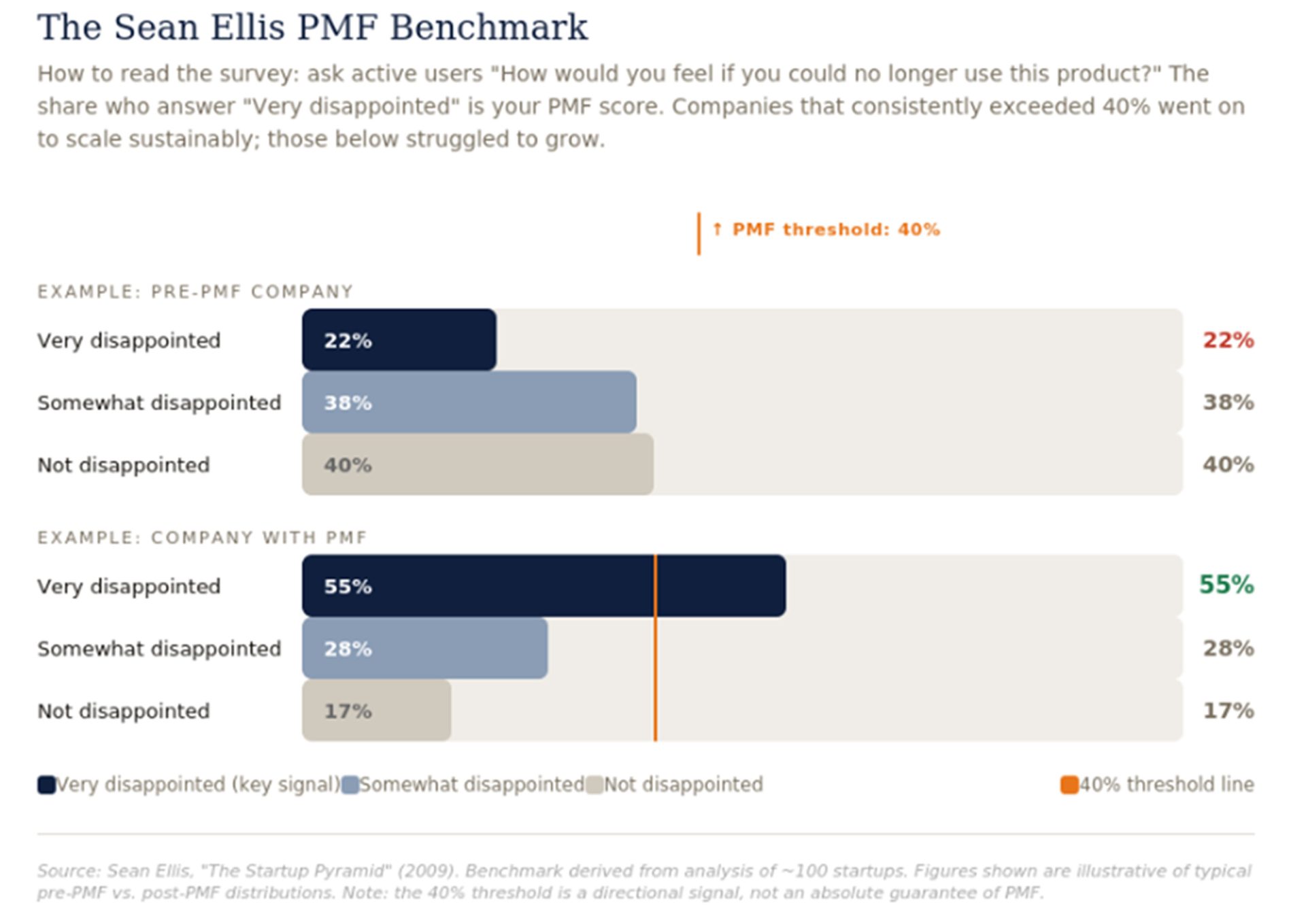
The most cited PMF test comes from Sean Ellis: Survey your active users and ask, “How would you feel if you could no longer use this product?”
If 40% or more answer “very disappointed,” you’ve likely found product-market fit. Below 40%, you’re still searching.
We’ve used this test with portfolio companies, and it’s remarkably predictive. Companies above 40% go on to scale sustainably. Those below struggle to retain customers despite aggressive growth tactics.
2. Retention Curves That Flatten
Watch your cohort retention curves closely. In the early days, you’ll see retention curves that slope down to zero, meaning every cohort eventually churns completely.
Product-market fit happens when retention curves flatten. Instead of trending to zero, they stabilize at 20-50%. This “stable base” of users signals you’re delivering recurring value.
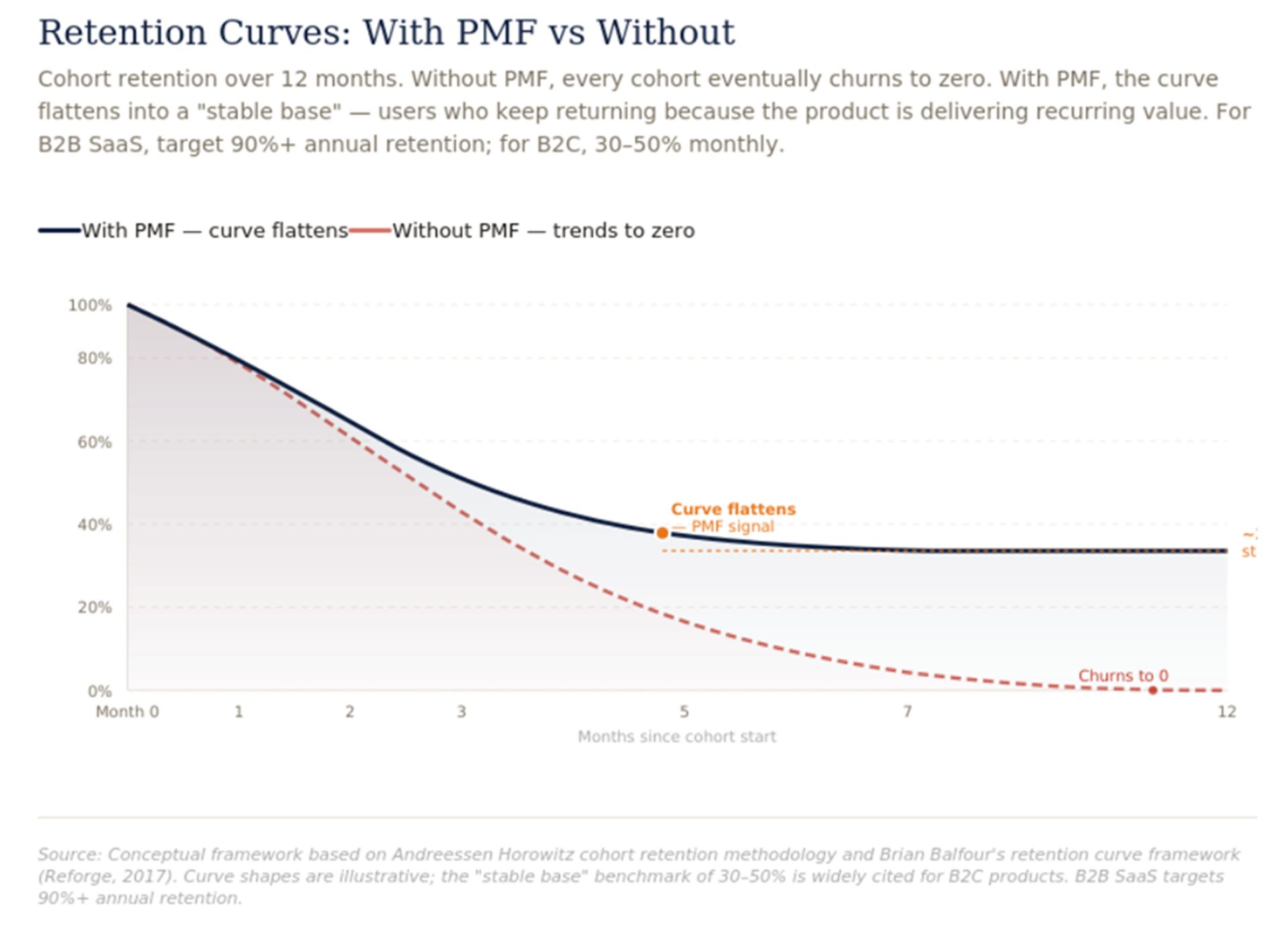
For B2B SaaS in India, look for 90%+ annual retention. For B2C products, aim for 30-40% monthly retention or higher, depending on your category.
3. Organic Growth Surpassing Paid
When product-market fit kicks in, your customer acquisition mix shifts. Organic channels; word-of-mouth, referrals, direct traffic, content, start contributing more than paid acquisition.
If you’re still dependent on paid ads for 80%+ of growth, you haven’t found PMF yet. The product isn’t good enough to sell itself.
4. Customer Retention Rate (CRR) Trending Up
Track the percentage of customers continuing to use your product over time. CRR should improve as you:
- Better understand your ICP (Ideal Customer Profile)
- Improve onboarding and activation
- Build features that solve core pain points
Rising CRR is one of the clearest signals of PMF. Flat or declining CRR means you’re acquiring the wrong customers or solving the wrong problems.
5. NPS (Net Promoter Score) Above 50
While NPS isn’t perfect, it’s a useful proxy for word-of-mouth potential. In India, we’ve seen successful startups achieve NPS scores of 50-70 once they hit PMF.
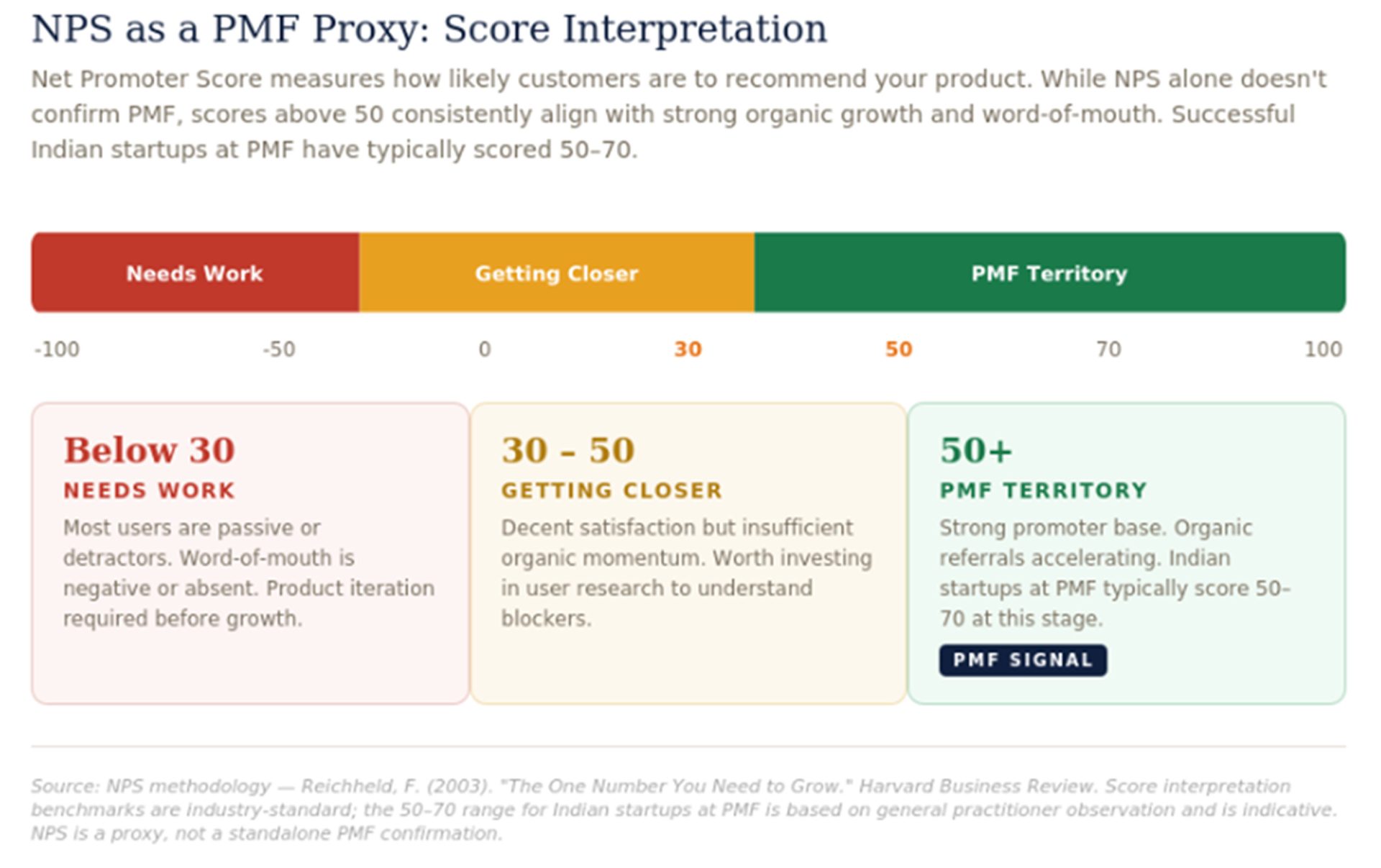
Below 30, you have work to do. Between 30-50, you’re getting closer. Above 50, customers are actively promoting you.
Qualitative Signals: What Customers Say and Do
Numbers tell you that you have PMF. Qualitative signals tell you why.
1. Customers Use Their Own Language
When customers describe your product in their own words, not your marketing copy, you know it’s resonating. Listen to sales calls and customer interviews. If they’re repeating your value prop verbatim, they don’t truly get it. If they’re explaining it in simpler, more personal terms, you’re onto something.
2. They Keep Coming Back Without Prompting
PMF feels like pull, not push. You’re not constantly sending emails to drive engagement. Customers log in daily (or weekly) without reminders because they need your product to do their jobs or live their lives.
3. Word-of-Mouth Is Happening Organically
You overhear customers recommending you in communities. You get inbound inquiries from people who heard about you from existing users. Your customer referral rate is above 20-30%.
Razorpay, one of India’s fintech success stories, knew they had PMF when merchants started moving their entire transaction volume to Razorpay and adopting additional products without the sales team pushing them. That’s the gold standard.
4. Customers Resist Alternatives
When competitors approach your customers or free alternatives exist, your customers stay. They’re not just using your product, they’re committed to it. Switching costs may be low, but they don’t switch.
India-Specific PMF Considerations
India’s market presents unique challenges and opportunities for identifying PMF:
1. Market Diversity
India isn’t one market, it’s 20+ markets. PMF in Delhi might not translate to Bangalore or tier-2 cities. Language, income levels, internet penetration, and cultural preferences vary dramatically.
When evaluating PMF, segment by:
- Geography (metro vs tier-2/3)
- Language preference
- Income bracket / customer segment
- Industry vertical (for B2B)
You may have PMF in one segment and no PMF in another. Be precise about where you’ve found it.
2. Pricing Sensitivity
India’s price sensitivity can mask or reveal PMF. A product with great engagement but low willingness to pay might not have true PMF, users like it, but not enough to spend money.
Conversely, if customers pay despite a subpar experience because no good alternatives exist, you have a market need but not yet PMF. Sustainable PMF requires both usage AND monetization.
3. Mobile-First Behavior
In India, most digital experiences happen on mobile, often on lower-end devices with spotty connectivity. If your product doesn’t work seamlessly on mobile or requires high bandwidth, you’ll struggle to achieve PMF outside of tier-1 cities.
4. Trust and Brand Matter More
Indian customers often need more social proof before adopting new products. Word-of-mouth, testimonials, and brand recognition accelerate PMF. That’s why many Indian startups invest heavily in marketing even pre-PMF, it builds the trust required for adoption.
What Founders Get Wrong About PMF
1. Confusing Growth with PMF
A viral moment or successful marketing campaign can create a spike in signups that looks like PMF. But if those users don’t stick around, it’s just noise. PMF is about retention, not acquisition.
2. Declaring PMF Too Early
Founders often declare PMF after their first few happy customers. But 10 happy customers isn’t PMF, it’s customer validation. PMF requires repeatability and scale. Can you acquire 100, 1000, 10,000 customers with the same value proposition?
3. Assuming PMF Is Permanent
Markets shift. Competitors emerge. Customer needs evolve. PMF is not a one-time achievement, it’s an ongoing state that requires constant attention. You can lose PMF if you stop listening to customers or get complacent.
4. Optimizing Too Early
Some founders start optimizing funnels and growth loops before they have PMF. This is premature. First, find the core value. Then, optimize delivery of that value. Polishing a product no one truly needs is wasted effort.
When to Pivot vs Persevere
If you’ve been iterating for 12-18 months and still don’t see PMF signals, it’s time to ask hard questions:
Pivot when:
- Retention curves aren’t flattening despite multiple iterations
- Customers keep churning for the same core reasons
- You’re unable to articulate a clear, differentiated value prop
- Market feedback tells you there’s no urgent pain point
Persevere when:
- You see pockets of strong retention in specific segments (double down there)
- Qualitative feedback is positive, but product execution is lacking
- The market is real, but you haven’t found the right positioning yet
- A few customers are deeply engaged and expanding usage
The data will tell you, but only if you’re honest about interpreting it.
Scaling Playbook Once You Have PMF
Congratulations! You’ve found PMF. Now what?
1. Document What’s Working
Before you scale, codify exactly why customers choose you, how they use you, and which segments convert and retain best. This becomes your growth playbook.
2. Invest in Distribution
With PMF, distribution is the unlock. Double down on channels that work. Hire sales and marketing talent. Build partnerships. Product-market fit gives you permission to pour fuel on the fire.
3. Expand Within Your ICP
Scale within your Ideal Customer Profile before expanding to adjacent segments. Go deeper in what’s working before going wider.
4. Build the Team for Scale
Your scrappy, generalist team got you to PMF. Now you need specialists; sales leaders, demand gen experts, customer success managers, to scale efficiently.
5. Raise Capital with Confidence
Investors write checks for PMF. If you can demonstrate strong retention, organic growth, and clear unit economics, fundraising becomes significantly easier. Now is the time to raise for growth.
The Bottom Line
Product-market fit isn’t a moment, it’s a state. And in India’s complex, diverse market, it rarely looks the same for any two companies.
Stop chasing vanity metrics. Focus on retention curves, customer language, and organic growth. If 40% of your active users would be “very disappointed” without your product, and your retention curves are flattening, you’re there.
Once you have it, move fast. PMF opens a window of opportunity to scale before competitors catch up or market dynamics shift.
But until you have it, resist the urge to scale. Fix the product. Talk to customers. Iterate ruthlessly. Everything else is a distraction.