
Ten years ago, a meeting with a prospective investor in an Indian venture fund began with India. Was the market deep enough? Was governance sound? Could money leave? These are questions about a country, and a commitment built on them is a commitment to a story. Stories are bought in good years and sold in bad ones, which is roughly what happened to Indian venture in 2015 and again in 2021.
The questions now are narrower and considerably harder. Where does this fund sit against the funds that began the same year? When does cash come back? How do you value what you have not yet sold?
It is tempting to read this as sentiment improving. It isn’t. It is a change in what can be answered, which is a different thing and a far more durable one.
Machinery, not mood
Before 2020, an investor weighing an Indian venture fund had nothing to check it against. The manager supplied a number. You believed it or you didn’t, and the entire exercise collapsed into a judgement about people.
That ended with a SEBI circular dated 5 February 2020 making performance benchmarking mandatory for alternative investment funds. IVCA appointed Crisil, and India’s first fund benchmarks appeared on 1 October 2020, the original July deadline having slipped under the pandemic. Funds are now grouped by the year they began and measured on cash actually returned against cash paid in, with a public market comparison attached. That last element answers the only question a trustee genuinely has, which is whether the illiquidity was worth it. (Mondaq | Crisil)
Reporting followed, though only this year. A SEBI circular dated 4 March 2026 replaced scattered quarterly filings with one comprehensive annual record, filed on a common template through a single portal. Managers now report less often. They also report identically, and only the second of those is of any use to someone comparing two funds. (SEBI)
Access moved earlier still. A Ministry of Finance notification of 15 March 2021 permitted private provident, superannuation and gratuity funds, the retirement capital large Indian companies manage for their own employees, to place up to 5% of surplus into the fund categories that house venture capital. (Invest India)
The lag
Here is the part worth sitting with. The rules were substantially in place by 2021. It took until roughly 2024 for them to become usable.
That delay was not hesitation. It was correct, and understanding why is the whole point.
A benchmark with one reporting cycle behind it is a compliance obligation, not a decision tool. It has thin cohorts, no history, and nothing to say about how a manager performs across a cycle. A permission that nobody has exercised is not yet a market. Both needed years of accumulated evidence before an investment committee could responsibly act on them, and the committees waited precisely as long as they should have. What looked from inside the industry like foreign indifference to India was, more often, institutions declining to act on data that was not yet worth acting on.
What they were waiting for arrived without announcement. Crisil began publishing at sub-category level from November 2023, so a venture fund is now measured against venture funds rather than pooled with infrastructure and SME vehicles. Vintage years stacked up beneath the benchmarks. IVCA added Preqin as a second agency. (Crisil Intelligence)
Then the capital came, and it came steadily rather than in a single step. Commitments to alternative investment funds reached $185 billion (₹17.53 trillion) by June 2026, up 23.6% year on year, with capital actually deployed crossing $75 billion for the first time. The same June figure stood at $89 billion in 2023 and $124 billion in 2024. Machinery does not produce a step change. It compounds. (Business Standard. SEBI data, reported in rupees. Converted throughout at a constant ₹95 = $1, the June 2026 average, so the series shows growth rather than currency movement.)
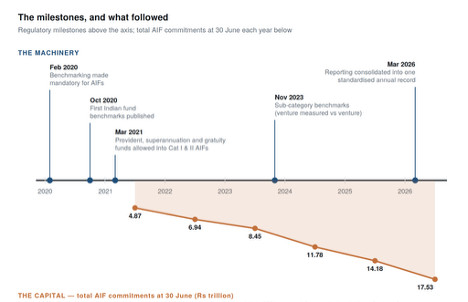
Source: Mondaq (Feb 2020) | Crisil (Oct 2020) | Invest India (Mar 2021) | Crisil Intelligence (Nov 2023) | SEBI (Mar 2026) | Business Standard (AIF Commitments)
The more consequential shift is where the money came from. Of roughly $5.4 billion raised by India-focused venture and growth funds in 2025, about $4 billion came from domestic managers, against about $2 billion the year before. Domestic capital did not merely grow with the market; it held roughly three-quarters of it through both a trough and a recovery. Average fund size rose more than a third, from about $50 million to $68 million, and eighteen funds closed above $100 million against four in 2024. Established managers led that formation while first-time managers found it harder to raise. (IVCA Report 2026)
Why domicile matters is not sentiment either. Foreign capital tracks global conditions. Rates move in Washington, a conflict opens somewhere, and emerging market allocations are trimmed irrespective of what Indian companies are doing. Domestic capital is insulated from that particular reflex. It also removes the currency mismatch, and most usefully it makes a fund raisable in a difficult year rather than only a benign one. Difficult years are when the best entry prices appear.
The question still outstanding
Three conditions met, then: comparison, reporting, access. The fourth is evidence that money comes back, and here India has genuinely lagged. Bain and IVCA find that Indian venture funds take 30% to 40% longer than American and European funds to return investors their original capital. That gap is real, it is measured, and it should not be softened. (IVCA Report 2026)
Which is why the most interesting Indian number of 2026 is not a funding total. It is that the average journey from a company’s first institutional round to its IPO fell from 14.5 years to 8.1 years. India also recorded thirteen technology listings in the first half of 2026 against twelve a year earlier, with average market capitalization at listing rising from $162 million to $297 million. (Tracxn)
That is a half-year observation of the companies that happened to list, not a fund-level measure, and it should not be over-read. But eight years is not the timeline that shaped a generation of scepticism about this market.
A second kind of evidence is newer than most people realise. India’s earliest venture funds are finally old enough to have finished. A fund that made its first investment in 2012 has had a full decade and more to run, and a completed fund is a categorically different object from one still holding positions at estimated values, because nothing remains estimated. Kae’s first fund, the India vehicle, registered with SEBI in 2011-12, is fully exited. Porter and HealthKart between them returned that entire fund several times over. (Kae Capital)
One finished fund is an instance, not a pattern. It is also precisely the category of evidence Indian venture could not produce until now, and each year adds to the number of managers who can.
Why founders should care about any of this
This reads like administration, and founders are entitled to ask why it concerns them. It concerns them for one reason that shows up on a cap table rather than in a filing.
Money that arrives because a market is in fashion departs when the fashion does. Money that arrives because a committee compared a fund against its vintage peers and approved an allocation behaves differently, and it behaves differently precisely in the years when nothing is going right.
That sorting is already visible. Fundraising in 2025 was led by established managers while first-time managers found it harder to raise, and the largest firms accounted for roughly 40% of all venture and growth investment, some five percentage points up on the prior year. Founders will read that as concentration, and it is. It is also what a market looks like when allocators can finally tell managers apart. (IVCA Report 2026)
So when a founder weighs two term sheets, the question of who funds the investor is not academic. It determines whether they can follow their money through a bad year, whether they can wait two more years for the right exit, and whether they will still be there at your Series B.
What this actually means
An asset class is not created when money arrives. Money has arrived in Indian venture before and left again. An asset class is created when the money can be interrogated: measured against peers, checked against a common standard, and eventually counted on its way back out.
India built that apparatus at the opening of this decade, then spent the first half of the decade waiting for it to become useful.
It is useful now.
The questions put to Indian fund managers today are harder than those put five years ago. That is not the price of progress. It is the progress.
A market in which every manager can tell a persuasive story is a market in which no manager can be distinguished from another, and for most of the last decade that was India. What changed is that the story stopped being the evidence. A fund can now be placed against the funds that began the same year, on cash returned rather than value asserted, and the placing is done by someone other than the fund.
That is a better market to invest in, and a better one to build in. Capital that arrives on evidence stays through the years when the evidence is thin. Founders get investors who can wait. Managers get judged on what they returned rather than what they promised. And the allocator who once had to decide whether to believe in India now gets to decide something far more useful: which part of it to back.
Five years ago that was not a choice anyone could make with confidence. It is now.