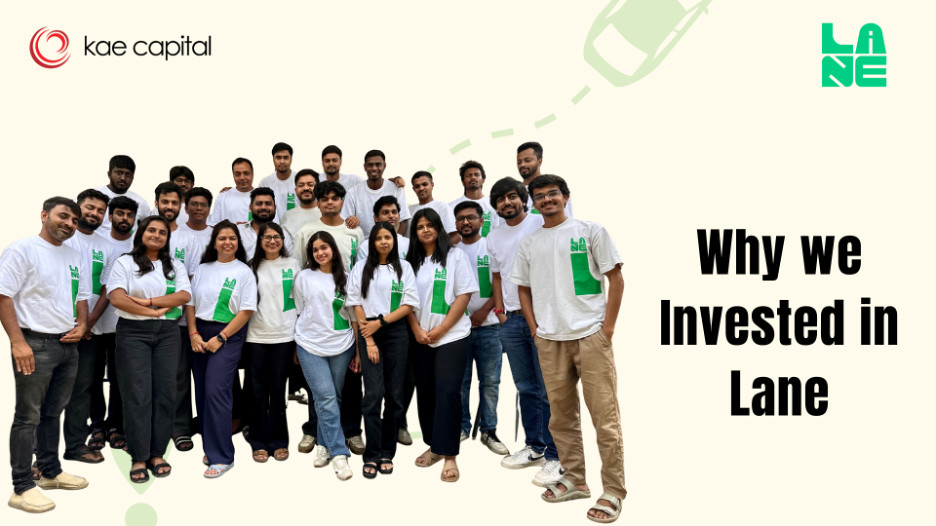

When we first met Samiksha, she described Lane as the first port of call for anyone starting their automotive journey in India. The wedge she chose – learning to drive – is one of the most overlooked, underbuilt categories in the country. We thought it was an un-obvious entry point in the life of car buyers yet every person we spoke to subsequently had at best an average experience in learning how to drive. That’s when we believed that Lane was onto something special.
A category that has been waiting for someone to rebuild it
India issues roughly 10 million new driving licenses every year. Adjust for urban and semi-urban learners and you have an addressable population of around 6 million new drivers annually. At an ARPU close to $110, that is a ~$667M opportunity from new drivers alone, with another $400M from existing license-holders who never actually learned to drive properly. Total driver’s-ed TAM in India sits north of $1 billion.
Yet the category remains almost entirely unorganised. Tens of thousands of local schools dominate the market, with the occasional OEM-backed chain like Maruti Suzuki Driving School. With over 500 centres,Maruti Driving School sets a modest benchmark for what a scaled curriculum might look like. Even with chain schools the experience provided is broadly uneven. Moreover, these schools run on an asset-heavy model (they own the cars, they employ the instructors) that makes scaling nearly impossible. The result is a customer experience that has barely moved in two decades: no standardised curriculum, perfunctory instructor vetting, poor vehicle upkeep, high in-lesson anxiety for the learner due to instructor’s poor behaviour, and almost no tech enablement whatsoever.
Globally, we have seen players emerge such as Ornikar in France, raise $175M from KKR and others, run an online driver’s-ed marketplace doing $100M+ in revenue — in a country a fraction of India’s size. Kruzee in Canada, Dribo in Spain, Guidoio in Italy, Clickdrive in the Netherlands — each is a venture-backed answer to the same problem. India, with the largest pool of new drivers in the world, has had no comparable bet.
A 10x experience, built on a net-new supply side
We took an NPS of Lane’s customers and 90% of them rated Lane’s experience as 10/10. On digging deeper, it became clear that the current driver’s ed set up suffers from poor teaching methods,pedagogy as well as bad infrastructure. Learning how to drive on a busy Indian roads is a scary experience and customers want a calm in-car environment to navigate these challenges.
Lane is solving this problem at its core.
Lane’s supply partners are a mix of part-timers and full-timers. They undergo rigorous training and follow module based teaching (clutch-break training, reversing, parking). They modify their own cars to be teaching-ready, and are explicitly taught how to teach. What also stood out was how deeply Lane cared about its customers. Every small piece of feedback was acted upon and the users were updated in a timely manner. This sort of obsession cannot be hacked, it is built into the company’s DNA.
On the demand side, the curriculum is modular and delivered in live conditions. Customers can pick the time that works best for them and the instructor shows up at their door with a car. One of Lane’s customers used a lesson to learn how to park in her office parking lot where she always felt underconfident. Another requested a class on how to drive on the highway! Post mastering these challenges, the customer’s delight is not one off but a rule at Lane. A meaningful share of users are people who already hold a license but never gained the confidence to actually drive their own car. Several of their customers have asked, unprompted, whether Lane can help them buy a car next.
What is the future?
India sold around 5-5.9 million used cars in FY24-25, a used-to-new ratio of 1.3-1.4x, with 70% of the market still unorganised. The average used-car buyer is in their early 30s, exactly the cohort Lane is already serving. Earning a learner’s trust at the most anxious moment of their automotive life is the single most defensible point from which to build a multi-product platform — advisory, used-car marketplace, maintenance and more. Lane is starting at the front door of the funnel, and the data already triangulates the next product.
The founder
After graduating from University of St Gallen, Samiksha joined her family’s contract manufacturing business. Within a year she closed a 200-crore personal-care contract in Egypt. Yearning to learn more about building a tech business, Samiksha spent four years in early stage VC where her managers described her as one of the firm’s fastest risers. Her managers noted how Samiksha was deeply involved with founders and worked to make those companies successful. This experience of working with founders helped her build the conviction to start off on her own journey.
What stood out for us was the clarity of her vision, the relentless focus with which she had executed and the mindset of constant experimentation. She still continues to delight us by pre-empting our questions with an experiment she has already run. It was clear that this founder has all the qualities to create a large consumer tech business in India and we were eager and excited to partner with her on the journey.
In closing
Lane is a rare combination: a large, durable, demonstrably broken market; a founder with the drive and self-awareness to build through it; and a product that is already delivering a 10x experience to customers in a category most investors would walk past. We are excited to back Samiksha and the team as they make Lane the front door to India’s automotive life.