How to Think About Pricing in India

Price is a signal before it is a number.

In most markets, a buyer evaluates a product and then reacts to the price. In Indian B2B markets, particularly at the enterprise and upper-SMB level, the price is part of the evaluation. It tells the buyer something about how the seller sees the product’s value, whether the company is financially stable, and how the relationship will be conducted. Founders who treat pricing purely as a revenue optimization problem miss this dimension entirely.

This guide is about the structural realities of pricing in India that most frameworks do not address, and the specific patterns that compound into problems if not understood early.

The Buyer’s Reference Point Is Not What You Think

The instinct when entering an Indian market is to benchmark against what comparable products charge in the US and apply a discount. The discount is usually too large, and the reference is usually wrong.

Most Indian B2B buyers are not comparing your product to its US equivalent. They are comparing it to what they currently do. And what they currently do, in a large part of the Indian economy, is employ people.

A procurement manager at a mid-size manufacturer is not thinking about what SAP charges. She is thinking about the two employees who currently manage procurement through phone calls and spreadsheets, what they cost, and what errors they produce. A logistics operator is not benchmarking against US fleet management software. He is calculating whether your product is cheaper than the coordinator who calls drivers every morning to confirm dispatch.

When the incumbent is a person rather than a product, the price comparison changes entirely. The cost of manual labor in India is not low: a competent junior employee in a Tier 1 city costs ₹25,000 to ₹40,000 per month inclusive of provident fund, insurance, and overhead. Two employees managing a process your software replaces represent ₹50,000 to ₹80,000 in monthly cost. A founder who prices their product at ₹8,000 per month because they are nervous about India’s price sensitivity is leaving most of the available value on the table and inadvertently telling the buyer that the product is not serious.

The right starting point is a conversation with the buyer about their current process: how many people are involved, how much time it takes, what errors it produces, and what those errors cost. That conversation establishes a value anchor that makes almost any reasonable software price look like a good deal.

Low Prices Communicate Risk

There is a counterintuitive dynamic in Indian enterprise sales that experienced founders know and early-stage founders regularly discover the hard way.

When an early-stage company prices significantly below what an enterprise buyer expects for a product that solves a serious problem, the buyer’s first reaction is often not relief. It is suspicion.

A large Indian business evaluating a software vendor is asking several questions simultaneously: Does this product work? Will this company support it when something goes wrong? Will this company still exist in two years? A price that feels dramatically low raises all three questions without answering any of them. The buyer’s inference is not that they are getting a good deal. The inference is that something might be wrong.

This is not unique to India, but it is more pronounced in Indian enterprise markets where the consequences of a failed vendor relationship are social as well as financial. A CFO who approved a vendor that failed has a problem that is visible inside the organization. The price they paid is part of that story.

Pricing to the value you deliver, rather than to the floor of what you believe the market will accept, is not just a revenue decision. It is a credibility decision. The two are more connected in India than most pricing frameworks acknowledge.

The Pilot Trap

Indian enterprise buyers ask for pilots. This is reasonable: they are evaluating an unknown vendor on a problem that matters. A pilot is how they manage that risk.

What is less reasonable, and more common, is the pilot with no defined end point and no conversion criteria. A free pilot of indefinite duration is not a pilot. It is a free subscription with the expectation managed on the buyer’s side and the cost borne entirely by the seller.

The founders who have seen this pattern a few times know what it looks like: four to six months of positive feedback, a growing list of internal users who love the product, enthusiastic check-in calls, and no commercial conversation. The pilot has become the relationship. The buyer has no incentive to convert it into a contract because the current arrangement is already giving them everything they need.

The correction is to charge for the pilot. Not a commercial rate, but a real number that requires an actual purchase order or bank transfer. Even a nominal paid pilot changes the dynamic in a specific way: it has required the buyer to involve their finance or procurement function. Someone has approved the expenditure. There is now a stakeholder inside the buying organization who has made a decision about this vendor, and that person has an interest in seeing the pilot conclude one way or another.

Conversion rates from paid pilots to commercial contracts are substantially higher than from free pilots. The explanation is not that paying unlocks goodwill. It is that a financial commitment, however small, forces organizational seriousness that a free engagement does not.

The Price Travels Through the Market

When a large or prominent customer signs at a significantly reduced price, that price often does not stay private.

Indian business communities, particularly within specific industries, are more connected than they appear from the outside. The textiles cluster in Surat, the gems and jewelry community in Mumbai, the automotive ancillary suppliers in Pune: these are communities where people talk, where the procurement head at one company knows her counterpart at a competitor, and where information about what vendors charge moves through the network.

A founder who prices a large conglomerate at 40 percent below list to win the account may find, within 12 to 18 months, that every other prospect in that industry has the same number in mind when the sales conversation starts. The discount has become the market price.

The version of this that compounds fastest is when a marquee customer is given free access in exchange for a reference or a case study. The reference often does not materialize, for reasons that have nothing to do with satisfaction: the internal champion moves roles, the legal team declines to allow public commentary, the company’s communications policies change. The free access remains. And the market knows that a name-brand company is using the product at zero cost.

The more durable approach with marquee customers is to charge a real price and invest in their success. A customer who paid fairly and had an excellent experience is a stronger reference than a customer who got a steep discount and is privately uncertain whether they would have paid commercial rates.

The Budget Cycle Most Founders Do Not Account For

India’s corporate fiscal year runs April to March. This is not a trivial detail. It shapes the entire rhythm of enterprise purchasing in ways that directly affect how deals close and when.

Large Indian enterprises set technology budgets in January and February for the fiscal year beginning in April. By October, most budget has been allocated. A deal that surfaces in November is almost always competing for unallocated budget from the current year or pre-selling against next year’s cycle. Both conversations are harder than they look.

The timing implication for founders: the most productive windows for enterprise sales in India are April through June (new budget, fresh priorities) and September through October (Q2 close, before year-end planning begins). Deals initiated in November and December often stall not because of product or price objections, but because the organizational machinery for approving new spend has slowed for the year.

Understanding this cycle also clarifies why some deals seem to move quickly and others take forever despite similar levels of enthusiasm. The prospect who is enthusiastic in August is working within active budget. The equally enthusiastic prospect in November is asking you to either compete for end-of-year unallocated funds or wait.

The Champion and the CFO Are Different Conversations

In Indian enterprise, the person who is most enthusiastic about your product is frequently not the person who controls the budget.

A supply chain head who wants your inventory management software has to convince a CFO who thinks about headcount, balance sheets, and the cost of changing systems. A marketing director who wants your analytics product has to convince a procurement team that evaluates vendors on stability and compliance criteria as much as on product quality. The internal champion and the budget authority are different people with different concerns, and pricing that works for one often does not work for the other.

The specific failure mode is pricing in a way that makes sense to the champion but does not give them the language to make the case to their CFO. A CFO evaluating a software purchase is asking a different set of questions than a functional head. They want to know: what happens to headcount? What is the three-year TCO? What is the risk if the vendor fails? What does this cost compared to what we currently spend?

Pricing that is designed to clear the CFO’s questions, not just the champion’s enthusiasm, closes faster. This means having a clear number for what the product replaces in cost terms, a total cost of ownership calculation that survives scrutiny, and a commercial structure (annual contract, clear implementation scope, defined support terms) that the CFO can defend internally.

Seat-Based Pricing Often Fails in Indian SMBs

In Indian small businesses, seat-based pricing runs into a specific behavioral reality: credential sharing.

A small business owner who is being charged per user will, very often, create one account and have multiple employees use it. This is not piracy in the way they think about it. It is the same mental model that governs sharing a cable subscription or a newspaper. One purchase, shared benefit.

This behavior means that seat-based pricing systematically underestimates usage and, critically, gives the founder no visibility into how widely the product is actually adopted within the customer’s organization. A customer who shows as one seat may have eight people using the product daily. When that customer churns, the real loss is eight users’ worth of embedded value, not one.

Per-transaction or per-outcome pricing sidesteps this problem entirely. The customer does not think about seats. They think about usage, and usage is what generates the bill. The founder gets accurate signal about adoption and a pricing model that scales with value delivered.

For products where per-outcome pricing does not fit the product structure, usage-based tiers (light, standard, heavy) based on actions or outputs rather than named users often work better in Indian SMB than pure seat counts.

Price Sensitivity Is Not Uniform Within a Category

Indian market analysis often treats price sensitivity as a feature of a buyer segment. SMBs are price-sensitive. Enterprise is less price-sensitive. This is a starting point, not a conclusion.

Within any segment, willingness to pay varies dramatically based on what is at stake if the problem is not solved.

Consider accounting software. The average Indian SMB might resist paying ₹3,000 per month for accounting software because the consequence of managing accounts manually is inconvenience and some time lost. The same SMB that has recently received a GST scrutiny notice will pay multiples of that immediately, because the consequence of getting accounts wrong has become reputational and legal risk.

Consider logistics software. A transporter who moves ordinary consumer goods may resist paying for a digital dispatch system. A transporter who moves pharmaceutical cold chain or high-value electronics, where a lost or delayed shipment means a contract termination, will pay significantly more because the cost of failure is asymmetric.

The implication for founders is that the same product can command very different prices depending on which version of the customer’s problem you are solving. The customer who has already been burned by the failure mode your product prevents is the easiest sale and the highest-value customer. Finding that customer, and pricing to the risk they are trying to eliminate rather than to the average willingness to pay in the segment, is one of the most underused approaches in Indian B2B pricing.

One Community Customer Can Make the Next Twenty Free to Acquire

This dynamic is specific to Indian markets and significantly undervalued in how founders think about early pricing.

Indian B2B markets in specific geographies and industries are genuinely community-structured. The diamond traders of Surat, the cotton ginners of Vidarbha, the auto component manufacturers of the Pune-Nashik corridor: these are industries where buyers know each other, trust each other’s recommendations, and frequently make adoption decisions as a community rather than independently.

In these markets, one genuine success story from a trusted peer is worth more than any amount of outbound sales or product marketing. A founder who acquires the right first customer in a community, invests heavily in making that customer successful, and creates conditions for that customer to talk about the product, will find that the second and third and tenth customer in the same community require almost no sales effort.

The pricing implication is that the first customer in a community is not just a revenue decision. It is a distribution decision. Spending more on that customer’s success, whether through implementation support, dedicated attention, or a slightly better commercial arrangement in the early stage, is not a cost of sale. It is a cost of distribution into the community. The economics of the arrangement look very different when you account for the customers it unlocks.

Frequently Asked Questions

Should Indian SaaS companies price lower than their US equivalents?

The right reference point is not the US price discounted for purchasing power. It is what the customer currently spends on the problem. In many Indian B2B categories, that number is the cost of the people doing the process manually. Understanding that number before setting a price tends to produce figures that are higher than founders assume the market will bear.

When does freemium work in India?

When adoption is individual-level and the product spreads virally through organizations. Developer tools, collaboration software, and products where one user inviting others generates organic growth can work on freemium in India. B2B products where the buying decision is organizational rarely convert well from free. A time-limited trial with a defined conversion moment usually outperforms a permanent free tier for organizational buyers.

How should founders handle requests for free pilots?

By charging for them, even nominally. A paid pilot requires the buyer to involve procurement or finance, which creates internal stakeholders with an interest in seeing the evaluation conclude. Free pilots with no end point frequently become free subscriptions.

What is the right way to handle discounting?

Every discount should have a documented rationale and a defined time limit. Volume commitment, annual billing, early customer status. Undocumented discounts become expectations, travel through market networks, and create a chaotic pricing history that is difficult to explain at Series A.

Does the fiscal year matter for enterprise sales timing?

Significantly. Indian enterprise budgets are set for April-March. The highest-velocity windows for enterprise deals are April through June and September through October. Deals initiated in November and December frequently stall because of budget cycle dynamics rather than product or price objections.


How to Sell to Indian SMBs

Selling to Indian SMBs is one of the largest and most misunderstood opportunities in the country.

The scale is well known. Roughly 63 million MSMEs, digitising fast, generating a growing share of India’s non-metro GDP. What is less understood is what actually converts an SMB buyer, and why so much of the standard advice on this market travels poorly.

Most playbooks that circulate are borrowed. Some come from enterprise SaaS. Some from consumer software. Some from writers who have never sat across a desk from a textile trader in Surat. None fit the Indian SMB cleanly, and the reasons are structural. The Indian SMB is not a smaller enterprise. It is not a business version of a consumer. It is a third kind of buyer, with its own decision cycle, its own trust mechanism, its own willingness to pay, and its own distribution reality.

Five principles below, drawn from patterns we have watched inside our portfolio and across the broader ecosystem. None are theoretical. All are things founders eventually learn on the ground. The point of writing them down is to shorten the curve.

Who we mean by “Indian SMB”

India has 63 million MSMEs. That number, on its own, is not very useful for product decisions. It stretches from the paan shop on the corner to a 400-crore auto-component manufacturer in Pune.

The addressable slice that venture-backed SaaS can realistically serve is roughly 2 to 3 million businesses. Owner-operated, 5 to 100 employees, revenue between 50 lakh and 50 crore, digitally adjacent (UPI, WhatsApp, sometimes Tally). The rest of the 63 million is a critical part of the Indian economy but requires a different model to reach: usually one where credit, commerce, or agent networks carry the cost of the software layer.

Five principles

1. The buying committee is bigger than you think

Nominally, one person runs the SMB. In practice, three to five people vote on any purchase above five thousand rupees a year. The owner. The spouse. The chartered accountant. The son or daughter being groomed. Sometimes a trusted peer in the community. Any one of them can kill the deal.

The chartered accountant is the highest-leverage of these voices. India has roughly 400,000 practising CAs, and every SMB defers to theirs on anything involving money, tax, compliance, or software. Vyapar and TallyPrime dominate not because their software is dramatically better but because every CA in India recommends them by reflex. Zoho Books built its India traction by making the CA the primary evangelist. If your product does not have a CA channel strategy on day one, you are competing with one hand tied.

Practical test: talk to twenty CAs before your seed round. If they cannot see why they would recommend the product to their SMB clients, redesign it.

2. Trust is a physical object

Enterprise buyers accept remote sales. Consumer buyers accept self-serve. The Indian SMB owner needs to see something physical. A local salesperson. A demo across a desk. A reference customer at the trade association meeting.

The channels that work: CA networks, trade associations (textile, jewellery, engineering, packaging), community networks (Marwari, Gujarati, Sindhi, Chettiar), franchise and agent models, in-market events. BharatPe’s early growth was not advertising. It was feet-on-street agents in Karol Bagh and Chandni Chowk, one merchant at a time.

The channels that do not work at scale: LinkedIn ads (LinkedIn is for salaried professionals, not owner-operators), Google Ads for generic SMB queries (mostly click farms), cold email (Indian SMB owners read WhatsApp, not inbox), and content marketing to English-speaking audiences (fine for building CA brand, wrong for the actual buyer).

3. Everyone underprices

The instinct is to price low because “SMBs won’t pay.” It is usually wrong. Indian SMB owners have a sharp sense of value. They pay 50,000 rupees a month to a good CA. They pay 25,000 a year for a Tally licence. They pay 100,000 for a security camera setup. What they will not pay is 500 rupees a month for something that feels like a nice-to-have.

Better structures: one clear annual price in the 5,000 to 25,000 rupee range, cash discount of 10 to 15 percent for annual upfront, one plan not four. Auto-debit adoption in Indian SMB is under 20 percent, so the US SaaS card-on-file model will not carry your renewals. Design for a renewal conversation, not an autopay pull.

Freemium works only if the free tier is a genuine funnel. In most Indian SMB categories, the free tier becomes the product and paid conversion stays under 3 percent.

4. Support is the product

Enterprise support is a ticketing system. Consumer support is a chatbot. Indian SMB support is WhatsApp. In-language. Human. Fast.

Khatabook built its user base on Hindi WhatsApp support that answered within thirty minutes. BharatPe put voice support in Indian languages at the centre of the merchant relationship. Refrens, Vyapar, and every winning SMB product has treated support as strategic, not a cost centre.

Cost math: an agent capable of Hindi, one South Indian language, and English costs 5 to 8 lakh a year fully loaded, and retains 400 to 600 customers annually if the product is stable. This works if the product is priced correctly. Founders who under-invest in support and over-invest in acquisition end up with high CAC, poor retention, and no idea what customers actually want.

5. The second sale is the real business

The first sale to an Indian SMB is a favour. The renewal, the upsell, and the referral are the actual business. Retention, when the product delivers, is remarkably sticky. An SMB owner who has trusted a product with their books, their payments, or their compliance does not casually switch. Lifetime values of five to seven years are common. Ten to fifteen is not rare.

But renewal is not automatic. Thirty days before expiry, someone on your team needs to WhatsApp the customer, share a summary of what the product has done in the last year, and invoice for the next twelve months. Skip this and happy customers churn out of forgetfulness.

The best Indian SMB companies are stack businesses. They land on one product (accounting, payments, invoicing) and expand into two or three adjacent ones over three to five years. Accounting to payments to credit to insurance is the pattern that keeps working. Founders who plan the stack from day one, but ship one product at a time, compound faster than founders who bolt on services later.

What Kae looks for

The founders who win in SMB can describe the target buyer’s family, not just the job title. Home town. Frustration with the incumbent tool. Sunday routine. That kind of specificity comes from either growing up in a business family or spending two to three years working inside the industry before starting. Secondary research from a Bengaluru office does not close the gap.

Beyond that, the pattern we back: a specific answer to “how do you reach the first 500 customers” that is not “Meta ads and content marketing”, a retention thesis before an acquisition thesis, a pricing number tested against what the buyer already pays for adjacent services, and a support model treated as strategic, not overhead.

The Indian SMB market is not getting easier. The buyer is still relational, still risk-averse, still under-served by imported playbooks. What is changing is the infrastructure. GST digitisation, UPI ubiquity, Account Aggregator, and a second generation of digitally-fluent owner-operators are all now real. The founders who understand this are compounding quietly. The ones who do not are running the same enterprise-lite motion that has failed for a decade.

What Do Indian VCs Actually Look For at Seed Stage?

Most advice on raising venture capital is written for Silicon Valley. It tells you to show exponential growth curves, talk about network effects, reference comparable exits in the US, and demonstrate product-market fit within six months of launch.

If you apply this playbook to raising seed funding in India, you will confuse most investors and misrepresent your opportunity.

India’s seed stage is different. The markets are different, the founder profiles are different, the timelines are different, and what constitutes a compelling signal at early stage is different. After 12 years of backing founders from day one, here is what Indian VCs, including Kae Capital, are actually evaluating when you walk into the room.

1. Insight, not just opportunity

Every pitch deck in India opens with a market size slide. Most of them say the same things: India has 1.4 billion people, internet penetration is growing, the middle class is expanding. These facts are true and also completely useless to an investor evaluating your specific company.

What Indian VCs are actually looking for is whether you have a piece of insight that explains why this problem exists and why it hasn’t been solved yet.

The best founders we’ve met don’t lead with market size. They lead with an observation: something they noticed that others missed. The Zetwerk founders saw that India’s manufacturing buyers and suppliers had no trusted way to find each other outside of personal relationships, and that this single friction point was strangling the growth of the entire industrial sector. That insight, specific, structural, and India-native, is what makes a seed pitch compelling.

If your insight is “this works in the US, therefore it should work in India,” you don’t have India insight. You have a hypothesis that needs to be tested with local context.

2. Founder-market fit over founder pedigree

Credentials carry weight in early-stage investing. Prior operational experience, academic background, and track record are all useful signals. But they are proxies, not predictors.

The founders who build category-defining companies in India often have something more valuable than credentials: they have lived the problem. They were the logistics manager who couldn’t find reliable last-mile partners. They were the MSME owner who got rejected for a loan despite running a profitable business for ten years. They were the rural healthcare worker who watched patients travel four hours for a consultation that could have happened over video.

This is founder-market fit: a deep, visceral understanding of the problem that no amount of desk research can replicate. When evaluating founders at seed, Indian VCs weight this heavily. It predicts resilience, it predicts product decisions, and it predicts the ability to build trust with customers who are often skeptical of outsiders.

3. India-specific timing arguments

Every good seed investment has a timing argument: a reason why this company, built now, will work when it might not have worked two or three years ago.

In India, these timing arguments are usually structural. They relate to infrastructure that recently became available, regulation that recently changed, or behaviour that recently shifted.

Examples of strong India-specific timing arguments:

  • The Account Aggregator framework (2022) made MSME cashflow data accessible for the first time, enabling a new generation of credit products
  • The PLI schemes (2020 onwards) created pull demand for manufacturing enablement technology that didn’t exist before
  • UPI’s rural penetration (2023-24) crossed a threshold that makes Bharat-first fintech businesses viable at scale

Founders who can say “this window opened 18 months ago and we are the right team to walk through it” are the ones who have done the work.

4. Customer signals, not revenue targets

At seed stage in India, most investors are not looking for consistent revenue. They are looking for evidence that real people with real problems find your solution genuinely useful.

This can take many forms:

  • Letters of intent from customers willing to pay once the product is ready
  • Paid pilots at below-commercial pricing with design partners
  • Waitlists with unusually high conversion rates
  • Qualitative feedback from 20 customer conversations that reveals a consistent, urgent problem

What Indian VCs are evaluating here is not the number. It is the quality of the signal. Ten customers who are pulling the product out of your hands are more compelling than 100 sign-ups from a Facebook ad campaign.

The critical test: if you stopped selling and went silent for a month, would your early customers chase you down? If yes, you have a real signal. If not, you may have interest but not urgency.

5. Capital efficiency as a worldview

India’s best founders are structurally more capital efficient than their global counterparts. This is partly necessity. The Indian market rewards founders who can do more with less. But it is also a worldview.

The founders we back who go on to build durable companies share a characteristic: they don’t spend money to validate what they can learn by talking to customers. They don’t build features before they know customers will use them. They think hard about unit economics before they think about growth.

At seed stage, Indian VCs are not looking for frugality for its own sake. They are looking for evidence that a founder understands what money is for: buying learning, not buying comfort.

6. Ability to attract and retain talent in a competitive market

India’s talent market for technology has evolved dramatically. The best engineers, product managers, and business operators have many options: large tech companies, well-funded startups, global remote opportunities.

A seed-stage founder who can convince talented people to join at below-market salaries for equity they may never see is demonstrating something important: they can sell a vision, they have a reputation worth betting on, and they understand that a great company is built by great people who chose to be there.

Indian VCs watch this closely. Who is on the team? How did they get there? Would they follow this founder through hard quarters?

What Most Founders Get Wrong

Pitching the product before the problem: Indian VCs are evaluating whether the problem is real and large before they evaluate whether the solution is good. If we don’t feel the urgency of the problem in the first five minutes, the solution doesn’t matter.

Benchmarking against US companies: “We’re the Stripe of India” or “we’re building the Shopify for India” tells us you’ve done market research. It doesn’t tell us you understand what is different about the Indian market that makes your specific approach the right one.

Treating traction as a substitute for insight: Early traction is valuable. But traction without an explanation of why it’s happening, what insight led to it, what makes it defensible, is not enough at seed stage. We want to understand the mechanism, not just the number.

Not knowing who else is building in the space: Indian VCs know the ecosystem well. If you don’t know who your competitors are, or you dismiss them as irrelevant, it suggests you haven’t done the work. Know the landscape. Have a clear view on why your approach is different.

The Kae Capital Lens

At Kae, we back founders at pre-seed to pre-Series A across Consumer AI, Deeptech, B2B, Manufacturing, Fintech, Healthtech, and AI & Automation. Our initial cheque is $1.5M–2M.

What we weight most: clarity of mind, audacity, and India-specific insight. In 12 years of doing this, the founders who have built the most significant companies were not always the ones with the strongest credentials. They were the ones who understood their problem better than anyone else in the room, with the conviction to keep building when everyone else was uncertain.

If that describes you, pitch us at kae-capital.com/contact.

Frequently Asked Questions

What do Indian VCs look for at seed stage?

Indian VCs at seed stage evaluate founder-market fit (whether the founder has lived the problem), a specific India-native insight that explains the opportunity, a timing argument rooted in structural changes in the Indian market, early customer signals demonstrating genuine urgency, and capital efficiency as a demonstrated worldview.

How is raising seed funding in India different from the US?

India’s seed stage rewards founders with deep market-specific insight over those with strong credentials or US-comparable traction. Timing arguments in India are structural, relating to new government infrastructure (UPI, Account Aggregator), regulatory changes, or shifts in consumer behaviour specific to India. Generic global playbooks rarely translate directly.

What is founder-market fit and why do Indian VCs care about it?

Founder-market fit means the founder has personal, operational experience with the problem they’re solving, not just research knowledge. Indian VCs weight this because it predicts product decisions, customer trust-building, and resilience through hard periods. Many of India’s most successful founders built companies around problems they had lived personally.

Do I need revenue to raise seed funding in India?

No. Most Indian seed funds, including Kae Capital, invest before consistent revenue. What matters at seed stage is the quality of early signals: paid pilots, letters of intent, strong qualitative feedback from customer conversations, or waitlists with high conversion rates. The signal matters more than the number.

What do Indian VCs mean by a timing argument?

A timing argument explains why this business works now when it wouldn’t have worked two or three years ago. In India, strong timing arguments are usually structural: a new government infrastructure layer became available, a regulation changed, or a threshold in consumer behaviour was crossed. “The market is large and growing” is not a timing argument.

How should I pitch to an Indian VC at seed stage?

Lead with the problem and your specific insight into why it exists, not with market size. Explain the timing argument. Show early customer signals and what they reveal about urgency. Be clear on what makes your approach India-specific rather than a transplant of a global model. Then cover team, use of funds, and milestones.

How Indian Founders Should Think About Going Global

India has produced companies that are genuinely global. Zoho serves customers in 150+ countries from its headquarters in Chennai. Freshworks listed on Nasdaq in 2021 with revenue from customers across the US, Europe, and Asia. Postman, built by Indian founders, became the API platform of choice for developers worldwide before the company was widely known outside the tech community.

The question for Indian founders is no longer whether it is possible to build a global company from India. It is how, when, and through which path. Those answers are more specific than most of the advice circulating about international expansion, and they depend heavily on what kind of company you’re building.

The Two Types of Indian Companies That Go Global

The first thing to understand is that “going global” means different things depending on what you built.

Type 1: Built global from day one: These are companies where the product’s natural customer is a global buyer regardless of where the company is incorporated. Developer tools, API infrastructure, horizontal SaaS, cybersecurity products. The Indian founder who built Postman was solving a problem for every developer on the planet, not for Indian developers specifically. BrowserStack’s customer was any software team with a testing problem, anywhere. For these companies, “going global” isn’t a second act. It’s the only act. The India headquarters is an operational choice, not a market choice.

Type 2: Built for India, then expanded: These are companies that found genuine product-market fit in India first, built a real business, and then used that foundation to expand to a second geography. Freshworks is the clearest example. The company spent years building a real SMB helpdesk business in India and among global SMBs before it became a publicly traded company on Nasdaq. The global expansion was funded by real Indian revenue, not by a narrative.

The distinction matters because the strategy is different. Type 1 companies should think globally from the first line of code. Type 2 companies should build the India foundation first and expand from a position of strength, with real revenue and a clear understanding of why the product works.

When Not to Go Global

The right time to think seriously about international expansion is when the India business is generating predictable, compounding revenue and you have figured out why. Not when it “seems to be working.” When you can explain, specifically, what is driving retention, what the sales motion is, what makes customers stay and what makes them leave. That clarity is the foundation for transplanting anything internationally.

The mistake is going global because:

The India market feels crowded: If your India market feels crowded, adding a second geography adds operational complexity without solving the crowding problem. You now have two markets where you’re not winning.

You want to raise from US or global funds: Some founders add a global narrative to their pitch because they believe it’s what international investors want to hear. It sometimes works in the short term and almost always creates problems when the fund asks for international traction at Series B.

A customer asked you to: One enterprise customer in Singapore who wants your product is not a market. Following individual customers into new geographies without a broader market thesis is a common path to building a services business instead of a product company.

You’re running out of India runway: International expansion is expensive and slow. A company that goes global because it’s struggling in India is compressing two problems into one. Fix the India problem first.

The US Is Harder Than It Looks

For most Indian founders, the US is the aspirational market. It has the largest B2B software spend in the world, the highest willingness to pay, and the most liquid exit environment. These things are true.

What is also true: the US is the most competitive market in the world for almost every category of software. Customer acquisition costs are multiples of what they are in India. Enterprise sales cycles are long and require a local presence. US buyers have strong incumbent relationships with US vendors and need a compelling reason to evaluate an unknown Indian company.

The Indian companies that have succeeded in the US have generally done so through one of three specific paths:

The price wedge: Freshworks entered the US SMB helpdesk market at a price point significantly below Zendesk and offered a product that was genuinely good enough for that segment. The price delta was large enough to overcome the switching cost and the unfamiliarity risk. This works when the incumbent is overpriced for a real segment and your cost structure allows you to sustain the discount.

The diaspora bridge: Some Indian companies have used the Indian diaspora in US companies (particularly in technology and finance) as a bridge to their first enterprise accounts. This is a real entry point but a limited one. The diaspora is not a market. It’s a warm introduction to a market. If the product can’t sell to the non-diaspora US buyer, the strategy runs out quickly.

Developer-led, bottom-up: Products that developers adopt individually before companies buy them can go global without a sales team. If an Indian developer tool gets adopted by developers in the US and Europe organically, you can build US revenue before you have a US office. Postman grew this way. Chargebee got early global traction through inbound developers who found it through search. This path requires a product that has genuine technical differentiation and a category where developers have purchasing influence.

If your company doesn’t fit one of these three paths, the US is probably not your second market. That is not a failure. It is a correct diagnosis.

The Markets That Actually Work as a Second Geography

Southeast Asia

For many Indian B2B companies, Southeast Asia is the most natural second market. The economic structure is similar in important ways: large informal economies being formalized, MSME customer bases, mobile-first populations, and regulatory environments that are navigating digital transformation in real time.

Indonesia is the largest economy in the region and has a genuine tech ecosystem. Singapore functions as both a market and a regional hub; many Indian companies open a Singapore entity before they open a US entity. Vietnam, Thailand, and the Philippines are earlier-stage but growing fast.

The meaningful caveat: Southeast Asia is not one market. Indonesia, Vietnam, Thailand, Malaysia, Singapore, and the Philippines have different languages, different regulatory frameworks, different payment infrastructure, and different B2B buying behaviors. A company that treats SEA as one geography and spreads thin across all six countries will underperform a company that picks Indonesia or Singapore seriously and owns it.

Middle East

The Gulf Cooperation Council countries, particularly the UAE and Saudi Arabia, have become a serious market for Indian technology companies. Several structural factors make this work:

The Indian diaspora is large and influential in GCC business communities. There is strong government willingness to pay for technology that supports national digitization agendas. The B2B spending capacity is high relative to the competitive intensity. And the geographic and timezone proximity to India is workable in a way that the US is not.

Indian companies in fintech, healthtech, edtech, and enterprise SaaS have found real traction in the UAE as a first international market. It is not the largest market in the world, but it is a market where an Indian company can win without the structural disadvantages it faces in the US.

Africa

Africa is the most frequently discussed and least frequently executed international market for Indian companies. The infrastructure parallels are real: large unbanked populations, mobile-first economies, MSME-dominated commercial activity, and digital payments infrastructure being built in real time. The companies that have succeeded are ones that built specifically for the African market rather than transplanting an India product.

The honest assessment: Africa is a more complex entry than founders expect. Currency volatility, regulatory fragmentation across 54 countries, and thin formal distribution infrastructure make it a market that requires longer time horizons and more operational depth than a single geographic expansion usually allows. It is a better third or fourth market than a second market for most Indian companies.

What Your Product Category Tells You

The product category is the most reliable signal for whether and when global expansion makes sense.

Developer tools and API infrastructure: Global from day one. The customer is a developer. Developers are globally connected, discover tools through the same channels, and make individual-level purchasing decisions. There is no reason to sequence India first.

Horizontal SaaS (CRM, helpdesk, finance, HR): Can go global, but needs a wedge. The US market has strong incumbents in every category. The wedge is usually price, a specific underserved segment, or a genuinely superior product experience. Going to Southeast Asia or the Middle East first is often a lower-friction path to international revenue.

Vertical SaaS for India-specific industries: Almost never global early. If your product is built for Indian textile manufacturers or Indian insurance agents or Indian logistics operators, the market is India. There are analogous industries in other countries, but the product usually needs significant rework to serve them. Build the India business fully before asking whether the vertical translates.

Consumer: Rarely global early. Consumer behavior is deeply local. Language, payment methods, social context, and trust mechanisms differ enough across markets that a consumer product built for India has limited transferability. The exceptions tend to be entertainment and content categories where the Indian diaspora is a real customer base.

Fintech and lending: Highly regulated, highly local. Every market has its own licensing regime, its own credit bureau infrastructure, its own payment rails. A fintech that goes global early is usually making a licensing bet, not a product bet. Sequence carefully and get legal counsel in each jurisdiction before committing capital.

The Operational Reality

Founders who decide to expand internationally tend to underestimate what it costs in time and attention before it costs money.

The founder time problem: International expansion in the early stages is founder-led. It is not something you can delegate to a hire you haven’t made yet. The founder who decides to expand to the UAE will spend a significant fraction of their time, for 12 to 18 months, on that expansion. That time comes from somewhere. Usually it comes from the India business.

Hiring locally is not optional: You cannot sell B2B software in a new market entirely from Bengaluru. Enterprise buyers want a local contact who understands their regulatory context, speaks their language, and can be in a room with them. The first local hire in any new market is the most important hire in that geography and the hardest to get right from a distance.

The legal and compliance overhead is real: Each new jurisdiction means new entity structures, new tax obligations, new employment law, new data residency requirements, and often new product compliance requirements. A company expanding to the EU needs GDPR compliance that affects the product architecture. A fintech expanding to Singapore needs MAS engagement before it can operate. These are not afterthoughts. They take time and legal spend before the first dollar of revenue arrives.

Currency exposure compounds quickly: If your revenue is in Singapore dollars, UAE dirhams, and Indian rupees, and your costs are primarily in rupees, you have a currency position that needs active management. This is not a problem at the pilot stage. It becomes a problem at scale.

Frequently Asked Questions

When should an Indian startup think about going global? When the India business has predictable, compounding revenue and the founder can explain clearly what is driving it. For most companies, this happens at Series A or Series B, not at seed stage. The exceptions are products with genuinely global customers from the start, such as developer tools or API infrastructure.

Which is the best first international market for an Indian company? It depends on the product category. Southeast Asia (particularly Singapore and Indonesia) and the Middle East (particularly the UAE) are the most common successful first markets for Indian B2B companies. The US is the most aspirational but requires a specific wedge to work. There is no universal answer.

Can Indian companies compete with US companies in the US market? Yes, but usually through price, a specific underserved segment, or bottom-up developer adoption. Indian companies that have succeeded in the US have generally not tried to compete head-on with incumbents. They found a segment the incumbents underserved and owned it.

Should Indian founders relocate to expand internationally? Not necessarily, but they need to spend significant time in the new market in the early stages. Most successful expansions involve the founder being physically present in the new market for months, not weeks. Hiring locally is essential; remote management of a new geography from India rarely works.

How to Build for Bharat

Most founders building “for India” are building for 10 cities.

That’s fine. Bengaluru, Mumbai, Delhi, Hyderabad, Pune, Chennai, and the other metros are real, high-GDP, high-density markets. But they are not Bharat. And Bharat, India’s Tier 2, Tier 3, and district-level economy, is where the next generation of category-defining companies will be built.

The challenge: almost all the advice circulating about building for Bharat is wrong, borrowed from consumer internet frameworks, or written by people who have never sold to a shopkeeper in Surat.

This is a practical guide. What actually works when you’re building for India beyond the metros.

The Core Mistake: Treating Bharat as a “Cheaper India”

The most common error founders make is treating Tier 2/3 India as a price-compressed version of metro India. Same product, lower price point, different geography.

This doesn’t work because Bharat is not structurally cheaper metro India. It has fundamentally different:

  • Trust mechanisms: Business in Bharat runs on personal relationships and community reputation, not contracts and institutional credibility.
  • Language: Your product may need to work in Hindi, Marathi, Tamil, Gujarati, Kannada, or Odia. English-first is a silent filter that eliminates most of your potential market.
  • Distribution: The last-mile infrastructure that exists in metros (logistics networks, payments rails, formal retail) is thin or absent in many Tier 3 geographies.
  • Decision-making cycles: A kirana owner in Nagpur doesn’t make a buying decision the way a procurement manager in a Bengaluru SaaS company does. The cycle is slower, more relational, and community-validated.

Founders who treat these as minor surface-level tweaks (translate the app, lower the price) fail. Founders who redesign the product around these structural realities often find markets an order of magnitude larger than they expected.

What the Bharat Opportunity Actually Looks Like

Before the tactical section, let’s be specific about what’s at stake.

MSMEs: India has approximately 63 million micro, small, and medium enterprises. Roughly 80% of them are outside the top 10 metros. Most are in manufacturing, trading, services, and agriculture. Most do not have a bank account actively used for business, a GST-compliant invoice process that works smoothly, or digital inventory management. Many have a WhatsApp group for procurement.

The kirana economy: India’s 12 million kirana stores serve as the primary retail infrastructure for the country. Roughly 90% are outside metros. They collectively move ₹30–40 lakh crore in goods annually. Their primary logistics partner is still the local wholesale market and the trusted supplier who visits on a fixed day.

The working capital gap: India’s formal MSME credit gap is estimated at ₹20–25 lakh crore. Most of this gap is in non-metro geographies where formal credit assessment infrastructure (bureau scores, audited financials, property documentation) doesn’t apply to the majority of business owners.

These are not “emerging” markets in the sense that they’re small today. They are the majority of Indian economic activity, operating outside the infrastructure that startups have built so far.

Five Principles for Building in Bharat

1. Trust before transaction

In metro India, a founder can sell to a business if the product works and the price is right. In Bharat, a business owner needs to trust you before they’ll try your product. That trust is earned through community, not through features.

In practice this means:

Hire from the geography. Your first sales rep in Surat should be from Surat, ideally with existing relationships in the trading community you’re targeting. A salesperson from Bengaluru who doesn’t speak Gujarati will struggle with leads that a local person converts in one meeting.

Use reference customers aggressively. In Bharat markets, one happy customer in a community can unlock 20 more through word of mouth. Your CAC is effectively zero for the second 20 customers if the first one talks. Design your onboarding to make customers feel like they want to tell others.

Be present physically, at least initially. The founders who figure out Bharat markets typically do it by spending time there: not visiting from Bengaluru, but being in Surat, Indore, Coimbatore, or Rajkot for weeks at a time. The insight you get from sitting in a wholesale market for two days is not available from any secondary research.

2. Design for spoken language, not written English

The default startup assumption is that users will read your interface. In Bharat, many business owners read slowly or not at all in English. Some read slowly in their own language. Voice-first or WhatsApp-first interfaces are not compromises. They are the right interface for this market.

Companies that got this right early:

  • Udaan (B2B commerce): built around a mobile-first, Hindi-compatible flow for the kirana-to-distributor transaction. Made the procurement experience feel like a WhatsApp conversation, not a B2B portal.
  • BharatPe (merchant payments): early success in non-metro markets specifically because onboarding was designed for merchants who had never used a smartphone for business before.
  • LocoNav (fleet management): built for truck fleet operators, many of whom are semi-literate. Designed alerts and notifications in local languages, used voice assistants.

Practical test: Have someone in your target geography use your product without any help. Watch what confuses them. If an English sentence is creating a 10-second pause, it’s a drop-off point. Remove it.

3. Distribution is the product in Bharat

In metro India, good products often find distribution through digital channels: app stores, Google ads, LinkedIn outreach. In Bharat, the product’s distribution model is as important as the product itself. Often more.

The most effective Bharat distribution channels:

Trade associations and industry bodies. If you’re selling to textile manufacturers in Surat, the Surat Textile Association can unlock your entire market or shut you out. Understanding the political and social structure of the trade association is as important as understanding the product-market fit.

Franchise and agent networks. Many successful Bharat businesses distribute through a network of local agents who earn commissions and handle the local relationship. The technology company becomes the platform; the agents are the distribution. This works for insurance (Digit, Acko), lending (IndiaLends, CreditBee), and increasingly for B2B commerce.

FOCO (Franchise-Owned, Company-Operated) or FOFO (Franchise-Owned, Franchise-Operated) models. For physical-world companies, owning your own outlets in Tier 2/3 markets burns capital quickly. Franchise structures transfer the local knowledge problem to people who actually have it.

The payment distribution insight: PhonePe and Paytm didn’t win in Bharat by being better apps. They won by building dense agent networks that activated merchants in person, handled disputes locally, and created a physical presence that digital-only competitors couldn’t replicate.

4. Working capital is the product

In Bharat, the business opportunity is often not the software or the logistics or the marketplace. It’s the credit.

Most Bharat business owners operate on thin working capital: they pay suppliers before they collect from buyers, they need to carry inventory for weeks, and they have limited access to formal credit when they need to expand. The company that solves their credit problem earns a relationship that is nearly impossible to displace.

Founders building in Bharat should ask: can working capital be part of our product?

  • B2B marketplace + embedded credit (buy inventory from us, pay in 30 days) = lower buyer acquisition cost and higher retention
  • SaaS for kirana + credit against verified transaction data = faster product adoption and a lending business
  • Logistics platform + advance payment to truckers = solved the #1 pain point for fleet operators before it’s a product at all

The account aggregator framework (launched 2022) makes business cashflow data from bank accounts shareable with consent. This data can underwrite Bharat businesses in ways that traditional credit assessment cannot. Founders who build consent-based data flows into their products early create a lending capability that is 3–4 years ahead of competitors who try to add it later.

5. Accept that your metrics will look different

Most startup advice assumes a certain metrics model: acquire users quickly, achieve high engagement, scale aggressively, raise the next round on growth rates.

Bharat businesses often look worse on these metrics initially, and better on the fundamentals that matter.

Lower NPS volatility. When you earn trust in a community, churn is very low. A kirana owner who has been using your platform for six months and trusts you doesn’t leave for a competitor who dropped their price by 5%.

Slower viral loops. Word of mouth in Bharat is slower than social media virality. But when a community adopts your product, it adopts it collectively. The adoption curve is S-shaped and steep once it tips, rather than linear.

Higher servicing costs early. The first hundred customers in a Tier 2 market will require more hand-holding than a cohort of Bengaluru SMEs. Accept this as market development investment, not as an inefficiency. The economics improve dramatically at scale.

Longer sales cycles. Bharat B2B sales cycles can be 2–3x longer than metro equivalents. This is not negotiating behavior. It’s relationship development. A founder who tries to compress this cycle by applying pressure will lose the sale.

The Geography Selection Problem

Not all Tier 2 cities are the same. There are meaningful structural differences between, say, Surat (textiles, diamond trade, dense MSME base), Coimbatore (engineering, manufacturing, strong industrial ecosystem), and Guwahati (entry point for Northeast India, different cultural context, different regulatory landscape).

Before choosing a Bharat geography to enter, understand:

  1. What is the dominant trade / industry in this geography? Your product should have an obvious application to the local economy.
  2. What is the existing digital infrastructure? Some Tier 2 markets have strong smartphone penetration and 4G coverage; others don’t. This affects your product assumptions.
  3. Who are the community influencers? In every market, there are 5–10 people whose endorsement matters disproportionately. Find them before you enter.
  4. What VC-backed company has already been here before you? If someone tried and failed in this market, understand why before you replicate their mistake.

The Founder Profile That Succeeds in Bharat

Kae’s portfolio has taught us something specific about the founder type that succeeds in Bharat markets.

They typically have personal exposure to the problem — they grew up in or near the community they’re serving, had a family member in the trade, or spent 2–3 years working in the industry before starting. They have an insider’s understanding of the informal rules that govern the market.

They are not deterred by the absence of comparable metrics. When a metro VC says “show me your DAU” and the founder says “my product is used once a week but it’s embedded in every workflow and churn is 3% annually,” the founder needs to be able to explain why that’s a better business than high-DAU with 30% annual churn. Bharat founders who internalize this can raise from the right investors and ignore the wrong ones.

They speak the language — literally. Not necessarily every language of every geography, but they have enough cultural proximity that their team is credible in the market. A founder who has to translate every customer conversation through an intermediary is at a structural disadvantage.

What Kae Looks For in Bharat-Focused Founders

We have backed companies operating in Bharat markets across commerce, manufacturing, healthtech, and logistics. What distinguishes the founders we back:

They have firsthand insight, not secondhand research. They know the market because they were inside it, not because they read a McKinsey report on India’s Tier 2 economy.

They have an early customer signal. Not necessarily revenue — but evidence that the community finds the problem interesting. A letter of intent from a trade association. A paid pilot with 10 kirana owners. A design partner conversation with a manufacturer in Coimbatore. Zero signal is hard to underwrite.

They have a specific answer to “why this geography first?” The best Bharat founders don’t start everywhere. They start in one community, one city, one industry cluster — and they own it before expanding. The ones who try to be pan-India on day one typically fail to be anywhere.

They understand the working capital dimension. Even if they’re not building a lending product, they’ve thought about how credit fits into their market. Because in Bharat, it almost always does.

A Note on Why This Matters Now

The digitization of Bharat is not a 10-year thesis. It’s a current-state transition.

For the first time, there is a generation of founders who grew up in Tier 2 and Tier 3 India, got engineering or MBA educations, worked in a metro or abroad for a few years, and came back. They understand both worlds. They know how a kirana owner in Nagpur thinks and they can write a software product spec. This cohort didn’t exist at scale in 2015. It does now.

Alongside them: UPI has already changed the trust infrastructure for payments at the base of the pyramid. A merchant in Rajkot who did zero digital transactions in 2019 now processes hundreds of UPI payments a month. That transaction history is an identity. It’s an underwriting signal. And it’s a relationship that someone is going to build a product on top of.

GST digitization has created a paper trail for MSME businesses that didn’t exist before. Roughly 15 million businesses now have a formal transaction record through GST filings. That data is the foundation for credit, inventory intelligence, and procurement optimization products that couldn’t have been built on an informal economy. The data became real in 2022. The products built on it are being built now.

And the first cycle of Bharat companies has closed the loop for investors. Porter, Zetwerk, Jumbotail, and others have proven the category exists and that Bharat businesses pay for real solutions to real problems. The investor skepticism that killed promising Bharat pitches in 2016 and 2017 is lower now. The bar to raise a seed round for a Bharat-focused company has dropped. The bar to build the actual product has not changed. That gap is the opportunity.

Frequently Asked Questions

What is “Bharat” in the Indian startup context?

Bharat refers to India beyond the major metropolitan cities: Tier 2 (cities with populations of 1–5 million), Tier 3 (smaller cities and district headquarters), and semi-urban/rural India. It represents the majority of India’s population and economic activity, but has historically been underserved by venture-backed technology companies.

Why do most startups fail to build for Bharat successfully?

The most common failure mode is applying a metro India or US product playbook to a structurally different market. Bharat requires a different distribution model, language-first product design, trust-based sales, and often an embedded working capital component. Founders who treat it as a cheap version of metro India fail; founders who redesign around Bharat’s actual structure succeed.

Does Kae Capital invest in Bharat-focused startups?

Yes. Many of Kae’s investments address markets that are structurally tied to Bharat — MSME commerce, manufacturing, B2B logistics, fintech for informal businesses. Kae specifically looks for founders with India-specific insight, which often means insight into how the non-metro economy actually works.

Is there venture capital available for Bharat-focused companies?

Yes, but it requires framing the opportunity correctly for investors. Bharat metrics look different from metro metrics: slower acquisition, lower churn, longer sales cycles. Founders need to explain why the fundamentals are stronger, not try to make Bharat metrics look like Bengaluru metrics. Kae, Blume Ventures, Stellaris, and India Quotient are among the funds with specific Bharat exposure.

What sectors work well in Bharat markets?

B2B commerce and supply chain, MSME credit and fintech, agritech, small manufacturer SaaS, logistics and fleet management, health infrastructure, and rural insurance. The common thread is that they address infrastructure gaps — the things that exist in metros but don’t exist at the same quality in smaller geographies.

Kae Capital has been the first institutional investor in India since 2012. Portfolio companies include Porter, Zetwerk, Tata 1mg, HealthKart, Myntra, and 90+ others. $7.7B+ portfolio value. Pitch at kae-capital.com.

Go-to-Market Strategy for Indian Startups: Distribution Channels That Actually Work

India’s e-commerce market is expected to hit $111 billion by 2026, with an additional 85 million individuals joining the digital economy. Yet over 50% of new startups fail in the first two years, not because they built bad products, but because they couldn’t figure out distribution.

Here’s the uncomfortable truth: Distribution makes or breaks Indian startups.

You can have the best product, perfect pricing, and strong product-market fit. But if customers can’t discover, access, or buy your product easily, none of it matters.

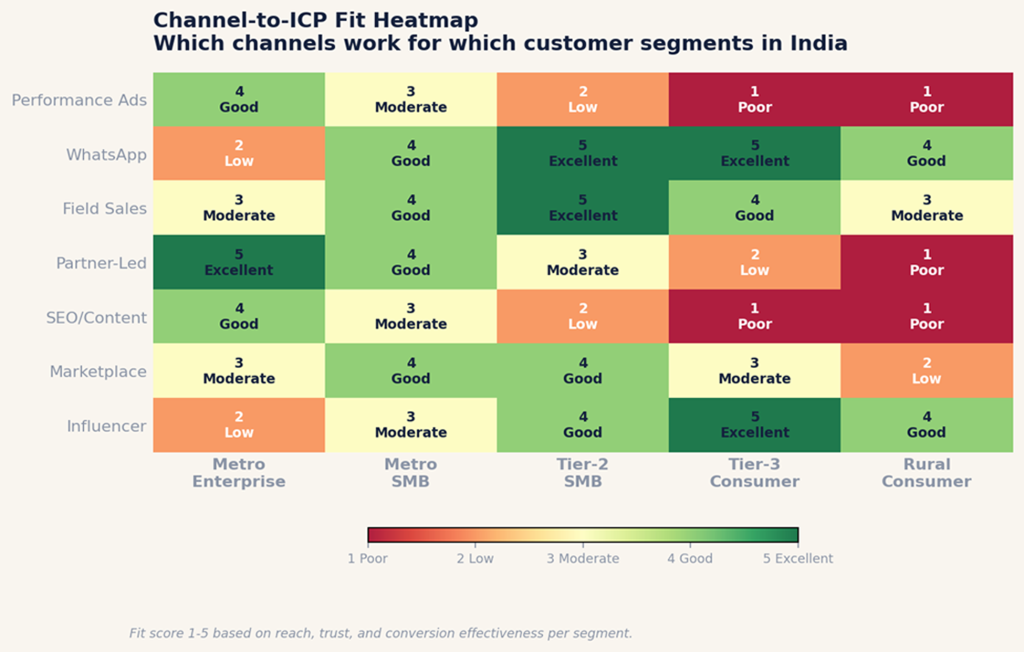
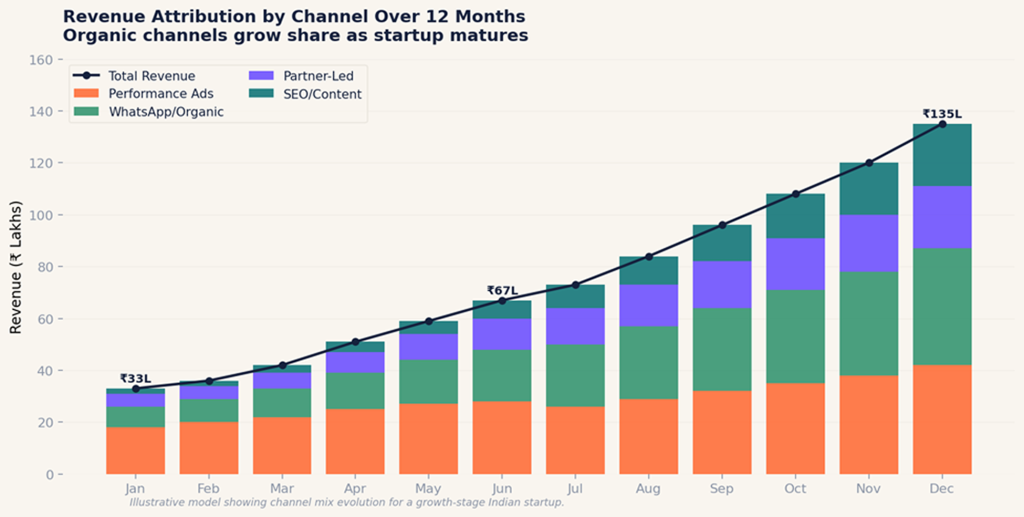
In 2026, effective go-to-market strategies in India blend multiple channels: performance marketing, marketplace distribution, partner-led sales, conversational platforms like WhatsApp, and field sales for high-consideration products.

This guide will help you choose the right mix for your startup and avoid the costly mistakes we’ve seen founders make.

Understanding Your ICP in India’s Diverse Market

Before choosing distribution channels, you must define your Ideal Customer Profile with precision. India isn’t one market, it’s dozens of markets segmented by:

Geography: Metro cities (Delhi, Mumbai, Bangalore) vs tier-2 cities (Jaipur, Kochi, Chandigarh) vs tier-3 towns. Tier 2 and tier 3 cities now account for over 45% of e-commerce growth, but require different acquisition strategies than metros.

Language: English-first vs vernacular-first customers. If your product doesn’t support Hindi, Tamil, Bengali, or other regional languages, you’re cutting off massive addressable markets.

Income Bracket: Premium customers (top 10%) vs mass market (next 40%) vs aspirational users (bottom 50%). Each segment requires different messaging, pricing, and channels.

Digital Maturity: Early adopters comfortable with apps vs late adopters who need hand-holding. WhatsApp is now a primary sales channel for over 50 million Indian SMEs because it meets customers where they already are.

Get specific. “SMBs in India” isn’t an ICP. “10-50 employee NBFC branches in tier-2 cities using legacy accounting software” is.

B2B Channels: Direct Sales, Partnerships, Marketplaces

For B2B startups, the right channel mix depends on deal size, sales complexity, and buyer sophistication.

Direct Sales (Outbound + Inbound)

Best for: ACV above ₹5 lakhs, complex products requiring demos, enterprise customers

Direct sales gives you control and deep customer relationships, but scales slowly. In India, B2B buyers expect relationship-building, don’t just send cold emails. Get warm intros through investors, industry groups, or LinkedIn.

Typical metrics for B2B SMB SaaS in India:

  • 10-15% activation rate from free trial or demo
  • 12-18% trial-to-paid conversion
  • ₹15K-50K CAC for SMB deals

Partner-Led Distribution

Best for: Products that integrate with existing workflows, need local presence, benefit from co-selling

Partner with banks, NBFCs, consulting firms, system integrators, or industry associations to access their customer base. This is particularly effective in fintech, where banks can distribute your product as white-label or co-branded solutions.

The trade-off: Partners take margin (20-40%) and you lose direct customer relationships. But they provide instant credibility and distribution at scale.

Marketplace/Platform Distribution

Best for: Horizontal SaaS tools, products needing quick trust-building

Listing on platforms like AWS Marketplace, Shopify App Store, or Zoho Marketplace can accelerate trust and discovery. Indian SMBs often discover software through these platforms rather than Google search.

B2C Channels: Digital Marketing, Offline, Community-Led Growth

For B2C startups targeting Indian consumers, you need a phygital (physical + digital) approach.

Performance Marketing: The Sequencing Matters

Start with Google Search ads. If users aren’t actively searching for your solution, you likely have a product-market fit problem, not a channel problem. Search validates demand.

Once search is saturated and showing strong ROAS (Return on Ad Spend), layer in Meta (Facebook/Instagram) and social ads to drive awareness. Social ads trigger “branded search”, users see your ad on Instagram, then Google your brand name later. This significantly lowers your blended CAC over time.

For tier-2 and tier-3 cities, consider regional social platforms and YouTube in vernacular languages. Video content performs exceptionally well for product education in markets with lower text literacy.

Offline and Phygital Strategies

Don’t underestimate offline channels in India:

  • Field sales and feet-on-street: For products requiring trust or education, having salespeople visit customers in person still works. This is common in fintech, insurance, and healthcare.
  • Pop-up stores and kiosks: Temporary physical presence in malls or markets can drive app downloads and brand awareness.
  • QR code distribution: Print QR codes on flyers, posters, or product packaging. QR adoption exploded post-COVID and remains a low-friction way to drive downloads.

WhatsApp as a Sales Channel

Over 50 million Indian SMEs use WhatsApp as their primary sales channel. For B2C brands, WhatsApp Business API enables:

  • Abandoned cart recovery
  • Customer support
  • Order updates and delivery notifications
  • Personalized offers

Customers in India prefer WhatsApp over email for brand communication. Meet them there.

Community-Led Growth

Building communities around your product, through Telegram groups, Discord servers, or in-person meetups, creates organic advocates. This works particularly well for:

  • Developer tools (foster open-source communities)
  • Creator economy products (build creator communities)
  • Health and fitness apps (local workout groups)

Community-led growth has high upfront effort but creates defensible, low-CAC acquisition over time.

Hybrid Approaches for India: Phygital Strategies

The most successful Indian startups blend digital and physical:

Swiggy and Zomato combine app-based ordering with hyperlocal delivery infrastructure and offline restaurant partnerships.

Urban Company uses digital booking with on-ground service providers.

Meesho enables social commerce through WhatsApp combined with logistics partnerships.

Think about how your product can bridge online and offline experiences. Can sales happen online but delivery offline? Can discovery happen through influencers but purchase through retail partners?

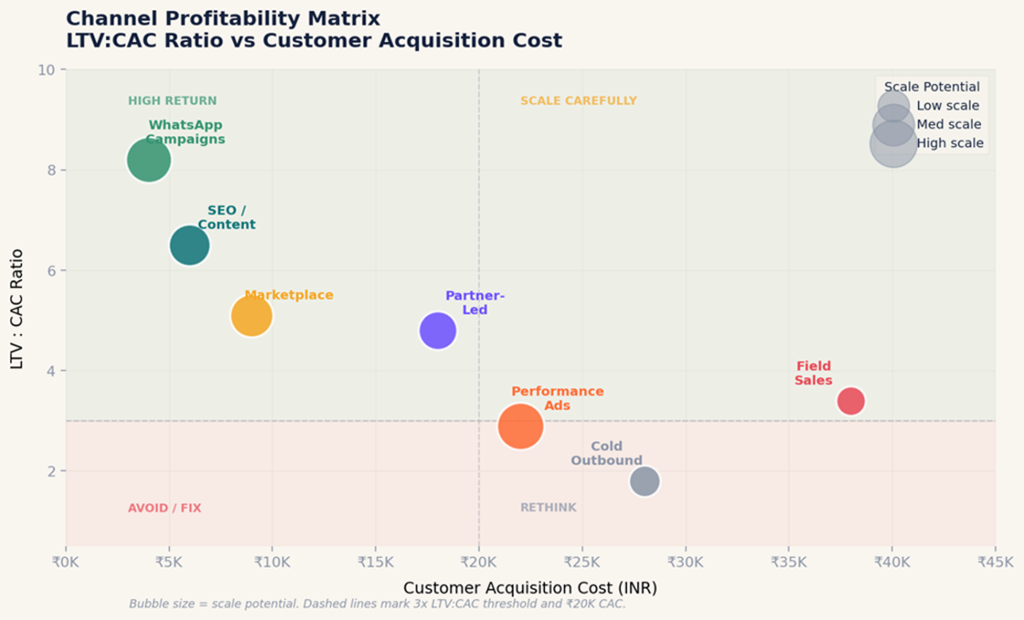
Channel Economics: Which Channels Scale Profitably

Not all channels are created equal. Track these metrics by channel:

CAC (Customer Acquisition Cost): How much does it cost to acquire one customer through this channel?

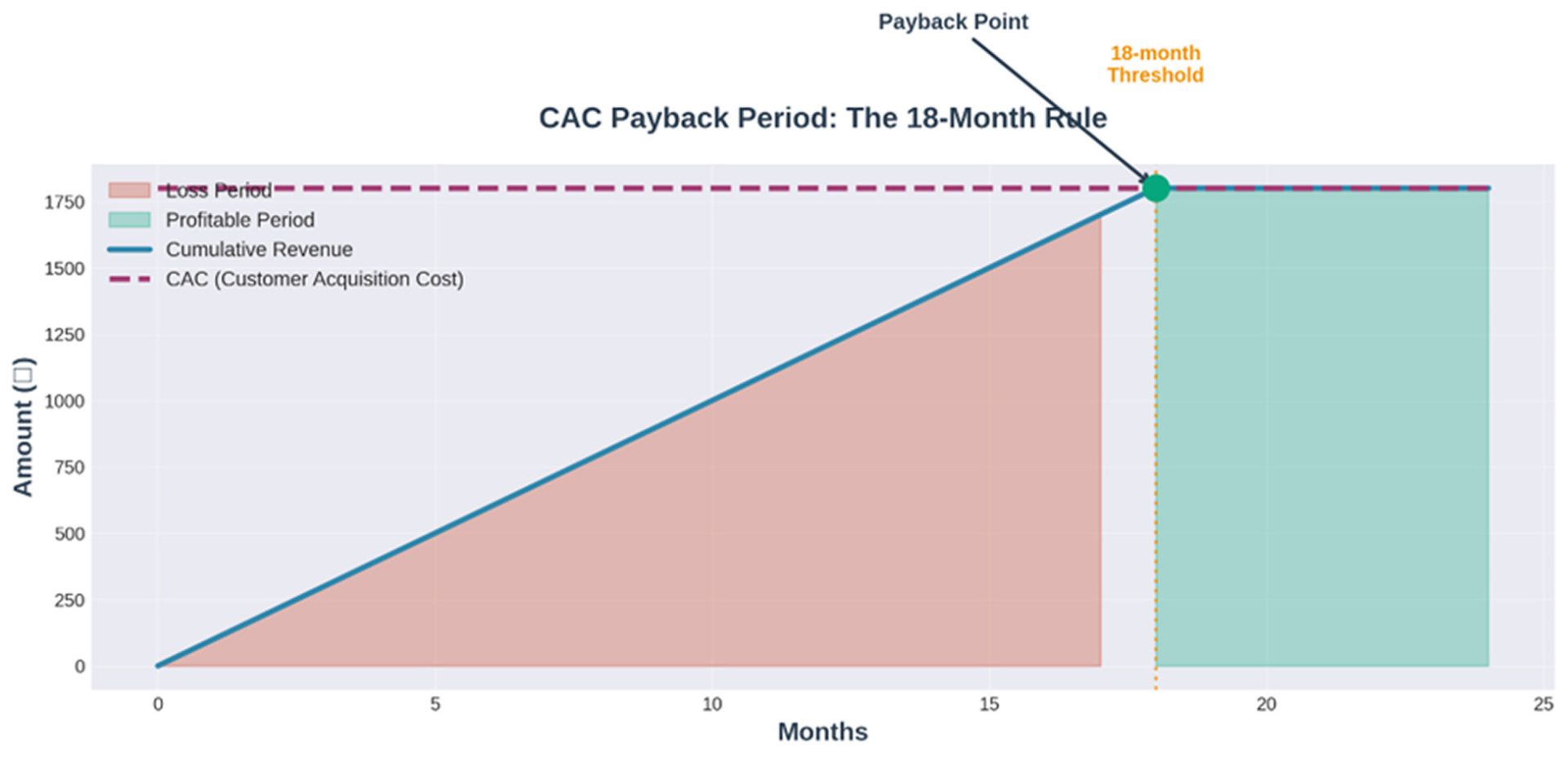
Payback Period: How long until customer revenue covers CAC?

LTV:CAC Ratio: Is this channel generating customers worth 3x+ their acquisition cost?

Scale Potential: Can this channel deliver 100 customers? 1,000? 10,000?

In our experience, Indian founders often make two mistakes:

  1. Sticking with high-CAC channels too long because they were the first to work. If digital ads worked early, don’t assume they’ll scale profitably forever. Test constantly.
  2. Abandoning channels too quickly. Some channels (SEO, content marketing, partnerships) take 6-12 months to show ROI. Don’t kill them after 30 days.

Common GTM Mistakes in Indian Context

1. Going Multi-Channel Too Early

Focus beats spread. Pick 1-2 channels, master them, then expand. Spreading thin across 5 channels simultaneously means you’ll be mediocre at all of them.

2. Ignoring Regional and Language Differences

A campaign that works in Bangalore won’t necessarily work in Lucknow. Localize messaging, creative, and language. Generic, English-only campaigns miss 80% of India.

3. Optimizing for Vanity Metrics

App downloads mean nothing if users don’t activate. Website traffic means nothing if it doesn’t convert. Optimize for revenue and retention, not top-of-funnel metrics.

4.Underestimating Friction

Every form field, every app permission request, every additional step in checkout increases drop-off. Indian consumers are particularly sensitive to friction. Simplify relentlessly.

5. Copying Western Playbooks

What works in the US won’t always work in India. The buyer behavior, price sensitivity, trust dynamics, and infrastructure are fundamentally different. Adapt, don’t copy.

90-Day GTM Experiment Framework

If you’re unsure which channels will work, run structured experiments:

Weeks 1-2: Research and Hypothesis

  • Define your ICP with precision
  • Research where they spend time (platforms, communities, media)
  • Hypothesize 3-4 channels worth testing

Weeks 3-6: Small-Budget Tests

  • Allocate ₹25-50K per channel for initial testing
  • Run ads, partnerships, or campaigns
  • Track CAC, conversion rate, activation rate

Weeks 7-10: Double Down or Kill

  • Kill underperforming channels ruthlessly
  • Double budget on channels showing positive unit economics
  • Optimize creative, messaging, targeting

Weeks 11-12: Scaling Playbook

  • Document what’s working (ICP, messaging, creative, budget allocation)
  • Build repeatable systems to scale the winning channel
  • Prepare to layer in secondary channels

When to Double Down vs Diversify Channels

Double down on a single channel when:

  • You’re seeing consistent ROAS of 3x+ and the channel isn’t saturated
  • CAC is stable or declining as you scale spend
  • You haven’t yet maximized the addressable market in that channel

Diversify to multiple channels when:

  • Your primary channel is saturating (CAC rising, ROAS declining)
  • You want to reduce dependency risk (platform policy changes, competition)
  • You have proven unit economics and can afford to experiment
  • Different customer segments require different channels

The Bottom Line

In 2026, successful Indian startups don’t choose between digital and offline, paid and organic, direct and partner-led. They orchestrate a channel mix optimized for their specific ICP and market. Start narrow. Test rigorously. Scale what works. Kill what doesn’t.

The right distribution channel can turn a mediocre product into a market leader. The wrong channel strategy can kill a great product.

Distribution isn’t just about getting customers, it’s about getting the right customers, cost-effectively, repeatably.

Build the product. Then build the distribution machine. In India’s crowded, competitive market, the better distribution system wins.

Product-Market Fit in India: Signs You’ve Found It

Product-market fit is the most talked-about, least understood milestone in a startup’s journey.

Founders claim they have it when they see their first spike in signups. Investors doubt it until they see retention curves flatten. And everyone agrees it’s critical, but few can articulate exactly what it looks and feels like.

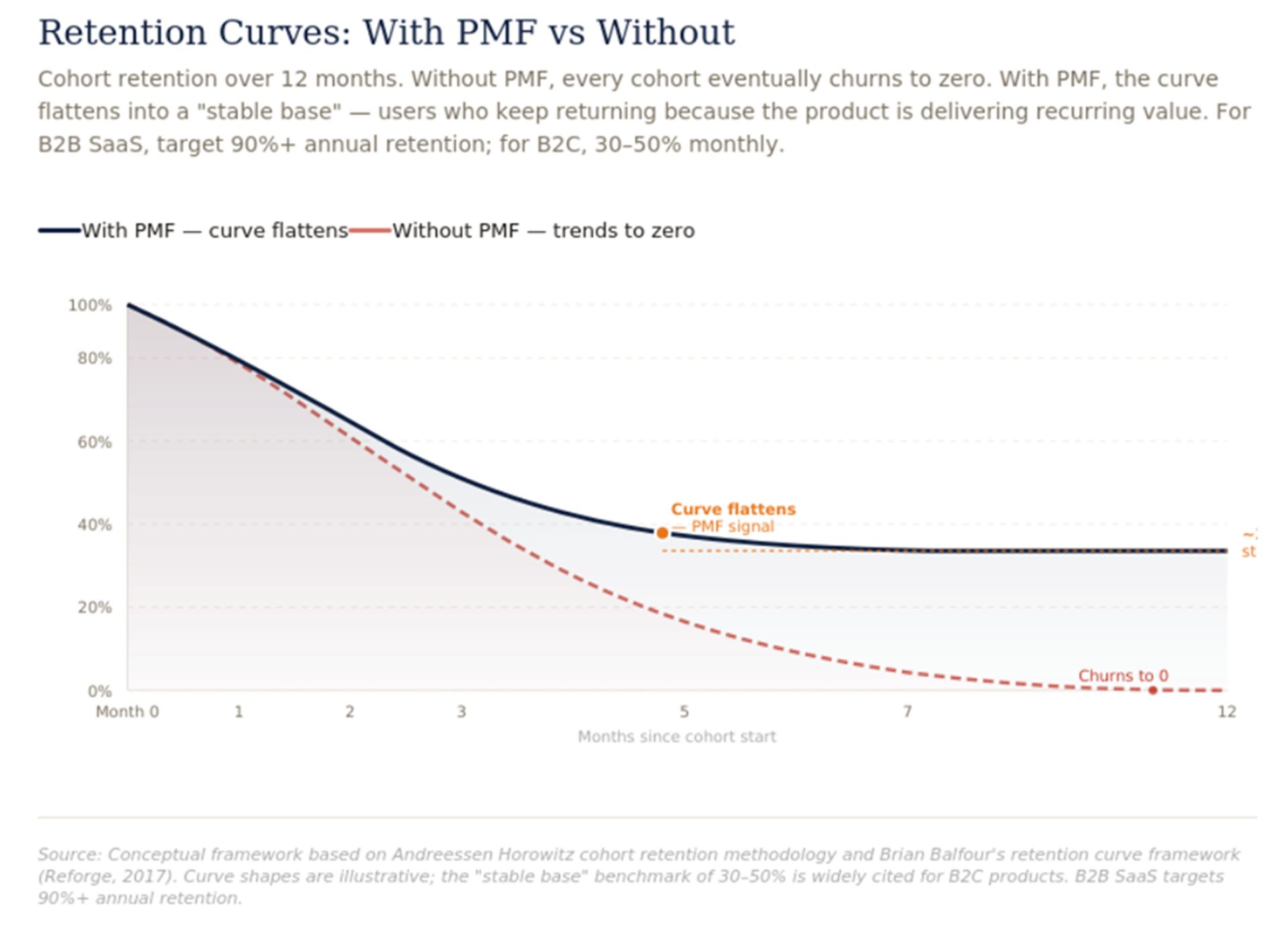
Here’s the truth: In 2026, retention is the ultimate validator of product-market fit. In a product with PMF, the retention curve flattens out at 20%, 30%, or 50%, meaning you have a “stable base” of users who find recurring value, month after month.

This guide will help you understand what PMF actually means in the Indian context, how to measure it, and what to do once you’ve found it.

What PMF Actually Means (Beyond Vanity Metrics)

Product-market fit means being in a good market with a product that can satisfy that market.

More specifically, it’s when:

  • Customers actively seek out your product (pull, not push)
  • They keep using it without constant nudging (retention)
  • They tell others about it organically (word-of-mouth)
  • They’d be very disappointed if it disappeared tomorrow

PMF is not:

  • 10,000 signups from a viral campaign that churns within a month
  • High engagement that doesn’t translate to paying customers
  • Great press coverage that doesn’t drive sustainable growth
  • One customer segment loving you while others churn

In India’s diverse market, PMF often looks different across customer segments, geographies, and use cases. You might have PMF with SMBs in Bangalore but not with enterprises in Mumbai. You might have it for one use case but not adjacent ones. This nuance matters.

Quantitative Signals: The Metrics That Matter

1. The 40% Benchmark

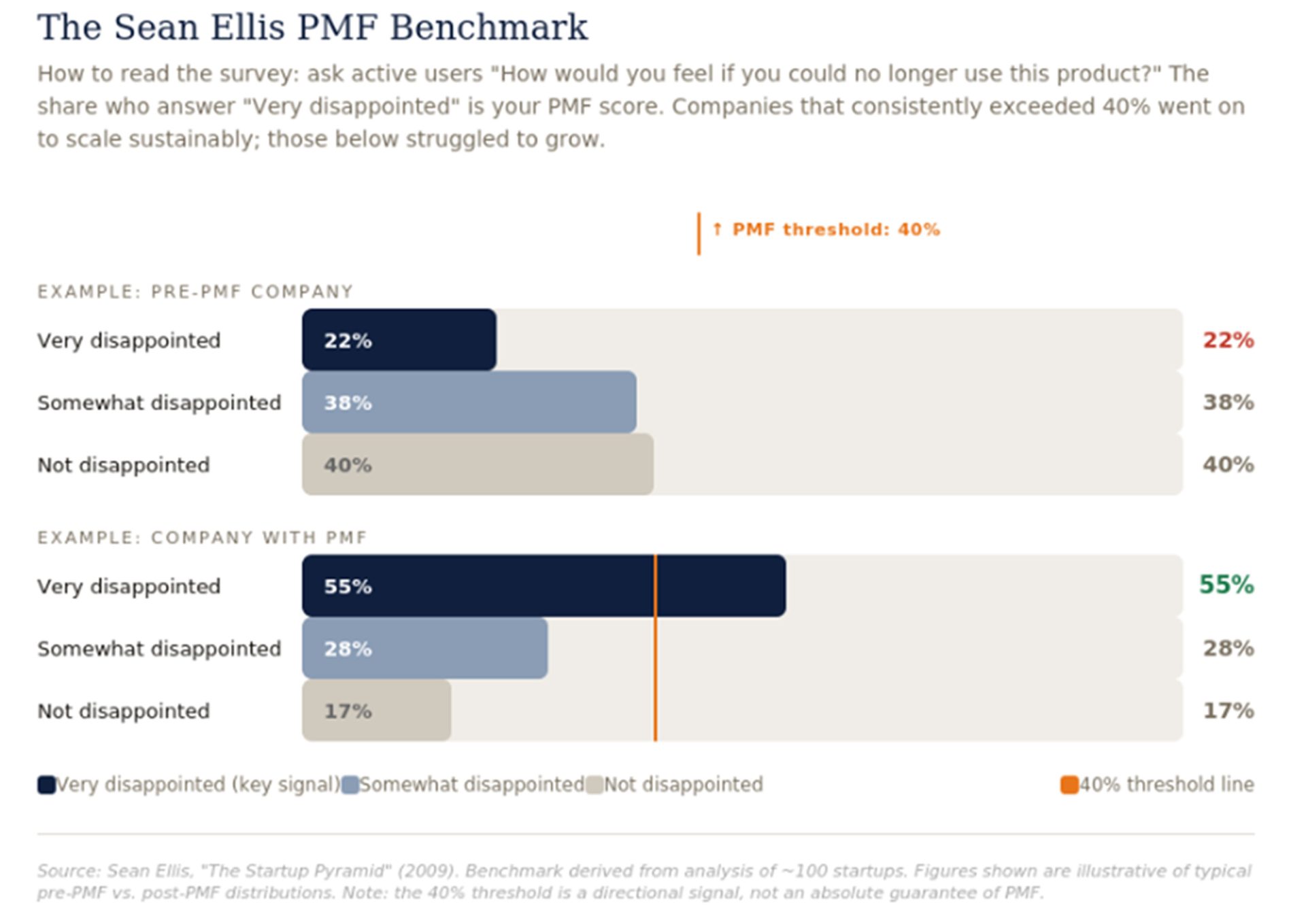
The most cited PMF test comes from Sean Ellis: Survey your active users and ask, “How would you feel if you could no longer use this product?”

If 40% or more answer “very disappointed,” you’ve likely found product-market fit. Below 40%, you’re still searching.

We’ve used this test with portfolio companies, and it’s remarkably predictive. Companies above 40% go on to scale sustainably. Those below struggle to retain customers despite aggressive growth tactics.

2. Retention Curves That Flatten

Watch your cohort retention curves closely. In the early days, you’ll see retention curves that slope down to zero, meaning every cohort eventually churns completely.

Product-market fit happens when retention curves flatten. Instead of trending to zero, they stabilize at 20-50%. This “stable base” of users signals you’re delivering recurring value.

For B2B SaaS in India, look for 90%+ annual retention. For B2C products, aim for 30-40% monthly retention or higher, depending on your category.

3. Organic Growth Surpassing Paid

When product-market fit kicks in, your customer acquisition mix shifts. Organic channels; word-of-mouth, referrals, direct traffic, content, start contributing more than paid acquisition.

If you’re still dependent on paid ads for 80%+ of growth, you haven’t found PMF yet. The product isn’t good enough to sell itself.

4. Customer Retention Rate (CRR) Trending Up

Track the percentage of customers continuing to use your product over time. CRR should improve as you:

  • Better understand your ICP (Ideal Customer Profile)
  • Improve onboarding and activation
  • Build features that solve core pain points

Rising CRR is one of the clearest signals of PMF. Flat or declining CRR means you’re acquiring the wrong customers or solving the wrong problems.

5. NPS (Net Promoter Score) Above 50

While NPS isn’t perfect, it’s a useful proxy for word-of-mouth potential. In India, we’ve seen successful startups achieve NPS scores of 50-70 once they hit PMF.

Below 30, you have work to do. Between 30-50, you’re getting closer. Above 50, customers are actively promoting you.

Qualitative Signals: What Customers Say and Do

Numbers tell you that you have PMF. Qualitative signals tell you why.

1. Customers Use Their Own Language

When customers describe your product in their own words, not your marketing copy, you know it’s resonating. Listen to sales calls and customer interviews. If they’re repeating your value prop verbatim, they don’t truly get it. If they’re explaining it in simpler, more personal terms, you’re onto something.

2. They Keep Coming Back Without Prompting

PMF feels like pull, not push. You’re not constantly sending emails to drive engagement. Customers log in daily (or weekly) without reminders because they need your product to do their jobs or live their lives.

3. Word-of-Mouth Is Happening Organically

You overhear customers recommending you in communities. You get inbound inquiries from people who heard about you from existing users. Your customer referral rate is above 20-30%.

Razorpay, one of India’s fintech success stories, knew they had PMF when merchants started moving their entire transaction volume to Razorpay and adopting additional products without the sales team pushing them. That’s the gold standard.

4. Customers Resist Alternatives

When competitors approach your customers or free alternatives exist, your customers stay. They’re not just using your product, they’re committed to it. Switching costs may be low, but they don’t switch.

India-Specific PMF Considerations

India’s market presents unique challenges and opportunities for identifying PMF:

1. Market Diversity

India isn’t one market, it’s 20+ markets. PMF in Delhi might not translate to Bangalore or tier-2 cities. Language, income levels, internet penetration, and cultural preferences vary dramatically.

When evaluating PMF, segment by:

  • Geography (metro vs tier-2/3)
  • Language preference
  • Income bracket / customer segment
  • Industry vertical (for B2B)

You may have PMF in one segment and no PMF in another. Be precise about where you’ve found it.

2. Pricing Sensitivity

India’s price sensitivity can mask or reveal PMF. A product with great engagement but low willingness to pay might not have true PMF, users like it, but not enough to spend money.

Conversely, if customers pay despite a subpar experience because no good alternatives exist, you have a market need but not yet PMF. Sustainable PMF requires both usage AND monetization.

3. Mobile-First Behavior

In India, most digital experiences happen on mobile, often on lower-end devices with spotty connectivity. If your product doesn’t work seamlessly on mobile or requires high bandwidth, you’ll struggle to achieve PMF outside of tier-1 cities.

4. Trust and Brand Matter More

Indian customers often need more social proof before adopting new products. Word-of-mouth, testimonials, and brand recognition accelerate PMF. That’s why many Indian startups invest heavily in marketing even pre-PMF, it builds the trust required for adoption.

What Founders Get Wrong About PMF

1. Confusing Growth with PMF

A viral moment or successful marketing campaign can create a spike in signups that looks like PMF. But if those users don’t stick around, it’s just noise. PMF is about retention, not acquisition.

2. Declaring PMF Too Early

Founders often declare PMF after their first few happy customers. But 10 happy customers isn’t PMF, it’s customer validation. PMF requires repeatability and scale. Can you acquire 100, 1000, 10,000 customers with the same value proposition?

3. Assuming PMF Is Permanent

Markets shift. Competitors emerge. Customer needs evolve. PMF is not a one-time achievement, it’s an ongoing state that requires constant attention. You can lose PMF if you stop listening to customers or get complacent.

4. Optimizing Too Early

Some founders start optimizing funnels and growth loops before they have PMF. This is premature. First, find the core value. Then, optimize delivery of that value. Polishing a product no one truly needs is wasted effort.

When to Pivot vs Persevere

If you’ve been iterating for 12-18 months and still don’t see PMF signals, it’s time to ask hard questions:

Pivot when:

  • Retention curves aren’t flattening despite multiple iterations
  • Customers keep churning for the same core reasons
  • You’re unable to articulate a clear, differentiated value prop
  • Market feedback tells you there’s no urgent pain point

Persevere when:

  • You see pockets of strong retention in specific segments (double down there)
  • Qualitative feedback is positive, but product execution is lacking
  • The market is real, but you haven’t found the right positioning yet
  • A few customers are deeply engaged and expanding usage

The data will tell you, but only if you’re honest about interpreting it.

Scaling Playbook Once You Have PMF

Congratulations! You’ve found PMF. Now what?

1. Document What’s Working

Before you scale, codify exactly why customers choose you, how they use you, and which segments convert and retain best. This becomes your growth playbook.

2. Invest in Distribution

With PMF, distribution is the unlock. Double down on channels that work. Hire sales and marketing talent. Build partnerships. Product-market fit gives you permission to pour fuel on the fire.

3. Expand Within Your ICP

Scale within your Ideal Customer Profile before expanding to adjacent segments. Go deeper in what’s working before going wider.

4. Build the Team for Scale

Your scrappy, generalist team got you to PMF. Now you need specialists; sales leaders, demand gen experts, customer success managers, to scale efficiently.

5. Raise Capital with Confidence

Investors write checks for PMF. If you can demonstrate strong retention, organic growth, and clear unit economics, fundraising becomes significantly easier. Now is the time to raise for growth.

The Bottom Line

Product-market fit isn’t a moment, it’s a state. And in India’s complex, diverse market, it rarely looks the same for any two companies.

Stop chasing vanity metrics. Focus on retention curves, customer language, and organic growth. If 40% of your active users would be “very disappointed” without your product, and your retention curves are flattening, you’re there.

Once you have it, move fast. PMF opens a window of opportunity to scale before competitors catch up or market dynamics shift.

But until you have it, resist the urge to scale. Fix the product. Talk to customers. Iterate ruthlessly. Everything else is a distraction.

Unit Economics for Indian Startups: When to Prioritize Profitability vs Growth

The Indian startup ecosystem has undergone a dramatic shift. In 2026, profitability and unit economics are no longer optimization goals, they’re the price of entry for capital. Over one-third of Indian startups chose profitability and runway extension over fundraising in 2025, signaling a fundamental behavioral change in how founders build companies.

But here’s the challenge: knowing when to prioritize profitability versus growth isn’t always clear-cut. Push too hard on growth, and you might burn through cash before finding sustainable economics. Focus too early on profitability, and you could miss a critical window to capture market share.

This guide will help you navigate that decision with clarity.

Understanding Unit Economics: The Fundamentals

Before deciding between profitability and growth, you need to understand what unit economics India actually means for your business.

Customer Acquisition Cost (CAC): The total cost to acquire one paying customer, including marketing spend, sales team costs, and tools. In India, CAC can vary dramatically by channel—digital ads in metro cities cost significantly more than community-led acquisition in tier-2 towns.

Lifetime Value (LTV): The total revenue you expect from a customer over their relationship with your company. In India’s price-sensitive market, LTV calculations need to account for higher churn rates and lower ARPU (Average Revenue Per User) compared to Western markets.

Contribution Margin: Revenue per customer minus variable costs. This tells you if each sale actually makes you money before accounting for fixed costs.

The golden ratio that investors typically look for is an LTV:CAC ratio of 3:1; meaning you make 3x what you spent to acquire a customer. In our experience working with Indian startups, achieving this ratio often takes longer than founders expect, especially in B2C businesses targeting mass-market customers.

The 2026 Reality: Profitability Is No Longer Optional

The funding environment has fundamentally changed. Startup funding in India for 2026 is projected to remain at $11.5-13.8 billion, closer to 2019-20 levels than the 2021 peak. What does this mean for you?

Investors are now emphasizing governance, unit economics, and a real path to profitability over “growth at any cost.” Founders who can demonstrate capital efficiency and disciplined CAC/LTV ratios are finding it easier to raise capital.

This doesn’t mean growth is dead. It means undisciplined growth is dead.

When to Prioritize Profitability: The Framework

You should prioritize profitability when:

  1. Your market is mature and competitive
    If you’re entering a crowded space where customer switching costs are low, sustainable unit economics matter more than land-grab tactics. We’ve seen startups in fintech and edtech learn this the hard way, burning capital to acquire customers who churn quickly destroys value.
  2. Your CAC payback period exceeds 18 months
    If it takes more than 18 months to recover your customer acquisition cost, you’re essentially funding your customers’ use of your product. In India’s current funding climate, that’s a dangerous position. Focus on improving conversion rates and reducing acquisition costs before scaling.

  1. You’re in a B2B SaaS business
    B2B businesses in India typically benefit more from sustainable growth. The sales cycles are already long, and customers expect established, reliable vendors. Demonstrating profitability builds trust and makes renewals easier.
  2. Your market size is uncertain
    If you’re still validating whether a large enough market exists, profitable growth lets you extend runway and gather more data without constantly fundraising. This is particularly relevant for startups targeting tier-2 and tier-3 cities where market behavior is less understood.

When Blitzscaling Makes Sense in India

You should prioritize growth over profitability when:

  1. Winner-takes-most market dynamics exist
    In categories with strong network effects (marketplaces, social platforms, certain fintech categories), early market share compounds into defensibility. If being #1 vs #3 means 10x the enterprise value, aggressive growth makes sense, provided you can demonstrate improving unit economics over time.
  2. You have true product-market fit with proven retention
    If your organic retention is above 80% monthly (for consumer) or above 90% annually (for B2B), and customers are actively referring others, you’ve earned the right to pour fuel on the fire. The key phrase is “earned the right”, don’t confuse early enthusiasm with true PMF.
  3. A funded competitor is growing aggressively
    Sometimes the market forces your hand. If a well-funded competitor is capturing share and building switching costs, you may need to match their aggression. However, we’ve seen this rationale abused to justify undisciplined spending. Ask yourself: are you responding to a real competitive threat or using competition as an excuse to avoid hard unit economics work?
  4. You’re in a “Bharat-first” or underserved category
    For founders building for India’s mass market; regional content, credit for underbanked, agritech, the playbook is different. CAC, LTV, and payback periods look very different in these models, and that difference can be a competitive advantage. Early investment in customer education and ecosystem building can create long-term moats.

The Hybrid Approach: Profitable Growth

The best Indian startups in 2026 aren’t choosing between profitability and growth, they’re achieving both. Here’s how:

Segment your customer base: Identify which customer segments have the best unit economics and focus acquisition efforts there. Use learnings from profitable segments to improve economics in others.

Optimize by channel: Not all acquisition channels are created equal. We’ve seen startups cut CAC by 60% by shifting from paid digital ads to community-led growth or strategic partnerships. Test ruthlessly and double down on what works.

Improve retention before acquisition: A 5% improvement in retention can increase profits by 25-95%. In India’s price-sensitive market, retention is often the unlock for sustainable growth. Focus on activation, engagement, and value delivery.

Build in revenue milestones: Set clear revenue milestones ($100K ARR, $1M ARR) where you pause to evaluate and improve unit economics before scaling further. This disciplined approach prevents you from scaling broken economics.

Metrics to Track Monthly

Create a simple dashboard and review these metrics monthly:

  • CAC by channel: Where are you acquiring customers most efficiently?
  • LTV:CAC ratio: Are you maintaining at least 3:1?
  • CAC payback period: How many months to recover acquisition cost?
  • Gross margin: Are you making money on each transaction?
  • Net revenue retention: Are existing customers expanding their spend?
  • Burn multiple: How much are you burning for each dollar of new ARR?

The Bottom Line

In 2026’s funding environment, Indian startups must demonstrate both growth and a path to profitability. The days of “we’ll figure out monetization later” are over.

Start with honest unit economics. If your LTV:CAC ratio isn’t trending toward 3:1, or if your payback period exceeds 18 months, growth will only accelerate your path to failure. Fix the fundamentals first.

But if you have genuine product-market fit, strong retention, and improving economics, don’t be overly conservative. Strategic growth investment, when backed by data, can compound into category leadership.

The question isn’t profitability OR growth. It’s profitability AND growth, in the right sequence, with the right discipline.