What To Build: AI Infra

AI infra as a category tends to get collapsed into three things: foundation models, GPU clouds, and Nvidia. At that layer of the stack (the largest models, hyperscaler compute, the biggest inference platforms), capital and scale do decide the outcome. The players are largely set. It is a hard place for a small team to find a wedge, and that is a fair reading.

Most AI builders, though, spend their day one layer down. In the collection of developer tools, orchestration primitives, observability platforms, evals, and vertical infra that lets them actually build with foundation models rather than just call them. That layer is where the durable software businesses are being built, and it is not concentrated. Teams that ship well-designed developer tools with tight product loops, sharp positioning, and fast iteration are winning meaningful market share. Braintrust reached an 800 million dollar valuation on 120 million dollars raised. Dash0 crossed a billion dollar valuation with 110 million raised, defining AI-native observability as a category. Langfuse was acquired by ClickHouse in January 2026 for what most funds would call a strong outcome. Temporal, a durable-execution primitive, hit a 5 billion dollar valuation on a Series D that closed in February 2026.

None of these companies built a foundation model. Every one of them built a piece of the plumbing that people who build with foundation models cannot function without.

That is the map. India in 2026 has a specific opening in it. The IndiaAI Mission is running 34,000 subsidised GPUs at 150 rupees per hour for startups. Sarvam open-sourced 30B and 105B sovereign models in February. Krutrim crossed 300 crore in FY26 revenue and hit its first annual net profit. Q1 2026 alone brought 3.94 billion dollars of AI funding into Indian startups, roughly six times all of 2025, minting two new AI unicorns in four months. And underneath all of this, a generation of Indian infra engineers who spent the last decade building the payments, streaming, and observability infrastructure of the world is now free to build for AI natively.

The ideas below are the layer of AI infra we think is most buildable in 2026, from India, in a way that a small disciplined team can win. Most of them travel globally. A handful are India-specific because a regulatory or linguistic wedge creates a moat that global players cannot easily copy. All of them share one property: the winners will be developer-love companies, not compute-scale companies.

If you are building one of the twenty below, or a sharper version of one, come talk to us.


1. The India inference cloud

Every foundation model provider (OpenAI, Anthropic, Google, Meta) hosts inference in United States or European data centres. Indian enterprises, particularly in BFSI, government, healthcare, and telecommunications, are under increasing pressure from DPDPA, RBI, IRDAI, and internal risk teams to keep sensitive workloads onshore. The Indian government’s own AI adoption is contingent on sovereign hosting. Neysa is proving early enterprise demand. Yotta, ESDS, and Krutrim are building capacity. But the software layer, an inference platform that behaves like an API to a developer while running physically inside India, is still under-built.

Build an inference cloud designed for the Indian enterprise buyer. Support open-source models (Llama, Sarvam, Krutrim, Mistral) plus a curated set of proprietary alternatives via passthrough. Physical hosting inside Indian data centres with clear DPDPA-compliant data flows. Pricing that undercuts global providers by 30 to 40 percent on the models where hosting matters. SDK that is a drop-in replacement for the OpenAI SDK so developers can switch with a single line change.

Why now: DPDPA rules mature through 2026. RBI’s data residency guidance for BFSI tightened in 2025. IndiaAI Mission subsidises the underlying GPU cost.

Who wins: a founder with real cloud infra credibility (ex-AWS, ex-Google Cloud, ex-Nvidia) paired with an enterprise sales operator who has closed regulated buyers in India.

Watch-outs: this is a capital-intensive business at scale. The seed and Series A can be done leanly, but Series B onwards requires access to GPU financing that few Indian funds are set up for. Have that conversation with your syndicate early.

2. The Indic application layer

Sarvam, Krutrim, AI4Bharat, and a handful of others have delivered foundation model capability in Indian languages. What is missing is the application-ready layer above them: a set of building blocks that any developer can use to add fluent Indian-language capability to a product without training or fine-tuning a model themselves.

Build the Indic application layer. Speech-to-text and text-to-speech APIs across the 22 scheduled Indian languages, priced per minute, with SDKs and clear latency guarantees. Multilingual embeddings tuned for retrieval across code-switched Hindi-English or Tamil-English content. Translation and transliteration primitives that handle Indic idiom, not literal word-for-word. Prebuilt agent skills for the most common Indian workflows (KYC, appointment booking, GST invoice generation, insurance policy explanation).

Why now: Sarvam Bulbul V3 crossed acceptable voice quality in early 2026. Sarvam Audio’s ASR now covers 22 Indian languages. Developer demand for a “just work” Indic layer has crossed a threshold where a well-designed platform can consolidate.

Who wins: a founder with speech or NLP research depth paired with a strong developer-product founder. This is a product-led-growth business, so the developer experience is the entire moat.

Watch-outs: Sarvam and Krutrim are natural competitors here and have the underlying model advantage. Your wedge is the developer surface, the documentation, the reliability, the pricing predictability, and the specific application skills. Compete on those, not on model claims.

3. The production agent runtime

Every fund’s inbox in 2026 has a deck for an agent framework. Most of the current tools are optimised for prototyping and demos, which is a different job from running the same workflow reliably in production. The layer developers need in production, a durable execution runtime that handles retries, state, human-in-the-loop, tool calls, and long-running workflows without falling over, is a category the current leaders (LangChain, LlamaIndex, CrewAI) are still working through. Temporal is doing 5 billion dollar business with durable execution, but Temporal was not designed for LLM workflows.

Build an agent runtime that is native to LLM workflows and durable to production reality. Handles a 40 minute agent conversation that pauses for human input, resumes after a system restart, retries a failed tool call, and produces an auditable trace. Written in a language and paradigm that Indian and global infra engineers already know (Python, TypeScript, Go). Priced predictably, not as a mystery-box cloud service.

Why now: enterprise deployment of agents crossed the pilot-to-production threshold in early 2026. Agent teams that started with earlier-generation prototyping frameworks are actively looking for tools designed around production reality.

Who wins: a founder pair from a distributed systems background (ex-Uber, ex-Netflix, ex-Google infra) plus a developer relations leader with real audience in the AI dev community.

Watch-outs: this category will consolidate. The teams that ship best-in-class in 12 months and land 20 to 50 serious production deployments will win. Slower teams will end up as features inside larger platforms.

4. AI observability and traces

Datadog, New Relic, and Grafana solved observability for microservices. They have not solved observability for AI systems. An agent that calls a model that calls a tool that calls another model that calls a database and returns a hallucinated answer needs a different kind of trace than a REST call graph. Dash0’s billion-dollar valuation shows the market is real; the category is not solved.

Build an AI-native observability platform. Trace the full agent flow from user prompt to final response, including every intermediate LLM call, tool invocation, retrieval, and evaluation. Cost attribution per user, per feature, per agent. Latency debugging that understands where the time actually went. Drift detection for model outputs. Alerting for hallucinations and regressions caught by evals.

Why now: agent deployments are now large enough to justify a dedicated observability spend. Datadog and Grafana are moving into this space but are architecturally constrained by their existing metric-first designs.

Who wins: a founder from a serious observability company (ex-Datadog, ex-Splunk, ex-Grafana) paired with a strong AI systems engineer.

Watch-outs: build the pricing carefully. Metric-volume-based pricing punishes users at scale. Session-based or ingest-flat pricing is the design that keeps large customers happy.

5. Evals as a service

Braintrust’s 800 million dollar valuation on 120 million raised is the clearest signal in the category. Evals are the discipline that separates production AI from demoware, and every AI team eventually gets religion about them. The tooling is still nascent. There is space for a second and third entrant with sharper positioning, better developer experience, or India-specific pricing.

Build an evals platform. A CI-compatible workflow that runs regression, prompt experiments, and canary evals on every deploy. Judge models that are cheaper than GPT-4 class comparisons. Dataset management with human review workflows. Task-specific eval suites for common patterns (RAG, agents, extraction, summarisation, code generation). Integration into the major agent runtimes and CI systems.

Why now: enterprises are moving beyond “the model looks good” to “we can prove regression across 500 evals before every release.” The teams that formalise this discipline are pulling ahead of teams that don’t.

Who wins: an ML researcher or MLE with production experience, paired with a strong developer-tools product person. Developer experience is the entire moat.

Watch-outs: Braintrust, Langsmith, and Weights and Biases will be entrenched. Your wedge is a specific customer segment underserved by them (India enterprise, specific verticals, or specific eval methodologies) plus better pricing.

6. Vector database for the enterprise

Pinecone, Weaviate, LanceDB, Qdrant, and Chroma have battled for the vector database category over the last three years. Most of the winning has happened at the cloud-hosted, developer-first end of the market. The enterprise end, where the customer needs on-premise or hybrid deployment, DPDPA-compliant hosting, and integration with existing data platforms, is under-served.

Build a vector database designed for the Indian and global enterprise. On-premise or hybrid deployment as a first-class option. High-availability, replication, and backup that a bank or a large enterprise CIO recognises. Integration with existing data warehouses (Snowflake, Databricks, BigQuery). Query optimisation for the specific workloads Indian enterprises are running (multilingual retrieval, compliance-heavy search, RAG over policy documents).

Why now: RAG is now a routine deployment inside enterprises. The cloud-only vector DB is a non-starter for a growing set of buyers. The gap is not filled.

Who wins: a founder pair with one deep database systems engineer (someone who has built a real database) and one enterprise sales leader who can move a big-bank procurement cycle.

Watch-outs: Postgres with pgvector is genuinely good and free. Your product has to be 10 times better on the specific workload the enterprise cares about, or you lose to “just use Postgres.”

7. The prompt engineering platform

Every AI team of more than five people ends up building a home-grown prompt management system: a Notion doc, a Google Sheet, a git repo, sometimes a small internal tool. All of them are inadequate. Version control for prompts, A/B testing across models, team collaboration, and safe deployment are not solved anywhere in a production-grade way.

Build a prompt engineering platform. Git-like versioning of prompts, treat prompts as first-class artifacts. Deploy prompts independent of code deploys. A/B test prompts across model providers with statistical rigour. Team collaboration with role-based access. Integration with evals so a prompt change triggers the regression suite. Priced per seat, not per token.

Why now: every AI application team has felt the pain. The winning tool will consolidate the market fast because switching costs are low and network effects around prompt libraries are real.

Who wins: a founder from a developer platforms background (ex-GitHub, ex-Vercel, ex-Notion) paired with a strong AI application engineer.

Watch-outs: this is a feature many observability and eval platforms will bolt on. Your durability comes from being the developer’s daily tool, not the platform team’s dashboard.

8. Data labelling and RLHF as a service

Scale AI, Surge, and Labelbox have proven the market. India has been the physical labelling supply for a decade already, quietly. The opportunity in 2026 is to build the software layer on top of that supply, capturing more of the value chain, and to serve the emerging RLHF and RLAIF workloads that require both scale and quality of judgement.

Build a data labelling and RLHF platform. A trained workforce inside India, but a software layer that serves global AI companies with the workflows, quality assurance, and delivery guarantees they need. Specialised skills (medical annotation, legal, financial, code, multilingual) at global-competitive pricing. Integration into the customer’s training pipeline. Reputation-based reviewer pools rather than gig-worker roulette.

Why now: RLHF and RLAIF have replaced supervised fine-tuning as the dominant training paradigm. The demand for high-quality judgement labels is at an all-time high. Scale AI’s Meta deal in 2024 reset the category’s pricing, opening space for a well-run competitor.

Who wins: an operator with real labelling operations experience plus a strong software founder. This is a business that has to run both a workforce and a platform well.

Watch-outs: quality is the entire business. One bad delivery to a serious customer damages the brand for years. Build the quality process before the sales process.

9. Synthetic data generation

Training data is the most expensive input to an AI company. Real data has legal, privacy, and volume constraints. Synthetic data (LLM-generated or simulation-based) is now credible enough for many use cases, particularly in verticals where real data is scarce or protected (healthcare, financial, autonomous systems). The market has a handful of players (Gretel, Mostly AI, Tonic) and space for more.

Build a synthetic data platform. Generate structured tabular data that matches production statistical properties. Generate document, image, and multimodal synthetic samples for training. Handle the privacy proofs (differential privacy, k-anonymity) that regulated buyers require. Serve specific verticals (financial services, healthcare, autonomous driving) with pre-built pipelines.

Why now: LLM quality is finally good enough to generate synthetic training data that improves rather than harms downstream model performance. Enterprise buyers are actively asking for it as a compliance-friendly alternative to production data.

Who wins: an ML researcher with real training pipeline experience, plus a founder who understands the specific compliance and privacy requirements of the target vertical.

Watch-outs: generic synthetic data is a race to the bottom. Vertical-specific synthetic data with real quality guarantees is a business.

10. DPDPA and PII compliance for AI pipelines

The Digital Personal Data Protection Act came into force in 2024 and its penalties regime is coming into effect in 2026. Every AI application in India that touches user data will need clear consent flows, purpose limitation, right-to-erasure, and audit trails. Global AI application companies also need PII redaction and privacy compliance layers to serve regulated customers. The category exists in the US (Skyflow, Privado, Piiano) and is under-built in India.

Build a data privacy and compliance layer for AI. PII detection and redaction that works in Indian languages (a real gap in existing tools). Purpose-limited data pipelines. Consent management with ABDM-style granularity. Model input and output filtering for confidential information. Auditable data flows for DPDPA compliance officers. Sold to CTOs and CISOs at Indian enterprises and to compliance officers at global AI companies serving Indian users.

Why now: DPDPA penalties activate in 2026. Every serious Indian enterprise CIO has this on their 2026 roadmap.

Who wins: a founder with real privacy or security background plus a strong enterprise sales operator. Compliance sales are relationship-heavy and slow; plan for it.

Watch-outs: do not sell fear. Compliance products that lead with fear-of-fines earn short pilots and lose renewals. Sell operational efficiency alongside compliance and the customer stays.

11. AI security and prompt injection defense

Prompt injection, model jailbreaks, and data exfiltration through AI systems are now real production security concerns. The category has emerging players (Prompt Armor, Lakera, Robust Intelligence, HiddenLayer) but is a long way from mature. Enterprise buyers know they need something in this space and do not know what to buy.

Build an AI security platform. Runtime prompt injection detection. Output filtering for confidential data leakage. Red-teaming as a service, both automated and human-in-the-loop. Model behaviour monitoring for drift and jailbreak attempts. Integration into the enterprise’s existing security stack (SIEM, SOC tools). Sold to CISOs.

Why now: agent-driven autonomy is expanding the attack surface. High-profile prompt injection incidents in 2025 raised board-level awareness. CISOs are budgeting for AI security in 2026 CIO plans.

Who wins: an application security veteran (ex-CrowdStrike, ex-Cloudflare, ex-Wiz) plus a strong AI systems engineer.

Watch-outs: this is a category where the buyer is often skeptical of vendor claims. Build public benchmarks and be willing to be tested. Overpromising once is a career-ending mistake with CISOs.

12. AI FinOps

Every AI-first company past a Series A has a spreadsheet somewhere that tries to track token costs across OpenAI, Anthropic, Google, and open-source hosted alternatives. That spreadsheet is always out of date and always missing at least one line item. FinOps for tokens is a category the market is quietly asking for.

Build an AI FinOps platform. Track cost per user, per feature, per model provider, per prompt version. Alert on cost anomalies. Recommend model swaps that maintain quality while reducing cost. Forecast spend for finance teams. Integrate into the model gateway or observability layer that the customer is already using.

Why now: AI spend has crossed the threshold of being a real budget line item for serious AI companies. CFOs are asking for it. Nobody has built the category-defining product yet.

Who wins: a founder from cloud FinOps (ex-Vantage, ex-CloudZero, ex-Apptio) paired with an AI infra engineer.

Watch-outs: the cost data lives inside the model providers’ APIs, which are inconsistent. Building the ingestion layer well is unglamorous but is 60 percent of the product.

13. AI code review and security

Cursor, Cody, Copilot, and Devin are producing enormous volumes of code. The review layer, particularly for security and quality, is under-invested. Snyk, GitHub Advanced Security, and Semgrep are traditional players. AI code review specifically for AI-generated code is a new category.

Build an AI code review platform focused on AI-generated code. Detect common failure modes (secrets in code, insecure patterns, deprecated APIs, license violations). Suggest fixes with the same AI capability, cutting the cycle time between generation and safe merge. Integrate into GitHub, GitLab, and Bitbucket workflows. Priced per developer per month.

Why now: AI-generated code volume is exploding. Traditional review tools flag too many false positives on AI output. A specialised layer has real demand.

Who wins: an application security founder plus a strong AI engineering leader. This is a very engineering-heavy product; the founder pair needs to have shipped serious platforms before.

Watch-outs: developer trust is fragile. False positives at high volume train developers to ignore alerts. The precision-vs-recall calibration is the entire product.

14. AI DevOps and infra automation

Terraform, Kubernetes, and CI/CD pipelines are the daily reality of every serious engineering team. AI can meaningfully improve the DevOps workflow: infrastructure debugging, incident response, on-call handling, config drift analysis. The category has early entrants (Cleric, Traceroot) and space for a leader.

Build an AI DevOps assistant. Ingest logs, metrics, traces, and infrastructure state. On an incident, generate a hypothesis about the cause, propose remediation, and coordinate the fix with the on-call engineer. On steady state, detect and suggest fixes to config drift, cost bloat, and infrastructure vulnerabilities. Priced per engineer or per infrastructure spend.

Why now: LLMs can now read logs and configs at production scale and reason about them credibly. On-call fatigue is at an all-time high. Engineering leaders are actively looking for tools.

Who wins: a founder with real SRE or infrastructure engineering leadership experience, paired with an AI infra engineer.

Watch-outs: mistakes in DevOps cost customers real money. The product has to be exceptionally careful about autonomous action versus recommendation. Start recommendation-only, earn trust, then graduate.

15. AI test and QA automation

Manual QA is one of the largest labour lines in Indian software services. AI-generated tests, AI-driven regression, and AI-based UI testing are collectively poised to reshape how testing happens. Selenium and its descendants have owned the space for two decades. There is space for an AI-native alternative.

Build an AI testing platform. Generate test cases from feature specs. Run regression across every commit with AI-based UI understanding (not brittle CSS selectors). Prioritise test runs based on the code changed. Report failures with useful, human-readable summaries. Integrate into every major CI system.

Why now: the volume of AI-generated code needs matching test coverage. Traditional test frameworks cannot keep pace. Enterprise engineering teams have budget.

Who wins: a founder from a testing or QA background (ex-BrowserStack, ex-Applitools, ex-Testim) plus a strong AI engineering leader.

Watch-outs: BrowserStack is Indian, well-funded, well-run, and will move in this direction. Your wedge is a specific slice (mobile, or specific frameworks, or a specific developer experience) that they will not prioritise.

16. Voice AI infrastructure

Bolna in India, Retell, Vapi, and Deepgram globally are proving that voice AI is finally a production-ready category. The infrastructure underneath (real-time speech, turn-taking, agent orchestration for voice, telephony integration) is a full stack that most application developers do not want to build themselves.

Build a voice AI infrastructure platform. Real-time speech recognition and generation in the target languages. Turn-taking and interruption handling that feels natural. Agent orchestration integrated with the voice layer. Telephony integration (SIP, WhatsApp Voice, IVR replacement). Pricing per minute or per session. Serve the specific customer needs that a global voice API (Vapi, Retell) will not prioritise: Indian languages, Indian telephony providers, DPDPA compliance.

Why now: voice AI has crossed the acceptable-quality bar in most major languages. Enterprise voice deployments are moving out of pilot in 2026. Vapi hit unicorn valuation in early 2026 on this thesis.

Who wins: a founder with real telephony or voice infrastructure background (ex-Twilio, ex-Ozonetel, ex-Exotel) plus a strong AI engineer.

Watch-outs: telephony integration is the deep unglamorous work that decides winners. Founders who skip it and ship “voice AI on the web” end up as demos.

17. Multimodal generation platform

Image and video generation have moved from novelty to production use in marketing, e-commerce, creator content, and enterprise design. The infrastructure layer (model orchestration, pipeline management, brand consistency, safety filtering) is still being built. Runway, Pika, Ideogram, and a handful of others are competing at the model layer. The application infrastructure layer is open.

Build a multimodal generation platform for the enterprise or the creator business. Model routing across image, video, and audio generation models. Brand consistency guarantees (LoRAs, style transfer, watermarking). Safety and compliance filtering. Version control for generated assets. Team collaboration and asset library management. Sold to marketing teams, e-commerce operators, and content studios.

Why now: video generation quality crossed a threshold in 2025 that made enterprise use viable. Marketing budgets are shifting to generated content. The category has real demand and no clear leader for enterprise workflows.

Who wins: a founder from a creative tools or design platform background (ex-Adobe, ex-Canva, ex-Figma) plus a strong generative AI engineer.

Watch-outs: model quality changes every quarter. Building on top of specific models is dangerous. The abstraction layer that lets customers switch models without changing workflow is the durable business.

18. On-device and edge AI

Consumer devices, industrial IoT, automotive, and healthcare hardware are all pushing AI inference to the edge. On-device inference is faster, cheaper, more private, and often more reliable than cloud inference for specific workloads. The infrastructure layer (model compression, quantisation, deployment, monitoring on the edge) is nascent.

Build an on-device AI infrastructure platform. Model compression and quantisation tuned for specific hardware (mobile SoCs, embedded chips, automotive-grade compute). Deployment and update management across a fleet of devices. Monitoring and observability from edge to cloud. SDK support for the target platforms (iOS, Android, Linux embedded, RTOS). Sold to enterprises with real edge deployments.

Why now: consumer hardware (phones, laptops) is shipping with NPUs capable of usable local inference. Enterprise edge use cases (industrial IoT, connected vehicles) are moving to production. Global players (Qualcomm AI Hub, MediaTek) are opening tooling that a smart third party can build on top of.

Who wins: a founder from an embedded systems or mobile platform background paired with a strong ML systems engineer.

Watch-outs: hardware fragmentation is the trap. Support the top three or four hardware platforms deeply rather than every possible target shallowly.

19. The AI model gateway

Every AI application team past a certain scale ends up building a model gateway: a layer that routes requests across OpenAI, Anthropic, Google, and open-source models based on cost, latency, quality, and availability. LiteLLM proved the demand is real. Commercial products (Portkey, Kong AI Gateway, Cloudflare AI Gateway) are competing. The category has clear space for a leader.

Build an AI model gateway. Route requests intelligently across model providers. Handle failover, rate limits, and cost optimisation. Provide unified observability, cost tracking, and access control. Cache aggressively. Integrate authentication and PII redaction inline. Priced per request or per team.

Why now: AI application teams past Series A have this problem uniformly. The market is aware. The winner will be the tool with the best developer experience, not the most features.

Who wins: a founder from an API platform background (ex-Kong, ex-Cloudflare, ex-Auth0) plus a strong AI infra engineer.

Watch-outs: this is a category where an open-source project could commoditise the paid layer overnight. Your durable business is a hosted offering plus enterprise controls, not the core routing.

20. AI-driven code and system migration

Legacy code migration is a category most people ignore because it is not exciting. It is also a 50 billion dollar global services market that AI is finally credibly attacking. COBOL to Java, Angular to React, SAP customisations to modern platforms, mainframe modernisation, database re-platforming. The category has emerging players (Cognition’s Devin is dabbling, Cognify.ai, GitLab is investing) and enormous latent demand from Fortune 500 IT teams and Indian services companies.

Build an AI code and system migration platform. Ingest a legacy codebase, model its behaviour, generate a modernisation plan, execute the migration in reviewable chunks with human sign-off. Focus on one migration path at a time (COBOL to Java is the classic; Angular to React is the modern equivalent). Sell to Fortune 500 IT teams and to Indian services companies as an accelerant to their existing engagements.

Why now: LLM code understanding at scale crossed the threshold in 2025. Fortune 500 IT teams have modernisation budgets that have been stuck for a decade. Indian services companies are actively looking for AI to protect margins as their base offering commoditises.

Who wins: a founder with real enterprise services background (ex-TCS, ex-Infosys, ex-Accenture consulting arm) paired with a strong compiler or systems engineer.

Watch-outs: this category rewards enterprise sales patience. Nine-month cycles are the norm. The upside is that once you land a Fortune 500 migration, the expansion inside that customer can be enormous.


Picking one

Five filters for AI infra specifically.

First, developer love is the moat. AI infra is a developer-first market. The category winners have been the tools developers pick up on a Friday afternoon, try in fifteen minutes, and champion inside their teams the following Monday. Documentation, SDK quality, examples, and community are not marketing costs. They are the product.

Second, the frontier moves. Every model, every API, every capability that anchors your product will change in six months. Build abstractions and interfaces that survive the change. Founders who bet their product on a specific model, a specific tokenisation scheme, or a specific pricing tier are building a business on top of a fault line.

Third, compete on unit economics. Open source and commodity pressure are both real in AI infra. The categories where the winner is not competing on the marginal cost of a request are the categories worth building in. Categories where you cannot beat GPU-hour math are the categories to avoid.

Fourth, distribute where developers are. Not on LinkedIn. On GitHub, on Hacker News, on the AI Discord servers, at the Bengaluru meetups. Sales starts with product-led adoption. Enterprise contracts follow developer champions. Founders who invert this order end up with a slower sales cycle and a weaker product.

Fifth, India-specific wedges are underrated. DPDPA, RBI data residency, IRDAI on health data, and enterprise appetite for sovereign AI all create real product wedges that a global player cannot easily match. Founders who build for India-first infra needs, then export the same product globally on the same technical base, are compounding two flywheels at once.

A final macro note. The temptation in AI infra is to look at the giants (Nvidia, OpenAI, Anthropic, Databricks, Snowflake) and conclude the category is set. The more useful view is to look one layer down. The businesses that will define the next decade of infra are being built by two-founder teams in Bengaluru, Berkeley, Delhi, and London with fewer than fifty engineers, shipping tools that developers use every day. India in 2026 has the compute, the talent, the regulatory wedges, and the capital to compete in that layer at the level of any global market. What is missing is not the ingredients. It is founders who see the opportunity clearly and start building against it.

This is the last volume in the AI arc. We will follow up with what to build in adjacent categories that have their own compounding stories: manufacturing and B2B commerce, climate and energy, and new consumer brands. If you are building one of the twenty above, or a sharper version of one, we want to hear from you.


A note on intent: this is a thought piece, not an investment thesis.

What To Build: Fintech

Part two of the ‘What to Build’ series. We did consumer AI first because that was where the anxiety was loudest. We are doing fintech second because that is where the opportunity is least understood.

The “fintech is over” reflex is wrong, and quite badly.

Here is the conventional wisdom in any founder WhatsApp group in April 2026. Payments are commoditised; UPI killed the market. Lending is over-funded and the RBI is choking the consumer book. Neobanks have failed. Insurance is impossible. Wealth tech is a Zerodha and Groww duopoly. The conclusion: fintech is done.

This take is wrong on every clause. It conflates the death of one consumer fintech playbook with the death of fintech itself. The previous wave was about layering one feature (UPI rails, BNPL, P2P lending, low-cost broking) on top of an underdeveloped consumer market. That wave is genuinely tapped out. The next wave is being built on top of an entirely different stack, and almost no one has noticed.

Consider what India shipped in the last twenty four months. The Account Aggregator framework now has more than 110 million linked accounts and consent volumes growing at three percent week on week. The Unified Lending Interface began moving from agricultural pilots into MSME and personal credit, with disbursal times collapsing from four to six weeks down to under ten minutes in early production deployments. The new Digital Personal Data Protection Act, the revised co-lending norms, and 100 percent FDI in insurance all landed in the last eighteen months. India received 137 billion dollars in remittances in 2024, the most of any country in history. The 63 million MSMEs in India still represent a 530 billion dollar credit gap. Twelve million gig workers have less than fifteen percent formal credit penetration. Retail wealth is one third of GDP and the average Indian household still allocates two thirds of net worth to gold and real estate.

Read those numbers slowly. India in 2026 has more usable financial primitives than the United States. It has a larger underserved credit population than any country on earth. It has a diaspora that sends home more money than the FDI book and almost no fintech that serves them as customers rather than as remittance pipes. The “fintech is done” take is just an artefact of having looked at the wrong layer of the stack.

The list below is the layer we think is open. Same principles as the consumer AI piece. Twenty ideas, India-first and globally relevant where the unit economics travel, written for founders who actually want to build, not for decks. Each idea passes a four-part test: a real cohort with budget, a wedge that compounds with use, a why-now that did not exist eighteen months ago, and a non-obvious watch-out. None of these are easy. All are buildable today. We have tried to be specific about who wins.

If you are building one of these, or a sharper version of one of these, come talk to us.


1. The MSME underwriter on GST, AA, and ULI

There are 63 million MSMEs in India. Only 14 to 16 percent have ever received formal credit. The credit gap is approximately 530 billion dollars. The reason is not capital scarcity. The reason is that the marginal cost of underwriting an MSME for a 5 lakh working capital loan was, until recently, higher than the lifetime expected interest income. Banks could not justify it.

ULI broke that equation. With GST returns, bank statements via Account Aggregator, and credit bureau data flowing in real time through a single consent layer, an underwriter can now assess a small business in minutes for a fraction of the previous cost. The infrastructure is there. The product is not.

Build a vertical-specific MSME underwriter that combines the new data sources with proprietary cash flow signals from a specific industry. Start with one vertical (kirana, restaurants, salons, automobile workshops, pharmacies) where you can build a deep pattern library of revenue and stress signals. Lend off your own balance sheet via an NBFC partnership initially, then graduate to co-lending with banks under the new RBI norms.

Why now: ULI plus AA plus GST plus DPDPA is finally a closed loop. Two years ago, the data was either not consented, not standardised, or not real time. All three are solved.

Who wins: a founder pair with one credit person who has actually run a portfolio through a bad cycle, and one technical founder who can build the data pipelines. Not a marketplace founder who underestimated what underwriting actually means.

Watch-outs: do not underwrite at scale before you have lived through one cycle of stress in your chosen vertical. The losses on month 18 will define whether you are a real lender or a vintage-2026 statistic.

2. Vertical embedded credit for B2B software

A B2B SaaS company in India sees the entire transaction history of its customers. A pharmacy management software knows how much each pharmacy bills, what it owes its distributor, and what its working capital cycle looks like. A logistics platform knows which fleet operator has consistent payments coming in next week. None of them currently lend, because lending is hard and they are software companies.

Build an embedded credit infrastructure that lets vertical SaaS companies offer credit to their customers without becoming lenders themselves. The product is a B2B platform. You handle the underwriting using the platform’s data and AA, you handle the regulated entity (NBFC partnership or in-house licence), the SaaS company handles the relationship and the distribution. Revenue split. The SaaS company gets a new monetisation lever. The customer gets credit that actually understands their business. You get scale through the SaaS company’s existing distribution.

Why now: the new RBI co-lending norms make these arrangements far cleaner than they were even a year ago. Vertical SaaS companies are now mature enough (10 to 100 crore ARR) to want a credit revenue stream.

Who wins: a founder with both fintech and B2B SaaS DNA. Pure fintech founders underestimate how hard distribution is. Pure SaaS founders underestimate how hard credit is.

Watch-outs: pick three verticals and go deep. The temptation to be a horizontal embedded credit player kills companies. Stripe’s lending product took a decade to expand; you do not have that runway.

3. Healthcare lending at the point of care

Indian households spend roughly 50 percent of healthcare costs out of pocket, the highest share among large economies. A hospitalisation or major procedure routinely wipes out savings or pushes families into informal debt. Hospital tie-ups with NBFCs exist but are clunky, slow, and limited to chains. The point-of-care moment, where a family is being told they need to pay 2 lakh in the next 24 hours, is one of the most acute willingness-to-pay moments in the entire Indian economy and almost no fintech serves it well.

Build a point-of-care lending product that lives inside hospitals, diagnostic chains, and IVF centres. Approval in under five minutes using AA. Repayment plans that align with cash flow rather than calendar months. A back-end that integrates into hospital billing software so the loan is invisible to the patient until the conversation. Credit life insurance bundled.

Why now: every major hospital chain in India has gone digital with billing in the last two years. Account Aggregator coverage of the salaried middle class crossed a usable threshold in 2025. Together they make in-the-moment lending operationally viable.

Who wins: a founder pair who can actually sign hospital chains. This is half product, half enterprise sales. Without the relationships, the product never reaches the patient.

Watch-outs: this is a category where collections are the entire business. A patient who took a loan for cancer treatment is a different collections psychology from a personal loan default. Build the empathy into the recovery process from day one or you end up on the wrong end of a Mint expose.

4. The study abroad financing product

One million Indians apply to study abroad every year. The average US graduate program costs 60 to 80 lakh rupees. The current education loan market is dominated by HDFC Credila, Avanse, and Auxilo, products built for a more analog era, requiring co-applicants, collateral, weeks of paperwork, and rigid disbursal schedules. The market is begging for a digital-first product.

Build an education loan product designed entirely around the student journey. Pre-approval at the application stage based on the student’s profile and target school. Co-applicant flow that uses AA rather than physical paperwork. Disbursal directly to the university. Tuition paid in dollars at preferential rates through the cross-border layer. Optional living-cost top-ups. A repayment structure that defers principal until graduation plus six months. The full product is the financial companion across the eighteen-month admission-to-arrival journey.

Why now: PA-CB licences from RBI now make legitimate cross-border tuition disbursal possible without the friction of the previous correspondent banking flow. The Indian middle class is sending students abroad at unprecedented rates, and the willingness to pay for a clean financial product is high.

Who wins: a founder with strong credit DNA paired with someone who has either gone through the process themselves or worked at one of the existing lenders.

Watch-outs: the political environment in destination countries (US visa rules, UK student work rights) materially affects default rates. Build the model with a real understanding of how cohort default behaves under macro stress, not under steady-state assumptions.

5. Working capital for Indian exporters

India’s services exports crossed 350 billion dollars in 2024. Goods exports added another 450 billion. Roughly 200,000 small Indian exporters are sitting in a structural cash crunch: they ship product or deliver services, get paid in 30 to 90 days, and need bridge capital to fulfil the next order. The current options are restrictive bill discounting from banks, slow LCs, or expensive private working capital. Wise and Skydo solved the inbound payment leg. The financing leg is open.

Build a working capital product for the Indian exporter. Underwrite the receivable using verified buyer data and the export documentation. Finance against the verified invoice in 24 hours. Settle in INR or hold in USD as the exporter prefers. Recover from the inbound payment when it lands. The product is invisible if done right. The exporter ships, draws, and repays as cash flows in.

Why now: PA-CB licences and Skydo, Payoneer, Wise, and the new RBI cross-border framework have collectively opened up the data layer required to underwrite an Indian exporter. Platform-based exporters (Amazon Global, Etsy, Upwork, Toptal) have full transactional visibility that did not exist five years ago.

Who wins: a founder with trade finance experience or a deep payments operator. This is not a generalist consumer fintech play.

Watch-outs: forex risk and counterparty risk are real and unforgiving. A few large bad debts can sink the book. The team that takes risk management seriously wins. The team that treats this as a software arbitrage does not.

6. AI-native, humane debt collections

The single ugliest part of Indian fintech in 2024 was collections. Aggressive call centres, public shaming on social media, harassment of family members, occasional violence. The RBI cracked down hard in 2024 and 2025. Most lenders are now scrambling to clean up their collections function while maintaining recovery rates. The category is broken and the regulator is watching.

Build an AI-native collections product that works at scale and behaves with dignity. Voice agents that genuinely listen, understand a borrower’s situation, and offer realistic restructuring. Personalised payment plans generated in real time based on cash flow patterns from AA. Multilingual outreach that respects regional norms. Escalation flows that are calibrated to financial stress, not to recovery KPIs. Sell as a SaaS plus revenue share to lenders.

Why now: voice LLMs in Indian languages crossed a usable bar in 2025. The regulatory cost of bad collections jumped sharply. Lenders are actively shopping for solutions.

Who wins: a founder who has either built a collections function inside a lender or is a domain operator who has seen the bad version up close. This cannot be built by people who think collections is a routing problem.

Watch-outs: do not over-promise on recovery rates. The honest pitch is that you maintain or marginally improve recovery while sharply reducing complaints, regulatory risk, and reputational damage. That is a real product. A product that promises higher recoveries through pressure is the old playbook in a new wrapper.

7. The next-generation credit bureau

CIBIL, Experian, Equifax, and CRIF dominate the Indian bureau market. Their data is bank-centric, lagging, and increasingly inadequate for the new credit cohorts: gig workers, new-to-credit borrowers, exporters, MSMEs with cash-heavy operations. The RBI’s tightening of unsecured retail lending in late 2023 exposed how thin the existing scoring models were when stressed. Lenders are paying for bureau pulls but underwriting on a parallel set of alt data they have hacked together themselves.

Build the next-generation bureau as a product, not as a regulatory body. Combine traditional bureau data with AA cash flow patterns, GST returns, platform earnings (Ola, Uber, Swiggy, Zomato, Meesho, Amazon, Upwork), telco signals, and verified employer data. Sell to lenders as an underwriting layer. The output is not a single score but a structured risk vector with explainability. The compounding moat is data.

Why now: AA volumes crossed a usable threshold in 2025. Multiple alt-data sources are now consented and clean. The bureaus have been slow to integrate them. The window is now.

Who wins: a founder with deep credit DNA paired with strong data engineering. Probably someone who has worked inside CIBIL or a major NBFC and seen the gaps from the inside.

Watch-outs: this is a regulated category and the existing bureaus will lobby aggressively. Build with a clear regulatory thesis, possibly via the existing CIC framework, and engage with the RBI early rather than late.

8. The financial OS for India’s gig workers

Twelve million Indians drive for Ola and Uber, deliver for Swiggy, Zomato, Blinkit, and Zepto, or run shifts for UrbanCompany. Less than fifteen percent have access to formal credit. Forty percent earn below 15,000 rupees a month. They are the most underserved consumer financial cohort in the country. KarmaLife and a handful of others have made a start, but the category is wide open.

Build a full financial OS for the gig worker. A neobank-style account that pulls earnings from multiple platforms. Earnings-linked credit that adjusts in real time. Health and accident insurance bundled at thin premiums. Auto-savings into a micro-SIP linked to busy days. Term life for the worker’s family. Emergency credit that disburses in fifteen minutes when a medical or vehicle emergency hits. Voice-first support in regional languages. Pricing simple, transparent, free at the base tier.

Why now: India Stack components (AA, OCEN, ULI, eKYC) plus platform API access plus voice LLMs in Indian languages plus the new gig worker welfare framework introduced in the 2026 Budget all combine for the first time.

Who wins: a founder who has lived alongside this cohort, not someone optimising on a TAM slide. The product trust is built by going to driver canteens, not corporate offices.

Watch-outs: the platforms (Ola, Swiggy) will sometimes try to build this themselves. The right answer is to be the worker-side product, with the platforms as data partners. Picking sides between the worker and the platform is the most important strategic choice in this category.

9. The wealth coach for the UPI generation

A generation of Indians born after 1995 has grown up with UPI, Zerodha, Groww, and SIPs. They are saving and investing earlier than any previous generation. They are also making consistent, predictable mistakes: over-allocation to direct equities they do not understand, under-allocation to tax-advantaged products, near-zero allocation to insurance, no estate planning, no goal alignment. Zerodha and Groww built the rails. They did not build the coach.

Build a personal wealth coach for the salaried 25 to 40 cohort. Onboard via AA so you see the full picture of bank balances, mutual funds, stocks, EPF, and credit. Give honest advice, not product pushes. Optimise tax with a real understanding of the user’s bracket and instruments. Run goal-based planning for marriage, home, and children with real probabilistic models. Recommend term life and health insurance as the first product, not the last. Charge a flat fee, not a commission. Build trust by being the rare honest player in the category.

Why now: AA full-coverage, the SEBI investment advisor framework, and the maturity of direct mutual fund and ETF infrastructure together make a fee-only AI advisor feasible at retail prices.

Who wins: a founder who understands both the regulatory grain (SEBI RIA) and the product grain (consumer fintech). The credibility of the voice is the moat.

Watch-outs: do not optimise for AUM growth. Optimise for retention and Net Promoter. The wealth coach business compounds over decades. The team that thinks in years compounds. The team that thinks in quarters churns.

10. Wealth and decumulation for Indian retirees

India has 150 million people over the age of sixty and growing fast. Average household financial assets at retirement run between 25 and 75 lakh for the urban middle class. The product set serving this cohort is brutally inadequate: bank fixed deposits, postal savings, a handful of senior citizen schemes, and an LIC annuity book that is mispriced. The right product, decumulation planning that turns a lump sum into a multi-decade income with care for inflation, healthcare costs, and longevity, simply does not exist at scale in India.

Build a retiree wealth product. The first conversation is not a portfolio question; it is “how do you want to live for the next 25 years?” The product translates that into a structured income plan, allocates across instruments (bonds, debt funds, REITs, annuities, equity), layers in healthcare and long-term care planning, and maintains it. Charge a flat annual fee. Pay relationship managers to do quarterly check-ins, especially for users with no adult child managing their finances.

Why now: 100 percent FDI in insurance opened up annuity innovation. Bond and REIT retail availability has matured. The diaspora children of Indian retirees are willing to pay for their parents’ financial care.

Who wins: a founder with deep wealth advisory experience plus genuine empathy for an older Indian user. Most wealthtech founders are 28 and building for themselves. This product needs the opposite.

Watch-outs: do not let the children become the buyer and the parent become an afterthought. The product has to delight the seventy-year-old user. If the seventy-year-old does not log in, the product has failed regardless of who is paying.

11. The retail bond and private credit platform

Indian retail investors hold roughly 60 lakh crore in fixed deposits and another 40 lakh crore in small savings. The post-tax return is poor. The bond market is largely institutional. SEBI opened up retail access to corporate bonds in 2024 and to a wider private credit set in 2025. Wint Wealth, GoldenPi, and Tap Invest have started, but the category is still under-built.

Build the retail bond and private credit platform that India’s wealth-accumulating middle class deserves. Curate a clean shelf of corporate bonds, government securities, REITs, InvITs, and accredited private credit deals. Offer fractional access where the regulator permits. Provide credit ratings, default histories, and stress test outputs in plain language. Auto-allocate ladders for FD-style users who want a 7 to 10 percent post-tax yield without the lockup. Pricing flat, never commission.

Why now: SEBI’s revised framework on online bond platforms made retail access cleaner. The AA-driven income proofing for accredited investors is now operational. Distribution can finally scale without the broker call centre model.

Who wins: a founder with a real fixed income background plus consumer fintech distribution chops. This is not a category where you can fake the credit work.

Watch-outs: when the credit cycle turns, retail will get hit with defaults they did not understand. Your job is to over-disclose and to choose your shelf carefully. The first big retail default that lands on a platform without proper risk communication will set the category back five years.

12. The wealth product for the Indian SMB owner

The 1.5 to 2 million Indian SMB owners running businesses with 5 to 50 crore in annual revenue are uniquely under-served. Their wealth lives largely in business equity, real estate, and gold. Their financial advisors are the family CA, who optimises for tax compliance, not wealth creation. They are too small for a private banker and too big for a Groww account.

Build a wealth product specifically for the SMB owner. Personal balance sheet that integrates business equity, household assets, and liabilities. Tax planning that optimises across personal, business, and family. Succession and inheritance structuring (HUF, LLP, family office light). Portfolio allocation that recognises the concentration risk in their business and counterbalances. A service tier with a real human relationship for the moments that matter (acquisitions, exits, divorce, disputes).

Why now: AA, GST, and corporate filings make a unified wealth view possible for the first time. Demographic transition, the second generation taking over the business, has created a willingness to professionalise.

Who wins: a founder who has been a wealth advisor in a private bank or has come out of a CA practice that served this exact cohort. Credibility is the product.

Watch-outs: the buyer makes decisions slowly and emotionally. Do not over-engineer the onboarding. The first three meetings are about trust, not features. Build the product to be patient.

13. The full-stack NRI bank

India received 137 billion dollars in remittances in 2024, the largest remittance flow to any country in history. The Indian diaspora numbers 35 million, including 16 million NRIs. Most of them bank in their country of residence and remit to India. None of them are well served by either side. Indian banks treat NRIs as a low-touch deposit base. Foreign banks treat them as a marketing segment. Nobody has built the product the actual NRI wants: a single financial home across two countries.

Build a full-stack NRI bank. Multi-currency accounts (USD, GBP, AED, SGD, INR) with FX at near interbank rates. NRO and NRE seamlessly managed. Mutual fund and PMS investing in India with KYC, FATCA, and PFIC handled in software. Real estate investment with end-to-end legal and registration. Tax filing in both jurisdictions. Estate and inheritance planning across borders. Concierge for the parent in India who needs help with anything (from a hospitalisation to a property dispute).

Why now: the diaspora is wealthier, older, and more willing to pay for service than at any prior point. RBI’s revised NRI account rules and the new tax framework on foreign remittances both landed in 2025, opening up product space.

Who wins: a founder who is themselves a sophisticated NRI or is married to one. The product nuances are buried in lived experience.

Watch-outs: regulation in two jurisdictions is harder than founders expect. Do not start with twenty geographies. Pick US-India or UAE-India and own that corridor before expanding. Each corridor is a different product.

14. Cross-border payments for Indian SMBs

PA-CB authorisations from RBI in 2025 and 2026, granted to Wise, Payoneer, Skydo, and a handful of others, opened up the legitimate cross-border payments market for Indian businesses. Skydo has shown what is possible: tens of thousands of Indian service exporters on the platform, flat-rate pricing, zero forex markup. The category is no longer regulatory blocked. It is now a product and distribution race.

Build a cross-border payments product for a specific cohort that the current players underserve. Indian e-commerce sellers exporting on Amazon Global. Indian agencies serving global clients on retainer. Indian SaaS companies billing in dollars but operating in India. Indian creators monetising on YouTube and Substack. Each cohort has a slightly different set of needs around invoicing, recurring payments, and currency hedging. Pick one. Build the deepest product for that cohort. Expand later.

Why now: PA-CB regime is operational. Payment volumes are growing. The previous semi-legal corridors are shutting down, pushing volume onto legitimate rails.

Who wins: a founder with both payments operations DNA and a real understanding of one specific exporter cohort. Generalists lose.

Watch-outs: this is a high-volume, low-margin business. Unit economics matter from day one. A founder who plans to subsidise growth with venture capital will hit a wall when a more disciplined competitor underprices them.

15. Embedded insurance in commerce flows

The IRDAI’s 2025 framework and the rollout of API-driven insurance distribution have made embedded insurance commercially viable. PwC India estimates the embedded insurance market could exceed 2 billion dollars by 2026 and protect 100 million gig and mobility users in that period. Insurance bundled into a Swiggy delivery, an Ola ride, a Cleartrip flight booking, an Amazon order is now a real distribution channel.

Build an embedded insurance infrastructure that lets any consumer platform offer relevant insurance at the right moment in the customer journey. Mobility flows, e-commerce flows, travel flows, and utility flows each have different relevant covers. The product is a B2B platform that handles underwriting, regulatory compliance, claims processing, and fraud detection, while the consumer platform handles distribution. Revenue share with the platform.

Why now: IRDAI’s regulatory updates, the maturity of API-led insurance product design, and consumer comfort with thin, single-event insurance products all converged in the last 24 months.

Who wins: a founder pair with insurance DNA and platform partnership chops. This is a B2B sale to consumer platforms, then a regulated insurance operation underneath. Both halves are hard.

Watch-outs: claims experience is the make-or-break. A platform partner whose customers have a bad claims experience will turn off the integration in a quarter. Build the claims layer with the same rigour as the underwriting layer.

16. Parametric crop and weather insurance

Roughly 85 million Indian farmers depend on agriculture. Climate volatility has made the last five monsoons increasingly variable. Traditional crop insurance, primarily PMFBY, is plagued by slow claims, dispute, and corruption. Parametric insurance pays out automatically based on triggers (rainfall, temperature, satellite-derived crop health) without the slow human-driven claim assessment. The technology is finally cheap enough to deploy at India scale.

Build a parametric insurance product for Indian farmers. Use satellite data, weather station inputs, and on-ground IoT (where available) to define triggers per crop and region. Distribute through agri-input retailers, FPOs, and rural NBFCs, the points where the farmer already has a financial relationship. Settle claims directly to bank accounts via UPI or AePS. Bundle with crop loans for retention.

Why now: Bajaj’s ClimateSafe and a handful of pilots demonstrated the technical and operational viability in 2025. Satellite data costs have collapsed. IRDAI is encouraging the category. Climate risk is rising.

Who wins: a founder with deep rural distribution DNA paired with insurance and remote sensing capability. The hardest part is rural distribution. The technology is the easier half.

Watch-outs: parametric basis risk (the gap between the parameter and the actual loss) is real. Educate the farmer up front. A product that pays out when the satellite says “drought” but the farmer’s specific field had rainfall is a credibility disaster. Build the trust by paying out fairly even at the edges.

17. Insurance for chronic disease cohorts

Roughly 77 million Indians have type 2 diabetes. 200 million have hypertension. Tens of millions live with PCOS, cardiovascular conditions, asthma, and other chronic illnesses. Standard health insurance treats these as risks to price out. The right product treats them as cohorts to manage actively, sharing the upside of better management with the patient.

Build a chronic-disease-first health insurance product. Continuous monitoring through CGMs, BP cuffs, and connected devices. A care team (nutritionist, coach, doctor) included. Premium discounts for verified clinical improvement (HbA1c down, BP under control, weight in range). Claims paid via cashless network. Integration with the AI health concierge from the consumer AI list.

Why now: 100 percent FDI in insurance, IRDAI’s openness to outcome-based health products, and the dramatic drop in CGM and connected health device prices over the last 24 months together make this category technically and commercially viable.

Who wins: a founder pair with one healthcare insider (preferably a doctor who has seen the chronic care population in scale) and one insurance operator who can stand up the regulated entity.

Watch-outs: the unit economics are tight at the start. You will lose money on the first cohort. The bet is that better-managed members generate dramatically lower claims after year two. If you do not have the conviction and the capital to ride that, do not build this.

18. AI tooling for chartered accountants

India has roughly 400,000 practising chartered accountants. The CA serving the 5 lakh small business owners and the 15 million salaried filers spends most of their time on data entry, reconciliations, GST, TDS, and form filing. The actual advisory work that justifies their fees is squeezed by the operational load. The right product is not consumer accounting software. It is the picks-and-shovels tool that makes the CA dramatically more productive at scale.

Build an AI-native CA practice management product. Auto-import bank, GST, and platform data via AA and OCEN. Auto-categorise transactions with pattern learning. Auto-prepare and auto-file ITRs, GSTs, TDS returns, and ROC filings, with the CA reviewing and signing. Built-in client communication that drafts the right reminder at the right time. Pricing per CA seat, plus per filing. Distribution through ICAI bodies and regional CA networks.

Why now: AA and the GST API combined with capable LLMs make end-to-end auto-preparation viable. The CA is overwhelmed by compliance load and is genuinely shopping for tools.

Who wins: a founder with either a CA background or deep experience in a regulated B2B tooling category. The trust of the practitioner is the product.

Watch-outs: do not try to bypass the CA. The dream of “consumer self-filing replaces the CA” has failed for thirty years in India for good reason. The CA is a trusted relationship. Make them more powerful and you have a customer for life.

19. The AI compliance product for fintechs

Indian fintechs spend a stunning percentage of engineering and ops time on compliance. RBI guidelines change frequently, IRDAI now ships material updates every quarter, SEBI moves on its own cycle, and DPDPA layers a privacy regime on top. Most fintechs run compliance as a manual operation with a spreadsheet and a worried compliance officer. The cost of a bad call is regulatory action, which can mean a 30-day pause or a permanent shutdown.

Build an AI compliance product for the fintech sector. Continuous monitoring of regulatory updates with auto-mapping to a fintech’s products. Pre-built control libraries for KYC, AML, transaction monitoring, customer disclosures, and grievance redressal. Audit-trail-ready evidence packages. Voice or text agent that the compliance officer can ask in plain English. Pricing per regulated entity per month.

Why now: the regulatory cadence has accelerated. The compliance burden has become a real engineering and finance line item. LLMs are finally good enough to map regulatory text to product controls reliably.

Who wins: a founder who has been a compliance head inside a regulated fintech, paired with strong product engineering. Domain depth is non-negotiable.

Watch-outs: do not over-promise on automation of regulatory judgement. The product augments the compliance officer; it does not replace them. Sell that frame. The fintech that thinks they bought a replacement and gets fined will be vocal.

20. The corporate card for India’s SMBs

Razorpay X, Cred Escrow, Open, and a handful of others are building corporate cards and spend management for the Indian startup. Most stop at the funded startup tier. The 1.5 million Indian SMBs running 5 to 50 crore businesses, almost all of them bootstrapped or family-owned, are a different segment with no real product.

Build a corporate card and spend management product for the bootstrapped SMB. Underwrite based on GST, AA, and bank statements rather than on equity funding. Issue cards with line discipline (per category, per vendor, per employee). Auto-reconcile against GST input tax credit. Built-in vendor and employee reimbursement workflows. Bundle with payment gateway and working capital. Pricing based on transaction volume, not subscription.

Why now: GST input credit auto-reconciliation needs the GST API maturity that landed in 2025. AA and corporate filings allow underwriting without equity collateral. The SMB market has digitised payment behaviour materially in the last 24 months.

Who wins: a founder with deep SMB distribution chops, ideally from a payments or accounting background. This category lives or dies on the ability to acquire SMBs at low cost.

Watch-outs: the larger banks and the existing fintech leaders will compete hard once the segment proves out. Your edge is the depth of fit for the bootstrapped SMB and the efficiency of acquisition. Premium pricing or premium positioning will not work in this segment. Build cheap, build accurate, build trusted.


Picking one

Twenty ideas is a menu, not a strategy. Here is how we would think about narrowing if we were sitting across from a founder next Tuesday.

First, fintech is a regulated category and the regulator is a co-author of every product. The teams that win in fintech are the teams that go to the regulator early, listen carefully, and design within the lines. The teams that try to operate first and ask permission later have a one to two year window before they hit a wall they did not see coming. Pick a category where you understand the regulatory thesis cold.

Second, the unit economics are different in fintech. There is no growth-at-all-costs path. A fintech that loses money on every loan, every premium, every transaction does not turn the corner with scale; it turns into a bigger losing fintech. We wrote in January that companies which controlled burn and proved unit economics raised cleanly in 2025. That is twice as true in fintech. Build a model that is profitable at the loan or policy level on day one. Subsidise distribution if you must. Never subsidise risk.

Third, distribution is the moat in Indian fintech. The product layer is being commoditised. The data layer is being democratised. What is left is who acquires customers cheaply and retains them honestly. The categories above all have a specific distribution advantage attached: a vertical SaaS partnership, a hospital chain, a CA network, a retiree relationship. Pick yours up front. Without one, you are buying customers from Google and Meta at a unit cost that will kill you.

Fourth, fintech rewards founders who think in decades. The wealth coach, the chronic disease insurer, the NRI bank, the retiree wealth product are all multi-decade businesses with compounding trust as the asset. The crypto-era playbook of “ship fast, raise fast, exit fast” is a fintech graveyard. The team that can hold the line for ten years wins. The team that needs an exit in three should pick a different sector.

Finally, India in 2026 is not the India of 2018 in fintech terms. The infrastructure is genuinely better. The regulator is genuinely more thoughtful. The customer is genuinely more aware. The cliche of “this could only happen in India” used to be a cope. It is now the actual differentiator. Build accordingly.

We will follow up with what to build in vertical AI SaaS next, then AI infra. If you are building one of the twenty ideas above, or a sharper version of one, we want to hear from you.


A note on intent: this is a thought piece, not an investment thesis. We write to surface ideas worth thinking about and to start conversations with builders.

What To Build: Consumer AI

Part one of the Kae “What To Build” series. We are starting with consumer AI because that is where the anxiety is loudest and the opportunity, counterintuitively, is largest.

The anxiety is real. It is also wrong.

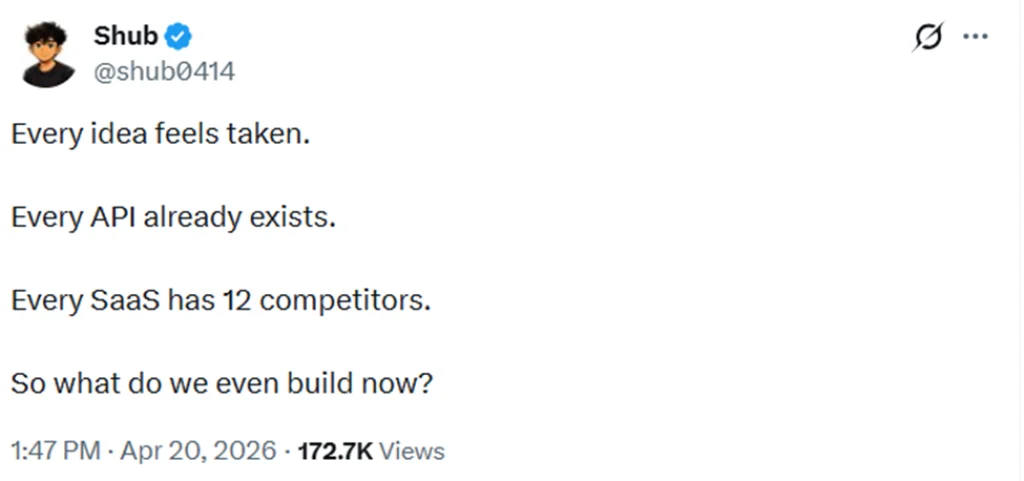
You have probably seen some version of this tweet:

A generation of builders has been handed the most powerful creation tool in history and cannot decide what to point it at.

Here is the reframe. In January 2026, ChatGPT crossed 180 million monthly users in India. Google Gemini hit 118 million. Perplexity briefly overtook ChatGPT on the Indian App Store. a16z’s Top 100 Consumer AI list is dominated by horizontal assistants and global creative tools built for an American median user. The largest AI consumer market in the world is being served by products that speak to it in the wrong accent.

This is what the tweet misses. “Everything is taken” is only true if you think the game is still model quality or clever prompts. It is not. The remaining game is distribution, trust, data that no one else has, and cultural fluency. India has nine hundred million smartphone users, five hundred million internet users who do not use English as their first language, UPI on every phone, WhatsApp as the operating system, and a service economy that runs on relationships rather than software. None of this shows up in the training data of a frontier model.

The products below are not speculative. For each one, the wedge exists in 2026, the underlying behaviour is already measurable, and the reason no one has nailed it yet is specific. We have tried to be precise about who wins, why now, and where the body is buried. None of these are easy. All of them are legible.

A quick note on what this list is not. It is not twenty ChatGPT wrappers. It is not twenty “AI for X” ideas where X is a vertical. It is a set of products that each require a real insight about an Indian user, a real loop that gets stronger with use, and a real reason to exist after the novelty of generative AI wears off. Consumer AI in India will be won by teams that understand one user cohort deeply, not by teams with the best fine-tuning budget.

If you are deciding what to build, read this with a highlighter. If you ship one of these, come talk to us.


1. The Bharat voice assistant

Text-first chat is a product built for English speakers with keyboards. It is not how the next three hundred million Indians will interact with AI. The winner of Indian consumer AI will look more like a phone call than a chat window.

Build a voice-native assistant that speaks Hindi, Tamil, Telugu, Marathi, Bengali, and six other languages at native fluency. It should listen more than it talks, hold multi-turn conversations, remember who the user is across calls, and cost less than three rupees per session to run. BharatGPT already powers IRCTC’s voice assistant in twelve languages; Sarvam, Krutrim, and a handful of others are building foundation models that can handle dialect and code-switching. The real product work is the layer on top: latency under 800ms, intent stitching across topics, and a product shape that works for someone whose first interaction with AI is a missed call.

Why now: voice LLM inference costs dropped roughly 80 percent between early 2024 and early 2026. Feature phones running KaiOS have gotten good enough. Jio, Airtel, and Vi are all piloting voice-first bundles.

Who wins: a team with one foot in speech ML and one foot in rural distribution. Think a Shaip or Karya co-founder paired with someone who has actually spent time selling to tier 3 India.

Watch-outs: do not confuse multilingual with multi-dialect. Haryanvi is not Hindi. Malayali English is not English. The product either understands this from day one or it does not ship in Bharat.

2. The AI tutor that actually replaces tuition

Byju’s and Unacademy built the first wave of Indian edtech on content plus celebrity teachers. The next wave has to build on something those companies could never deliver at unit economics: true one-on-one tutoring. There are roughly 250 million Indian students and fewer than 10 million qualified tutors. The math has never worked. Now it can.

Build an AI tutor that solves a specific board and grade combination end to end. CBSE Class 10 math is the sharpest wedge because the syllabus is finite, the exam is high stakes, and parents are already paying eight to twenty thousand rupees a month per subject for tuition. The product should teach in the student’s language of comfort, diagnose the exact misconception in real time, drill weak spots, and generate infinite practice questions aligned to NCERT patterns. It should feel less like Khan Academy and more like the best tuition didi in the neighbourhood.

Why now: voice mode plus image input means the tutor can watch a student solve a problem on paper, spot the error at the step level, and explain the fix. That was not possible even in mid-2025.

Who wins: someone who has taught the exact cohort in person for five years, paired with a strong ML engineer. Not someone who thought of education as a TAM slide.

Watch-outs: parents buy education, kids use it. The product has to delight the kid and make the parent feel in control. Homework streaks are not enough; the parent needs a weekly diagnostic that feels like a real tutor’s report.

3. The study abroad coach

Close to one million Indians apply to study abroad every year. The typical family spends between two and five lakh rupees on a consultant before the student has even written a personal statement. The category is a mixed bag: a handful of excellent boutique advisors and a long tail of opaque, templated-essay shops charging premium rates for median work. The entire process (GRE, GMAT, SAT, IELTS, TOEFL prep, university shortlisting, essay coaching, application management, visa prep, financial aid strategy) is ripe for a real AI co-pilot.

Build an end-to-end study abroad product for a single destination. Start with the United States because it is the largest outbound market, the application is the most complex (Common App, multiple essays, recommendation wrangling, financial aid, I-20, F1 visa interview), and the willingness to pay is highest. The product is a companion from junior year of undergrad through visa stamping. It shortlists universities against profile, budget, and aid probability. It writes essay drafts with genuine feedback on voice, not just grammar. It simulates the visa interview in the officer’s actual cadence. It tracks deadlines for the student and the parent in parallel.

Why now: generative models are finally good enough to produce real essay feedback, not just surface edits. Voice simulation for the visa interview has crossed a useful fidelity bar. Two years ago this would have been a toy.

Who wins: a founder who has been through the process themselves (ideally as both a student and a sibling-mentor) or spent real time inside a foreign admissions office. The pattern recognition is the product.

Watch-outs: do not compete with the high-end boutique consultants at their price point. Compete with the messy middle. The student whose family cannot afford a three-lakh consultant but will pay twenty thousand for a product that feels like one.

4. The mental health companion for India

India has roughly one psychiatrist per 100,000 people. The WHO recommends three. The gap is not going to close with human therapists. The current anxiety, depression, and burnout load in urban India is catastrophic and mostly unspoken. ChatGPT and Character.ai are already being used as de facto therapists by tens of millions of Indians, except neither is designed for it, neither is clinically informed, and neither has Indian cultural context.

Build a voice and text mental health companion that does three things no general model does: it uses evidence-based CBT and ACT frameworks, it is trained on the specific texture of Indian stressors (joint family dynamics, arranged marriage pressure, hostel culture, job-market anxiety, caste and class overhang), and it knows when to escalate to a human. The business model is a low monthly subscription plus optional human therapist access for crisis moments.

Why now: Character.ai’s second-largest source of traffic after the US is India (about 9 percent of global). The behaviour already exists. The product that formalises it, adds clinical guardrails, and earns the trust of family members is open.

Who wins: a clinical psychologist and a product founder, ideally co-founded. One without the other ships either a toy or a form.

Watch-outs: this is a product where the safety layer is the product. One high-profile failure of a suicidal user being failed by the bot and the category is set back five years. The team that takes this seriously wins; the team that treats it like growth hacking does not.

5. The chronic disease concierge

Seventy-seven million Indians are diabetic. Roughly two hundred million are hypertensive. One in five Indian women of reproductive age has PCOS. These are lifelong conditions that require daily management, and they are not well served by episodic visits to a doctor once a quarter. The job to be done is someone who knows you, knows your numbers, and guides you through three hundred and sixty five days of decisions.

Build a condition-specific AI concierge. Start with PCOS because the patient cohort is young, digitally native, underserved by existing clinical pathways, and already self-organising on Reddit and Instagram. The product is a companion app that reads the user’s CGM or glucometer, tracks cycle and symptoms, generates a personalised diet and movement plan, prepares her for the quarterly endocrinologist visit with the exact questions to ask, and has an always-on voice mode for the 2 am panic about a missed period. Pharmacy and supplements are the revenue layer, not the product.

Why now: CGMs like Abbott FreeStyle Libre dropped below 3,000 rupees per sensor in India in 2025. Continuous data is now consumer-affordable. Hormone tests can be done at home. This was not true two years ago.

Who wins: an endocrinologist or gynaecologist who has seen 5,000 patients, paired with a founder who can build a retention-first product.

Watch-outs: “AI health” regulation is tightening globally. Get the clinical governance right on day one or you will be rebuilding it on day 800 under pressure.

6. Astrology, built as a codified expert system

One in three urban Indians and two in three rural Indians consult an astrologer at least once a year. AstroTalk does roughly 1,500 crore in annual revenue and is growing twenty percent year on year. The behaviour is not going away. What is changing is that the median customer is now a 25-year-old woman in Bengaluru who will pay 300 rupees for a voice note from a real astrologer at 1 am.

The naive AI version of this is a GPT wrapper that hallucinates. The actual product is hybrid. You take a panel of senior astrologers with twenty years of practice, you codify their decision trees into a structured reasoning engine of about two hundred expert rules, and you wrap it in an LLM for natural conversation. The LLM handles language; the expert system handles the logic. This flips the product from “AI astrologer you cannot trust” to “trusted companion with astrological reasoning.”

Why now: astrology usage peaks between 9 pm and 2 am, exactly when human astrologers are asleep or expensive. AI has the unit economics to serve this window at scale for the first time.

Who wins: a founder who is either culturally fluent or deeply sceptical. The worst version is a founder who looks down on the user.

Watch-outs: astrology is not fortune telling, it is anxiety management in disguise. Build it as a wellness product with astrological framing and you compound. Build it as prediction and you end up in the same credibility trap as the current Instagram scammers.

7. AI matchmaking for Indian realities

Shaadi.com has existed for close to thirty years. It is still essentially a search engine. Bumble and Tinder have less than 10 percent penetration in the arranged marriage middle class. The real job to be done here is complicated: understand the user, understand the family, filter for the thousand soft constraints that no one will write into a profile (sect, sub-caste, family income bracket, dietary preference, eldest-daughter dynamics), and produce five genuinely promising matches a week.

Build an AI matchmaker that spends the first two weeks interviewing the user (and optionally a parent) via voice. It builds a private, deep profile including attachment style, values, and deal-breakers. It then searches a pool of similarly-interviewed users and proposes matches based on compatibility, not filters. The interaction model is like a trusted aunty who has already vetted the other side.

Why now: the post-2020 cohort is exhausted by both swiping and by aunties. They want curation with warmth. Voice interviewing plus deep user modelling is finally technically viable at consumer cost.

Who wins: a founder with either strong diaspora credibility or a real matrimonial insider. Ideally both.

Watch-outs: the two-sided cold start problem is brutal. Start in a single narrow vertical (Tamil Brahmins in the US, Marwari business families in Mumbai, queer Indians anywhere) and expand from there. Horizontal at day one kills the product.

8. The AI companion built for the Indian emotional texture

This is distinct from mental health. Mental health is clinical. Companionship is everything else: loneliness, ambient conversation, the specific ache of being the first in your family to move to a Tier 1 city, the ache of being the NRI who calls home less than you should. Character.ai and Replika are massive globally precisely because they serve this need. Neither is built for the Indian user.

Build a companion that is voice-native, remembers everything across months and years, speaks the user’s first language, understands Indian family dynamics (joint family vs nuclear, the guilt economy, festival cycles), and knows when to be quiet. The personality is not a fictional anime character. It is a warm, specific human archetype the user can actually relate to: the elder cousin, the college roommate, the co-worker who also moved from Patna.

Why now: audio companions cross fifty million monthly users globally in 2026. Revenue run rates have crossed two hundred million dollars. India has both the population and the loneliness. What is missing is the product.

Who wins: a founder who has themselves felt the loneliness they are solving. This cannot be built as a pattern match from a New York office.

Watch-outs: the line between companionship and emotional dependency is thin. Build in healthy friction, encourage real-world connection, and do not optimise purely for session time. The next wave of regulatory scrutiny on companion apps will reward the careful and punish the rest.

9. The WhatsApp commerce agent

Eighty five percent of Indian internet users are on WhatsApp. A meaningful share of transactions in India already happen through WhatsApp: small business ordering, B2B distribution, creator commerce, local services. The app is the interface. But the commerce experience on WhatsApp today is a mess of manual back-and-forth, broken order flows, and unstructured catalogs.

Build an AI agent that lives inside a WhatsApp Business account, handles the entire customer conversation, understands the catalog, negotiates price within set bounds, confirms orders, triggers payment, and schedules delivery. The primary customer is not the shopper; it is the one million small businesses and D2C brands currently running WhatsApp commerce manually. Charge a monthly subscription plus a thin take on transactions.

Why now: Meta opened up WhatsApp Business API pricing substantially in 2025, and voice notes on WhatsApp now exceed text messages in volume. An AI agent that can both read and listen is finally credible on the platform.

Who wins: a founder who has actually run a D2C business on WhatsApp at some point. The edge cases only become obvious after you have dealt with a thousand of them.

Watch-outs: Meta is both the platform and the potential competitor. Build something they cannot easily clone, which means owning the last-mile integrations: payment reconciliation, inventory sync with Unicommerce, and logistics handoff with Delhivery or Shadowfax.

10. The AI legal co-counsel for the Indian household and MSME

Sixty two million MSMEs in India. Forty million rental agreements signed every year. Ninety percent of personal legal issues (property disputes, rental, labour, family, consumer complaints) are solved without a lawyer because lawyers cost too much and move too slowly. The addressable market is not the corporate legal team; it is everyone else.

Build a focused legal assistant for two cohorts. One, the small business owner who needs help with GST notices, vendor agreements, employee offer letters, and shop and establishment licensing. Two, the urban household that needs help with rental agreements, society disputes, consumer complaints, and property paperwork. The product generates the document, explains it in plain Hindi or English, flags the three specific things to worry about, and connects to a human lawyer only when escalation is actually warranted.

Why now: the Digital Personal Data Protection Act, the new labour codes, and the GST reconciliation regime have collectively added more compliance load to the small-business owner in the last twenty four months than the previous decade. The need has gone from latent to urgent.

Who wins: a lawyer who has practised in the actual trenches (district courts, consumer forums, MSME tribunals), not a top-tier firm partner. Their pattern recognition is the product.

Watch-outs: do not get seduced by the enterprise legal ops opportunity. It is a different product, a different customer, a different sales motion. Stay on the consumer and MSME side.

11. AI fashion try-on and personal styling

Myntra and Ajio have spent a decade trying to solve the return rate problem on apparel. Returns are still 30 to 40 percent. The core reason: Indians cannot try on before buying, Indian body types are not well represented in the imagery, and the stylists are all optimised for American body standards from two years ago.

Build a personal stylist that does two jobs. First, a try-on engine that actually works for Indian body types, skin tones, and the specific garments that matter (kurtas, lehengas, sarees, which are not well handled by current Western try-on tools). Second, a stylist that understands the user’s wardrobe, the occasion (office, wedding, karwachauth, first date), and the budget, and curates six to ten items from the catalogue that actually work.

Why now: image-to-image diffusion for garment fitting crossed a quality bar in mid-2025 that makes try-on stop feeling uncanny. Major Indian marketplaces have opened up product feeds via affiliate APIs.

Who wins: a fashion insider plus a technical founder with a computer vision background. This is not a generalist consumer play.

Watch-outs: the moat is not the tech; it is the data flywheel from what actually converted. Instrument every try-on and every purchase, and compound the styling recommendations from that feedback loop. Without the flywheel, Myntra clones it in a quarter.

12. The parenting and child-development companion

Indian parents over-invest in education and under-invest in early childhood development. The gap between ages zero and six is where most of the long-term child outcomes are shaped. The current resources are a patchwork: BabyCenter, WhatsApp groups, a pediatrician they see once every three months, and Instagram reels from foreign influencers that do not map to the Indian context.

Build an AI companion for the parent. It tracks milestones by age, flags concerns early (speech delay, motor delay, anxiety, nutrition), generates week-by-week activities calibrated to the child’s stage, answers the 2 am question about a fever, and maintains a developmental diary. The target user is the first-time parent aged 28 to 38 in tier 1 and tier 2 cities who is willing to pay for their child’s edge.

Why now: the Indian middle class has shrunk family size (now averaging 1.9 children) and doubled per-child investment. Willingness to pay for “best for my child” has never been higher. Generative AI is the first technology that can personalise the answer rather than offer generic content.

Who wins: a pediatrician or child psychologist plus a strong mobile product team. The credibility of the founding team is 40 percent of the sell.

Watch-outs: be careful with health claims. Build as a supportive companion, not a diagnostic tool. The product that gets this tone right is trusted for twenty years. The one that gets it wrong gets taken down in a quarter.

13. AI kitchen and meal intelligence

The Indian kitchen has not had a real software layer. Zomato and Swiggy serve the outside-the-home meal. Blinkit and Zepto serve grocery supply. Nobody serves the decision: what to cook today, with what is in the fridge, for which family member, at which budget. This is a daily problem for India’s roughly three hundred million households.

Build a product that lives in the kitchen. It knows what is in the fridge (via a barcode scan at purchase or a quick camera check), knows each family member’s preferences and dietary restrictions, and generates the week’s meal plan in under two minutes. It auto-generates the Blinkit or Zepto cart for the week, surfaces recipes from the grandmother’s cookbook that match the pantry, and voices back instructions in the cook’s language as she cooks. Monetisation via grocery affiliate plus a modest subscription.

Why now: one in four urban Indian households now orders groceries online weekly. The friction is not discovery; it is planning. Generative AI is the first planning layer that can actually personalise.

Who wins: a founder with deep roots in an Indian kitchen (this is not a throwaway line; generic food tech founders get this wrong) plus strong consumer product chops.

Watch-outs: the temptation is to pivot to cloud kitchens or to compete with Swiggy. Resist. This is a planning and personalisation business, not a logistics business.

14. The career and interview coach

Seventy million Indians change jobs every year. Naukri and LinkedIn are distribution platforms. Neither helps you actually prepare for the interview, negotiate the offer, or decide between two offers. The individual who can afford a professional career coach pays between 10,000 and 50,000 rupees a session. Nobody else gets coached.

Build an always-on career AI. It reviews the resume against a specific job description, runs mock interviews with domain-relevant questions (product manager at a startup vs. product manager at a bank are different interviews), negotiates the offer by walking the user through compensation benchmarks and scripts, and maintains a long-term career map. Pricing is a low monthly subscription with a one-time surge for the “I have an offer, help me negotiate” moment.

Why now: interview coaching via voice AI crossed a realism threshold in late 2025. The simulation is now good enough to genuinely prepare someone. Two years ago this would have been a toy.

Who wins: a founder with either strong recruiter DNA or strong top-of-funnel talent brand. Distribution is the hard part; the product is increasingly table stakes.

Watch-outs: LinkedIn is building this. Your edge has to be depth on a specific job family (data science, product, design, sales) and brand that the cohort trusts more than they trust LinkedIn’s generic coach.

15. The home-services concierge with memory

UrbanCompany is a transactional marketplace. You book a cleaner, a plumber, a beautician. It has no memory of who worked well in your home, which partner remembers your preferences, or which service you need to book three weeks from now. The actual job Indians want done is “run my home for me” and no product does it.

Build a home-services agent that runs proactively. It remembers that the AC servicing is due every six months, that the water purifier filter needs changing every three, that the maid took a week off last Diwali and the replacement was unreliable. It proactively books, confirms with the user, handles the scheduling, and maintains the trust graph of which service provider worked well. It can be marketplace-led (booking UC, Sulekha, Justdial) or direct.

Why now: memory as a primitive in AI products is where a16z believes the next competitive advantage lies. Home services is the cleanest consumer use case for it in India.

Who wins: an operator who has lived the service economy pain of running a household with kids, aging parents, and two working adults. Not a twenty-three-year-old engineer.

Watch-outs: do not try to be a supply-side aggregator. UrbanCompany owns the supply. You win by being the demand-side memory layer and routing to whichever supply is best.

16. The AI co-pilot for India’s online sellers

Roughly four million Indians sell on Amazon, Meesho, Flipkart, and Shopify. Most are two-person operations. They spend disproportionate time on listing optimisation, image creation, ad campaigns, customer service, and returns management. None of them can afford a growth team. All of them are the perfect customer for an AI co-pilot.

Build a seller co-pilot that does the whole operational stack. It writes listings optimised for each platform’s algorithm, generates product imagery (including the specific format and background that converts on Meesho vs. Amazon), runs the ad budget dynamically, answers customer queries in regional languages, and flags returns patterns before they become reviews-destroying trends. Pricing is a percentage of GMV or a per-listing subscription.

Why now: Meesho and Flipkart are both pushing regional sellers hard in 2026, which has expanded the long tail of sellers by an order of magnitude. None of them can handle the operational load alone.

Who wins: someone who has sold on these platforms themselves. The specific pain points are deeply non-obvious from the outside.

Watch-outs: the platforms will build their own version. Your window is two to three years. Use it to build the data moat (which listings actually convert, which returns cluster where) and a cross-platform dashboard the native platforms will never offer.

17. The AI accountant for freelancers and creators

India has roughly 15 million freelancers, creators, and solo consultants. None of them can afford a CA. All of them struggle with GST registration, quarterly filings, income tax returns, TDS on client payments, and the seventy tiny decisions that determine whether they owe money or get a refund. The current “AI accountant” products are receipt scanners. The actual product is a full agent.

Build an always-on AI accountant. It connects to the user’s bank, UPI, and client payment platforms. It categorises every transaction, suggests deductions, generates GST invoices on request, prepares ITR returns, and files them with a human CA reviewing in the background. Priced at 999 rupees a month or 9,999 a year. Economics work because the AI does 90 percent of the work and the human CA does the last mile at scale.

Why now: the government’s Account Aggregator framework matured in 2025 and consent-based bank data aggregation is now routine for consumer products. Tax filing APIs are open. Two years ago the data was trapped; it is not anymore.

Who wins: a chartered accountant who has run a small practice, plus a strong product founder. Not a generic fintech founder.

Watch-outs: Zoho and Cleartax are going to compete. Your wedge is being a delight-first, solo-user product rather than a feature-heavy tool built for the tax professional. Do not let your roadmap drift into small-business accounting; the buyer and product are different.

18. The AI elder-care companion

Roughly 150 million Indians are over the age of sixty, and the cohort is growing faster than any other age group. A significant share live alone or with adult children who work long hours. The current options are underwhelming: a paid caretaker the family cannot afford, or family WhatsApp groups that do not scale. The older Indian is lonely, under-monitored medically, and often a fall away from a crisis.

Build an elder-care companion that works through a simple voice interface on a tablet or a dedicated device. It chats daily, flags mood or cognition changes, reminds about medication and appointments, detects a fall or distress via ambient audio, and loops in the adult children only when something warrants it. The family pays. The older user is the user.

Why now: two things changed in 2025. Voice LLMs became fluent enough to hold a real conversation with someone who does not want to talk to a machine. And the Indian diaspora, particularly in the US and the UK, is aging their parents alone at a rate that has created a real willingness-to-pay cohort. Subscription of 1,500 to 3,000 rupees a month is easily achievable.

Who wins: a founder whose own parents live alone. The product decisions are empathy-driven, and empathy has to be real.

Watch-outs: safety and privacy are the product. An ambient listening device in an older person’s room has to be bulletproof on data, and the family dynamic around surveillance has to be handled delicately.

19. The AI dubbing and creator suite

India’s regional content market grew 25 percent in 2025 on the back of Tamil, Telugu, Malayalam, and Marathi microdrama. Creators producing in one language are leaving three other languages of audience on the table. Dubbing is currently either expensive and slow (studio-based) or cheap and terrible (auto-dubbed). Neither works at creator scale.

Build a creator suite for Indian vernacular content. Voice-clone the creator across languages (with consent and control), sync lip movement, localise idioms and jokes, and push out in one click. Monetise per minute of dubbed output. The larger product is not just dubbing; it is a full regional-content creator stack including thumbnail generation, title testing, and multi-platform distribution.

Why now: voice cloning quality crossed the “indistinguishable” threshold in 2025 for Indian languages. Lip-sync with character-consistent video is now reliable. The creator market is large enough (three million active creators earning above 10,000 rupees a month) to support a paid tool.

Who wins: a founder with deep creator-economy instincts and a real AI team. You cannot win this with a generic wrapper.

Watch-outs: ElevenLabs and Runway will both target this. Your wedge is regional language quality and the local creator relationships. Both take time to build.

20. The gig worker companion

Roughly eight million Indians drive for Ola and Uber, deliver for Swiggy, Zomato, Blinkit, and Zepto, or run shifts for UrbanCompany and Porter. They are the economic backbone of urban India and the single most under-served consumer software cohort in the country. The platforms they work for optimise for the platform. Nobody builds for them.

Build a companion app for the gig worker that does four things honestly. One, earnings optimisation: tell the driver whether to log into Ola or Uber at 9 am given current surge, trip density, and cancellation history, and nudge the delivery partner toward the evening rush in the zone with the best tip pattern. Two, financial care: calculate the true hourly net of fuel, EMI, taxes, and platform commission, and auto-route weekly savings into a micro-SIP. Three, tax and compliance: generate the GST and ITR filings from platform earnings without the worker needing to touch a form. Four, a voice-first support layer for the thousand moments the worker needs a real human but cannot reach one. Account frozen. Fare disputed. Medical emergency mid-shift.

Why now: Account Aggregator makes consent-based access to bank and earnings data routine. Platform APIs increasingly expose worker earnings back to the worker. Voice LLMs in Hindi, Kannada, Tamil, and Bengali are finally fluent enough to be the primary interface for someone who does not read English comfortably.

Who wins: a founder who has spent real time alongside the worker. Ride-alongs, driver canteens, delivery partner WhatsApp groups. The product is empathy-driven and the pain points are not visible from a corporate office.

Watch-outs: do not position as adversarial to the platforms. The best version of this product is one the platforms eventually want to partner with, not sue. Keep the worker as the paying customer and the moat is the trust, not the data.


Picking one

Twenty ideas is a menu, not a plan. If we are sitting across from a founder next Tuesday, here is how we would think about narrowing.

First, pick the cohort, not the category. Most of the ideas above work because they serve a specific Indian cohort with a sharpness that a global product cannot match. Founders who pick the cohort first and then choose the product almost always win over founders who pick the tech first and then hunt for a cohort.

Second, find the wedge where trust is the moat. AI gets cheaper every quarter. Model quality converges. What does not converge is a user’s willingness to trust you with their health data, their child’s education, their tax filing, their loneliness. Trust compounds, and trust is what turns an AI product from a chat wrapper into a consumer franchise.

Third, build for retention from day zero, not growth. We wrote in January about what failed in 2025. Consumer AI is full of products that hit 50,000 users in a month and then watched 85 percent of them leave by month three. The winners in this list will be the ones where day-30 retention at launch is above 40 percent. If you cannot hit that in a small cohort, do not raise. Fix the product.

Fourth, pick a distribution you actually own. Paid acquisition on Meta and Google has become unviable for consumer AI in India unless you have a real monetisation moat. The winners will acquire through WhatsApp, through community, through a creator-led channel, through a parent company or distribution partner, or through a very specific organic wedge. If your GTM is “we will run ads”, reconsider.

Finally, assume the frontier model will catch up on capability and will never catch up on context. Your edge is the context. The Bharat user, the Tier 3 cook, the Kota aspirant, the diaspora son calling his mother in Pune. That is not in the training data. That is the opportunity.

We will follow this up with the next in the series: what to build in Indian fintech, then vertical SaaS, then AI infra. If you are building one of the twenty above, or a sharper version of it, we want to hear from you.