The App Abundance Bet: The Wabi Story

Wabi just raised $20M on a thesis that sounds deceptively clean: YouTube democratized video creation; Wabi will democratize software creation.

It’s a compelling analogy, and one that deserves to be interrogated carefully.

Eugenia Kuyda, who called AI companionship years before it felt obvious with Replika, is now making a bigger bet: that apps themselves are about to become a creative medium, not just tools built by professionals.

If she’s right, software stops being something you buy and starts becoming something you make; casually, personally, and often.

That’s a massive shift. But it’s far from inevitable.


Why Would Anyone Actually Use This?

1. Hyper-personalized utilities

Last weekend, I built a Superhuman clone. Five minutes. Zero code. It actually works.

I use it every day, not because it’s revolutionary, but because the real Superhuman costs $25/month and I only needed three specific features.

This is the strongest immediate case for Wabi: tools shaped precisely to one person’s quirks, constraints, and preferences. No roadmap debates. No feature bloat. No subscriptions for things you don’t use.

But the uncomfortable questions linger:

  • Is there enough volume of these hyper-specific needs across millions of people?
  • Will people bother creating when the pain is mild, not acute?
  • And if there are no ads, what are people paying for—the platform, or individual apps?

Personal utility is powerful. Whether it’s massively powerful is still unclear.


2. Self-expression and identity

YouTube didn’t just make video easier. It created a new identity: creator.

You weren’t uploading home videos, you were building a channel, an audience, a presence.

The question is whether software can follow the same arc.

Signals exist. GitHub stars. Figma plugins. Roblox worlds. Minecraft mods. These aren’t just utilities; they’re expressions of taste, competence, and imagination.

But there’s a key tension here. Video is inherently consumable as entertainment. Apps usually aren’t. Most software is meant to disappear into the background once it works.

So how many people want to browse apps the way they browse videos?
How many want to engage with software as culture, not just infrastructure?

That distinction matters enormously for scale.


3. Creator economics (the hard part)

The moment you build for others, things get messy.

  • There are no ads.
  • Anyone can fork your work.
  • Creation takes minutes, not months.
  • Differentiation is fragile.

So what are you charging for?

The deeper issue is whether the long tail of utility needs is deep enough to sustain a creator ecosystem. Utility demand tends to plateau; entertainment demand doesn’t.

It’s possible the most successful Wabi apps won’t be productivity tools at all, but creative, playful, or social experiences where imagination, not efficiency, is the constraint.

If that’s true, Wabi may look less like an app store and more like a creative platform.


Early Signals Worth Watching

Multiplayer use cases feel like the obvious early strength:
community tools, lightweight games, shared utilities.

Another promising signal is people rebuilding awful Play Store apps—overpriced, bloated, or poorly designed, and offering cleaner, cheaper alternatives.

The fork in the road is clear:

  • Does Wabi skew toward community and gaming (high engagement, social gravity)?
  • Or toward single-player utilities (deeply useful, but finite)?

Is this a utility layer, a community platform, or an entertainment network?
That answer likely determines everything about scale, retention, and monetization.


The Maintenance Problem

Content ages gracefully. Software doesn’t.

Your favorite YouTube video from 2015 still plays perfectly.
That Wabi app from 2026? APIs change. Auth breaks. OS updates roll out. Databases fill up. Something fails, and the creator moved on months ago.

GitHub has over 100 million repositories. Most are digital graveyards.

Here’s the intriguing counterpoint: if AI can build software, it should be able to maintain it too.

Imagine autopilot maintenance, AI fixes triggered by error logs, user complaints, or platform changes. This only works if complexity stays manageable, but if it does, it fundamentally alters the abandonment problem that has plagued software forever.

That may be one of Wabi’s most underappreciated bets.


The Distribution Risk

There’s a brutal reality here.

OpenAI, Google, or Anthropic could ship this as a feature.

“Build mini-apps in your sidebar” shows up inside ChatGPT or Gemini tomorrow. Two hundred million users already have distribution, trust, and habit.

Why would they switch?

The same risk exists with other AI-native builders entering mobile with social hooks. In consumer software, first-mover advantage matters far less than distribution—especially when the underlying technology is becoming commoditized.

Wabi’s differentiation has to be experiential, not technical.


Nobody Asked for YouTube Either

In 2005, if you asked people whether they wanted to make videos online, most would have said no.

Once friction disappeared, a latent desire revealed itself. Millions discovered they did want to create, they just hadn’t known it was possible.

Maybe software is similar.

Maybe millions would create apps if it were truly effortless. Maybe we’re about to uncover a form of creative expression we haven’t named yet.

That’s the real bet.


What Feels Solid

Wabi is one of the best interfaces to emerge in the AI era.
The social layer, the zero-jargon approach, the creation flow, the integrations—it’s all thoughtfully designed.

At the very least, this feels like the end of garbage mini-apps cluttering app stores. Even if nothing else works, Wabi raises the floor for what basic utility software can be.

The open question is whether it raises the ceiling too.

I built my Superhuman clone because it saved me $25 a month.
That’s one person, one need, one weekend.

Does that scale to millions of people, with thousands of needs, creating continuously?
Or does it plateau once everyone scratches their personal itch?

If Wabi is right, software creation is about to explode in ways that fundamentally reshape how we think about apps.
If it’s wrong, we’ll learn something important about the limits of creative democratization.

Either way, it’s worth watching closely.


What people are already building on Wabi

A Bangalore weekend planner, a game built by a single user, wildly different UI styles within Wabi, and a Superhuman-style email client; created in minutes, not months.

If you’ve been experimenting with Wabi, or have a strong take on where this breaks, I’d genuinely love to hear it.

India VC 2025 Review & 2026 Outlook

Indian startup funding in 2025 didn’t slow so much as it recalibrated. The numbers tell one story: seed rounds happened, some Series As closed, a handful of growth rounds made headlines. But the texture of those deals tells another. Capital didn’t dry up, it ossified into patterns so rigid that entire categories of founders found themselves suddenly uninvestable, not because their ideas were bad, but because the physics of early-stage financing had fundamentally changed.

This wasn’t a correction. It was a repricing of what “fundable” means.


What Actually Happened in 2025

Capital didn’t get scarce. It got forensic.

The shift in investor diligence between 2022 and 2025 was dramatic. In 2022, companies raised seed rounds on slide decks and Figma prototypes. In 2023, investors wanted early customers and growth charts. By 2025, the bar had moved to cohort retention tables, CAC payback analysis, and gross margin breakdowns at seed stage, not just Series A.

A fintech company in our network raised ₹15 crore in February on ₹35 lakh MRR and what they described as a “strong pipeline.” By October, at ₹1.5 crore MRR after 4xing revenue in eight months, they were passed on by seven funds. The issue wasn’t growth. Their month-3 retention had dropped from 78% to 61%. One fund’s feedback: “Come back when you’ve figured out why customers churn.”

This became the pattern across the ecosystem. Growth without retention was noise. Revenue without margin was a liability. Scale without unit economics signaled a fundamental misunderstanding of business model viability. The capital existed, sitting in funds that had closed large vintages in 2023 and 2024, but the willingness to fund unproven models had evaporated.

Founder behavior bifurcated along adaptation lines.

By mid-year, a clear split emerged in how founders responded to the new market reality. This wasn’t about sector, product category, or founder pedigree. It was about speed of adaptation.

One group cut burn by 30-50% in Q1, sometimes earlier. They pushed break-even timelines forward by 12-18 months, killing features that weren’t converting, letting go of non-performing hires, and ruthlessly prioritizing revenue generation and cost reduction. Customer conversations became weekly or daily, not because a playbook demanded it, but because customer behavior was the only reliable signal. Every rupee was treated as potentially the last.

The other group continued hiring based on the belief that “you can’t cut your way to growth.” They maintained 18-24 month runways assuming Series A would happen on schedule, invested in brand building and team culture, and pitched growth trajectories requiring consistent execution across multiple quarters.

The first group raised their next rounds. The second got bridge rounds at flat or down valuations, burned through those extensions in six months, and either shut down or are still raising on increasingly difficult terms as of early 2026.

The uncomfortable reality: the second group wasn’t operating irrationally. They were following advice that had worked consistently from 2020-2022: build fast, grow faster, address profitability later because scale solves structural problems. This approach didn’t just stop working. It became actively penalized as the market recognized that many high-growth companies from the boom years had destroyed rather than created value.

Founders who updated their mental models in Q1 or Q2 of 2025 adapted successfully. Those waiting for a “return to normal” struggled to survive. The normal they were waiting for isn’t returning.

Series A became a proof point, not a milestone.

Seed funding in 2025 occurred at roughly 2023 volumes, down perhaps 10-15% but not catastrophically. Series A was different. The gap between seed and Series A became the defining characteristic of the funding environment.

Across the ecosystem, roughly 30% of companies attempting Series A raises in 2025 successfully closed rounds. Another 55-60% were still raising as of January 2026, some for nine months or longer. The remaining 10-15% pivoted significantly or wound down.

What separated successful raises from ongoing struggles?

Companies that closed Series A rounds demonstrated either: (a) clear path to profitability within 12 months using current burn rates, backed by improving unit economics data, or (b) net revenue retention above 110% with expanding customer ACVs, meaning their customer base was growing in value faster than churn rates. Not projections or models. Actual cohort data showing the behavior pattern.

Companies still raising often had strong top-line growth, sometimes 30-40% month-on-month in H1. But underneath: retention rates requiring constant new customer acquisition to replace churned revenue, unclear margin structures from incomplete cost accounting, or dependency on paid acquisition that didn’t scale economically.

The investor response wasn’t outright rejection. It was “not yet” and “come back when you’ve proven this works.” In practical terms: “This doesn’t look like a sustainable business model, and we’re not deploying capital to find out.”

Series A stopped being a momentum round rewarding growth. It became a proof-of-business-model round requiring demonstration that the company works as a business, not just as a product with users. If the model didn’t prove out at ₹80 lakh MRR, investors lost confidence it would work at ₹8 crore.

The gap between hype and traction widened significantly.

Categories that attracted attention but struggled to convert interest into funding:

AI copilots claiming to save users “30% time” but unable to quantify what users did with that saved time or demonstrate willingness to pay. Vertical SaaS platforms where the vertical was “Indian SMBs” and the differentiation was “we’re building X for India,” which proved insufficient as a wedge. D2C brands treating Instagram reach as a defensible moat. Crypto projects, for well-documented reasons.

AI companies in H1 consistently showed impressive demos. The technology worked, output quality was compelling. By H2, the critical question shifted: “How many users actively engage 90 days post-signup?” Answers typically ranged from 15-25%, sometimes lower. Novelty effects wore off quickly when workflow integration remained shallow and tools required behavior change rather than fitting existing patterns.

Categories that attracted less attention but demonstrated clearer traction:

Compliance automation saving finance teams 40+ measurable hours monthly on specific tasks like GST reconciliation or TDS filing. B2B infrastructure addressing unglamorous problems like invoice reconciliation, vendor onboarding, or regulatory filing automation. Fintech products with 60%+ attach rates because they integrated into existing workflows rather than requiring adoption of new tools.

One company built software for chartered accountants, automating ITR filing data entry and form generation. They saved CAs approximately 6 hours per client monthly, charged ₹5,000 annually per CA, and achieved 80% annual retention because returning to manual processes became unthinkable after one filing season. They raised ₹12 crore seed in 45 days with multiple competing term sheets.

The pattern: solving acute problems for customers with budget, measuring impact in terms they care about (hours saved, errors reduced, revenue increased), and charging prices representing fractions of delivered value. Companies with these elements raised successfully. Those with “large TAM” and “strong growth” but vague value propositions got exploratory meetings that didn’t convert.


What 2025 Revealed About Early-Stage Dynamics

Burn efficiency emerged as the primary survival predictor.

Analysis of 2022-23 vintage companies revealed a stark pattern: companies successfully raising follow-on rounds weren’t necessarily the fastest growers. They were companies maintaining burn multiples under 2x.

Burn multiple calculation is straightforward: rupees burned to generate one rupee of new ARR. Spending ₹20 lakh to add ₹10 lakh ARR equals a 2x burn multiple. Under 1.5x represents exceptional efficiency. Under 2x is solid. Above 3x is concerning unless growth exceeds 20% month-on-month, and even then represents a precarious runway dynamic.

Companies encountering serious difficulties in 2025 typically had burn multiples above 4x. They were growing, sometimes impressively, but expensively. When they approached investors, the economics suggested multiple additional funding rounds before profitability, and investor appetite for that journey had disappeared.

Successful companies addressed burn in Q1 or Q2, when they still had 18+ months runway and could make deliberate decisions. They didn’t wait for market improvement or assume growth would resolve burn issues. They made necessary cuts to extend runway to 30+ months.

This reflects a structural shift in early-stage durability requirements. High burn only functions when the next round is certain, and 2025 demonstrated nothing is certain. That reality isn’t changing in 2026.

Founder psychology differentiated outcomes more than credentials.

Portfolio analysis comparing McKinsey alumni, IIT/IIM founder pairs, and founders without brand-name credentials revealed counterintuitive results. The credential-heavy group didn’t consistently outperform.

Top performers shared two specific characteristics: unusually high tolerance for difficulty and remarkably low ego attachment to being correct.

The most challenged founders were those with lifetime reinforcement of exceptionalism backed by impressive resumes. They had credentials, networks, and pattern-matching advantages. When market conditions shifted, they maintained pitch narratives instead of iterating models. They interpreted investor feedback as noise from people who “didn’t understand” rather than signals from experienced pattern recognition. They defended strategies in meetings instead of testing whether those strategies still functioned.

Successful founders could acknowledge “this isn’t working, let me try something different” within weeks rather than quarters. They didn’t need to be the most intelligent or credentialed. They needed to learn fastest and defend positions least.

One founder without prior startup experience had run a services business for six years. He launched a SaaS product in March, reached ₹8 lakh MRR by June through intensive effort and a strong initial wedge, then hit a retention wall at 50%. Instead of scaling sales to compensate, he stopped operations and called 40 churned customers over two weeks.

Discovery: he’d been solving the wrong problem. His feature set addressed what he thought was important, but customers churned because the product didn’t solve a different, more fundamental workflow issue. He pivoted the entire feature set in 8 weeks. Retention jumped to 85%. He closed an ₹18 crore Series A in December at valuation reflecting the fixed business model.

This psychology succeeded in 2025: extreme ownership of outcomes, zero defensiveness about errors, and relentless iteration based on actual customer behavior rather than assumptions about what customers should do.

Market size became the least valuable signal in pitch decks.

By April 2025, TAM slides had effectively lost meaning. Not because market size is irrelevant, but because every founder could generate “$10B TAM” figures through combinations of consulting reports, market data, and creative extrapolation. It became a credibility requirement rather than a differentiator.

The more valuable question: “Why will you win your first 100 customers? Not why you might or should, but why you will. What do you know or have that nobody else does?”

Strong founders provided answers rooted in unique insight or unfair access: “Six years in senior operations in this industry, observing this specific value-destroying problem daily.” “My cofounder built this exact workflow at their previous company and understands all the failure points.” “We have proprietary data from our previous business that competitors can’t access without replicating our three-year journey.”

Weak founders answered with capability: “Strong team.” “Execution-focused.” “Move fast and iterate.” These are baseline requirements, not competitive advantages. Everyone claims speed. Everyone believes their team is strong. Generic capability doesn’t create wins.

A healthcare company with a ₹400 crore TAM slide was asked: “Why will doctors adopt your software?” Response: “It’s better than current solutions and costs less.” Follow-up: “What do you know about doctor software adoption behavior that others don’t?” No substantive answer beyond “we’ve talked to some doctors who expressed interest.”

Another healthcare company had a ₹150 crore TAM. Same question about doctor adoption. The founder, a practicing surgeon: “I know the three specific reasons doctors won’t adopt new software regardless of quality: implementation time, data migration complexity, lack of EMR integration. I built around all three from day one. Here’s proof from my pilot with 8 surgeons at two hospitals where we achieved 90% daily active usage within two weeks.”

The difference wasn’t market size or credentials. It was depth of insight about the actual problem and actual customer.


Signals That Became More Predictive

Founders who spoke in business language, not startup jargon.

The most successful fundraises in 2025 came from founders who could explain their businesses in concrete business terms, the language appropriate for explaining P&L to an experienced CFO.

Not: “We have strong unit economics.” But: “Our CAC is ₹8,500, average customer LTV is ₹42,000, we recover CAC in 7 months, and here’s the spreadsheet showing payback by cohort with full methodology.”

Not: “We’re seeing great engagement.” But: “Our DAU/MAU ratio is 38%, average session time is 11 minutes, and our top 20% power users drive 67% of retention and 73% of revenue.”

Investors in 2025 stopped responding to narrative fluency. They wanted operators who understood their own numbers more deeply than the investors asking questions.

An informal test question: “Walk me through exactly how you make money on a single customer, from acquisition through renewal.”

Top quartile responses: Pulling up a clearly frequently-referenced spreadsheet, showing real customer data, explaining margin structure line by line, highlighting exactly where losses occur and why, describing the 2-3 specific levers being pulled to improve economics. Complete explanation in under five minutes with numbers matching the deck.

Bottom quartile responses: “Our LTV:CAC ratio is 3:1” without ability to show calculation methodology. Or calculations using projected LTV based on assumed retention rather than actual retention data. Or omitting major cost categories like customer success, support, or usage-scaling infrastructure costs.

The fundraising outcome gap between these groups approached 100%.

Early signals that actually predicted later success.

Tracking early-stage metrics against companies that raised strong Series A rounds revealed three unexpectedly strong predictors:

Time-to-value under 48 hours. If customers didn’t receive measurable, concrete value within two days of signup, churn rates became catastrophic. Product quality over 90 days was irrelevant if first-use experience didn’t deliver immediate tangible value. Retention collapsed without it.

Best-retention companies had first-session aha moments: “Uploaded invoices and system auto-reconciled 90% against bank statement.” “Connected accounting software and saw 90-day cash flow forecast in 30 seconds.” Value had to be immediate, visible, and relevant to current needs, not quarterly objectives.

Organic expansion within accounts without formal motions. Healthiest-scaling companies didn’t have aggressive upsell playbooks or dedicated expansion CSMs. They had products that naturally spread within organizations. One user invited teammates because tool effectiveness required team usage. One team’s obvious success made other teams curious. Usage grew without sales pressure.

One company averaged 3 seats at customer start, growing to 12 seats within 6 months without outbound effort. When product value is genuinely obvious and workflow integration is tight, it pulls additional users through observed behavior rather than sales pitches.

Weekly shipping cadence without exception. This sounds basic but proved to be the clearest leading indicator. Founders shipping new features, bug fixes, or iterations every single week built dramatically faster feedback loops, learned quicker, caught problems before crises, and maintained velocity that compounded over time.

Monthly or quarterly shippers treated products as finished objects requiring perfection before release. Weekly shippers treated products as living systems requiring continuous improvement based on user behavior learning. Product quality and market fit differences after 12 months were substantial.

Signals that lost predictive value.

“We’re in stealth mode.” Unless building defense technology or working in genuinely regulated spaces where disclosure creates legal risk, stealth mode in 2025 meant: no customers yet and fear of testing assumptions, or overestimation of idea value relative to execution. Neither signals strength.

“We’re a marketplace.” Marketplaces face brutal challenges. Two-sided chicken-and-egg dynamics, low margins, winner-take-all competition, disintermediation vulnerability. The only marketplace successes in 2025 started with one market side and monetized it profitably before adding the second. Building both sides simultaneously from zero almost certainly leads to capital exhaustion.

“Our competitors just raised ₹50 crore.” This became a negative rather than validating signal, typically indicating founders tracking competitor funding rather than customer behavior. The strongest founders rarely mentioned competitors without specific prompting, and when they did, discussed competitor vulnerabilities and mistakes, not funding amounts.

Press coverage. TechCrunch features, Economic Times profiles, Forbes lists stopped correlating with meaningful outcomes. Some best-performing companies had zero press. Some worst-performers had extensive coverage. Press is a lagging hype indicator, not a leading substance indicator.


What Stopped Working

The generous free tier playbook.

From 2019-2022, this strategy worked well: provide genuinely useful free product, hook users on workflow, convert 3-5% to paid over time, expand paid users through additional features and seats. Notion, Slack, Figma and others executed this successfully.

For new companies in 2025, this approach largely failed.

The problem: conversion rates collapsed. Users became comfortable on permanent free tiers, and paid tiers didn’t offer sufficient differentiated value to justify switching. Free versions had improved, often through competitive pressure, making marginal paid value too low.

Multiple companies with 50,000+ free users saw sub-2% paid conversion despite optimization attempts across pricing, packaging, and feature gating. When free tier limits were reduced to force conversion, users churned to competitors rather than converting.

2025 successes either started with paid-from-day-one models or used extremely limited free trials (7-14 days maximum). They forced value conversations during trial periods instead of hoping for organic future conversion. If customers wouldn’t pay after two weeks of full product access, they likely never would. Immediate clarity proved valuable.

Community-led growth without monetization clarity.

Community-as-GTM became popular in 2021-22. Discord servers with thousands of members, active Slack groups, monthly meetups and virtual events, newsletter audiences in tens of thousands. The theory: build trust and affinity, establish thought leadership, then monetize through products or services.

2025 was when “later” arrived, and most communities couldn’t monetize without community destruction.

High engagement existed. Brand affinity was strong. Net Promoter Scores exceeded 70. But monetization requests felt like betrayal to many members: “You built this as a free resource and now you’re charging?” The transaction violated implicit social contracts.

Exceptions were communities built around professional development or B2B networking where paid access was explicit from day one. One finance leader community charged ₹15,000 annual membership, had 400 paying members generating ₹60 lakh ARR from access alone plus additional revenue from workshops and job listings. But they started paid. No free member conversion was attempted because free members never existed.

The “raise big, hire fast” seed approach.

2021-22 conventional wisdom: raise large seed, hire strong team quickly, move fast to capture market opportunity. The assumption: Series A would happen in 12-18 months regardless, so optimize for speed and momentum, not capital efficiency.

This advice probably destroyed more companies in 2025 than any other single piece of boom-era conventional wisdom.

At least 8 companies across the ecosystem raised ₹3-5 crore seeds, hired 12-18 people within six months, burned ₹25-35 lakh monthly, and exhausted runway at 15-18 months without Series A traction. The issue wasn’t hire quality or team talent. It was burn rate relative to product-market fit progress.

At ₹30 lakh monthly burn, companies need to add at least ₹15 lakh new ARR monthly just to maintain reasonable burn multiples. Most weren’t close. They burned capital on team salaries, office space, and overhead while still figuring out basic product-market fit questions. By the time model problems became clear, they had 4-6 months runway and teams they couldn’t afford.

Survivors stayed lean until revenue absolutely justified headcount. Five highly productive people who understood the mission and moved fast consistently beat fifteen people with unclear mandates and overlapping responsibilities.


How 2026 Looks From Here

Early-stage has become more legible, reducing uncertainty.

Entering 2026, the market has strange clarity. The rules are obvious: control burn rate religiously, show repeatable revenue with strong unit economics, prove customer retention, achieve default alive status or demonstrate credible 12-month path to it.

These aren’t new rules. They’re decades-old principles that applied before the 2020-2022 period. For three years, they were optional. Growth covered everything. Narrative justified anything. Capital felt infinite, making mistakes cheap and allowing slow figuring-out processes.

That world is gone. 2026 isn’t the bubble’s return. It’s continuation and solidification of the new normal that emerged in 2025.

Counterintuitively, this makes early-stage investing less risky, not more.

When everyone raises on vision, market size, and growth projections, determining reality becomes genuinely impossible. Every deck looks similar. Every founder has the same market opportunity and unique approach story. Signal and noise become indistinguishable. When only companies with real traction and disciplined operations can raise, signal becomes dramatically cleaner. Businesses can be evaluated instead of narratives. Outcomes can be underwritten instead of potential guessed.

Founders self-selecting into 2026 raises will be those who’ve already done the hard work of model validation. This alone considerably improves odds.

Fewer raises, better survival rates.

Seed volume is expected to drop another 10-15% in 2026 versus 2025. Not from capital scarcity or lack of investor activity, but because founders unable to meet the new standards won’t attempt raises. They’ll bootstrap longer, pivot to different models, or recognize earlier that ideas aren’t working and shut down before burning 18 months and reputations.

Early 2026 is already showing a pattern: companies entering initial meetings have dramatically higher quality than early 2025. Founders arrive with revenue, real retention data, customer references willing to take calls, and specific capital deployment plans. They’ve proven significant model elements before fundraising begins.

Companies raising in 2026 will have meaningfully better fundamentals, tighter operations, more realistic growth plans, and longer runways before needing follow-on capital. Fewer will die in the Series A valley that consumed many 2021-2023 vintage companies.

2018-2019 vintages had strong survival because founders built in disciplined markets where capital was selective and standards high. 2021-2022 vintages had brutal survival because discipline was optional and decks alone could raise capital. 2025-2026 vintages will resemble 2018-2019. This is unambiguously positive for founders and investors, even if it feels harder in the moment.

Decision velocity is increasing in both directions.

A dynamic already evident in deal flow: investors were burned by 2022-23 vintages. They waited too long to pass on marginal deals, gave excessive benefit of doubt to founders with strong narratives but weak metrics, and ended up with zombie portfolio companies that couldn’t raise follow-on capital, couldn’t generate sufficient independent revenue, and couldn’t pivot effectively.

This experience created new investor behavior patterns: much faster decisions both ways.

Founders with genuinely strong traction and clean metrics should expect term sheets in 2-3 weeks, sometimes faster. Investors actively seek deals looking fundamentally different from recent batches. With 80%+ cohort retention, sub-2x burn multiple, and credible winning narratives, funds move extremely fast to avoid losing deals to other investors. Competition for the best deals is arguably higher than 2022, just for far fewer companies.

Founders without traction or with unclear metrics should expect first or second meeting passes. Investors aren’t doing courtesy follow-ups. They’re not “staying close” to watch development. They’re making binary calls quickly and moving on. This feels harsh but benefits everyone. Founders get clear signals faster instead of wasting months on investors who were never going to commit.

Investment focus: infrastructure over disruption.

Infrastructure making existing businesses measurably more efficient. Not disruptive innovation requiring world transformation. Incremental automation fitting existing workflows. Tools compressing 6-hour manual processes to 30 minutes. Software integrating with existing ERPs, CRMs, and accounting systems without expensive implementation or behavior change requirements.

Indian businesses across sectors have critical workflows held together by Excel, WhatsApp, and manual data entry. Founders who can eliminate these bottlenecks, prove functionality, and charge fractions of delivered value have businesses worth backing.

Vertical tools with immediate, measurable ROI customers can self-calculate. Products with value propositions like: “Use this for one month, save ₹50,000 in measurable time or cost, pay us ₹8,000.” Clean input-output. No hand-waving about long-term strategic value or platform plays. Simply: here’s the problem, here’s our solution, here’s exactly what it’s worth in rupees.

Founders who’ve personally lived problems for 5+ years minimum. The best 2026-backed companies will come from founders not discovering problems through market research. They’re solving problems after years of direct experience. They’ve felt the pain, worked around it with temporary solutions, and understand exactly why existing approaches fail. They have domain authority that can’t be Googled or learned through customer interviews.

Areas of caution: scale-dependent models.

Consumer social products. The attention economy is saturated. Distribution is expensive. Monetization is extraordinarily difficult. Risk-adjusted returns aren’t there for early-stage investors unless companies arrive with millions of organic users and clear profitable monetization evidence.

Marketplaces without genuine supply-side lock-in. If suppliers can easily multi-home across your platform and three competitors simultaneously, there’s no moat. It’s a lead generation business with thin margins and constant price competition vulnerability.

Models requiring massive user scale before functionality. The “build audience first, figure out monetization later” playbook is dead. If profitability paths require 500,000 users first without explanation of how to reach 500,000 profitably, expect immediate passes.

Important but non-urgent problems. Founders often want to solve significant societal problems: climate resilience, education access, healthcare affordability. These genuinely matter. But if customers don’t feel acute pain today and don’t have allocated budget this quarter, sales cycles will kill companies before achieving meaningful scale. The focus is on urgent problems with attached budget, not important problems requiring customer education and behavior change.

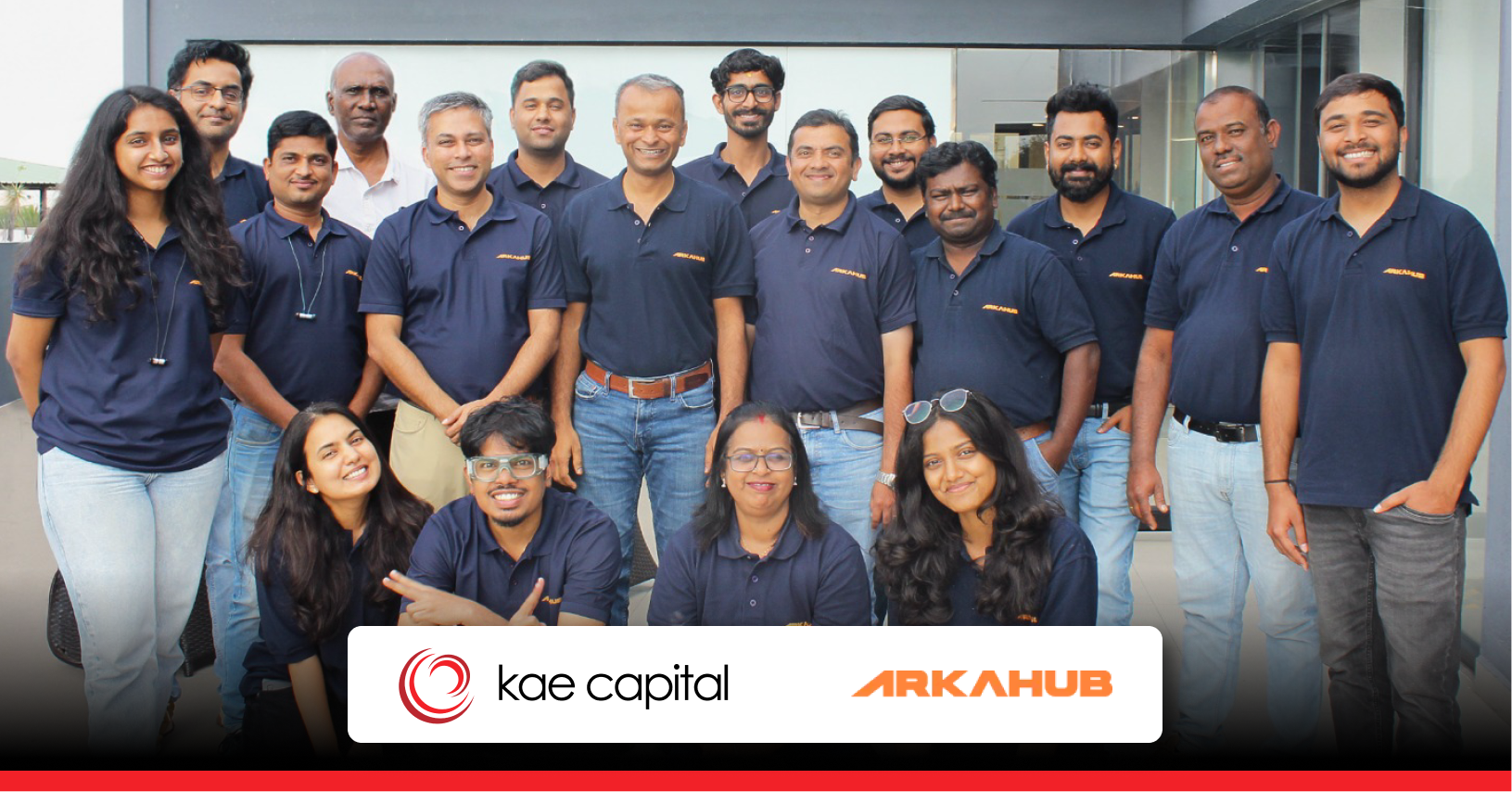
Why We Invested in Arkahub

India is entering a decade where energy resilience will increasingly be tested at home. Rapid urbanisation, rising power demand, climate volatility, and grid constraints are making reliable electricity a daily concern for households.

We believe this shift is creating a new consumer category: a Home Energy OS that enables households to generate, store, and manage power seamlessly. Arkahub is building consumer-grade home energy solutions tailored for India’s evolving needs.

The Problem: A Broken Buying Experience

Despite strong consumer intent, residential rooftop solar adoption in India remains extremely low. The core issue is not demand, but how the market is structured.

Buying solar today means navigating a fragmented, B2B-style EPC ecosystem with no trusted, unified solution. Discovery is informal and inefficient, driven by neighbour referrals, WhatsApp forwards, or manual searches through empanelled vendors. Execution only deepens the trust deficit. Vendors frequently overcommit and underdeliver, installation timelines stretch unpredictably, and post-installation support is inconsistent.

Poor system design, mismatched roof layouts, substandard components, and little attention to aesthetics further erode confidence. High upfront costs, opaque financing options, and unclear subsidy eligibility add even more friction. As a result, residential rooftop solar remains a service-heavy, trust-deficit category, and most homeowners, despite interest, choose to opt out.

The Insight: Solar Needs to Be a Consumer Product

Rooftop solar is still sold like infrastructure. Arkahub flips this model entirely.

They are building solar the way successful consumer categories are built: standardized, engineered, aesthetic, and easy to buy, own, and maintain. The experience is designed to feel closer to purchasing an AC or a TV than managing a construction project.

Under the hood, Arkahub is a deeptech platform. By combining indigenised solar hardware, smart inverters, energy monitoring software, and end-to-end system design. This integrated approach simplifies complexity while delivering reliable, consumer-grade performance across diverse Indian homes. This integrated approach lets them scale a seamless, trustable experience that traditional EPC-led solar cannot match.

The Arkahub Approach

Arkahub’s product vision is anchored around simplifying complexity without compromising performance

Key elements include:

  • Indigenised solar kits designed for different home types, tailored to roof structure, energy needs, and budget.
  • Full-Lifecycle Home Energy Management, delivered through a digital platform that manages design, approvals, installation, monitoring, and service, complemented by physical experience stores (launching soon).
  • Aesthetic-first engineering, with clean mounting systems, integrated inverter design, and consistent fabrication standards that are designed for how Indian homes actually look and function.
  • Built-in performance and support, including real-time performance dashboards, automated cleaning reminders, predictive maintenance, and trained in-house installation teams.

The result is a tightly controlled, end-to-end experience that removes uncertainty at every step of the customer journey.

Why This Is Interesting

Rooftop solar in India remains severely underpenetrated. Of an estimated ~637 GW of residential rooftop solar potential, only ~8 GW has been installed as of today. Adoption remains well below 1.5%.

At the same time, the underlying drivers have never been stronger. India is entering a decade of household energy transition. Electricity demand is rising, grid tariffs continue to climb, climate awareness is increasing, and government-backed incentives such as PM Surya Ghar Yojana are nudging consumers towards greater control over their energy use.

Yet adoption continues to lag because the ecosystem has not evolved. The market remains unstructured, service-heavy, and deeply trust-deficient. This gap between intent and execution is precisely where category-defining consumer brands get built.

Rooftop solar is fundamentally an execution-led category, and this is where Arkahub differentiates itself. Founders Manish Pansari  and Kaustabh Chakraborty bring over a decade of experience scaling consumer businesses where logistics, installation, and service quality are integral to the product, enabling them to build trust through standardised, on-ground execution at scale.

A Much Bigger Vision

Solar is Arkahub’s entry point, but the long-term advantage is how the stack gets productised beneath each installation. As the company scales, it is standardising hardware, system design, and installation workflows, while layering software led energy intelligence on top. This creates compounding know how and tighter control over performance, cost, and reliability.

With this foundation, Arkahub can expand naturally into battery storage, EV charging, apartment and balcony solar, and deeper energy optimisation without rebuilding distribution. What begins as a single purchase becomes a long term relationship with the home. We believe this positions Arkahub to build a durable consumer energy platform and a category defining brand in India’s clean energy transition.

Why We Invested in SuperLiving?

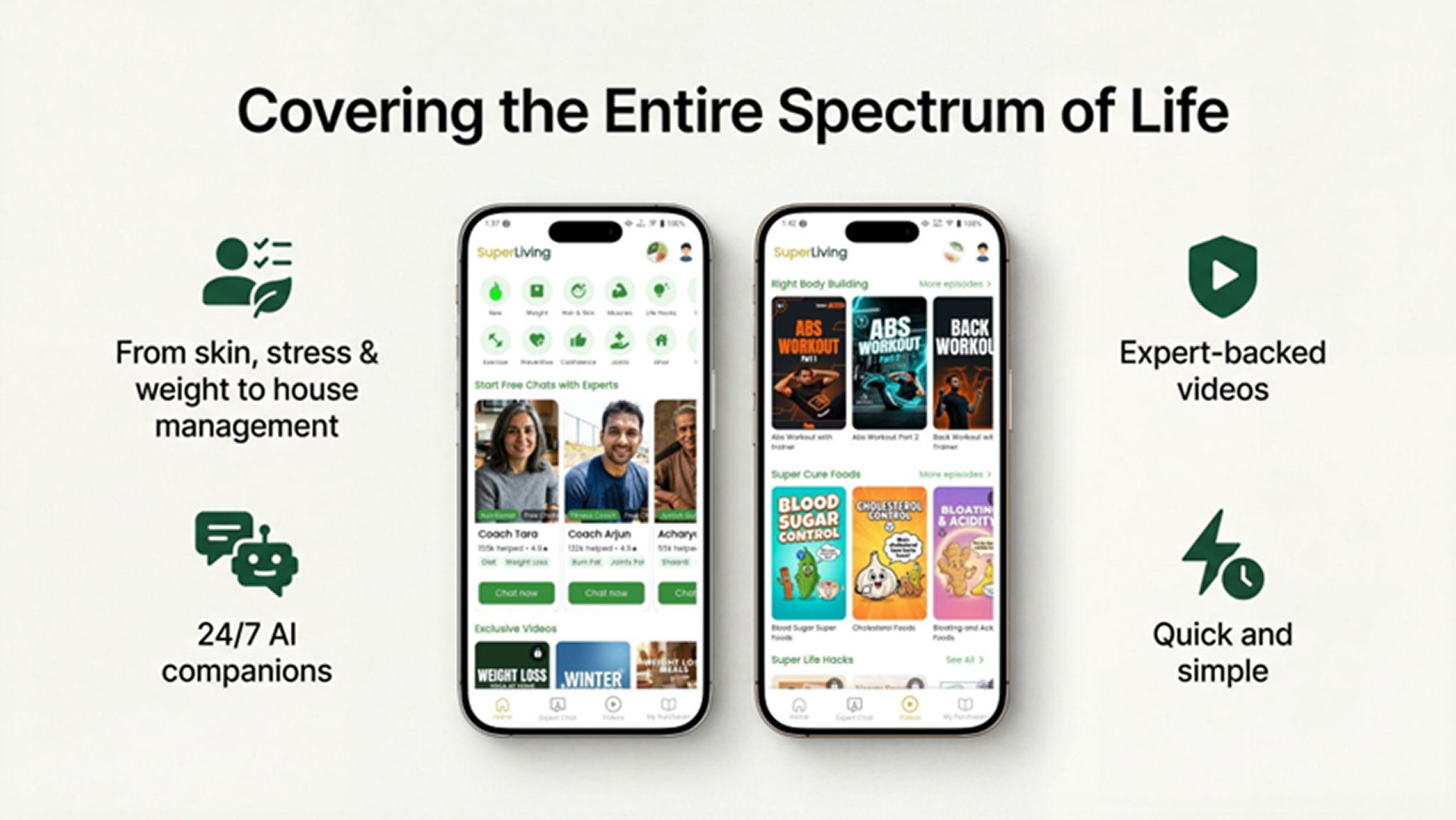
SuperLiving is building an AI-powered preventive health platform for Bharat, combining AI health companions and bite-sized courses to convert everyday lifestyle choices into lasting health outcomes.

Building for Bharat

Travel from Bathinda to Bhiwadi, Varanasi to Vishakapatnam and you will see the same story unfold. A homemaker runs a household like a COO, yet cannot find 15 minutes for herself. A mentally drained husband tries to show up better for his wife and kids but feels too worn down to try. A young couple tiptoes around conversations about weight and fertility, unsure of whom they can trust and too embarrassed to seek help.

This is the reality for millions in Tier 2 and Tier 3 India, not sick enough for a doctor, but uncomfortable enough to know that something is wrong. Fatigue, gut issues, joint pain, poor sleep, and low energy plague people’s lives, forcing them to struggle in silence.

SuperLiving is being built for this Bharat, where wellbeing is a daily discipline, helping people regain confidence, stay ahead of lifestyle-led issues, and live healthier, more fulfilling lives.

The Real Barrier to Better Health in Bharat Isn’t Knowledge, It’s support

Most people already know the basics. Eat better, move more, sleep on time, hydrate. The real challenge is doing it consistently while juggling work, kids, aging parents, financial pressure and the chaos of everyday life. In Bharat, that friction is sharper. Hiring a nutritionist or coach simply does not fit into most family budgets. Doctor visits are reserved for emergencies, and rarely go deeper than the symptoms.

So people turn to whatever they find – WhatsApp forwards, Youtube, reels, trending diets and free advice that is quick, catchy and mostly unreliable.

Ask why people fail and you won’t hear ignorance, you’ll hear overwhelm. “I want to start but I cannot keep up. I do not know what truly applies to me. I wish I had someone to ask when I hit a wall”. That is the reality for millions. Information is scattered, motivation comes and goes, and no one is there on the days when discipline runs out.

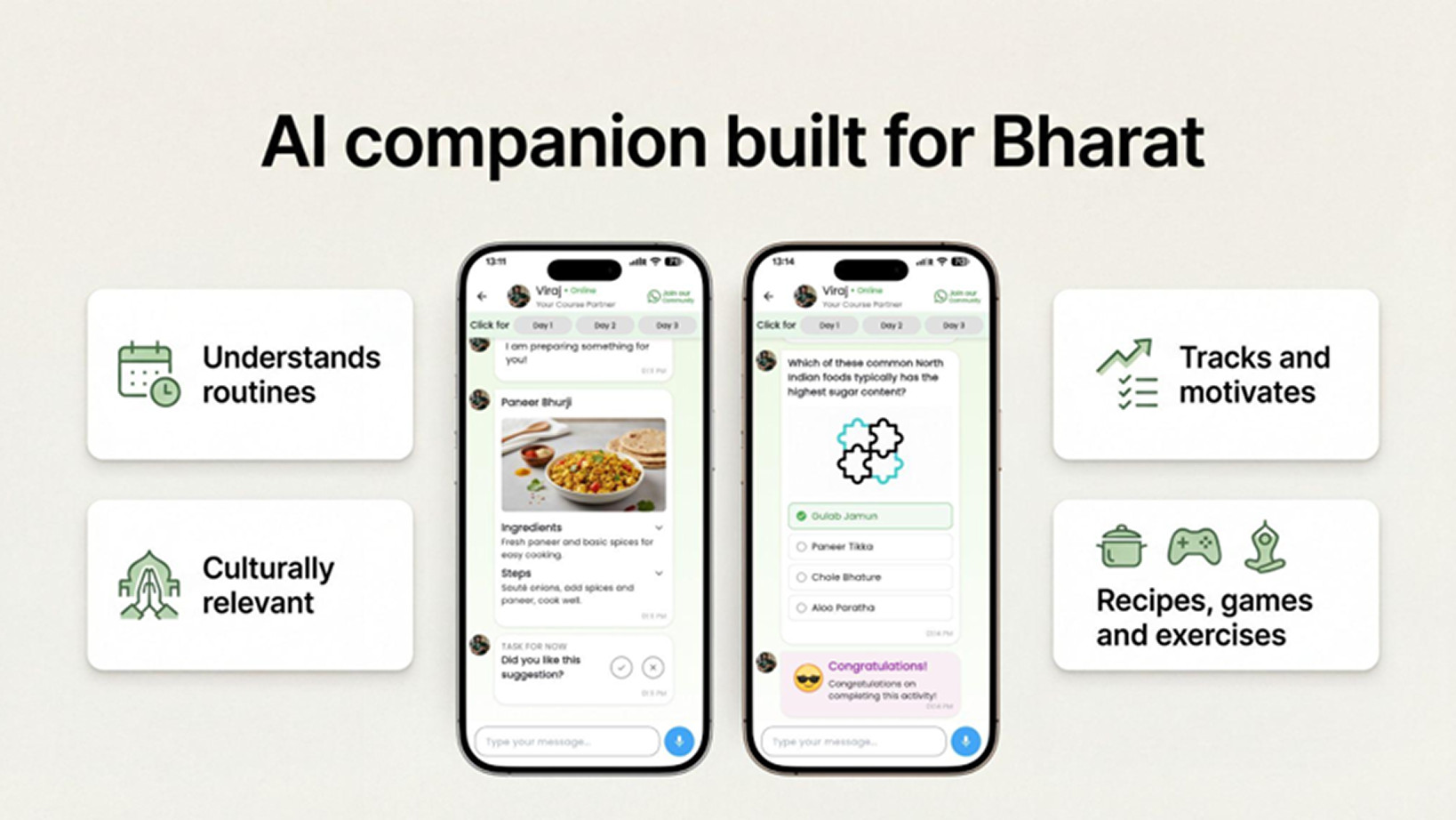
SuperLiving’s mission is simple: every Indian deserves a personal wellness companion that understands their life, culture, and constraints, and offers guidance that adapts and grows with them. AI has finally made this kind of support accessible to everyone, not just the privileged few.

Designed for real life, not ideal circumstances

SuperLiving provides bite-sized courses designed for real routines (from full body transformation and sugar control to muscle gain, skin care and hair health). They club this with micro-content in the form of snackable series, visual hacks and practical demos shaped for how Bharat consumes content today. The app has created a new category of “Lifetainment” content that makes even complex topics seem entertaining. All of this is backed by a 24×7 human-like AI companion that checks in, answers doubts, nudges users forward, making change feel achievable rather than overwhelming, with courses priced accessibly between INR 99 and INR 250.

The SuperLiving experience is built for how people actually live. It uses vernacular content, gentle nudges and tiny daily habits. They do not assume access to gyms, expensive ingredients, long hours of free time or the picture perfect routines you see on social media. It understands the constraints most people carry every single day and chooses to work within them, not against them.

Stories from the ground say it best. A 38 year old man from Haryana wanted to run again but life kept getting in the way. SuperLiving helped him rebuild stamina through stretch first routines and meals he could put together between work calls. Today he is training for a 5K, spending INR 250 a month instead of INR 4K on a personal trainer. A 46 year old boutique owner from Bathinda, who had quit every diet plan by week two, has now lost 7 kg in 2 months, walks an hour a day and swapped doom-scrolling for guided cooking and yoga simply because the plan met her where she was.

Along the way, SuperLiving is also collecting and learning from real-world user behaviour across 115+ lifestyle parameters, giving the platform a constantly improving understanding of what works for Bharat in practice, not just theory.

Wellness is no longer aspirational or metro-only. Urban fatigue has seeped into small towns, Bharat is adopting technology faster than most assume and while many AI offerings chase the top percentile, 73% of SuperLiving’s paying users come from Tier 2 and beyond.

Why We Backed SuperLiving?

What drew us to SuperLiving wasn’t just the idea, it was the people behind it.

Manavdeep Singh Grover, an engineer and IIM Lucknow MBA, brings lived experience with health struggles and a track record of building new verticals that unlock overlooked value, first at Meesho and then at PocketFM. His ability to spot gaps early and scale with intention is evident in how quickly SuperLiving is evolving.

Gurjot Kaur, also an engineer and IIM Lucknow MBA, anchors the cultural and content strategy. She previously scaled fashion and discovery at Meesho and shaped high engagement content experiences at PocketFM. Her content-first lens makes SuperLiving feel familiar, relevant, and non-intimidating.

Together, they balance urgency with empathy and strategic depth, giving the product heart as well as momentum.

At its core, we’re backing an operating system for everyday living and self care. Something every Indian deserves access to, not just those who can pay heavily or live in metros. Our belief is simple: India’s next major consumer category will be preventive lifestyle guidance that’s affordable, personal, and culturally rooted.

SuperLiving is building that future. Not with fear or diagnosis, but through clarity, companionship, and consistency. This is just the first chapter, as personalization deepens and behaviour data compounds, SuperLiving will define a new playbook for preventive health at scale. That’s a journey we’re proud to support.

Stealth Mode or Building in Public? A Founder’s Guide to Choosing

Every few months, a founder tweets their revenue dashboard and the replies divide into two camps. Half praise the transparency. The other half warn about competitors. Someone says “execution matters more than ideas” and someone else counters with “but why give them a head start?”

Both sides have a point. And that’s the problem.

This debate has become almost philosophical, like arguing about the right way to build a company. But it’s not about philosophy. It’s about understanding what actually protects your business and what you gain by keeping secrets or sharing them.

Most founders choose stealth or public based on what they see other successful founders doing, without understanding why it worked for that specific company at that specific time. They pick a strategy that feels right rather than one that fits their actual situation.

Here’s what actually matters: the structure of your competitive advantage, the nature of your market, and the resources you have access to. Get those three things clear, and the strategy becomes obvious.

Let’s break it down.

Why This Decision Is Harder Than It Seems

The default for most founders is what I call “semi-stealth by accident.” They’re not deliberately building in public, but they’re also not organized enough to maintain true stealth. They have a basic website, maybe some social media presence, but no real strategy behind what they share or hide.

This is actually the worst outcome. You get none of the benefits of true stealth (competitor confusion, narrative control, focused execution) and none of the benefits of building in public (feedback loops, community, organic marketing).

The real question isn’t “stealth or public?”

The real questions are:

  1. What specific advantage am I trying to protect or build?
  2. What does my market reward or punish?
  3. What resources do I actually have?

Let’s work through each of these.

Understanding When Stealth Actually Makes Sense

Let’s be clear about what stealth mode really is. A stealth startup is a company that operates under the radar, keeping its plans, products, and sometimes even its existence hush-hush from the public and competitors.

Most startups that claim to be in stealth are just pre-product. Real stealth mode requires something genuinely worth protecting.

When stealth mode is the right strategic choice:

1. You’re building something that takes years and can be replicated in months

Superhuman was built in private for more than two years before launching in 2017; Rahul became so absorbed by the idea of finding their product-market fit that he devised an engine based on customer surveys, and Superhuman is now one of the hottest tech startups on the market with over 300,000 people on its waiting list and a $260 million valuation.

Superhuman wasn’t in stealth out of paranoia. They were in stealth because they needed two years to achieve true product-market fit without the noise of public opinion. If they’d launched publicly at month six with a good-but-not-great product, they would have been dismissed as just another email client.

The stealth period bought them time to become exceptional before anyone could form an opinion about them being merely adequate.

2. You’re in a market where well-resourced players can move fast

This stealth-mode approach is most common in highly competitive sectors such as artificial intelligence, cybersecurity, biotechnology and deep tech, where first-mover advantages are critical and development cycles can span multiple years.

If you’re building in a space where a large tech company or well-funded competitor could replicate your product in three months with a team of 50 engineers, stealth mode isn’t paranoia. It’s smart positioning.

Siri’s stealth mode strategy is a textbook example of how secrecy can build momentum; its original domain name was literally Stealth-Company.com with no contact info, no phone number, no address, just a mystery; by the time Siri launched it was a fully developed product ready to scale, and two weeks later Apple called.

Siri’s team understood that voice assistants were obviously valuable. Apple, Google, and Microsoft all had the resources to build one. The only path to winning was to build it completely, prove it worked, and get acquired before the giants entered the space.

3. Your competitive advantage lives entirely in the technology

Some startups win because they have superior technology. Most win because they have better distribution, stronger brand, or faster execution. If you’re in the first category, stealth might make sense. If you’re in the second, it probably doesn’t.

Here’s the key question: if your competitor knew exactly what you were building, could they beat you to market? If yes, you don’t have a distribution advantage, you have a timing advantage. That’s valid, but it requires protection.

When stealth mode might be hesitation in disguise:

Many founders choose stealth not because of strategic advantage, but because of natural hesitation. They’re worried about:

  • Looking inexperienced if the product isn’t perfect
  • Competitors discovering their idea
  • Premature judgment from investors or press
  • Committing publicly to a specific direction

Here’s a useful test: if someone announced tomorrow they were building exactly what you’re building, would your startup be in serious trouble? If not, you probably don’t need stealth mode. The hesitation might be about something else.

Understanding When Building in Public Works

Building in public has become increasingly popular, especially in the indie hacker and solopreneur communities. But like any strategy, it works brilliantly in some contexts and fails in others.

What building in public actually means:

Building a startup in public is all about sharing the journey as it happens: the wins, the setbacks, the thought process behind key decisions.

It’s not about posting revenue numbers for social validation. It’s about sharing the actual decisions you’re making, the trade-offs you’re weighing, and the results you’re seeing, so others can learn and so you can get valuable feedback.

When building in public becomes your competitive advantage:

1. You’re in a crowded market and differentiation comes from connection

If you’re building in a space with many alternatives, your product might not be 10x better on day one. But your relationship with customers can be. Your willingness to be transparent and human can become the differentiator.

Roam Research used this approach by connecting with their targeted user group through Product Hunt, Twitter, LinkedIn, and Reddit; they managed to get 10,000 subscribers two months after launch, developing engaged communities on Slack, Reddit, and Github.

Roam’s product wasn’t dramatically more polished than Notion. But they built a devoted following by involving users in shaping the product and making them feel like insiders rather than customers.

2. Your product improves with continuous user input

If your competitive advantage comes from rapid iteration based on user feedback, building in public accelerates that cycle. Every person following your journey is a potential early adopter. Every piece of feedback helps you build something better.

Building in public allows for instant credibility; transparency shows confidence, and when founders share their journey openly they’re proving they believe in their vision and inviting others to believe in it too.

3. You’re building credibility from scratch

If you’re a second-time founder with successful exits, you already have credibility. People take your calls. Investors know your name.

If you’re a first-time founder from a non-traditional background, building in public is one of the fastest ways to establish credibility. Your transparency becomes proof that you’re serious, thoughtful, and committed to learning.

When building in public might be more performance than strategy:

The challenge with building in public is that it can become performative. Some warning signs:

  • Sharing only vanity metrics without context
  • Broadcasting every small win to maintain momentum appearance
  • Performing vulnerability without genuine openness
  • Optimizing for engagement rather than useful feedback

Effective building in public means sharing the decisions you’re struggling with, not just the ones you’ve already made. It means genuinely asking for help, not just documenting success. It means being honest about what’s not working, not just celebrating what is.

The Real Trade-Offs (Beyond the Obvious)

Everyone knows the surface-level trade-offs. Stealth means less feedback, public means visibility to competitors. But the deeper trade-offs are more nuanced and often more important.

What you actually give up with stealth:

1. The discipline that comes from public accountability

Lack of user feedback is key in tech, especially when building a new product that relies on user interaction; without this pivotal resource, the stealth startup is at a major disadvantage.

When you build in private, it’s easier to iterate in circles without making real progress. Public accountability forces clarity. You need to articulate what you’re doing and why, which often reveals gaps in your thinking.

2. Access to talent that’s motivated by mission

A stealth startup is often a red flag for experienced prospective employees; people generally want to know what they will be working on and dedicating their time to, and limited information in a job listing could cause most professionals to pass over it.

The best early employees at startups aren’t primarily motivated by compensation. They’re motivated by mission, learning, and being part of something meaningful. If you can’t tell them what you’re building, you can’t inspire them.

You’ll still be able to hire, but you’ll attract people who are motivated primarily by equity and salary. Those people tend to leave when they get better offers.

3. The serendipity of public presence

Some of the best opportunities that come to startups are unplanned. Someone sees your post and introduces you to a perfect customer. A journalist discovers your blog and writes about you. An investor you weren’t targeting reaches out.

Stealth mode eliminates most serendipity. Growth becomes more planned and controlled, which can be good, but you also miss unexpected opportunities.

What you actually give up building in public:

1. The ability to pivot quietly

When you build in public, every significant change becomes a public acknowledgment that your initial direction needed adjustment. That’s healthy in principle, but it can be challenging in practice.

Extended stealth can raise concerns; if investors don’t see steady progress, they may start questioning whether things are on track or if there’s cause for concern.

In stealth, you can test multiple approaches and only reveal the one that succeeded. In public, you need to explain why earlier approaches didn’t work out.

2. The time investment in narrative management

Building in public requires ongoing time investment. Each week, you decide what to share, how to frame it, how to respond to feedback and questions.

Being in the public eye can distract your team and hurt your business; if you want to focus on just your product or service without worrying about variables like branding or public relations, a stealth mode startup may be your best strategy.

For some founders, public engagement is energizing. For others, it’s draining. Be honest with yourself about which category you fall into, because it will significantly impact your productivity.

3. The subtle pressure to optimize for appearance

Once you start sharing metrics publicly, there’s natural pressure to show consistent improvement. This can lead to optimizing for metrics that make good updates rather than metrics that genuinely matter for your business.

You might ship features that look impressive rather than features that solve core customer problems. You might pursue growth tactics that create short-term numbers rather than sustainable business health.

The Framework for Deciding

Here’s how to actually make this decision for your specific situation:

Step 1: Identify your actual competitive advantage

Be honest about what it is right now, not what you hope it will become:

  • Technology advantage: You’ve built something technically difficult that would take competitors significant time to replicate
  • Distribution advantage: You have unique access to customers, channels, or networks
  • Insight advantage: You understand the problem better than anyone because you’ve lived it deeply
  • Execution advantage: You can ship, iterate, and operate faster than competitors
  • Brand advantage: People trust you or connect with your story in a way that’s hard to copy

If your primary advantage is technology, stealth might make sense. For most other advantages, building in public probably serves you better.

Step 2: Understand what your market rewards

Different markets have different dynamics:

Markets that tend to reward privacy:

  • Enterprise software (buyers often prefer established-seeming companies)
  • Regulated industries (public sharing can create compliance complexity)
  • Deep tech (well-resourced competitors can out-execute if they see you coming)

Markets that tend to reward transparency:

  • Consumer products (people connect with brands they feel they know)
  • Developer tools (technical audiences trust transparent, technical founders)
  • SMB software (small businesses appreciate companies that feel approachable)

Step 3: Assess your actual resources

Stealth startup strategy requires operational sophistication and industry credibility, which explains why it’s dominated by veterans from major tech companies or experienced entrepreneurs.

Stealth mode requires more resources because you need to:

  • Hire without the ability to sell a public vision
  • Build brand awareness later rather than continuously
  • Fundraise without public proof of traction

If you’re a first-time founder with limited capital and a small network, stealth mode is challenging. Building in public gives you access to feedback, community, and credibility that would otherwise require significant resources.

If you have an established reputation and strong funding, you can afford the costs of stealth mode.

The Hybrid Approach (What Many Smart Founders Do)

The most sophisticated founders don’t choose full stealth or full transparency. They operate with selective openness.

What typically makes sense to share:

  • Your mission and the problem you’re solving
  • Interesting challenges you’re working through and your thinking process
  • Lessons you’re learning that could help others
  • Enough traction information to build credibility without revealing strategic details

What typically makes sense to keep private:

  • Specific product roadmap and upcoming features
  • Detailed financial information that could affect negotiations
  • Customer names and specifics (unless they’ve given permission)
  • Technical implementation details that constitute your advantage

Some startups operate in partial stealth mode where the company is publicly known, but specific details such as the product, funding, or customers remain confidential.

Stripe is an excellent example of this approach. They’ve always been public about their mission of making payments easier for developers. They built strong awareness and trust in the developer community. But they’ve been quite private about their actual product roadmap, expansion plans, and strategic partnerships until ready to announce.

This gave them the benefits of building in public (community, feedback, brand) without the downsides (competitive intelligence, premature judgment).

Case Studies: When Stealth Works and When Public Works

Superhuman: Stealth Done Right

Superhuman was built in private for more than two years before launching in 2017; Rahul became so absorbed by the idea of finding their product-market fit that he devised an engine based on customer surveys, and Superhuman is now one of the hottest tech startups on the market with over 300,000 people on its waiting list and a $260 million valuation.

Why it worked: Rahul Vohra understood that email clients are judged on experience quality. Launching publicly at month six with a good product would have positioned them as “another email client.” The two-year stealth period gave them time to become genuinely exceptional.

Roam Research: Building Community Through Openness

Roam Research used this approach by connecting with their targeted user group through Product Hunt, Twitter, LinkedIn, and Reddit; they managed to get 10,000 subscribers two months after launch, developing engaged communities on Slack, Reddit, and Github.

Why it worked: The note-taking space is crowded. Roam’s product wasn’t dramatically better than alternatives on day one. But by building in public and involving early users in shaping the product, they created strong community devotion. Users didn’t just use Roam, they became advocates.

The Pattern:

Superhuman and Roam made opposite strategic choices and both succeeded. The commonality: both understood their specific competitive advantage and optimized their approach around it. Superhuman’s advantage was achieving perfection (required stealth to reach it). Roam’s advantage was community (required transparency to build it).

Closing Thoughts

There’s no universally right answer here. The choice depends on your specific situation: your advantage, your market, your resources.

If you’re still uncertain after working through the framework, consider defaulting to building in public. It’s generally the lower-risk choice for first-time founders. You’ll learn faster, build credibility more quickly, and avoid the isolation that can hurt stealth-mode startups.

The key is to do it authentically. Share genuine struggles, not curated highlights. Ask real questions, not rhetorical ones. Be transparently transparent, not performatively vulnerable.

The founders who succeed aren’t necessarily the most secretive or the most public. They’re the ones who understand what they’re protecting, what they’re building, and they make intentional choices based on their specific situation rather than following trends.

Make the choice that fits your startup, not the choice that fits someone else’s.

Decision Framework

Consider Stealth If:

  • You’re building deep tech requiring extended development time
  • You’re in a space where well-resourced competitors could move quickly
  • You’re an experienced founder with an established network
  • Your advantage is primarily technical and could be replicated easily
  • You have resources to operate without public presence

Consider Building in Public If:

  • You’re a first-time founder establishing credibility
  • Your product benefits from continuous user feedback
  • You’re in a crowded market seeking differentiation
  • Your advantage is execution, community, or brand
  • You have limited resources and need organic growth

Consider Hybrid If:

  • You need feedback but have strategic elements to protect
  • You’re raising funds and need to demonstrate traction
  • You’re hiring actively and need to attract talent
  • You want brand awareness while protecting competitive information

Most founders will find the hybrid approach most effective. Share your thinking and mission openly, protect specific strategic details.

EdTech’s Second Act: Supernova and the 95% Nobody Served

Most founders will tell you about their pivots in hindsight, when the narrative is clean and the outcome is known. Maharishi RB, Anirudh Coontoor, and Nawin Krishna lived through three of them in two years, burning just $250K of their $1.1M raise before finding what actually worked.

This is the story of how Supernova went from gamified math worksheets to becoming an AI English tutor reaching $1M ARR in a single state (Tamil Nadu) and why that journey matters more than the destination.

India’s Education Revolution Needs a Second Act

Indian EdTech wrote one of the most remarkable growth stories of the last decade. Companies like BYJU’S, Vedantu, and Unacademy proved that Indian parents would pay for quality education. They digitized learning at scale. They created thousands of jobs. They brought live teaching to homes across the country.

But here’s what else happened: the entire industry optimized for the same 5% of families.

The playbook was consistent across players. Target affluent urban families. Charge ₹50,000 to ₹150,000 for annual courses. Invest heavily in performance marketing and inside sales teams. Focus on competitive exams where ROI is measurable and parents are already desperate.

It worked spectacularly until market saturation hit. Customer acquisition costs climbed. Competition for the same cohort intensified. Growth rates that once made investors salivate started looking pedestrian.

Meanwhile, India has 250 million kids under 18. EdTech’s first wave captured maybe 12-15 million of them. The rest attend government schools or affordable private schools charging ₹15,000 to ₹20,000 annually. Their parents care deeply about education but can’t afford existing solutions. Their learning needs are just as urgent but completely unserved.

This isn’t a market failure. It’s a massive white space hiding in plain sight.

Pivot One: When Good Enough Isn’t Good Enough

The first version of Supernova was an interactive worksheet and quiz platform for kids aged 4-12, covering Math, Science, and English. Think Kahoot meets CBSE curriculum with better design and social features.

The logic seemed sound. Worksheets and quizzes already exist in schools. Kids do them anyway. Make them engaging, live, social, and gamified, and you’ve got something parents and teachers want.

They built it. They shipped it. Early feedback was positive. Usage was decent.

But something was off. The product was good but the problem wasn’t urgent enough. Teachers weren’t desperately searching for better worksheets. Parents weren’t losing sleep over quiz engagement. It was a nice-to-have in a world where EdTech needs to be a must-have to break through.

The team had the honesty to admit it wasn’t working and the discipline to move on quickly.

The Pivot We Don’t Know About

Between gamified worksheets and the AI English tutor, there was at least one more pivot. The details are sparse, but the data point matters: the team burned only $250K across three different product directions.

That number tells you everything about how they operate. Most founders spend six months building what could’ve been validated in six weeks. They fall in love with solutions before confirming problems. They conflate spending with progress.

The Supernova team ran lean experiments. They learned fast. They killed ideas faster. Every dollar not burned in a bad direction was a dollar available to double down when they found the right one.

Capital efficiency isn’t about being cheap. It’s about being intellectually honest.

The Insight: English as India’s Gateway Skill

By late 2023, they’d landed on something fundamentally different: an AI-powered English speaking tutor for kids. Not reading comprehension. Not grammar worksheets. Spoken English fluency.

The insight came from asking a better question: What single skill has the highest ROI for the 95% of Indian kids nobody’s serving?

English fluency is the gateway. It unlocks better schools, better colleges, better jobs, better life outcomes. Parents know this. Kids know this. It’s why English-medium schools command premiums even in small towns. It’s why parents stretch budgets to afford spoken English classes.

But supply can’t meet demand. Good English teachers are expensive and scarce. Live tutoring doesn’t scale. Traditional apps are asynchronous, boring, and terrible for developing speaking confidence.

Then LLMs happened.

Suddenly, you could build a conversational AI that actually felt natural. One that could listen, correct pronunciation in real-time, adapt to a kid’s level, and do it at a marginal cost approaching zero. One that was always available, endlessly patient, and never made kids feel stupid for making mistakes.

The timing was perfect. The technology was finally good enough. The market was desperately underserved. And the team had the right combination of product, engineering, and EdTech experience to nail the execution.

The Tamil Nadu Strategy: Deep Before Wide

When most startups find product-market fit, they immediately try to scale nationally. Supernova did the opposite. They went obsessively deep in one state: Tamil Nadu.

The reasoning was clear-eyed. English learning isn’t generic. Tamil speakers face different pronunciation challenges than Hindi speakers. Cultural references that land in Chennai don’t land in Lucknow. Marketing channels that work in one region don’t work in another. Local word-of-mouth networks matter enormously in EdTech.

Instead of being mediocre in fifteen states, they chose to be exceptional in one.

The decision paid off. Supernova hit $1M ARR from Tamil Nadu alone. Daily active usage was high. Completion rates were strong. Parents were telling other parents. The organic growth signal was unmistakable.

When you have that kind of clarity in one market, investors notice. All of Supernova’s early backers (Kae, Lumikai, All In, AdvantEdge, Goodwater) doubled down in the next round. Some went 2-3x their previous check size.

That’s not just confidence. That’s conviction based on seeing real traction in a focused geography.

What They Got Right: The Boring Stuff That Matters

The Supernova story isn’t about a viral moment or growth hack. It’s about operational discipline that sounds boring but compounds over time.

Capital Efficiency as Operating System

Three pivots on $250K isn’t luck or austerity. It’s a function of how they work. Run cheap experiments. Kill bad ideas fast. Don’t mistake activity for progress. It’s the kind of muscle memory you can’t fake.

Building for Users They Actually Understand

The founders didn’t study the 95% market through user research and surveys. They grew up in it. When you’re from a smaller town and education changed your trajectory, you don’t need focus groups to understand what matters. You know it bone-deep.

Focus as Competitive Advantage

The Tamil Nadu strategy wasn’t about budget constraints. It was strategic discipline. They wanted to solve regional nuances completely before scaling. Most founders don’t have the patience for this. Supernova made it non-negotiable.

No Teacher Supply Constraints

Traditional EdTech has a fundamental bottleneck: hiring, training, and retaining quality teachers at scale. Supernova eliminated it entirely. Their AI tutor can serve ten students or ten million students with the same unit economics. That’s not an incremental advantage. That’s a different business model.

The White Space Gets Bigger From Here

EdTech’s first wave proved India would pay for digital education. Now the question is: who does the second wave serve?

The affluent top 5% is saturated. Growth there means fighting over the same families with higher CAC and unsustainable unit economics. That’s not a venture outcome. That’s a treadmill.

The real opportunity is in the 240 million kids everyone else ignored. Families earning ₹5-15 lakhs annually in tier 2/3 cities and towns. Parents who value education intensely but need solutions under ₹5,000 per year. Kids in government and affordable private schools who deserve the same quality of learning as their urban peers.

This market was impossibly hard to serve profitably until recently. Live teacher models didn’t work at these price points. Recorded content didn’t drive outcomes. Marketing costs were prohibitive for low ARPU customers.

AI changes the entire equation. You can deliver genuinely personalized, conversational learning at scale with marginal costs approaching zero. You can operate profitably at price points the first wave of EdTech couldn’t touch. You can reach families through digital channels that didn’t exist five years ago.

The timing is perfect. LLMs are good enough. Smartphone penetration has reached critical mass in tier 2/3 India. Parents increasingly see English fluency as non-negotiable for their kids’ futures. The infrastructure is in place for someone to build at scale.

Supernova is betting they’re that someone.

What Comes Next: The Obvious and The Hard

The roadmap from here looks straightforward on paper. Expand beyond Tamil Nadu into Karnataka, Andhra Pradesh, Maharashtra. Deepen language support and regional customization. Layer in more subjects beyond English using the same AI tutor model. Expand age ranges beyond kids into adult learners who need English fluency for careers.

But strategy is always easy. Execution is hard.

The real challenge is maintaining product quality as they scale. LLMs are probabilistic, not deterministic. Edge cases are infinite when you’re working with kids. Maintaining that “feels natural, not like AI” experience at 100,000 users is hard. At 10 million users, it’s really hard.

They’ll also need to resist the gravitational pull toward becoming sales-driven. The unit economics only work if distribution stays organic and product-led. The moment they start building inside sales teams and performance marketing orgs, they become every other EdTech struggling with CAC/LTV math.

The product has to be so good that parents tell other parents. That’s the only sustainable moat in a category this competitive.

Why This Story Matters

Supernova matters because it’s not about AI hype or billion-dollar TAM projections. It’s about founders who had the courage to pivot three times until they found the right problem, the discipline to do it on $250K, and the patience to go deep in one market before expanding.

India’s education challenges won’t be solved by policy alone. They’ll be solved by founders who build scalable, affordable products for the 250 million kids everyone else is ignoring. Who understand that serving the 95% isn’t charity or impact investing. It’s the biggest commercial opportunity in Indian EdTech.

Supernova isn’t there yet. But they’ve proven they know how to find signal in noise, build what matters, and scale what works. For Kae Capital, that’s the bet: not just on what they’ve built, but on how they build.


Supernova was founded in 2021 by Maharishi RB, Anirudh Coontoor, and Nawin Krishna. Kae Capital led their seed round in 2022. The company has raised $4.67M to date from investors including Kae, Lumikai, AdvantEdge, All In Capital, and Goodwater Capital.