Why we Invested in Grapevine

When we first met Saumil, Jainam, and Shreeyash, they weren’t just pitching us one product. They had a clear thesis: careers, and employment in India are all about to be rebuilt by AI, and they wanted to build the ecosystem for it. They already had Grapevine, a pseudonymous professional community where 200,000 white-collar workers talk openly about salaries, workplace culture, and career decisions. The users were real (verified through work emails), and the conversations were the kind people have in private Slack channels but never post publicly. They had clarity on Round1, their AI voice interview platform, and a broader vision for a suite of AI-first products that would sit on top of this community.

We led Grapevine’s $4.1 million round alongside Peak XV and Unilazer Ventures. Here’s what convinced us.

The problem is older than it looks

Recruitment in India hasn’t changed much in almost three decades. The core loop is the same: candidates upload resumes, recruiters keyword-search through databases, and everyone hopes the right people surface. The incumbents added social layers and premium tiers, but still run on text profiles and search queries.

The real issue is that resumes are bad at capturing what matters. They flatten years of work into bullet points. They reward people who are good at writing resumes, not people who are good at their jobs. On the other side, job descriptions are just as lossy. A recruiter’s mental model of what they need rarely matches the JD they publish.

Staffing agencies exist precisely because of this gap. A human recruiter picks up the phone, has a conversation, and figures out things a resume never reveals. But that doesn’t scale. A recruiter can make maybe 15-20 screening calls a day. India’s professional search segment alone is projected to reach INR 8,200 Cr by 2030, with 200,000-250,000 jobs closed annually just through agencies. There’s an enormous amount of manual labor holding this market together.

Where Round1 and TAL Come in

Round1 is an AI-powered voice interview platform. When a company posts a role, candidates don’t submit a resume and wait. They have a conversation. The AI interviewer asks technical and behavioral questions, follows up based on answers, and generates a detailed assessment. The output is a ranked shortlist of the strongest candidates, built from interview transcripts, resumes, and pre-screening data. Profiles are stack-ranked using a chess-style tournament where each candidate is rated relative to the others.

The product works. Companies that have used Round1 tell us the technical pre-screening catches things traditional agencies miss, where candidates who look great on paper get filtered out in a voice conversation. Round1 now conducts over 500 AI-led interviews daily, with about 90% of candidates progressing from the Round1 screen to a company’s next stage.

Then there’s Tal, which launched days ago. Tal is an AI talent agent for Indian professionals. It talks to candidates the way a good recruiter would: understanding their career goals, what they’re actually looking for, what matters to them beyond compensation. From there, it finds matching roles, helps build resumes, identifies the right people to reach out to, and figures out how to approach them.

Round1 solves the employer’s problem: finding the right candidates fast. Tal solves the candidate’s problem: navigating the job market without drowning in noise. Together, they form two sides of a marketplace that incumbents haven’t built because they are fundamentally database businesses, not curation businesses.

Why the timing works

Voice AI has only recently become good enough for production use at this level. Six months before Round1 launched, you couldn’t have built it the way it works today. The latency, the comprehension, the ability to follow up on nuanced answers, all of that required infrastructure that wasn’t commercially viable until very recently.

But here’s the part most people miss: AI isn’t shrinking the hiring market. It’s expanding. Saumil wrote about this recently, and his framing stuck with us: “When software becomes cheaper and easier to build, the world usually doesn’t want less software. It wants more of it.” The Jevons paradox applied to software development. In the old world, maybe a thousand companies could justify building serious software. In the new world, tens of thousands of businesses can, even if each only needs a handful of engineers. As Saumil put it: “More startups, more SMBs, more products, more experiments, more teams. Even if each team is smaller, the number of teams can grow enough that demand for strong engineers still rises.”

This is already playing out in India. A wave of new AI product companies are being built here, with early traction in the US, and the volume of hiring activity Grapevine is seeing from these companies is a signal. The old India IT story of huge teams and giant benches may shrink. But a different, stronger model is growing in its place: smaller teams, better engineers, more product ownership. India’s entrepreneurial base is massive even before the current AI wave. What happens to that number when building software gets 10x cheaper?

The broader staffing and recruitment market in India is projected at INR 15,770 Cr by 2030. Within the professional search segment (people with 3-5 years of experience, Grapevine’s sweet spot), the opportunity is close to $1 billion. Every company that adds AI to its stack, every new AI-native startup that gets funded, every business that can now justify building custom software, all of them need to hire. And as the talent bar goes up, the need for better screening, not just more screening, goes up with it. That is exactly what Round1 and Tal are built for.

Why this team

What stood out about this team was how deeply they understand the Indian white-collar professional. They didn’t start with Round1 or Tal. They started with Corporate Chat India, a Discord server where 15,000 employees talked anonymously about their companies. That evolved into Grapevine. And Grapevine’s community is what gives them something no other AI recruiting startup has: a living, engaged user base of verified professionals. Employees at some of India’s fastest-growing startups show above 50% adoption rates on the platform.

Saumil was previously at Google and worked on YouTube India marketing. In our conversations, what came through was an obsessive focus on user experience and a product instinct that people around him at Google noticed very early in his career. Shreeyash spent four years at InMobi in product management across gaming, weather, and shopping verticals, and the product work he shipped there still underpins parts of Glance’s US operations. In our conversations, people who worked closely with him described someone they’d back before an idea even had traction. Jainam came from InMobi and Porter’s consumer growth team. Everyone we spoke with flagged the same thing: creative product instincts and an entrepreneurial itch they’d been expecting him to act on for years. Saumil doesn’t just run an AI hiring company. He has a view on where the market is going, and he’s willing to stake the business on it. As he wrote recently: “From close to the hiring market, this doesn’t feel like the beginning of a collapse. It feels like the beginning of something great.” That kind of clarity matters when you’re building in a space where most investors see only risk.

Beyond individual backgrounds, what won us over is how fast this team ships. They went from launching Round1 to seeing serious company interest in weeks. They built voice interview technology that we found to be better than most dedicated voice AI companies we’ve spoken to. And then they shipped Tal, which wasn’t even a concept when we wrote our investment memo a few months earlier. In AI right now, the teams that iterate fastest tend to win. This team iterates very fast.

Their vision

Grapevine already has the retention layer that every other AI recruiting startup is missing. Users come to the app to check salary data, discuss workplace culture, and stay plugged into their professional network. When they’re ready for a new role, Tal is there. When employers need candidates, Round1 delivers.

But the team isn’t stopping at hiring. As previously mentioned, their vision is an ecosystem of AI-first products for the Indian professional: careers, and employment. Grapevine is the community. Round1 is how companies find talent. Tal is how professionals navigate their careers. And what comes next, whether it’s skilling, upskilling, or something we haven’t discussed yet, will sit on the same foundation of verified professionals and AI-native interactions.

The incumbents aren’t well positioned to respond. They have massive resume databases and sales models built around access to those databases. Even if they layered on voice AI, they’d be bolting it onto a fundamentally different product architecture. A curation product would eat into their existing business lines.

Most VCs are skeptical of recruitment startups in India. Fair enough. A lot of startups have tried to disrupt the incumbents over the past decade and ended up becoming agencies themselves. But those companies didn’t have a new technology layer to build on. AI changes what information is available to make hiring decisions. When the information changes, the market structure follows.

We think Grapevine, through Round1 and Tal, is the team best positioned to build the AI-native career ecosystem India needs. We’re backing them to do it.

Why We Invested in Cartesian Kinetics?

The modern “Demand Web” requires logistics to move with the agility of data, yet most fulfillment centers are stuck running on legacy workflows and partial fixes. The paradox is clear: warehouses have an existential need to boost productivity, but current automation leaders have largely ignored the 20,000+ constrained, existing brownfield facilities across the U.S.

Incumbent Automated Storage and Retrieval Systems (ASRS) solutions demand costly, disruptive greenfield rebuilds and infrastructure overhaul, making them inaccessible to existing facilities. Meanwhile, Autonomous Mobile Robots (AMRs) offer flexibility but are fundamentally throughput-limited, struggling to exceed ~100 picks per hour and failing to improve storage density.

Cartesian Kinetics breaks this cycle: Cartesian approaches automation as an intelligence problem, not a hardware problem. Its system augments existing racks and workflows, layering Physical AI (P-AI) that perceives the floor in real time, optimizes every movement, and drives predictable throughput without requiring operators to rebuild their warehouses.

The Real Problem: Warehouses are Dynamic, Not Static

Traditional automation assumes a stable, predictable environment, but real warehouses are dynamic. SKU profiles change, inventory shifts, demand fluctuates, bottlenecks form, machines slow down, and workflows are reconfigured as business needs evolve. Legacy systems struggle because their workflows are rigid and updating them takes months.

P-AI is the core enabler. It doesn’t just execute tasks; it reads the environment, weighs constraints, and autonomously selects optimal actions as conditions evolve.

Cartesian’s stack mirrors the architecture of modern embodied AI agents:

  • Perception through sensors and positional awareness
  • Cognition through task allocation, orchestration, optimization, and digital twins
  • Actuation through robotic systems that adjust to real-world variability.

This is what allows the system to continuously improve and respond, rather than wait for human reprogramming.

The Wedge: A Retrofit System That Actually Aligns With How Warehouses Operate

The primary advantage of Cartesian Kinetics is that the hardware serves only as the entry point, while the software stack transforms Carte+ into a P-AI native system. P-AI systems integrate cognitive intelligence with physical actions, allowing them to flexibly and safely respond to diverse and unpredictable real-world environments. This intelligence-centric approach is what makes retrofit viable at scale, because the system adapts to the warehouse rather than forcing the warehouse to adapt to it.

Carte+ was engineered for brownfield reality. It is an Omni Rack Robotics system that is fully retrofit-native, attaching directly onto existing racks without any need to rip or replace infrastructure. It can be installed aisle by aisle, with full deployment completed in just 8 to 12 weeks. The full-stack architecture (CarteCloud, CarteEdge, CartePLC) then drives the outcomes, using orchestration algorithms and advanced path planning to deliver a 3 to 5x throughput lift, achieve 300+ picks per hour, cut labor costs by half, and generate payback in a little over two years.

Digital Twin (eCarte+)

At the core of the P-AI architecture is the Digital twin (eCarte+) a high-fidelity, physics-based simulation built using Emulate3D that models the entire warehouse before a single robot is deployed. It learns SKU flows, tests routing and operational scenarios, and generates precise hardware and software configurations directly from a customer’s order patterns. By running real order profiles in a human-in-the-loop environment, eCarte+ lets operators evaluate productivity, throughput, and turnaround times upfront, effectively validating ROI before deployment. This “virtual commissioning” sharply reduces engineering cycles, lowers integration risk, and allows customers to plan placements, labor, and throughput with confidence long before installation begins.

The Orchestration Layer

The Carte+ system’s multilayered architecture functions as the “warehouse brain”, coordinating the entire fulfillment process through a modular stack built to support customers at any stage of automation maturity. Its core algorithms, including orchestration and path planning, synchronize racks, robots, conveyors, and human operators as one adaptive system, optimizing SKU placement, minimizing travel distance, and increasing tote presentation rates. The orchestration layer spans WMS for planning, WES for real-time execution, and WCS for hardware control, unifying every subsystem into a single high-throughput, continuously adaptive engine.

The X-Y-Z Framework: How Cartesian Turns P-AI Into a Strategic Moat

Fun fact: the name Cartesian Kinetics comes from Cartesian (coordinate systems) and Kinetics (the study of motion). Fittingly, the team’s P-AI strategy is built along 3 orthogonal vectors, a simple X-Y-Z framework that mirrors the way their system perceives and controls physical space.

X-Axis: Expanding Footprint (From Robotics to Orchestration)

The X-axis represents how the system grows inside a warehouse, moving from powering a single workflow to orchestrating nearly every task on the floor.

By decoupling from hardware and evolving into a Warehouse OS, Cartesian can go from touching <10% of workflows to influencing 90%+ of all movement: picking, putaway, replenishment, batching, routing, charging, and dispatch.

This expansion is powered by Learning Orchestration (CarteCloud), AI models that constantly rebalance work across racks, robots, conveyors, and people. This creates:

  • deeper penetration within each facility
  • stickiness as the AI learns the nuances of that warehouse
  • natural expansion from “robot system” to “warehouse intelligence layer”

Y-Axis: Performance Uplift (Real-Time Optimization at Scale)

The Y-axis measures how well the system performs once deployed.

Through its edge and cloud stack (CarteEdge + CarteCloud), Cartesian makes sub-second micro-decisions across destination allocation, pathing, dynamic charging, and SKU mix optimization.Warehouses behave like living systems, shifting constantly, and real-time inference is what keeps throughput stable. In industrial settings, this approach has consistently reduced downtime and improved cycle times. Cartesian brings that same level of precision to the warehouse floor.

Z-Axis: Operational Certainty (Reliability as a Moat)

The toughest part of automation is not deployment. It is keeping a robotic fleet running consistently, day after day, with minimal downtime.

Cartesian focuses heavily on this layer. The system uses AI-powered predictive maintenance and edge-based fault prediction to identify issues early and prevent disruptions. This is what turns automation from useful to mission-critical. At this point, customers stop viewing Cartesian as a robotics vendor and start depending on them as part of their core operations.

Why This Team?

What stood out to us at Cartesian Kinetics is how naturally the team fits the problem. Each leader has spent years in robotics, supply chain, or enterprise automation, not just studying the challenges but grappling with them first-hand. That depth of experience, paired with the clarity of lessons learned, is what gives us conviction in their ability to build a category-defining company.

Jayendran Balasubramanian leads Cartesian. An IIT Bombay graduate who later completed his MS at Stanford with a focus on Mechatronics. He brings a rare blend of academic depth and hands-on robotics experience. He previously built automation at Nextfirst and experimented with last-mile delivery at Taykit. What stands out is his clarity, speed of thought, and ability to move seamlessly from system-level engineering detail to high-level strategic decision making.

Veena Radhakrishna, brings years across Intel, IBM, and Nextfirst, translating complex robotics workflows into scalable, production-grade software.

Sarjoun Skaff  has deployed robots across 600 Walmart stores and raised over $100 Mn at Bossa Nova, giving him a front-row view into what scaling robotics really takes. Initially introduced to Cartesian as an evaluator, he chose to join full-time, a strong signal of his conviction in both the opportunity and the leadership.

Rounding out the team, Kimberly Barr brings nearly two decades of enterprise automation sales and partnerships, navigating the exact multi-stakeholder environments Cartesian is selling into.

Our Bet

At Kae, our conviction stems from:

  1. The Product Wedge: What stood out to us was how Cartesian approached deployment and control from first principles. The product is designed to work with operational reality rather than ideal conditions, delivering meaningful performance gains without forcing customers into disruptive change. That ability to drive outcomes while fitting seamlessly into existing workflows gives the solution a clear adoption advantage and a credible path to becoming deeply embedded in day to day operations.
  2. An Underserved Market at an Inflection Point: We see Cartesian operating at the edge of a large market undergoing transformation. Brownfield warehouses, long ignored by traditional automation, represent an underpenetrated opportunity where technological and operational pressures are converging. Cartesian’s retrofit-native model does not just compete within the market, it expands it by making automation viable for thousands of facilities previously locked out.
  3. The Team: The team brings rare operating muscle memory from deploying robotics at scale, building enterprise-grade systems, and navigating complex warehouse environments.They know what breaks, what scales, and what customers trust, and they are building Cartesian Kinetics with those lessons baked in

Warehouse automation is entering a new phase. As operational complexity rises and labor, space, and throughput constraints tighten, the next wave of winners will be systems that adapt to reality rather than impose rigidity. Cartesian Kinetics sits at that inflection point, unlocking a vast, underserved segment of the market through an intelligence-led, retrofit-first approach. We are excited to partner with the team as they build the core automation layer that helps warehouses evolve, not break, under pressure.

Audio OTTs’ Day in the sun – Our investment in Eight Network

Audio may be the first entertainment format in human history. Radio broadcasts have entertained audiences at scale for over a century. The advent of the internet helped digital audio platforms to flourish; changing the way people consumed audio content. With Apple launching iTunes in 2001, the popularity of digital music exploded. Since then, new audio formats such as podcasts, audiobooks, storytelling, non-fiction, short-form content etc. have evolved. We are super excited about the opportunity and invested in Eight Network early last year.


The opportunity

While video formats are dominant, audio has tremendous growth potential as it has independent use cases. With the high penetration of smartphones and headphones, there’s a substantial opportunity in the background entertainment space. This helped non-music audio content (growing at a CAGR of 33%) to claim a sizable share in the media & entertainment space, complementing the on-the-go lifestyle of young consumers.

There is a large audience for audio formats in the world. Spotify has over 550 Mn monthly active users (average) in Q3 of 2023; a 26% growth YoY. It is estimated that 170 Mn+ users are listening to audio on a monthly basis in India. While most of them consume music content, the share of non-music content has been going up rapidly. As per the Redseer report, the share of non-music has gone up from 3% in 2019 to 5% in 2023.


Major Indian players

On the music front, the largest players in India have been Gaana, Saavn and Spotify. Some of these have explored podcasts in some shape or form. However, the core offering for these platforms still remains music.

The second wave of companies in the OTT space include PocketFM, KukuFM, Headfone and Eight Network. They vary from each other in the genre and target audience. Pocket FM’s core product offering has been long-format audiobooks and stories. Kuku has focused on the Bharat audience, offering non-fiction content that includes motivation & education in many vernacular languages. 


Eight Network

The latest of these, Eight Network, has focused more on the immersive content around audio shows, live and podcasts.  While short-form content seems to have worked for video, long-form episodic content has worked well for audio platforms to improve retention and engagement.

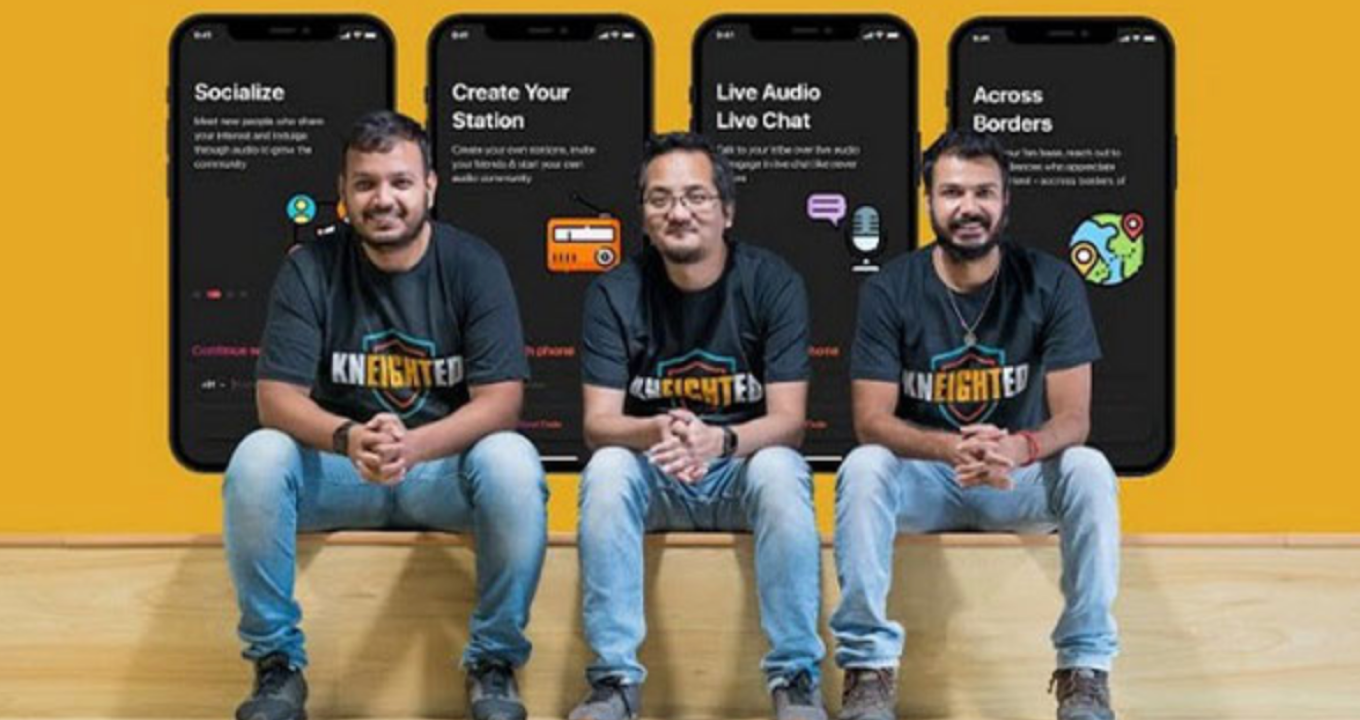
Eight, targeting the young urban demographic, has experienced remarkable customer love, largely because this group has been significantly underserved. Though relatively earlier in the journey than its peers, Eight is currently the highest-rated audio app in India, highlighting its success in meeting the quality its segment desires. The founders Mohit Paliwal, Mohit Goswami and Yugal Tamang are all second-time entrepreneurs and are passionate about the space. They spent some time on Social Radio before they found their PMF in immersive audio shows.


Urbanizing youth segment

Eight focuses on urbanized young consumers. Millions of young content consumers are either semi or completely urbanised and are exposed to high-quality video content on OTTs like Netflix, Prime and Hotstar,  e.g. consumers of Paatal Lok, Sacred Games etc. They have a high expectation of the quality of content. This is a broader trend and not limited to affluent youth.

This user also has periods when he/she can’t look at the screen – such as while commuting, performing certain household or work chores etc. So audio serves as the best means to keep company.


Right to win

Eight is the first and only Audio OTT platform to serve this base of users by offering immersive content in the tone best suited for young audiences. Most of their content is in Hinglish, which sounds very similar to how young Indians converse.

Eight has curated 100s of hours of such premium immersive content. They have a strong tech and community enabled playbook in place and are on the path to host the largest inventory of high-quality audio for young urban consumers. This scalable content strategy offers natural moats for the business at scale. 90% of the audience on Eight is between the 18-34 age bracket and is from the top 15 cities, signifying strong PMF for this segment.


Role of technology and community

Digital platforms have leveraged tech well by supporting creators with tools that help them make high-quality content easier. They have also built creator communities and enabled collaboration between them. AI is being rapidly adopted to make the content creation process faster and easier.

The Eight team recently unveiled the beta version of their creator web tool, Eight Studio, specifically designed to empower podcasters and audio creators. This platform enables creators to collaborate, craft, and directly publish their shows on the Eight App. A standout feature of Eight Studio is its integration of Generative AI technology, which aids creators in developing content ideas, making it an ideal tool for refining concepts at their inception.

What sets Eight as a platform apart is its strong emphasis on community engagement. Already, Live Community at Eight has facilitated the creation of breakthrough content IPs for the company. By launching Eight Studio, the team aims to democratize content creation, offering aspiring creators a platform to expand their reach and cultivate their own audience. 


International play

TikTok, in short-form video, has been super successful in the US. Almost all the above audio non-music OTT platforms have gone international (primarily US). They have both repurposed the content as well as created new content tailored for the US audience. 


Monetization

The digital audio streaming market is estimated at $40 Bn in 2023 by Redseer. Deloitte puts this a bit lower at $30 Bn in 2024. While this is ~25% of the video streaming opportunity, the market is pretty big to create multiple winners – more so if there are global plays.

  • Advertising: According to Statista, the Digital Audio Advertising market is projected to reach $11.13 Bn in 2024. While this seems to be a large opportunity, given the struggles of Indian content platforms to monetize effectively, the new-age audio OTTs have largely stayed away from this – both in India and overseas
  • Subscription – Indian audio OTTs have preferred to go with the freemium model with some content behind a paywall. To keep the retention high even among the unpaid subs, some of them have released new episodes over a period of time


The Indian players seem to have scaled well. Pocket FM has seen multiple content assets such as ‘Insta Millionaire’ and ‘Saving Nora’ that have yielded revenues of $12-15 Mn each. Kuku has over 3 million active paying subscribers.


The explosion of content formats and genres in India and globally has made this an exciting space. Given the revenue scale that some of the players have reached within a span of 5-6 years, large outcomes are possible. It is one of the few spaces where content – from India to the world – is likely to see success.

Investment in GobbleCube

Why GobbleCube?

In the evolving retail e-commerce sector, the global market, valued at $5.3 trillion in 2022, is expected to see significant expansion, with a CAGR of 11.2% through 2030. This growth is driven mainly by the increased use of smartphones and the convenience of shopping from home. Factors such as a wide range of choices, lower prices than in-store, and increased internet usage are enhancing consumer demand globally. The Asia Pacific region contributed a 42% revenue share in 2022. It’s more than just numbers, it’s about our evolving lifestyles and how tech is reshaping our shopping carts.

With the advent of AI, online shopping is anticipated to see an uptick. Innovations such as AI shopping assistants, chatbots, personalized experiences, and tailored recommendations are set to redefine customer service. Additionally, features like real-time interactions and virtual product trials aim to significantly enhance customer engagement and boost conversion rates.

E-commerce penetration is growing rapidly, becoming a key focus for major brands, outpacing traditional retail with a CAGR twice as fast. This growth in e-commerce has led brands to diversify across multiple platforms, adding complexity to their operations. They face challenges in managing revenue and consolidating data across platforms like Amazon, Walmart, Flipkart and various quick commerce sites. The traditional methods of spreadsheets and manual data analysis are proving inadequate for scaling in this fast-evolving landscape.


At Kae, we recognize the genuine need for solutions in complex workflows, seeing great potential in AI for simplification. The GobbleCube team is aptly poised to address this substantial challenge. GobbleCube is the go-to platform for consumer packaged goods (CPG) brands looking for seamless revenue management. Offering real-time analytics, it is essential for enhancing brand visibility, availability, and market presence, factors directly influencing sales.

GobbleCube automates data and decision-making processes across the entire e-commerce value chain to boost share of voice (SOV), minimize out-of-stock (OOS), and prevent revenue leakages, leveraging AI and automation to present brands with actionable insights. This enables brands to focus on executing actions that drive growth and profitability, while it abstracts the entire end-to-end process.

GobbleCube team has a strong founder market fit, with co-founders originally part of Blinkit’s leadership, instrumental in developing India’s major quick-commerce platform. At Blinkit, Manas built out Data as a Practice, Sri led Category and Merchandising and Nitesh was heading Consumer Engineering. During those 7+years, they collaborated with 500+ brands and gained a first-hand understanding of the everyday challenges faced by brands as they expand their presence on online platforms.


We had been in touch with the co-founders for several months even before this round. They have a deep understanding of the business and customer empathy- essential for product development. GobbleCube aligns with our investment thesis in vertical SaaS companies that address specific industry challenges and automate existing manual processes. It assimilates, models, triangulates, and analyzes vast amounts of data to quickly surface those crucial high-priority issues using contextual intelligence. This enables sales teams to get into action immediately by asking the right questions to the right stakeholders. Already implemented by various mid to large global brands, GobbleCube is demonstrating its market relevance and potential.

We at Kae are very excited to partner with them in this journey. This presents a large opportunity, and we believe they are the best team to build this business.


Investment in Onwo

We at Kae Capital are very bullish on India to the world theme. We have already seen an increase in the global software businesses building from India. We believe to see a similar trend in global trade as well.

India is one of the largest agri-product exporters in the world. In FY22, the Indian agri exporters reached $49.6Bn, which is a 20% increase from the previous year. India is an agri commodity hub and one of the largest producers of several agri commodities like rice, sugar, and spices.

Most of the food products are traded as commodities from India with little to no value add. Major value chain margins lie with the outside processors/ buyers. There is a scope for adding value at the source to ensure better margins and value for the Indian manufacturers and sellers. The Government of India is pushing a lot to increase food exports and processing from India. The ministry of food processing industries (MoFPI) is boosting investments across the value chain of the food processing industry. Under PMKSY, GoI is making efforts to develop many mega food parks, agro-processing clusters, food processing units, and cold chain projects across the country. We believe with maturing processing infrastructure, India is at an inflection point to become a processing superpower. India’s food processing sector is one of the largest in the world and is expected to reach the output of $535 Bn by FY26.

The majority of these producers are MSMEs with a broken, unstructured and offline supply chain. Global food supply chains have a lot of intermediaries, inefficiencies and low transparency on the rates and transaction timeline. There is a need for an online platform to bring in trust and efficiencies in the value chain, which is where ONWO comes in.

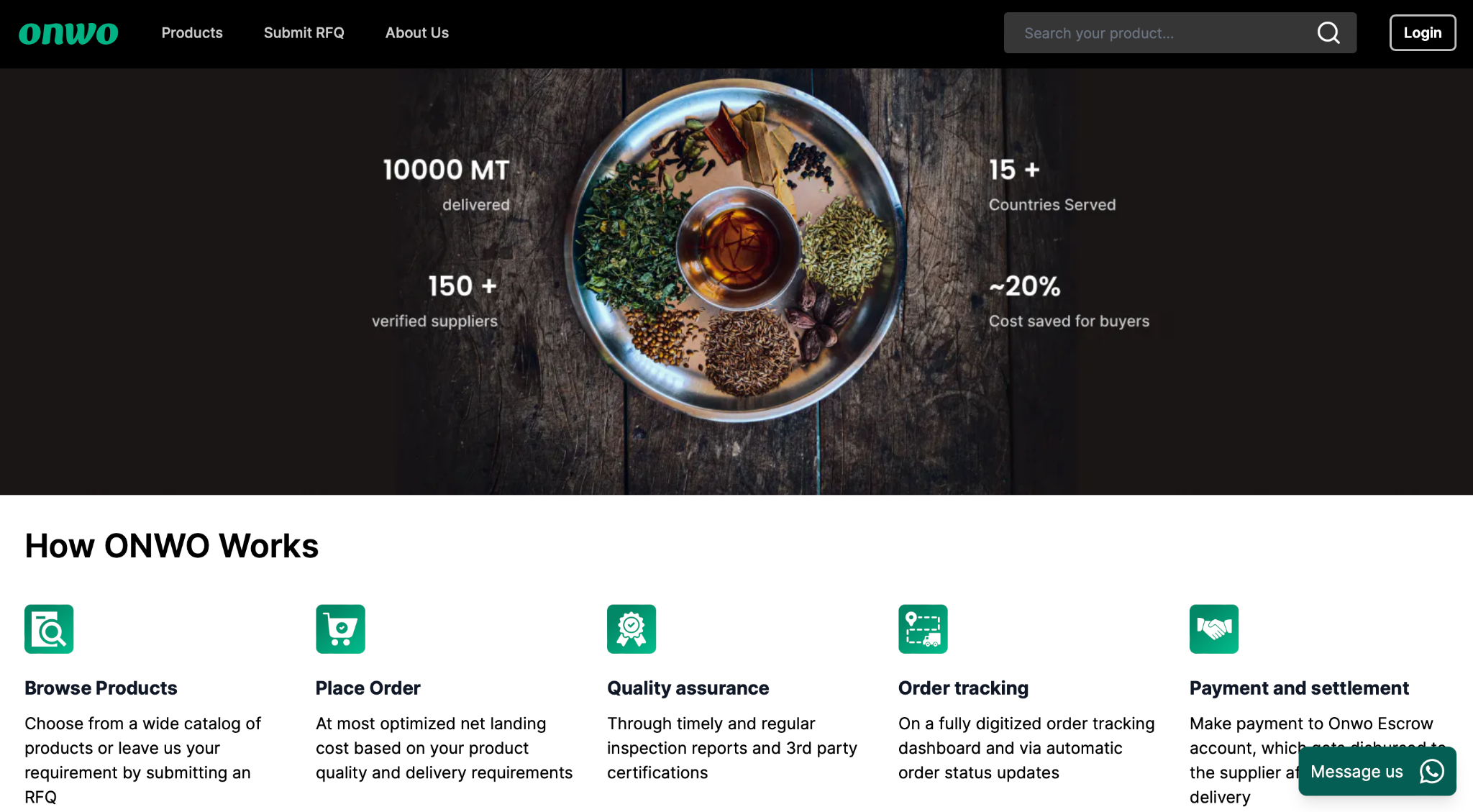
ONWO is at the forefront of reimagining the food export industry using a digital-first approach in an otherwise traditional industry. ONWO’s full-stack solution will help Indian manufacturers and SMEs access the global markets in a fully managed and asset-light model. ONWO is creating a digitized global food supply chain through contract manufacturing and a structured food export segment, allowing Indian manufacturers to ship processed products to the world.

ONWO is a curated marketplace to reliably discover, transact and fulfill orders of processed food products from Indian manufacturers. ONWO offers end-to-end solutions to its customers in a full-stack digital model, involving contract manufacturing and private label solutions, quality assurance and risk management and complete order fulfillment using a cutting-edge technology platform. ONWO ensures better margins and value add for both manufacturers and buyers. The key markets serviced by them are the US, Canada, UAE, Saudi Arabia, Qatar and Oman.

Onwo was started by second-time entrepreneur and former Flipkart executive Bipul Kumar in July 2022. We have known Bipul from his first startup and believed in his vision of transforming India’s food export value chain. Bipul has built an experienced and high-quality team. They have executed well in the last 6 months, exporting more than 10,000 MT of food products, with a high repeat rate of >90%. ONWO has covered more than 15 countries in operations.

ONWO is on a mission to build a solution for this large category. We are very excited to partner with them. It is a massive opportunity and they are a great passionate team with the right skills to build this business.

Investment in Contlo

Global e-commerce is a massive market. Online retail sales are expected to reach $6.5Tn by 2023, according to eMarketer and Statista. The US D2C (direct-to-consumer) sales have crossed $128Bn in 2021 and are expected to reach $213Bn by 2023.

The pandemic has led to unprecedented growth in digital adoption, shifting consumers’ shopping behaviour to online. We have seen an exponential rise of D2C brands from India post-pandemic. According to the Unicommerce report on India’s retail and e-commerce, D2C brands are driving growth in India’s e-commerce with a 45% CAGR and has the potential to reach $ 70Bn in a few years. According to Statista, India’s D2C market is expected to grow by more than 15 times from 2015 to 2025. In 2020, it was around $33Bn and is forecasted to reach $100Bn by 2025.

Globally e-commerce brands are moving away from marketplaces to headless commerce platforms like Shopify. Shopify is an e-commerce platform which enables merchants to set up online stores and has seen massive growth, doubling the number of merchants using Shopify in the two years from 2019. Shopify ARR was around $5.2Bn in Sep 2022, a 24.5% YoY growth. It was $4.6Bn in 2021, 57.4% YoY growth from 2020.

As brands continue to sell online, they struggle with high marketing spending on CAC and customer retention. They want to build direct relationships with consumers on different channels. To build a long-lasting relationship with the consumer, a consumer needs to be engaged at different points in the journey.

At Kae, we have invested in many D2C brands and keep evaluating more D2C brands in different categories. From all our conversations, customer engagement and high marketing spending came across as common areas of concern. The legacy horizontal marketing tools are not built for e-commerce specific use cases. There is a need for a verticalized marketing automation solution for e-commerce.

We are very bullish on vertical SaaS as a theme and believe the next evolution of customer engagement/marketing automation has to be more personalized. This is exactly where Contlo comes in. It is purpose-built for deep e-commerce use cases via seamless integration with leading e-commerce platforms like Shopify, and Magento. We have been in touch with Ishaan and Mukunda, from their early days and have seen their impressive journey of building an AI-led marketing automation for e-commerce.

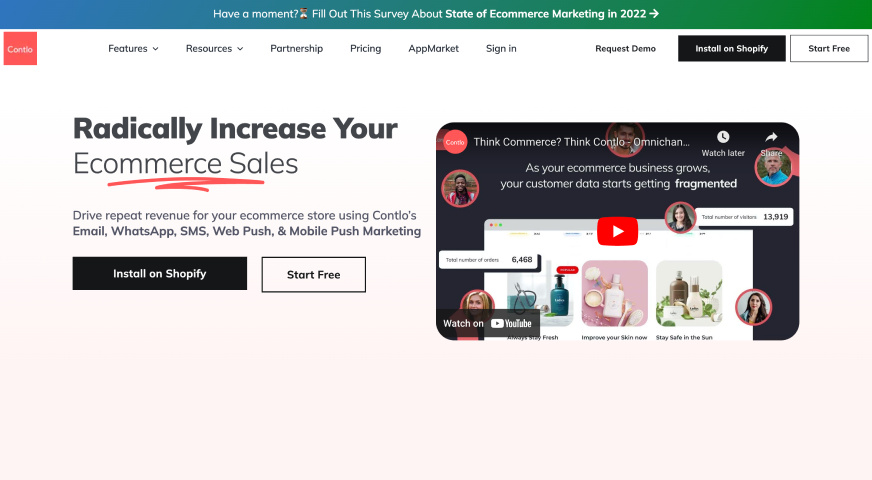
Contlo enables e-commerce and D2C brands to accelerate their sales growth, drive revenue generation and automate personalized experiences for its customers using e-commerce centric omnichannel customer engagement across email, SMS, WhatsApp, mobile and web push. It is leveraging AI to build hyper-personalized commerce experiences for end customers.

Today more than 1000+ brands use Contlo globally. It has witnessed a 50% MoM growth since its inception. It is empowering brands to build direct channels with their consumers, leading to increased retention and LTVs.

Contlo beautifully fits our investing framework for SaaS, leveraging data to build an AI-based vertical SaaS software with a PLG motion.

We at Kae, are thrilled to partner with Ishaan and Mukunda in this journey. They have built a very strong team with a vision to build a world-class AI product. You can find out more about Contlo here.

Investment in Hatica: Engineering Analytics to Boost Developer Productivity

The demand for software developers is ever-increasing! Digitisation, cloud adoption and software stack globally are driving this demand, amongst other things, but there is not enough supply. According to the State of the Developer Nation report, in 2021 there were 26.8Mn active software developers in the world and they predict it to reach 45Mn by 2030. This makes it a very large and growing market.

Software developers use multiple tools for their daily work and a lot of precious development time is lost in low-value work of context switching between tools, collaboration, documentation, version control, duct taping the issues etc. There is a developer experience gap. Strong dev tools can bridge this developer experience gap and improve a developer’s experience across the entire workflow.

Dev tools are an array of products focused on developers to help them build, deploy and collaborate on a daily basis. Some of the global leaders in this market are Github, Slack, JIRA, Browserstack, Snowflake, Postman and Datadog. Dev tools have seen massive growth in the last few years. There are more than 73Mn developers on Github, with 16Mn+ developers added in 2021 alone. Snowflake reported stronger than expected Q4 2021, with revenue rising by ~117% to $107Mn. A shift has been witnessed, from a ‘Build and Buy’ decision-making mentality to a ‘Buy and Build’ approach. Developers are now open to buying platforms which can help them decrease the time of development.

This shift is further fueled by remote working. The Dev tools market has experienced tailwinds from this increased digital adoption. The pandemic forced teams to shift remotely, which has further aggravated the problem of collaboration and communication. Many SaaS tools are building for the future of work to make this transition easier, without affecting the productivity of teams. Developers are one of the most expensive resources of a tech startup, and any reduction in productivity is a big loss in terms of money and timeline of projects. According to U.S. News, the median annual salary for a software developer is $101,790, which will bring the cost of the average developer minute to ~$0.81. Therefore, every wasted minute of developers potentially impacts the company’s cost structure and profitability. Companies are now becoming more receptive to dev tools to ensure that most of the developers’ time is spent on actual development.

High-performing engineering teams are essential for the success of companies as they can release products to market faster. There is a need for tools which can empower them to manage their daily tasks- context switching, collaboration, etc. in an efficient way. Developer productivity tools is a massive emerging market to solve this problem.

We are happy to back Hatica, as it aligns well with our thesis on developer productivity and the future of work. Hatica has been cofounded by a couple of experienced techies, building a global SaaS tool to provide an engineering analytics platform to boost developer productivity. Embedding the culture of remote work internally, they have built a powerful product to improve engineering efficiency and optimize dev workflows. Hatica has early customers from US, Europe and India. We are thrilled to be part of this journey and believe it has the potential to become one of the top engineering analytics platforms globally.

What I Learnt With Fynd

The genesis of Fynd – Harsh tells the full story here….but here’s an extract to get you started.

Since Sept 27, 2012 (when addSale was officially registered in Mumbai), we have gone through two industries, two serious potential buyers, three ground-up built teams, three names, five offices, 10 internal and external products, trying to sell in 15 countries, 22 names on the cap table, deployments across 25 cities in 100+ stores and 120+ team members.

Along all of this, we have always remained true to our passion to build products that help people shop.

Our vision was to be at the intersection of technology and retail. We wanted to straddle the gap between the ease, convenience and personalization of digital technology with the instant gratification, touch and feel experience of physical retail.


So how did we become one of the 22 names on the cap table?

I will never forget the meeting with 7 of us crammed in our very tiny conference room in Nariman Point looking at a demo video where Harsh was at a Diesel store mixing and matching looks on a touch screen powered by (then) addSale. The pitch was that retail was going to go digital and in order to stay relevant, physical retailers and brands needed to up their game and introduce digital experiences in-store to enhance sales. While in February 2013, this required a little bit of mind-bending by us. Harsh, Farooq and SMG exuded confidence, conviction, optimism and a real passion for solving for this Physical-Digital divide. That is what we bought into. Their conviction and commitment.

Over the last 6 years, spending time with the founders and the team has been like being in an entrepreneurship boot camp of sorts for me. I have learnt that doing more with less is an art, but building a data-driven organisation is a science. For a founder, knowing and believing in their purpose is central to persevering and ignoring the noise that surrounds them. Brutal honesty and transparency is directly linked to speed of execution.

To paraphrase what Farooq says, “great leaders build great cultures that build great companies”, (read the full blog here for more on Fynd’s culture.) and there are two things that have really stood out for me.

Data-driven has never been a buzzword, it is a religion at Fynd. Every (and I mean every) single person in the company is an expert on all the internal data systems and SQL literate. This means, that everyone can query data and find their own insights that help them take better decisions in real-time. There are giant screens all over the office that are constantly streaming dashboards. Transparency rules here.

The second is their grit. Farooq says “ We have had a fairly difficult fundraising history, but that has never stopped us from thinking big and then executing relentlessly.” It is this ability to never give in to what looks impossible, but to in fact turn that into an advantage that has made the Fynd team and their journey special. It is their infallible grit and grind that keeps them moving forward.

Kae Capital was the first institutional investor in addSale which rebranded to ShopSense and then again in Fynd. We have been privileged to see this journey from its inception to rapid scale to exiting an investor who has big plans for retail in India. We wish the Fynd team the very best on this new adventure of theirs.

We have always backed exceptional founders through good times but especially through bad times and will continue to do that.