Understanding Ideal Customer Profile (ICP) Part 1: Defining the ICP

This article talks about the importance of defining an Ideal customer profile in the initial days (when you have none or very few customers) and provides a framework for doing so.

Founders are often tempted to capture as much value (or revenue) as possible from different types of customers. To do this, they often wastefully spend their energies and resources on capturing multiple types/avatars of customers and therefore lose sight of the company’s core value proposition and focus. As a founder, you must identify and focus your energies on the customers who are going to be most successful for you- the ‘Ideal Customers’

First of all, it is important to expand on the term ‘Ideal Customer Profile (ICP)’. An ICP is not the customer that gives the most revenue, it is also not only the customer with the easiest sale potential. An ideal customer is one who is deriving the maximum value from your offering and whom you can serve best (compared to alternatives). This translates to:

  1. Easier Sale and lower cost of acquisition
  2. Better retention and higher Lifetime Value
  3. Customer Advocacy and referrals


You should also not confuse ICP with customer/buyer personas (‘marketing Michelle’ or ‘HR Harvey’). A buyer/user persona comes after you have defined a broader ICP and is used to create messaging that helps you connect best with different personas in that ICP group. An ICP defines Who to sell to, while a persona defines How to convey the value proposition of your offering to this customer.

Your ICP is a clear, common, objective definition of who the ideal buyers and users of your product are. A well-defined ICP lays the groundwork for your positioning, messaging, pricing, GTM, and even product roadmap. Once you have clarity and validation of your ICP, everything else ties into it. An important point to note is that the ICP definition is not stationary, it keeps on evolving along with the organization. As you keep on acquiring and learning about more and more customers, the ICP definition will keep changing and becoming sharper.


Defining the ICP

A good way to define your ICP in the very early days is to look at the broad market that you are trying to solve for and look for a common subset where you believe you are best positioned to serve that customer group. Look at the overall landscape of customers and competitors. You are looking for a large opportunity which primarily can be because of:

  1. A gap in the market– There is a gap in the market and a large customer segment is underserved.
  2. Better product/experience– There is an opportunity to serve the customers in a much better way compared to the current alternatives. A low NPS/Retention for the current alternatives points in this direction.
  3. Opening of the market– There is a latent need in the market or the customer behaviour is changing rapidly for a new offering to come in and disrupt.


You should then speak with your best customers (or do surveys with prospects if the product/service is yet to be launched) and list down their attributes.


For B2C Businesses

For a consumer-focused(B2C) business, the following attributes are a good start

    1. Demography
      • Age group
      •  Gender
      •  Religion, Race and Ethnicity
      •  Occupation
      •  Income
      •  Relationship/Family status
      •  Geography


  1. Psychographic and behavioural traits
    • Values
    •  Interests
    •  Hobbies
    •  Aspirations and Fears
    •  Social media behaviour
    •  Buying behaviour


A few iterations using customer surveys/research will lead you to your ICP.


For B2B Businesses

For B2B businesses, the following attributes are a good start

    1. Target Company
      • Industry
      • Customer base/Business model- For example ‘B2B company serving SMBs and mid-market customers’
      • Size- Very Small/Small Medium/Mid Market/Enterprise Businesses
      • Geography
      • Maturity/other differentiators- For example, ‘fast-growing startups’ or ‘more than 20 people development team’


  1. Target customer profile
    • Profile- Ex Sales Development Representative/VP Marketing/Engineering Manager
    • Key goals of the customer
    • What is the core problem?


Put your target group into different segments and think through your value proposition from the perspective of the following parameters. The attractiveness of your solution (compared to the alternatives) for a segment will drive you towards your ICP:

  1. Problem intensity– The problem you are solving can be severe and (or) frequent. Pain point intensity usually is different in different kinds of companies. It relates strongly to the industry, size, and maturity of the company.
  2. Awareness and urgency– How aware is the customer of the pain point? Is it a need (urgent) or good to have?
  3. Ability to pay– Does this customer segment have the ability to pay the right value for your solution? This usually relates to the size and industry of the company.
  4. Ability to sell and serve efficiently– How efficiently can you acquire customers of one segment? How equipped are you to serve them? Geography and size of the company are the most important variables for this parameter.
  5. Competition/Advantage over the competition– Are there any other solutions for this customer segment? Is your solution much better than the current competition? Is there a gap/underserved market segment that you can go for? Usually, this parameter relates strongly to size and geography. It is probably the most critical parameter which gives direction to a possible whitespace or possibility of disrupting incumbents.


A few iterations using customer surveys/research will lead you to your ICP. Articulate it very clearly. Try to be as specific as possible and use more nouns/verbs than adjectives.

Example: Hull.io ICP definition- “Post Series-A (scaling) SaaS startups with more than $5 million in annual revenue, who use Salesforce & Redshift.”

After nailing the ICP statement, to plan and sharpen your go-to-market (GTM) strategy, we suggest that you put together the following as well:

  1. Success metric for the customer– What is the metric that the customer is likely to look at to validate that your solution is proving to be successful? (eg. it can be the lowering of churn or increasing of NPS)
  2.  Success metric for you– What is the metric that you would track to validate that your customer is deriving value from your solution? (eg. it can be the number of emails sent or tickets closed)
  3. Value Metric– What is the metric/unit that the customer is likely to measure that correlates with the perceived value? (eg. it can be the number of users or GBs of data storage)
  4.  Time to value– How much time does it take for the customer to start realising the value of your solution?


This way, you can approach the problem of defining your ICP, depending on the kind of customer profile and end goals you are targeting.

In part 2, we will talk about steps taken, post defining your ICP.

Generating the Future: Transforming SaaS with GenAI

In the last 6 months, the world of generative AI has seen an explosion of interest and hype. There is no denying that GenAI is changing the landscape of software development. GenAI is disrupting the industries, software and the way we work, and it is happening at an incredibly fast pace. Every knowledge worker is playing the game of catching up with so many AI models and sexy tools getting launched every week.

SaaS as an industry is undergoing a complete disruption; nearly all the startups we have evaluated in the last 3 months were using GenAI in some form. The GenAI tech stack has been rapidly evolving, with the emergence of several new models and tools.


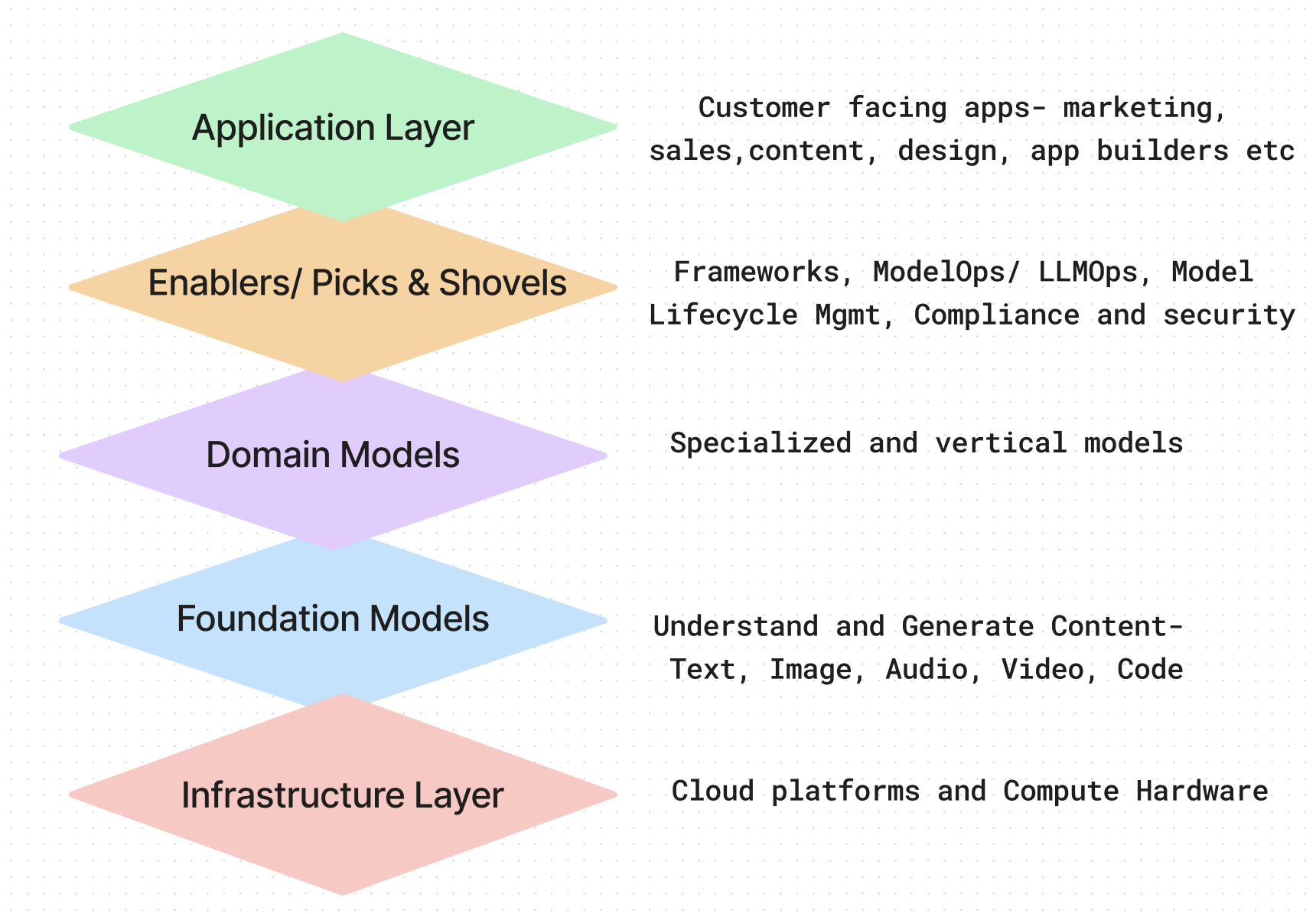
We broadly look at the existing stack in five layers-

Infrastructure layer includes hardware and cloud platforms which provide compute hardware and GPU. This includes companies such as Nvidia, AWS, GCP, Azure.

Foundation Models are GenAI models on top of which the entire stack is being built. They are AI neural networks trained on massive unlabeled datasets, enabling them to perform a diverse range of tasks, including test/ image/ audio/ code generation, text translation, and summarization. GPT-3, PaLM2, LLaMa are the well-known LLMs. Some open-source models trained on much smaller parameters are also getting interest for specific use cases.

Companies are using a combination of different models to increase accuracy and performance. A layer of domain/ vertical-specific models (health, legal, ecommerce, finance etc.) over foundation models has become a well adopted practice.

Next is a layer of tools that enables the use of these models, which we call Enablers. These tools are critical for the rapid adoption of foundation models by developers/ businesses, facilitating the shift where every company large or small is working towards adding GenAI capabilities to their products. Building production-ready AI apps is a challenging task that involves various steps. Starting with infrastructure setup, model hosting, database configuration, data collection and preparation tools, model selection, training or fine-tuning with your data, orchestrating different models based on use cases, integrating with your systems, deployment and maintenance of models, monitoring performance and cost of these models – all are part of this complex process. Hence, the emergence of enablers. Enablers offer capabilities such as orchestration, model management, observability, compliance, security, and more. Pinecone and Langchain are the most popular ones in this layer. Pinecone is a managed, cloud-native vector database with a simple API and no infrastructure hassles. Langchain is a framework for developing applications powered by language models.

Next is the Application layer, where customer-facing applications are built on top of GenAI models. It includes tools like Jasper, Glean, Copy.ai, Rephrase.ai. With GenAI, companies are providing better personalized customer experience, the conversation interface is taking over the clunky software UI and reducing their time to value.

Beyond all the excitement, it’s important to note that building and scaling an AI native tool is not as easy as it looks from all the Twitter chatter. We have spoken to many GenAI founders and tried to understand the challenges they are facing in customer adoption and product building. There are few interesting insights –

  1. Most of the GenAI tools from India are very early. They are seeing a lot of excitement and adoption from the market. Users are trying out different tools, but there is high churn. Prosumers and SMBs are the initial adopters of these products, but founders have to crack the retention and path to monetisation.
  2. Generational and non-critical use cases are seeing more traction. Generational use cases are some kind content generation- text, image, blog, code, audio etc. Non-critical use cases are business use cases where the cost of failure is not high and can work with not-so-high accuracy – sales, marketing, hiring etc. In high value use cases like cybersecurity, there is a cautious adoption of GenAI.
  3. GTM motion for enterprise SaaS remains the same. There is a sense of curiosity among enterprises regarding GenAI and acceptance to use it in their workflow but they are cautious. Their concerns about data privacy, security, and compliance persist, and there is limited trust in public LLMs. We are seeing a trend of building on the client’s VPC, which can increase the time to adoption.
  4. ChatGPT has changed the customers’ expectations. Customers are conversing with tools in natural language, they are not only asking for information or insights from the data, they are expecting end-to-end tasks to be done. The expectation is AGI (Artificial General Intelligence). We spoke with an AI native marketing product from India where customers are spending more than 30 min every session and asking in one single command to look into the data, identify cart dropout and design and send a campaign to them.
  5. There is a lot of adoption of picks and shovels- libraries, tools helping developers build apps for different use cases. Autonomous agents have become very popular. SuperAGI is one of our portfolio companies, which has gained more than 7k GitHub stars in two weeks. It is one of the trending repositories on GitHub. It is a dev-first open-source autonomous AI agent framework, enabling developers to build, manage and run useful autonomous agents quickly and reliably.


Based on our learnings over the last few months, we are more bullish on a few spaces in GenAI where we believe large outcomes from India can be generated:

  1. Picks and Shovels for developers: GenAI tech stack has become fairly complex and it is changing rapidly, only LLMs can’t help with production level use cases. As discussed in the above section, it is a long iterative process and these tools help developers build, experiment, train, and compare quickly. This is a new need that has emerged while developing in GenAI. Vector database, framework, model orchestration layer, autonomous agents are some examples of the types of tools getting created. Pinecone and Langchain fall under this category.
  2. No code enablers for businesses: We have seen copilot (GenAI) in a box model, where the entire AI stack is taken care of by the tool, you just have to integrate with your existing software. This new layer is emerging in the tech stack and it can be an opportunity for new players.
  3. ModelOps/LLMOps:MLOps used to be a not-so-attractive industry until 6 months ago. With GenAI, more models are going into production and none of the existing MLOps were made for that. Existing MLOps companies are adding capabilities and a new set of ModelOps tools are also emerging. ModelOps/ LLMOps tools include model lifecycle management, observability, data security and privacy, and model monitoring.
  4. Autonomous Agents:As discussed above, customer expectation is for AGI which can be provided by autonomous agents. They have the ability to analyze intricate problems, solve them iteratively, and take actions. AutoGPT is the most popular one, it has more than 139K stars on GitHub. In today’s form, it is not easy to use AutoGPT for business use cases. AGI is still in the early phase and will take some time to reach the customers’ expectation levels.
  5. AI native companies: On the application layer, we are keen on these companies. In many use cases, incumbents have the right to win because of distribution advantage. That’s why we believe all the niche use case products will get commoditised as incumbents will launch it as a feature. However, if you are building an AI native software with some vertical focus and data flywheel, then there is an opportunity to deliver better accuracy compared to incumbents.
  6. GenAI-powered Vertical SaaS: Vertical LLMs are trained on curated high-quality data from a specific industry. This allows Vertical LLMs to generate more accurate and relevant results. Legal, health, and finance are among the industries where a lot of knowledge resides in the massive historic data, which is the play of Vertical LLMs. GenAI-powered Vertical SaaS companies are getting popular, such as Hippocratic in healthcare and Evenup and Harvey.ai in legal.


A lot is happening in the GenAI world and we have been continuously learning about the latest developments. Our thesis will keep evolving. We will release a series of articles on GenAI to keep you updated on our learnings. If you are a founder building in GenAI or an enthusiast, we would like to have a discussion. Please feel free to reach out to veenu@kae-capital.com or sarthak@kae-capital.com.