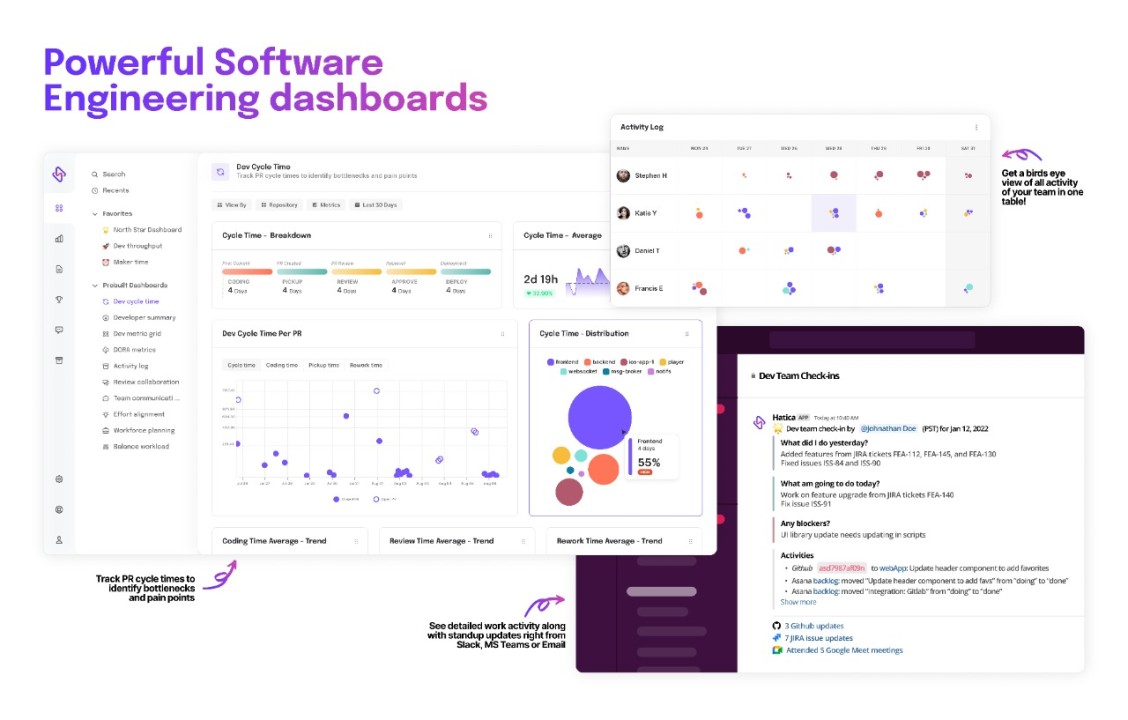
Investment in Hatica: Engineering Analytics to Boost Developer Productivity

The demand for software developers is ever-increasing! Digitisation, cloud adoption and software stack globally are driving this demand, amongst other things, but there is not enough supply. According to the State of the Developer Nation report, in 2021 there were 26.8Mn active software developers in the world and they predict it to reach 45Mn by 2030. This makes it a very large and growing market.

Software developers use multiple tools for their daily work and a lot of precious development time is lost in low-value work of context switching between tools, collaboration, documentation, version control, duct taping the issues etc. There is a developer experience gap. Strong dev tools can bridge this developer experience gap and improve a developer’s experience across the entire workflow.

Dev tools are an array of products focused on developers to help them build, deploy and collaborate on a daily basis. Some of the global leaders in this market are Github, Slack, JIRA, Browserstack, Snowflake, Postman and Datadog. Dev tools have seen massive growth in the last few years. There are more than 73Mn developers on Github, with 16Mn+ developers added in 2021 alone. Snowflake reported stronger than expected Q4 2021, with revenue rising by ~117% to $107Mn. A shift has been witnessed, from a ‘Build and Buy’ decision-making mentality to a ‘Buy and Build’ approach. Developers are now open to buying platforms which can help them decrease the time of development.

This shift is further fueled by remote working. The Dev tools market has experienced tailwinds from this increased digital adoption. The pandemic forced teams to shift remotely, which has further aggravated the problem of collaboration and communication. Many SaaS tools are building for the future of work to make this transition easier, without affecting the productivity of teams. Developers are one of the most expensive resources of a tech startup, and any reduction in productivity is a big loss in terms of money and timeline of projects. According to U.S. News, the median annual salary for a software developer is $101,790, which will bring the cost of the average developer minute to ~$0.81. Therefore, every wasted minute of developers potentially impacts the company’s cost structure and profitability. Companies are now becoming more receptive to dev tools to ensure that most of the developers’ time is spent on actual development.

High-performing engineering teams are essential for the success of companies as they can release products to market faster. There is a need for tools which can empower them to manage their daily tasks- context switching, collaboration, etc. in an efficient way. Developer productivity tools is a massive emerging market to solve this problem.

We are happy to back Hatica, as it aligns well with our thesis on developer productivity and the future of work. Hatica has been cofounded by a couple of experienced techies, building a global SaaS tool to provide an engineering analytics platform to boost developer productivity. Embedding the culture of remote work internally, they have built a powerful product to improve engineering efficiency and optimize dev workflows. Hatica has early customers from US, Europe and India. We are thrilled to be part of this journey and believe it has the potential to become one of the top engineering analytics platforms globally.

Alt Protein: The Next Big Thing

The post-COVID era has changed the way people think of health, nutrition and the environment. With this, a small but promising community of startups have begun India’s chapter of the Alt Protein landscape in the last few years. Over 3Bn USD has been poured into the Alt Protein category in 2020, around the globe. In India, we are at a nascent stage, perhaps right before it reaches the inflexion point. 

How large is the market?

In India, this nascent but promising market of plant-based meat is estimated to be around 200-500Mn USD by 2022 (GFI). The plant-based dairy industry is expected to reach 68Mn USD by 2024 (GFI). However, if adoption ramps up, it has the potential to reach $4Bn in the next 5-7 years. Adoption rates will become clear once commercial production starts for many of the players in the Indian market, who are currently market-testing their products or are in the R&D stage. An observable trend is an increase in the consumption of meat as a by-product of nations transitioning from developing to developed countries. Naturally, as disposable incomes increase, more people are likely to spend on meat consumption which is otherwise seen as a luxury. 

Why is plant-based food important for India?

Contrary to popular belief, we are not a vegetarian nation. Over 70% of consumers in India identify as non-vegetarians, but unlike the West, our frequency of consumption of meat-based products is relatively low. At present, Indian diets are predominantly cereal-based, and 60% of protein is derived from cereals that have poor digestibility and quality. 80% of India is protein deficient.

India is also facing a double burden of malnutrition and an increasing share of global Greenhouse gas (GHG) emissions (6.55%), making it the third-largest contributor to anthropogenic GHG emissions, a lot of which comes from the animal slaughter industry. Analyses of the environmental impact of plant-based meat showed that plant-based meat production uses 72-99% less water and 47-99% less land. Furthermore, it causes 51-91% less water pollution and emits 30-90% less greenhouse gas emissions. 

Process of developing Plant Based food

Recognising that any plant-based food company is a food science tech player first, and then a consumer brand is important. Being a brand is a long-term possibility but should not be the focus in the initial days when consumer adoption is unclear. There is a technical process involved in developing plant-based protein, and getting it to its final form.

Why is Plant-based food expensive?

Protein isolates are available to all players in the market. The basic material, in this case, protein isolate, is available at cheap prices to all, but it’s the additional flavouring, additives and preservatives which go into the final product that makes plant-based food expensive. These additional products are called ingredients and having control over the ingredient formulation is a strong way to have price parity in the long run. For a few players, high prices are also due to the cost of extrusion machines in the supply chain.

The price per kg comparison of the majority of the products across plant-based meat, dairy, and seafood are nearly 2-3x more expensive than their conventional counterparts. There is a significant scope for this to come down in the next 5 years as infrastructure improves.

Challenges and opportunities in this market

Lack of awareness: While Indians are massive consumers of raw plant products like lentils and pulses, processed product awareness and acceptance is prominent among urban consumers only. It is slowly picking up in smaller cities with the support of government campaigns.

Infrastructure challenges: India’s cold chain storage and transportation capacity is still ill-equipped to handle its fresh produce volumes, despite recent government efforts, making intra-state transportation challenging and costly.

Constrained R&D Ecosystem: India’s overall R&D spending as a percentage of GDP is lowest even among BRICS nations. Government institutions are restrained by funding challenges.

Low meat eating: Even people who eat meat in India are primarily vegetarians, who consume meat once or twice a week, whereas in the West, meat eaters consume meat three times a day.

Price elasticity is very high: When it comes to chicken consumption, the prices of Plant-based meat are 2-3x compared to the incumbents

Availability of Talent: Another more fundamental issue with this space is the lack of quality senior-level talent in the industry. The IT sector boom was facilitated by a lot of Indian overseas talent returning, if this happens for this sector as well, we could see faster growth. 

Despite its challenges, the market continues to grow and provides a lucrative opportunity for many players to build for this. In the next 6-12 months, a lot more activity especially on the commercialisation of these products will take place, adding another layer of insights about this space. 

Kae Capital is looking forward to connecting with more startups that are building for this category.