Alt Protein: The Next Big Thing

The post-COVID era has changed the way people think of health, nutrition and the environment. With this, a small but promising community of startups have begun India’s chapter of the Alt Protein landscape in the last few years. Over 3Bn USD has been poured into the Alt Protein category in 2020, around the globe. In India, we are at a nascent stage, perhaps right before it reaches the inflexion point. 

How large is the market?

In India, this nascent but promising market of plant-based meat is estimated to be around 200-500Mn USD by 2022 (GFI). The plant-based dairy industry is expected to reach 68Mn USD by 2024 (GFI). However, if adoption ramps up, it has the potential to reach $4Bn in the next 5-7 years. Adoption rates will become clear once commercial production starts for many of the players in the Indian market, who are currently market-testing their products or are in the R&D stage. An observable trend is an increase in the consumption of meat as a by-product of nations transitioning from developing to developed countries. Naturally, as disposable incomes increase, more people are likely to spend on meat consumption which is otherwise seen as a luxury. 

Why is plant-based food important for India?

Contrary to popular belief, we are not a vegetarian nation. Over 70% of consumers in India identify as non-vegetarians, but unlike the West, our frequency of consumption of meat-based products is relatively low. At present, Indian diets are predominantly cereal-based, and 60% of protein is derived from cereals that have poor digestibility and quality. 80% of India is protein deficient.

India is also facing a double burden of malnutrition and an increasing share of global Greenhouse gas (GHG) emissions (6.55%), making it the third-largest contributor to anthropogenic GHG emissions, a lot of which comes from the animal slaughter industry. Analyses of the environmental impact of plant-based meat showed that plant-based meat production uses 72-99% less water and 47-99% less land. Furthermore, it causes 51-91% less water pollution and emits 30-90% less greenhouse gas emissions. 

Process of developing Plant Based food

Recognising that any plant-based food company is a food science tech player first, and then a consumer brand is important. Being a brand is a long-term possibility but should not be the focus in the initial days when consumer adoption is unclear. There is a technical process involved in developing plant-based protein, and getting it to its final form.

Why is Plant-based food expensive?

Protein isolates are available to all players in the market. The basic material, in this case, protein isolate, is available at cheap prices to all, but it’s the additional flavouring, additives and preservatives which go into the final product that makes plant-based food expensive. These additional products are called ingredients and having control over the ingredient formulation is a strong way to have price parity in the long run. For a few players, high prices are also due to the cost of extrusion machines in the supply chain.

The price per kg comparison of the majority of the products across plant-based meat, dairy, and seafood are nearly 2-3x more expensive than their conventional counterparts. There is a significant scope for this to come down in the next 5 years as infrastructure improves.

Challenges and opportunities in this market

Lack of awareness: While Indians are massive consumers of raw plant products like lentils and pulses, processed product awareness and acceptance is prominent among urban consumers only. It is slowly picking up in smaller cities with the support of government campaigns.

Infrastructure challenges: India’s cold chain storage and transportation capacity is still ill-equipped to handle its fresh produce volumes, despite recent government efforts, making intra-state transportation challenging and costly.

Constrained R&D Ecosystem: India’s overall R&D spending as a percentage of GDP is lowest even among BRICS nations. Government institutions are restrained by funding challenges.

Low meat eating: Even people who eat meat in India are primarily vegetarians, who consume meat once or twice a week, whereas in the West, meat eaters consume meat three times a day.

Price elasticity is very high: When it comes to chicken consumption, the prices of Plant-based meat are 2-3x compared to the incumbents

Availability of Talent: Another more fundamental issue with this space is the lack of quality senior-level talent in the industry. The IT sector boom was facilitated by a lot of Indian overseas talent returning, if this happens for this sector as well, we could see faster growth. 

Despite its challenges, the market continues to grow and provides a lucrative opportunity for many players to build for this. In the next 6-12 months, a lot more activity especially on the commercialisation of these products will take place, adding another layer of insights about this space. 

Kae Capital is looking forward to connecting with more startups that are building for this category. 

 

Rally of New Traders!

The NSE has 19Mn active clients of all stockbrokers combined as on June 30, 2021, an increase from 12Mn on June 30, 2020, a jump of 58% in one year. Zerodha is the largest, accounting for 19% of clients (up from 15% last year), followed by ICICI Securities and Upstox. (Zerodha has ~2Mn Active clients, ~1Mn Inactive clients)

The number of investor accounts with Central Depository Services (India) Limited (CDSL) has more than doubled from 21.2Mn in March 2020 to 46.4Mn in September 2021. In fact, more than half of the additional 25.2Mn accounts — 13Mn — have come in the last six months between April and September 2021. Even NSDL added nearly 27 lakh accounts between April and September 2021.

Okay, but how many of them were retail investors?

In the last year, the number of retail investors has jumped more than 41 percent, data available with BSE showed. More than 70Mn investors were registered with BSE as of July 8.

Retail investor participation continued to grow exponentially in FY21 as well, with almost 4.5 million retail investor accounts being added in just the first two months of the fiscal year. The total number of retail investors increased by an astonishing 14.2 million in FY21, with 12.25 million new accounts being opened on CDSL 1.9 million in NSDL.

The result is that the Indian stock market is now dominated by retail investors. The NSE alone saw retail investors share grow from 33% in 2016 to 45% in 2021

Why will this number grow?

The industry has the potential to cross INR 100 trillion in AUM in the twenties. Reaching the INR 100 trillion vision during the mid-twenties can help the industry become the 11-13th largest asset management industry in the world from its current standing of 17th largest asset management industry. BCG estimates indicate that achieving this growth will require a 5x increase in the investor base from 20Mn in 2020 to 100Mn investors soon.

The problem is that the new investors coming into the market do not fully understand the market. A large number of them are in their 20s and 30s taking massive positions in F&O which is a much riskier asset class. A study by ISB showed that the majority of them tend to exit winning trades quickly and hold on to losing trades longer (A textbook mistake done by rookie traders who half gamble due to lack of understanding of the markets)

This is a gap that the market has not been able to fill so far. New traders are not as savvy as the older ones. While there may be enough YouTube videos or upskilling players helping them pick up the tricks of the trade through theory and a few live trade sessions here and there, the vast majority of them do not follow the basic hygiene of being a trader, i.e Building a solid trade setup.

Now the question is – Are the existing stock brokers available in the market well equipped to provide this service to new traders? 

The answer would be No. New traders need risk management systems, a chart to track their daily earnings or losses, discipline in setting targets, stopping losses, and risk-to-reward ratios, which today is typically done outside of the brokerage platform and on excel sheets.

India, being one of the fastest growing markets for retail investors in the world with a large market still untapped, needs platforms that help regulate and bridge the learning curve for new investors/traders.

After all, investing in financial freedom is the winning bet of them all!

(If you are a company building in this space, do write to us at sarthak@kae-capital.com)

Creator Economy: Music Licensing Marketplace

The creator economy is buzzing now more than ever with YouTubers, Tiktokers, Educators, and entertainers having more influence than one could have ever imagined.

Everyone has been talking about helping creators monetize lately. And there is one such, rather less explored avenue for creators – in this case, Musicians, to make money for their hustle – Music Licensing.

What are we talking about?

Whatever music you hear in Public i.e inside restaurants, pubs, clubs, cafes, or live performances, everything is being paid for by someone licensing it. Someone created it, someone has to pay to use it. Makes sense right? Let’s even call it Music as a Service.

This must seem like a bizarre concept for most people in India, who think it is legal to casually play certain soundtracks at weddings, gatherings, parties etc. without paying for it!

Let’s get some statistics and a back story out of the way first before we deal with what Music Licensing is and if this can work in India.

The revenue from the recorded music industry in India is <INR1500 cr. and for the film industry is ~INR19K cr. Despite the direct relationship between the film industry and the music industry, the difference is stark. (Source: Deloitte | IMI reportIMI)

Why?

Archaic laws 

It’s estimated that around 2016 cr. to 2791 cr. annually is lost by the recorded music industry due to obsolete laws. And of course, piracy is an issue. They lose about ₹1,000 crore a year due to piracy, which, makes up for 67% of the market — (for context) the global piracy average is 27% (Source: 2019 International Federation of the Phonographic Industry (IFPI) – Indian Music Industry (IMI) Digital Music Study)

All right, so we are losing money in the recorded music industry, which means Musicians especially independent creators must be struggling as well!

Cue IPRS. The IPRS was formed in 1969. It is a non-profit making organization that issues the license for the usage of music and literary work.

So why exactly is the IPRS important?

Because this is a central body in India that collects all royalties from artists for their musical work. There are two types of royalties – musical lyrics a.k.a underlying works royalty and then there is the royalty from the recorded music a.k.a masters. The masters are what labels like T-series own and the IPRS collects the underlying works royalty.

Now, this is where it gets interesting. This allows for a marketplace to be built that allows creators a channel to monetize their music and recover all this lost revenue!

Most upcoming independent music artists are making music from their studios, bedrooms or studios in bedrooms!

For each track made – there is someone who would be willing to pay for it if it serves their purpose. One side would-be creators of music and the other side would be buyers of soundtracks (Agencies, media houses, a YouTuber making an unboxing video, etc.)

That’s what a music licensing marketplace is. Epidemic Sound is the global leader in this at US$1.4Bn valuation after closing a US$450Mn round in March this year. (Read here)

But, there is an issue with this in India. To explore that, let’s look at how music creators today monetize. There are 3 things to note here – Medium. Scale. Payouts

Medium

Most creators make or attempt to make money today via YouTube, Facebook, TikTok, Instagram or Twitch. In India, homegrown startups like MX Takatak and ShareChat have a corpus of ~13.5Mn each for creator payouts. (Source)

Scale

Globally, SignalFire splits creators into amateurs (46.7 million) and professionals (2 million +). Closer home, in India, there are about 100Mn creators in all. The active content creators would be about 10% of this lot ~ 10Mn.

Payouts

This is where the challenge comes.

YouTube is the largest platform for creators in India today in terms of payouts (revenue from ads, subscribers, likes, comments etc).

So for the sake of simplicity, let’s explore creators using mainly YouTube as the primary source of revenue – via ads. In this model, YouTube charges 55% while giving back 45% of the ad revenue to creators.

The irony is that most of the world is trying to skip ads or paying a premium to get an ad-free experience.

So a creator needs a lot of views before they earn anything substantial.

The end result is that 97.5% of YouTubers don’t make enough money (to even reach the U.S. poverty line, $12,140) Therefore, YouTube creators need to find other ways to supplement their advertising income.

YouTube India’s payouts to creators are easily less than $500Mn per year, which translates to $50 a year per creator (For easy calculation, assuming that most of the revenue gets evenly distributed among 10Mn active creators)

In fact, the topmost Indian YouTuber earn 70% less than their US counterparts.

So with such minimal earnings, the primary pain point to solve for the creator economy is to provide channels to earn revenue that consumers are today willing to pay for. 

A few companies have come and tried to do so but quickly pivoted models when they realized that there is an intent to monetize from the creators’ side, but a fairly low willingness to pay from the consumers’ side for most content – except for content on edtech, onlyfans or gaming platforms.

Music licensing marketplaces could have been an interesting channel in India but it seems like until the earnings per year per creator increases, this model will not scale beyond a point. Influencer marketing is another interesting space for this.

While globally, companies like Epidemic Sounds have become billion-dollar businesses through this, closer home, it may still be early.

Hopefully, with payouts rising and/or more channels of monetization emerging, it is likely that this ratio will correct itself in the next few decades.

The opinions expressed here are those of the author. They do not purport to reflect the opinions or views of the Fund or its members.

Lessons from the Upskilling Market in India

We spent the last few months evaluating companies that could potentially make or break the backbone of our country – The Unskilled Youth of India.

When we approached this sector, the objective was to understand whether solving the “Skill Gap” was a scalable problem.

To take a step back – the market size was huge. 18Mn undergraduates in non-tech courses graduating in 2020 alone and 5-6Mn on the Tech side. Plus the section of working professionals looking to upskill themselves (at least 20Mn in white-collar jobs). With edtech products being sold and bought at 20K+ INR per course, the overall TAM was clearly north of a couple billion.

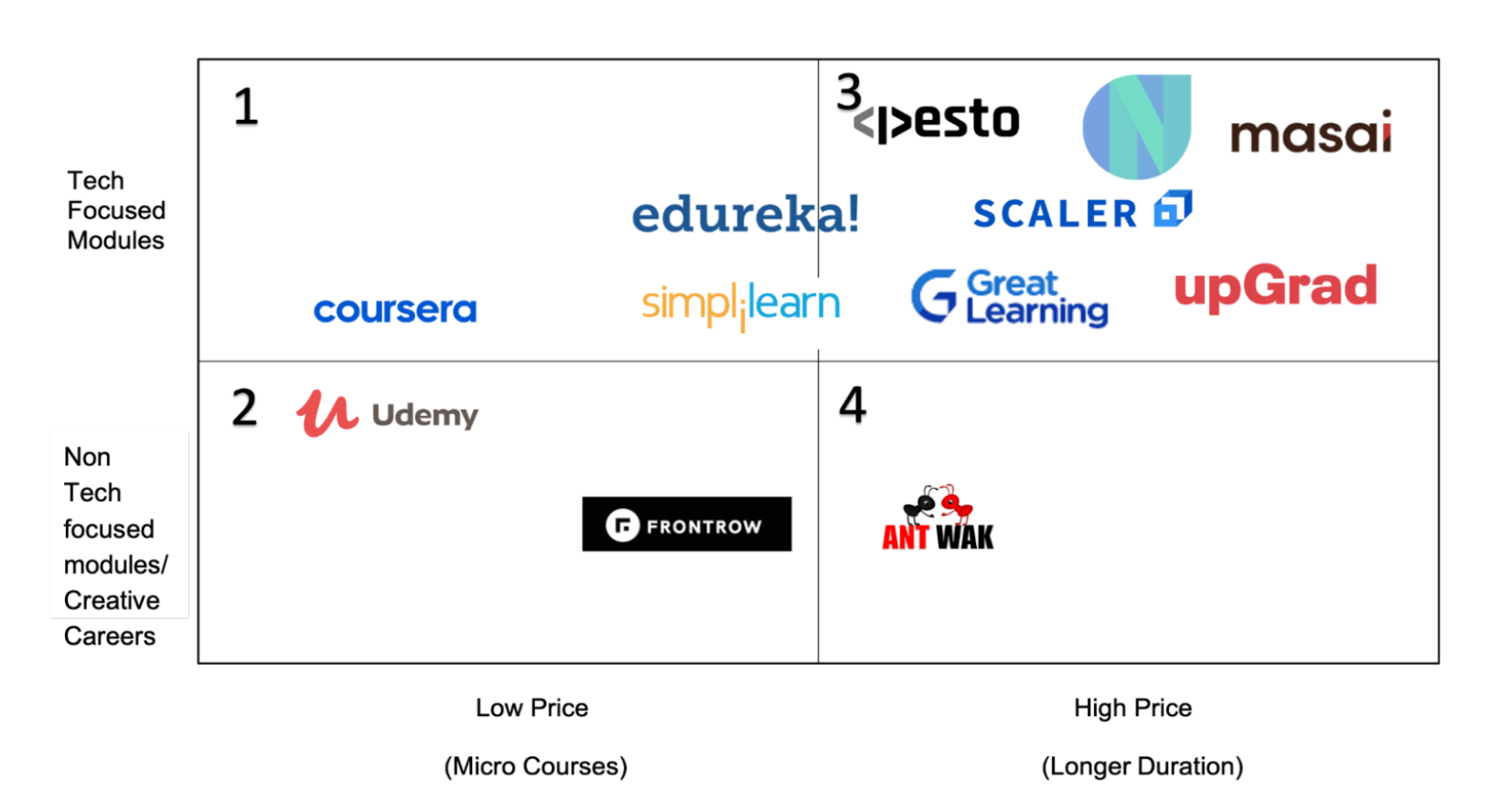
As we looked at this market, each player could be categorized on the basis of their courses, content type, and pricing (broadly).

With the rise in remote work and access to a highly-skilled tech workforce at 1/5th the cost when compared to the US, the market for tech-based upskilling & hiring was getting deeper and highly demanded in India. On a YoY basis, hiring in the tech sector grew 163% in June according to data from Naukri.com

But clearly, there seems to be white space for lower-priced tech-based courses and low or high-priced creative careers (or soft skills) focused on edtech players

 Now the question was

–       What differentiates the new players from the others in the market?

–       How do we solve for engagements & outcomes for the learners?

–       Can skilling reach the next half a billion at affordable prices?

The answers to these questions came from a few observations that we made from our discussions with founders building in this category, as below:

1. Companies focused on Upskilling had reached only the top 1-5% crowd of the country.

The majority of the courses were beyond the paying capacity of the majority of the people in the country. So how did the newer players make this more accessible?

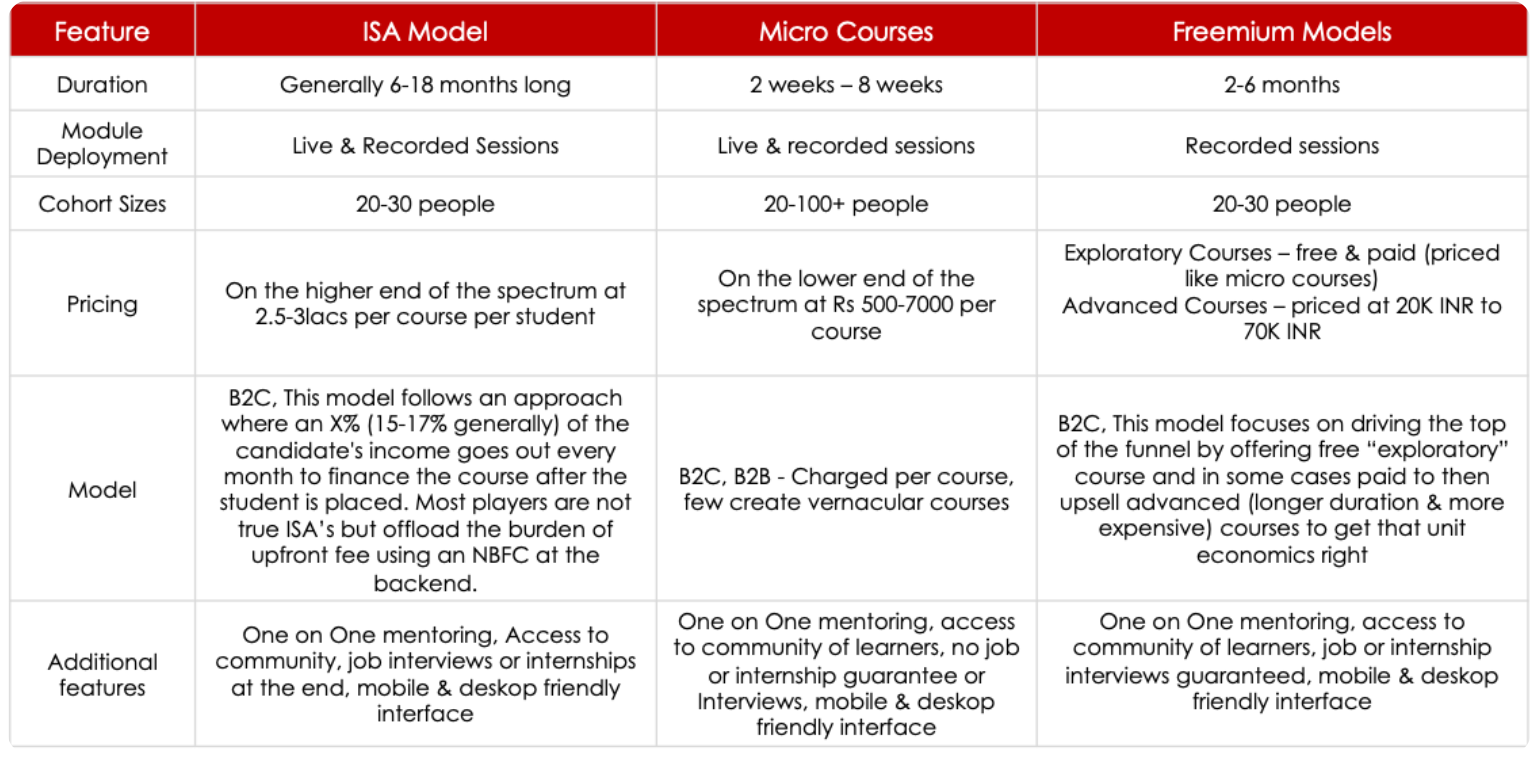
Most upskilling companies operate on either of the 3 models as shown below:


2. Why are more startups emerging in this category, when companies like Udemy and Coursera already provide micro as well as longer courses across both tech & non-tech domains? Where is the differentiation?

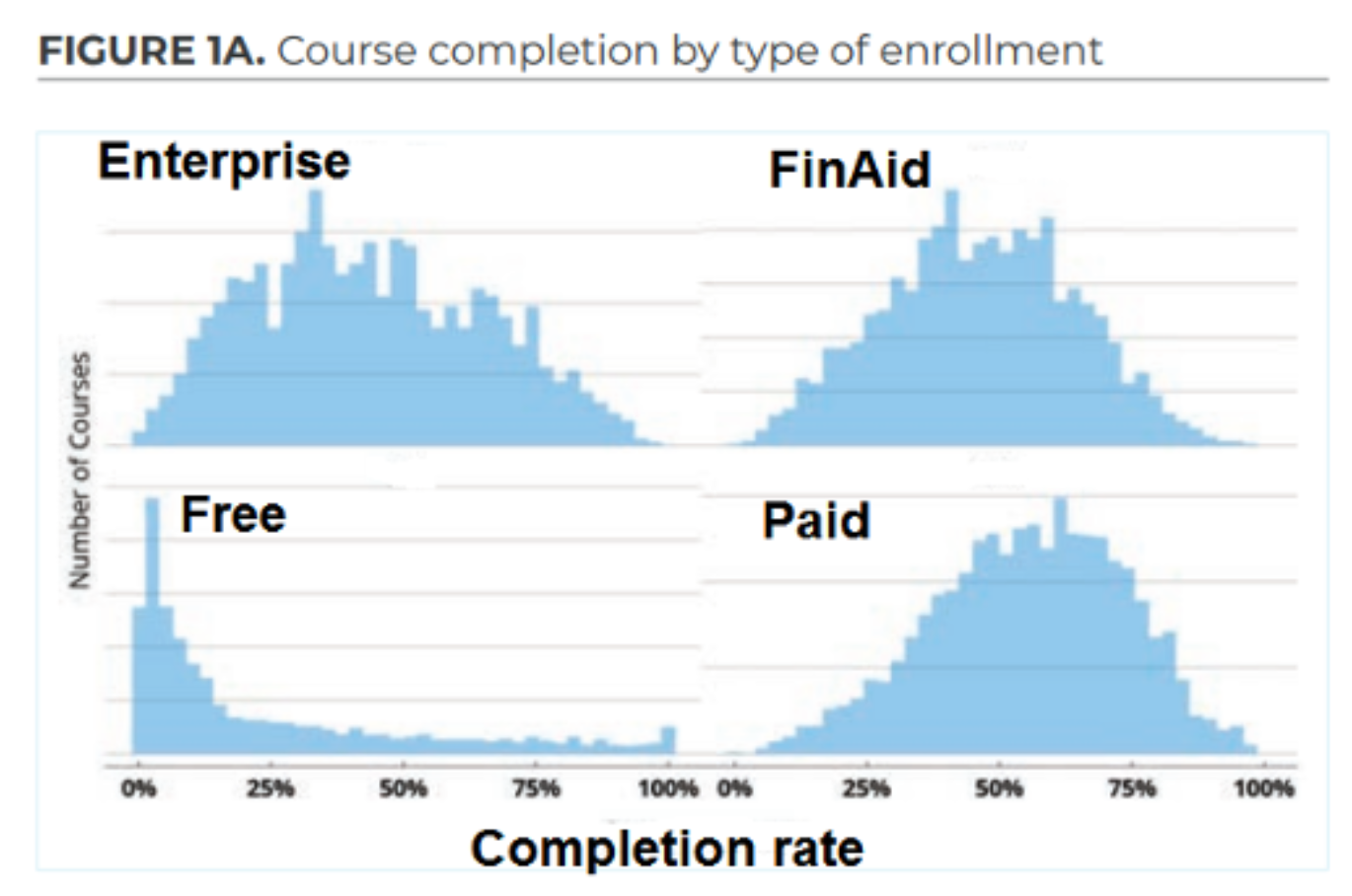
The differentiation came from a deep focus on outcomes & customer experience which Udemy & Coursera failed to address. For these companies, the course completion rates (% of people completing the entire course) were around 7- 10% until 2019. They did not focus on engaging the customer. They provided their courses like movies on Netflix. Nobody is going to binge-watch that!

But to their credit, Coursera published a report in 2020 which showed that post-pandemic, their completion rates for paid courses were averaging at ~55%. (Read Here)

Of course, being one of the largest players in this space at the moment, I would attribute the increase in this % to the tailwinds in the market for online learning and not to an improvement in the learning experience for the consumer.

People are looking for 2.0 methods of teaching online and clearly needed intermittent nudges to get them to stay engaged and complete the course. (If you have a different view, would love to chat at sonia@kae-capital.com!)

When newer players came to solve this, they identified that customers wanted to ask doubts, get real-time answers, connect with experts in the industry or peer learners and most importantly want to see an outcome more than a certificate. Most people will invest their time and energy if they either get a job, internship, or some real-world application.

3. This paved the way for a more holistic upskilling approach.

Companies focused on engaging the customer by improving the overall UI/UX, making the journey exciting with intermittent milestonesgamifying the experience using rewards and gifts, onboarding young industry experts (to increase approachability and relatability), focusing on partnering with companies that were hiring to directly engage with the learners with real-world projects and finally actually providing the network to get a job (no one actually guarantees a job, it is mostly a promise of getting access to 3-5 job interviews) at the end of the course

4. As competition increases in the seed stage for such companies, It is becoming harder to differentiate the newer players. Branding will become extremely important from Day 0

Beyond the courses themselves, all companies focus on similar offerings as highlighted in the table earlier, so selling the story of the brand, its teachers, its hiring partners and the unique power of its community will become critical nuances that a learner will scout for when selecting a course.

5. A major challenge with these models is that as the ecosystem matures, the cost of acquisitions is bound to increase.

As more edtech products get bombarded at people on a regular basis, it will be increasingly difficult to grab a piece of their mindshare. And thus, Customer Acquisition Costs will shoot up. Today it is anywhere between 1000 – 3000 INR for most companies in upskilling. Assuming this will go up by 20-25% each year based on a historical average.

At such CACs, Lower Priced Courses or Micro courses would have to either find extraordinary ways to acquires new users (B2C), or their LTV: CAC ratio would suffer in the long term.

In the short term, the relatively cheaper prices would make sense to acquire users fast, but for the company to scale to over a 100Mn in ARR at profitable unit economics would require them to eventually step up the prices, to ultimately land up in the same bucket as the ones following higher-priced/ISA models (anything above 20K INR per course at the current rates)

An interesting way some companies solved this is by onboarding celebrities as course tutors (following the masterclass model). By doing so, most of the top-of-the-funnel conversions came because of the traffic driven by the celebrity’s brand. This allowed them to continue at a lower price while keeping the paid CACs low. However, engagement for students may not be high here, which leads to low customer retention. Again, time will tell if this model breaks out.

6. Price of the course is hardly a differentiating factor for these companies in the long run. But a great hook to acquire new users.

The price of the courses is a culmination of the cost of creation of the course and revenue share for mentors/experts who helped curate the course among other costs. Courses that today are priced in the 1000 – 9000 INR category would eventually have to price it upwards as CACs increase.

However, offering good quality exploratory courses at cheaper prices or even free could create a strong funnel that could be leveraged to upsell the acquired user to buy more expensive courses to eventually justify the CAC.

7. Learners pay for the content, but is Content really a moat anymore?

Companies that have a high course price, generally invest in creating their own courses in partnerships with industry experts or leaders. Which is why they were priced so high.

Today, edtech ecosystem all over the world has matured enough that there is plenty of great good quality content available out there. Using the existing content on the internet, content can be created in a couple of hours with one or two engineers and with one line of code. Earlier, it took an entire content, R&D, and engineering teams several weeks & months to create courses to sell. To play the devil’s advocate, one can say that this content will not be original and hence of subpar quality in comparison.

Truth is, it probably may not matter that much. No student gets to go through the entire content before they pay for the course. If companies are able to drive top-of-the-funnel conversions by using free content and then effectively upselling them higher-priced modules, it could still help with keeping the CAC low. It seems very hard to believe that courses that are created in-house will be extraordinarily different from the ones using NLP over the next 10 years. But low-quality content could create poor word of mouth, a powerful tool that if played poorly could reflect in low NPS scores.

(NPS for a lot of upskilling companies is north of 60, which is extremely high in the category and to our understanding could become the new benchmark in edtech.)

The ecosystem for upskilling companies that are already in the market is ripe and it is a great time for the existing players to grow but it would get competitive as several newer players have come in the last couple of years. The market is large and is ever-increasing as learning is seen as a lifelong activity. For the players coming post-2020, it would get harder to differentiate and maintain healthy margins as acquisitions become expensive at scale. Edtechs will have to figure out innovative ways to get to mass India while being profitable.

 To sum this all up in one line – for any new player coming in the market, the key would be to crack Branding + Customer Experience + Customer Acquisition (Retention) + focus on outcomes before anything else, to be able to capture the market

The current school of players have plenty of scaling to do on their hands and we can hope that this would pave the way to edtech 3.0 soon

Did We Forget About Skills Along The Way?

India inherently was a nation that encouraged skill building in all domains of life but somewhere along the way, we lost track of this, becoming synonymous with a mass producer of an under-skilled technical workforce (with all due respect to the tech gurus out there, numbers don’t lie). Today we face a mass skilling gap especially when it comes to white-collar non-tech roles beyond the technical profiles, which I will briefly be touching upon.

Ancient India had its roots deep in specialization

Ancient India followed the principles of Karma, Varna, and Dharma, which assigned occupations to people based on the need to maintain a system in society. The ancient education system thrived on collaborating skills, specialization, and duty in tune with the functions of society.

The drawbacks of this system were much clear in the years that followed but for the scope of this note, we will focus on the merits alone. This system encouraged individuals to be specialized and by virtue of having a joint family system, individuals were constantly in contact with the family occupation and it was natural to be employed in the traditional family occupation.

Switching trades was not a popular option

Purely because picking the family trade brought with it a metaphorical Starter kit (tips and tricks of the trade, a.k.a skills), that were passed on from the ‘family elders’.

As the industrial revolution set in, the creation of gig work and mass culture became the first threat to this system

Money became the prime motivator of the workforce and we started levitating towards income generation above all else. Not to undermine any of the struggles of millions who lost their jobs out of necessity. Lots of individuals migrated to find a better life and opportunity. Somewhere along this journey, we lost our focus on developing skills and our pride in perfecting them over generations.

Fast forward to today

In India, 1 in 100 migrants moves out for education. 1 in 3 professionals in India is career sleepwalking and nearly 60% agree that switching careers to find a better opportunity is always on their minds.

Today, we have the third largest number of students pursuing higher education every year, succeeded by China and USA.

And yet, unfortunately, we rank 107 out of 141 countries in terms of workforce skills, and India Skills Report 2021 reported that today’s youth’s employability reduced to 45.9% from last year’s 46.2%.

Our Gross Enrollment Ratio stands at 26% which is projected to get to 50% by 2030 (optimistically)

So what does this mean for the future?

Based on this projection, it is safe to conclude that a lot of individuals (>100Mn) will be pursuing higher education in the next 10 years and a lot more will be pursuing diversified courses (not just engineering).

An interesting study also shows an early trend in dropping enrollment in professional (technical) courses in India. This would mean that a substantial part of the population that may have chosen engineering or medicine as an obvious option earlier, is now open to exploring more courses within the non-technical courses category.

Graduates from non-technical courses currently chose to apply for government jobs as a go-to option, with a few others opting for further studies. Very few elites have access to placement cells and a chance to pivot. Today this group is to the tune of ~18Mn non-tech graduates (based on our estimates).

Companies have realized the potential of this (non-tech) underdog, since a graduate from B.Arts and B.Com is reported as being as employable as a B.Tech grad in 2021. {Number crunching – this has gone up from ~26% (in 2015) to 45% (in 2021) for the former, compared to 54% (in 2015) down to 46% (In 2021)}

With a drop in enrollment in tech, a gradual skewing of the population towards non-tech and a GER target of 50% being a few of the many reasons, there is a high probability of a larger number of non-technical graduates than ever, coming out of the higher education ecosystem. For sure not all of them will go on to do government jobs or try to become technically skilled as is also supported by this survey done by LinkedIn (Jobs on the rise in 2021).

A fresh stream of professions

Then where will they be employed? Given the high amount of digitization and creation of SMBs in India, a likely consequence would be more jobs in sales, digital marketing, lead generation experts, SEO experts, design etc. There will be a large pool of non-tech jobs available which graduates will not have skills to pivot to.

We can see a rising trend for the sales and business development profiles for the last year since today on Naukri.com (which captures over 70% of the job recruitment marketplace) there are ~20,000 jobs in digital marketing and ~20,000 in sales (profiles like Sales Consultant, Sales Operations Assistant, Inbound Sales Specialist etc) for people with 0-2 year of experience. Comparing this to the number of technical jobs (with 0-2 years experience) was ~60,000, which means that for every 3 technical job openings in India for freshers, there are ~2 in sales and digital marketing with similar experience.

Given that today, we are faced with a total of 37Mn graduates (tech + non-tech) and a large chunk of them trying to upskill/reskill themselves without the umbrella of “elders” teaching them tricks of the trade nor having resources in college or at work, it is imperative for startups to come and solve for this gap.

If you are a team that is building for this category, with your focus being on the larger market of non-tech graduates, we would be happy to connect with you and brainstorm ideas!