Investment in GobbleCube

Why GobbleCube?

In the evolving retail e-commerce sector, the global market, valued at $5.3 trillion in 2022, is expected to see significant expansion, with a CAGR of 11.2% through 2030. This growth is driven mainly by the increased use of smartphones and the convenience of shopping from home. Factors such as a wide range of choices, lower prices than in-store, and increased internet usage are enhancing consumer demand globally. The Asia Pacific region contributed a 42% revenue share in 2022. It’s more than just numbers, it’s about our evolving lifestyles and how tech is reshaping our shopping carts.

With the advent of AI, online shopping is anticipated to see an uptick. Innovations such as AI shopping assistants, chatbots, personalized experiences, and tailored recommendations are set to redefine customer service. Additionally, features like real-time interactions and virtual product trials aim to significantly enhance customer engagement and boost conversion rates.

E-commerce penetration is growing rapidly, becoming a key focus for major brands, outpacing traditional retail with a CAGR twice as fast. This growth in e-commerce has led brands to diversify across multiple platforms, adding complexity to their operations. They face challenges in managing revenue and consolidating data across platforms like Amazon, Walmart, Flipkart and various quick commerce sites. The traditional methods of spreadsheets and manual data analysis are proving inadequate for scaling in this fast-evolving landscape.


At Kae, we recognize the genuine need for solutions in complex workflows, seeing great potential in AI for simplification. The GobbleCube team is aptly poised to address this substantial challenge. GobbleCube is the go-to platform for consumer packaged goods (CPG) brands looking for seamless revenue management. Offering real-time analytics, it is essential for enhancing brand visibility, availability, and market presence, factors directly influencing sales.

GobbleCube automates data and decision-making processes across the entire e-commerce value chain to boost share of voice (SOV), minimize out-of-stock (OOS), and prevent revenue leakages, leveraging AI and automation to present brands with actionable insights. This enables brands to focus on executing actions that drive growth and profitability, while it abstracts the entire end-to-end process.

GobbleCube team has a strong founder market fit, with co-founders originally part of Blinkit’s leadership, instrumental in developing India’s major quick-commerce platform. At Blinkit, Manas built out Data as a Practice, Sri led Category and Merchandising and Nitesh was heading Consumer Engineering. During those 7+years, they collaborated with 500+ brands and gained a first-hand understanding of the everyday challenges faced by brands as they expand their presence on online platforms.


We had been in touch with the co-founders for several months even before this round. They have a deep understanding of the business and customer empathy- essential for product development. GobbleCube aligns with our investment thesis in vertical SaaS companies that address specific industry challenges and automate existing manual processes. It assimilates, models, triangulates, and analyzes vast amounts of data to quickly surface those crucial high-priority issues using contextual intelligence. This enables sales teams to get into action immediately by asking the right questions to the right stakeholders. Already implemented by various mid to large global brands, GobbleCube is demonstrating its market relevance and potential.

We at Kae are very excited to partner with them in this journey. This presents a large opportunity, and we believe they are the best team to build this business.

 

Generating the Future: Transforming SaaS with GenAI

In the last 6 months, the world of generative AI has seen an explosion of interest and hype. There is no denying that GenAI is changing the landscape of software development. GenAI is disrupting the industries, software and the way we work, and it is happening at an incredibly fast pace. Every knowledge worker is playing the game of catching up with so many AI models and sexy tools getting launched every week.

SaaS as an industry is undergoing a complete disruption; nearly all the startups we have evaluated in the last 3 months were using GenAI in some form. The GenAI tech stack has been rapidly evolving, with the emergence of several new models and tools.


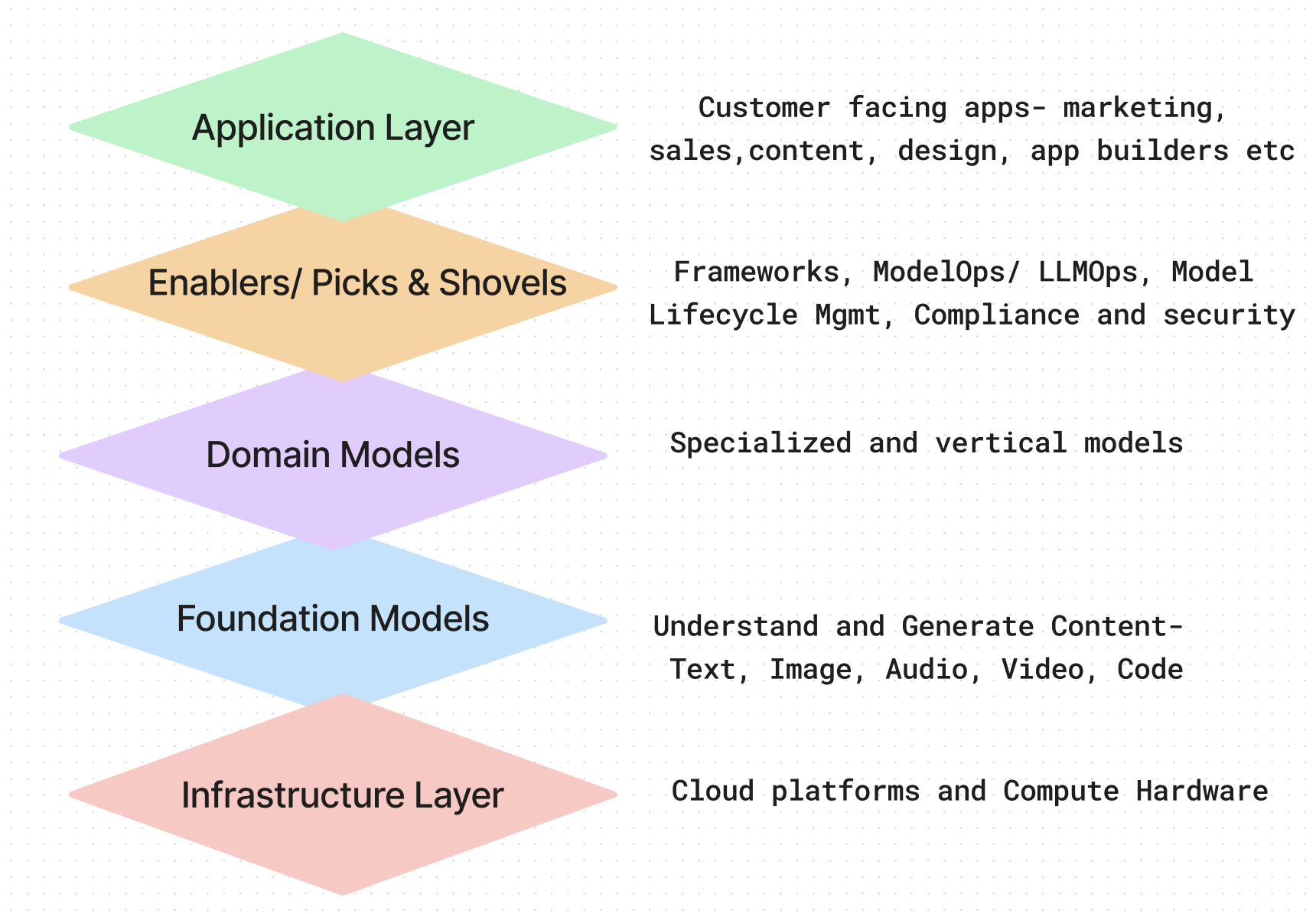
We broadly look at the existing stack in five layers-

Infrastructure layer includes hardware and cloud platforms which provide compute hardware and GPU. This includes companies such as Nvidia, AWS, GCP, Azure.

Foundation Models are GenAI models on top of which the entire stack is being built. They are AI neural networks trained on massive unlabeled datasets, enabling them to perform a diverse range of tasks, including test/ image/ audio/ code generation, text translation, and summarization. GPT-3, PaLM2, LLaMa are the well-known LLMs. Some open-source models trained on much smaller parameters are also getting interest for specific use cases.

Companies are using a combination of different models to increase accuracy and performance. A layer of domain/ vertical-specific models (health, legal, ecommerce, finance etc.) over foundation models has become a well adopted practice.

Next is a layer of tools that enables the use of these models, which we call Enablers. These tools are critical for the rapid adoption of foundation models by developers/ businesses, facilitating the shift where every company large or small is working towards adding GenAI capabilities to their products. Building production-ready AI apps is a challenging task that involves various steps. Starting with infrastructure setup, model hosting, database configuration, data collection and preparation tools, model selection, training or fine-tuning with your data, orchestrating different models based on use cases, integrating with your systems, deployment and maintenance of models, monitoring performance and cost of these models – all are part of this complex process. Hence, the emergence of enablers. Enablers offer capabilities such as orchestration, model management, observability, compliance, security, and more. Pinecone and Langchain are the most popular ones in this layer. Pinecone is a managed, cloud-native vector database with a simple API and no infrastructure hassles. Langchain is a framework for developing applications powered by language models.

Next is the Application layer, where customer-facing applications are built on top of GenAI models. It includes tools like Jasper, Glean, Copy.ai, Rephrase.ai. With GenAI, companies are providing better personalized customer experience, the conversation interface is taking over the clunky software UI and reducing their time to value.

Beyond all the excitement, it’s important to note that building and scaling an AI native tool is not as easy as it looks from all the Twitter chatter. We have spoken to many GenAI founders and tried to understand the challenges they are facing in customer adoption and product building. There are few interesting insights –

  1. Most of the GenAI tools from India are very early. They are seeing a lot of excitement and adoption from the market. Users are trying out different tools, but there is high churn. Prosumers and SMBs are the initial adopters of these products, but founders have to crack the retention and path to monetisation.
  2. Generational and non-critical use cases are seeing more traction. Generational use cases are some kind content generation- text, image, blog, code, audio etc. Non-critical use cases are business use cases where the cost of failure is not high and can work with not-so-high accuracy – sales, marketing, hiring etc. In high value use cases like cybersecurity, there is a cautious adoption of GenAI.
  3. GTM motion for enterprise SaaS remains the same. There is a sense of curiosity among enterprises regarding GenAI and acceptance to use it in their workflow but they are cautious. Their concerns about data privacy, security, and compliance persist, and there is limited trust in public LLMs. We are seeing a trend of building on the client’s VPC, which can increase the time to adoption.
  4. ChatGPT has changed the customers’ expectations. Customers are conversing with tools in natural language, they are not only asking for information or insights from the data, they are expecting end-to-end tasks to be done. The expectation is AGI (Artificial General Intelligence). We spoke with an AI native marketing product from India where customers are spending more than 30 min every session and asking in one single command to look into the data, identify cart dropout and design and send a campaign to them.
  5. There is a lot of adoption of picks and shovels- libraries, tools helping developers build apps for different use cases. Autonomous agents have become very popular. SuperAGI is one of our portfolio companies, which has gained more than 7k GitHub stars in two weeks. It is one of the trending repositories on GitHub. It is a dev-first open-source autonomous AI agent framework, enabling developers to build, manage and run useful autonomous agents quickly and reliably.


Based on our learnings over the last few months, we are more bullish on a few spaces in GenAI where we believe large outcomes from India can be generated:

  1. Picks and Shovels for developers: GenAI tech stack has become fairly complex and it is changing rapidly, only LLMs can’t help with production level use cases. As discussed in the above section, it is a long iterative process and these tools help developers build, experiment, train, and compare quickly. This is a new need that has emerged while developing in GenAI. Vector database, framework, model orchestration layer, autonomous agents are some examples of the types of tools getting created. Pinecone and Langchain fall under this category.
  2. No code enablers for businesses: We have seen copilot (GenAI) in a box model, where the entire AI stack is taken care of by the tool, you just have to integrate with your existing software. This new layer is emerging in the tech stack and it can be an opportunity for new players.
  3. ModelOps/LLMOps:MLOps used to be a not-so-attractive industry until 6 months ago. With GenAI, more models are going into production and none of the existing MLOps were made for that. Existing MLOps companies are adding capabilities and a new set of ModelOps tools are also emerging. ModelOps/ LLMOps tools include model lifecycle management, observability, data security and privacy, and model monitoring.
  4. Autonomous Agents:As discussed above, customer expectation is for AGI which can be provided by autonomous agents. They have the ability to analyze intricate problems, solve them iteratively, and take actions. AutoGPT is the most popular one, it has more than 139K stars on GitHub. In today’s form, it is not easy to use AutoGPT for business use cases. AGI is still in the early phase and will take some time to reach the customers’ expectation levels.
  5. AI native companies: On the application layer, we are keen on these companies. In many use cases, incumbents have the right to win because of distribution advantage. That’s why we believe all the niche use case products will get commoditised as incumbents will launch it as a feature. However, if you are building an AI native software with some vertical focus and data flywheel, then there is an opportunity to deliver better accuracy compared to incumbents.
  6. GenAI-powered Vertical SaaS: Vertical LLMs are trained on curated high-quality data from a specific industry. This allows Vertical LLMs to generate more accurate and relevant results. Legal, health, and finance are among the industries where a lot of knowledge resides in the massive historic data, which is the play of Vertical LLMs. GenAI-powered Vertical SaaS companies are getting popular, such as Hippocratic in healthcare and Evenup and Harvey.ai in legal.


A lot is happening in the GenAI world and we have been continuously learning about the latest developments. Our thesis will keep evolving. We will release a series of articles on GenAI to keep you updated on our learnings. If you are a founder building in GenAI or an enthusiast, we would like to have a discussion. Please feel free to reach out to veenu@kae-capital.com or sarthak@kae-capital.com.

Investment in Onwo

We at Kae Capital are very bullish on India to the world theme. We have already seen an increase in the global software businesses building from India. We believe to see a similar trend in global trade as well.

India is one of the largest agri-product exporters in the world. In FY22, the Indian agri exporters reached $49.6Bn, which is a 20% increase from the previous year. India is an agri commodity hub and one of the largest producers of several agri commodities like rice, sugar, and spices.

Most of the food products are traded as commodities from India with little to no value add. Major value chain margins lie with the outside processors/ buyers. There is a scope for adding value at the source to ensure better margins and value for the Indian manufacturers and sellers. The Government of India is pushing a lot to increase food exports and processing from India. The ministry of food processing industries (MoFPI) is boosting investments across the value chain of the food processing industry. Under PMKSY, GoI is making efforts to develop many mega food parks, agro-processing clusters, food processing units, and cold chain projects across the country. We believe with maturing processing infrastructure, India is at an inflection point to become a processing superpower. India’s food processing sector is one of the largest in the world and is expected to reach the output of $535 Bn by FY26.

The majority of these producers are MSMEs with a broken, unstructured and offline supply chain. Global food supply chains have a lot of intermediaries, inefficiencies and low transparency on the rates and transaction timeline. There is a need for an online platform to bring in trust and efficiencies in the value chain, which is where ONWO comes in.

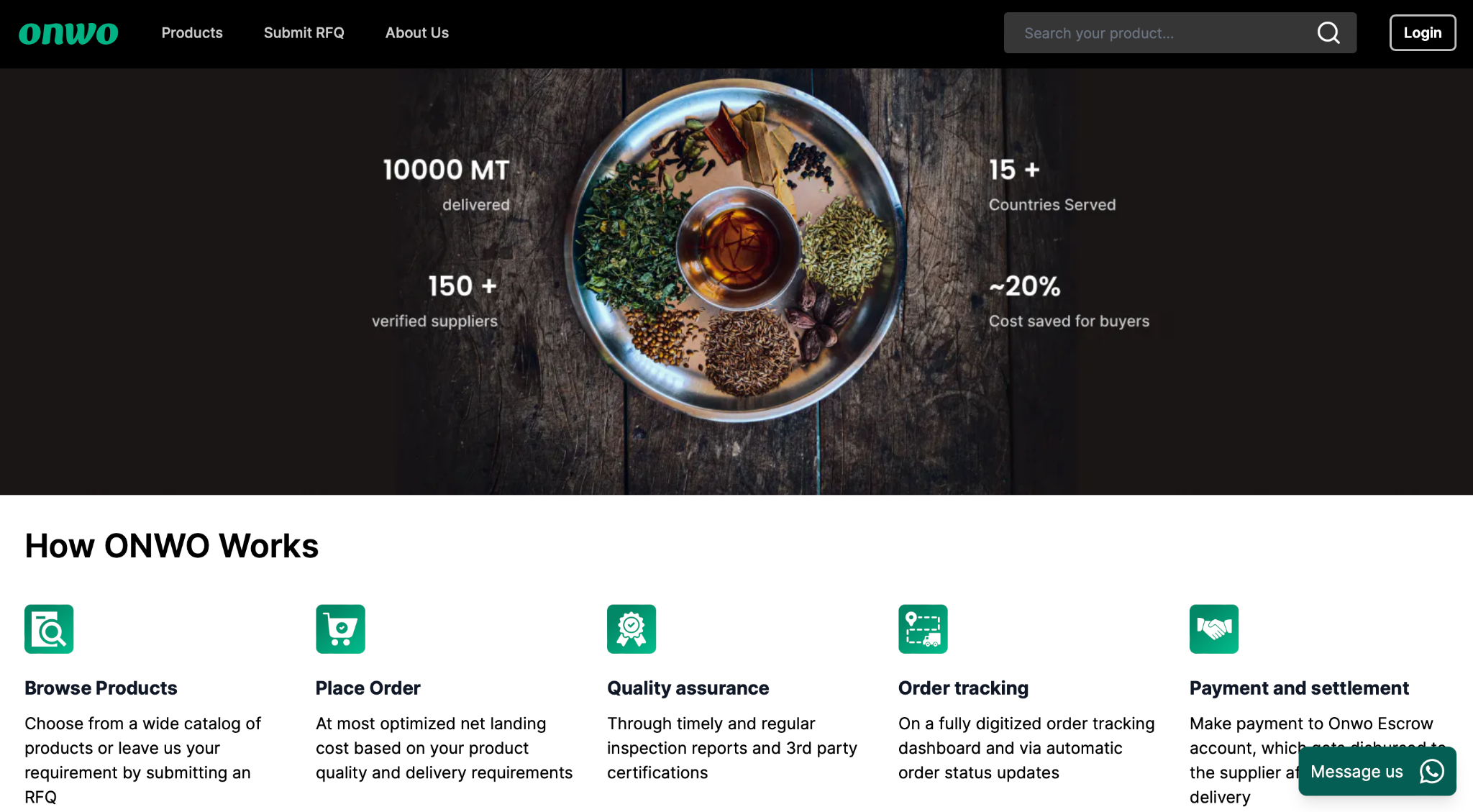
ONWO is at the forefront of reimagining the food export industry using a digital-first approach in an otherwise traditional industry. ONWO’s full-stack solution will help Indian manufacturers and SMEs access the global markets in a fully managed and asset-light model. ONWO is creating a digitized global food supply chain through contract manufacturing and a structured food export segment, allowing Indian manufacturers to ship processed products to the world.

ONWO is a curated marketplace to reliably discover, transact and fulfill orders of processed food products from Indian manufacturers. ONWO offers end-to-end solutions to its customers in a full-stack digital model, involving contract manufacturing and private label solutions, quality assurance and risk management and complete order fulfillment using a cutting-edge technology platform. ONWO ensures better margins and value add for both manufacturers and buyers. The key markets serviced by them are the US, Canada, UAE, Saudi Arabia, Qatar and Oman.

Onwo was started by second-time entrepreneur and former Flipkart executive Bipul Kumar in July 2022. We have known Bipul from his first startup and believed in his vision of transforming India’s food export value chain. Bipul has built an experienced and high-quality team. They have executed well in the last 6 months, exporting more than 10,000 MT of food products, with a high repeat rate of >90%. ONWO has covered more than 15 countries in operations.

ONWO is on a mission to build a solution for this large category. We are very excited to partner with them. It is a massive opportunity and they are a great passionate team with the right skills to build this business.

Investment in Contlo

Global e-commerce is a massive market. Online retail sales are expected to reach $6.5Tn by 2023, according to eMarketer and Statista. The US D2C (direct-to-consumer) sales have crossed $128Bn in 2021 and are expected to reach $213Bn by 2023.

The pandemic has led to unprecedented growth in digital adoption, shifting consumers’ shopping behaviour to online. We have seen an exponential rise of D2C brands from India post-pandemic. According to the Unicommerce report on India’s retail and e-commerce, D2C brands are driving growth in India’s e-commerce with a 45% CAGR and has the potential to reach $ 70Bn in a few years. According to Statista, India’s D2C market is expected to grow by more than 15 times from 2015 to 2025. In 2020, it was around $33Bn and is forecasted to reach $100Bn by 2025.

Globally e-commerce brands are moving away from marketplaces to headless commerce platforms like Shopify. Shopify is an e-commerce platform which enables merchants to set up online stores and has seen massive growth, doubling the number of merchants using Shopify in the two years from 2019. Shopify ARR was around $5.2Bn in Sep 2022, a 24.5% YoY growth. It was $4.6Bn in 2021, 57.4% YoY growth from 2020.

As brands continue to sell online, they struggle with high marketing spending on CAC and customer retention. They want to build direct relationships with consumers on different channels. To build a long-lasting relationship with the consumer, a consumer needs to be engaged at different points in the journey.

At Kae, we have invested in many D2C brands and keep evaluating more D2C brands in different categories. From all our conversations, customer engagement and high marketing spending came across as common areas of concern. The legacy horizontal marketing tools are not built for e-commerce specific use cases. There is a need for a verticalized marketing automation solution for e-commerce.

We are very bullish on vertical SaaS as a theme and believe the next evolution of customer engagement/marketing automation has to be more personalized. This is exactly where Contlo comes in. It is purpose-built for deep e-commerce use cases via seamless integration with leading e-commerce platforms like Shopify, and Magento. We have been in touch with Ishaan and Mukunda, from their early days and have seen their impressive journey of building an AI-led marketing automation for e-commerce.

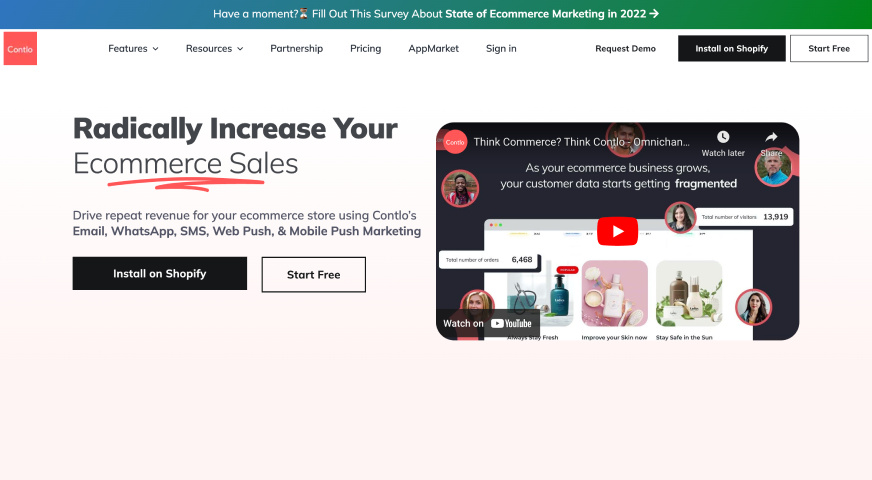
Contlo enables e-commerce and D2C brands to accelerate their sales growth, drive revenue generation and automate personalized experiences for its customers using e-commerce centric omnichannel customer engagement across email, SMS, WhatsApp, mobile and web push. It is leveraging AI to build hyper-personalized commerce experiences for end customers.

Today more than 1000+ brands use Contlo globally. It has witnessed a 50% MoM growth since its inception. It is empowering brands to build direct channels with their consumers, leading to increased retention and LTVs.

Contlo beautifully fits our investing framework for SaaS, leveraging data to build an AI-based vertical SaaS software with a PLG motion.

We at Kae, are thrilled to partner with Ishaan and Mukunda in this journey. They have built a very strong team with a vision to build a world-class AI product. You can find out more about Contlo here.

The Modern Data Stack

Data Sources

Companies generate a lot of data from different sources.

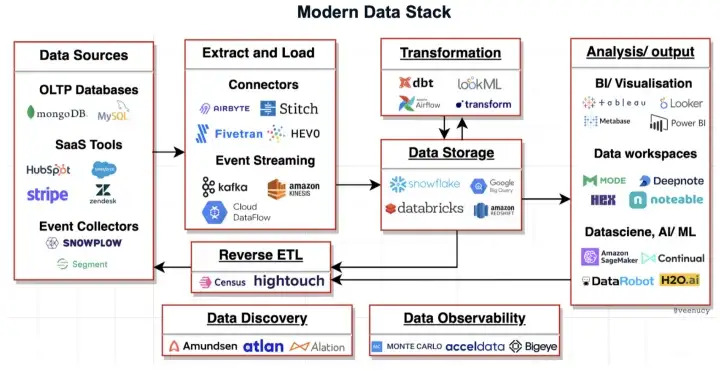
  • OLTP Databases– OLTP (Online transactional processing) systems handle large volumes of transactional data. It consists of user information and operational data generated by users such as e-commerce purchases and online banking. A standard database management system (DBMS) is an OLTP system. Mysql, mongoDB and Postgres are some well-known databases.
  • SaaS tools– Companies use many SaaS tools to run their business such as CRM tools to store sales, marketing and customer success data (Salesforce, Hubspot), payment/billing softwares (Stripe).
  • Event Collectors– Nowadays every possible touch point with the users is recorded as an event, which is used for analysis. It includes recording every click on websites and apps. Segment and Snowplow are popular choices for collecting events.

Extract and Load

All data from different data sources is extracted and loaded to a centralized data warehouse/ data lake. Earlier, the sequence used to be ETL- data is first extracted then transformed and then loaded into the data warehouse. Now, it has evolved to ELT- data is extracted and loaded into the datahouse and later transformed at the warehouse itself.

Data Storage

Ingestion tools stored the data at a cloud data warehouse or data lake. Data warehouse stores structured data (tables) that can be directly queried for analytics. The popular cloud data warehouses are Snowflake, Google Bigquery and Amazon Redshift.

Data Transformation

After storing the data, it is transformed directly in the warehouse into a structure ready for analysis, which is used by the data science and business team to run different analytics and ML models. Dbt, Airflow and LookML are the most popular transformation tools.

Analysis/ Output

The transformed data can used for different purposes-

  • BI/ Visualisation– These tools enable business users to derive insights. They provide a dashboard view with graphs/ pie charts which facilitates business visibility. Tableau, Looker, Power BI are some popular BI tools.
  • Data Workspaces– These tools make it easier for different users to query, visualize and collaborate on data and create dashboards. Some of the emerging data workspaces tools are hex, deepnote, mode, noteable.
  • Data Science, AI/ ML– Data scientists can run ML models on data with help of these tools. Some of the popular tools are Sagemaker, Continual.
  • Reverse ETL– It syncs back the aggregated data to SaaS tools like customer support, sales and marketing to provide full consumer visibility to business users at their primary software. Census and Hightouch are the popular reverse ETL tools.

Data Monitoring and Governance –

We also need to maintain operational data hygiene. There are three major data ops categories of softwares, which help in reducing the risk, operational complexity and cost of the cloud data-

  • Data Observability– Testing and monitoring pipelines are developed to detect and resolve errors or issues. Monte Carlo, Acceldata and Great Expectations are the popular choices.
  • Data Discovery– Data cataloguing, documentation and discovery so that people can discover the right tables for their use. Atlan, Amundsen, and Alation are the popular tools here.
  • Data Security– Access control and data security to safeguard the company’s data. Control which employee has access to which data. Cyral, Immuta are the emerging tools in this category.
  • Introduction of Data lakehouse by databricks and Unistore by Snowflake- Databricks has introduced the data lakehouse. A data lakehouse combines the flexibility, cost efficiency of a data lake with the data management capabilities of a data warehouse. It is an open data management architecture to enable analytics, BI and ML on all data types.
https://www.databricks.com/glossary/data-lakehouse
https://www.snowflake.com/en/data-cloud/platform/
  • Data Marketplace — Snowflake has become a behemoth and is now adopting a platform approach enabling products to develop on top of it. Idea is companies can use the native application framework to build native Snowflake apps that can be distributed through Snowflake Marketplace. Snowflake customers can discover, evaluate and run the apps in their accounts, removing the need to move data, thereby improving privacy and security. It is enabling customers to bring apps to data rather than moving data to different apps. It eliminates the delay and cost of traditional ETL with direct access to ready-to-query data and pre-built SaaS connectors.
https://www.snowflake.com/snowflake-marketplace/
  • MDSaaS– Modern Data Stack as a service. Data Stack is complex and evaluating tools and setting up the entire stack can be a challenging time taking process. There are low/no-code platforms that provide all the tools needed to go from data sources to interactive dashboards. Some of the emerging startups here are Selfr.io, Octolis.

A Guide to Improve and Maximise Developer Productivity: Metrics, Tools, and more


Developers in India are paid INR 410 per hour, on average. It can even touch INR 2000 per hour on the higher side. Despite that, the median code time per developer was found as 52 minutes per day, or four hours and 21 minutes of code time per week

Thus, there is a need for organisations to invest in platforms that help boost developer productivity

Developers have become the biggest ask for tech companies at this point in time. You may be seeing a lot of job openings now, but developers have had the privilege of constant job openings, with or without pandemic woes. The global application development software market is anticipated to reach $733.5 Bn by 2028, expanding at a CAGR of 24.3% from 2021 to 2028, as per Grand View Research, Inc. But while there seem to be so many opportunities for developers, their time presently is not being optimised well. If you want to know how to maximise your developer’s productivity, read ahead!

India’s app developer base is one of the highest in the world with 1.6 Mn jobs in the sector. The resultant websites and apps coming from the sector generated a revenue of $581.9 Bn in 2020.

Inefficient Utilisation Of Developers

The job of a software developer requires them to interact with multiple tools on a regular basis. But the time cost of context switching between tools, collaboration, documentation, version control, and duct taping the issues is quite high. This ends up eating into the employee’s development time.

According to Software’s Code Time Report, the median code time per developer globally was found as 52 minutes per day, or four hours and 21 minutes of code time per week. It was also found that developers spend an additional 41 minutes per day on other types of work such as reading code, reviewing pull requests, and browsing documentation. Thus, there’s a major developer experience gap.

Most companies are ineffectively deploying their developers, throwing various distractions their way. This is supplemented by further disruptions and meetings, as well as system inefficiencies, such as slow reviews, slow builds and bad tools. In order to ensure optimal utilisation of developers, strong dev tools are required. This can bridge the developer experience gap and improve a developer’s experience across the entire workflow.

Importance Of Dev Tools

Dev tools are a range of products focused on developers to help them build, deploy and collaborate on a daily basis. Global companies such as Github, Slack, JIRA, Browserstack, Snowflake, Postman and Datadog have created tools that are used by almost all developers. The dev tools market has made massive strides in the last few years. There are more than 73 Mn developers on Github, with over 16 Mn developers added in 2021 alone.

Snowflake reported stronger than expected Q4 2021 results, with revenue rising by about 117% to $107 Mn. There has been a steady shift from a ‘Build and Buy’ to a ‘Buy and Build’ decision-making mentality. Organisations have become more cognizant of these tools and the value they bring to the table. They are more than willing to invest in platforms that help boost developer productivity. This begs the question, what really caused this perception change?

Impact Of The Pandemic

This slow but steady shift got catapulted by the pandemic. The dev tools market has experienced tailwinds from this increased digital adoption. The pandemic forced teams to work remotely, which deepened the already existing problem of collaboration and communication. Many SaaS tools are being built for the future of work, to make this transition easier. These tools act as a supplement to the present working conditions, thus enhancing productivity.

To get a better understanding of why there’s a need to invest heavily in developers, we need to recognise that while developers have become a staple for tech companies, they are an expensive resource at the same time. On average, developers in India get paid INR 5.2 Lakh per year. This excludes bonuses, profit sharing and commission which are all big components for developers. Calculated on an hourly basis, it comes to INR 410, and even touches INR 2,000 on the higher side. This alone underpins the importance of optimising the developers’ time and helping them.

Thus, there’s a need to back developers and engineers with the right tools. At the same time, there’s a need to have visibility into DevOps. This, when backed by solid numeric data, can give a clear picture of the inefficiencies arising and help in optimising for these specific issues. At the end of the day, high-performing engineering teams are essential for the success of companies as they can release products to market faster.

There is a need for tools that can empower them to manage their daily tasks — context switching, collaboration, etc. in an efficient way. The developer productivity tools market is fast emerging to solve this problem. This would be key to look out for as we go deeper into cross-vertical functions and remote working.

Investment in Hatica: Engineering Analytics to Boost Developer Productivity

The demand for software developers is ever-increasing! Digitisation, cloud adoption and software stack globally are driving this demand, amongst other things, but there is not enough supply. According to the State of the Developer Nation report, in 2021 there were 26.8Mn active software developers in the world and they predict it to reach 45Mn by 2030. This makes it a very large and growing market.

Software developers use multiple tools for their daily work and a lot of precious development time is lost in low-value work of context switching between tools, collaboration, documentation, version control, duct taping the issues etc. There is a developer experience gap. Strong dev tools can bridge this developer experience gap and improve a developer’s experience across the entire workflow.

Dev tools are an array of products focused on developers to help them build, deploy and collaborate on a daily basis. Some of the global leaders in this market are Github, Slack, JIRA, Browserstack, Snowflake, Postman and Datadog. Dev tools have seen massive growth in the last few years. There are more than 73Mn developers on Github, with 16Mn+ developers added in 2021 alone. Snowflake reported stronger than expected Q4 2021, with revenue rising by ~117% to $107Mn. A shift has been witnessed, from a ‘Build and Buy’ decision-making mentality to a ‘Buy and Build’ approach. Developers are now open to buying platforms which can help them decrease the time of development.

This shift is further fueled by remote working. The Dev tools market has experienced tailwinds from this increased digital adoption. The pandemic forced teams to shift remotely, which has further aggravated the problem of collaboration and communication. Many SaaS tools are building for the future of work to make this transition easier, without affecting the productivity of teams. Developers are one of the most expensive resources of a tech startup, and any reduction in productivity is a big loss in terms of money and timeline of projects. According to U.S. News, the median annual salary for a software developer is $101,790, which will bring the cost of the average developer minute to ~$0.81. Therefore, every wasted minute of developers potentially impacts the company’s cost structure and profitability. Companies are now becoming more receptive to dev tools to ensure that most of the developers’ time is spent on actual development.

High-performing engineering teams are essential for the success of companies as they can release products to market faster. There is a need for tools which can empower them to manage their daily tasks- context switching, collaboration, etc. in an efficient way. Developer productivity tools is a massive emerging market to solve this problem.

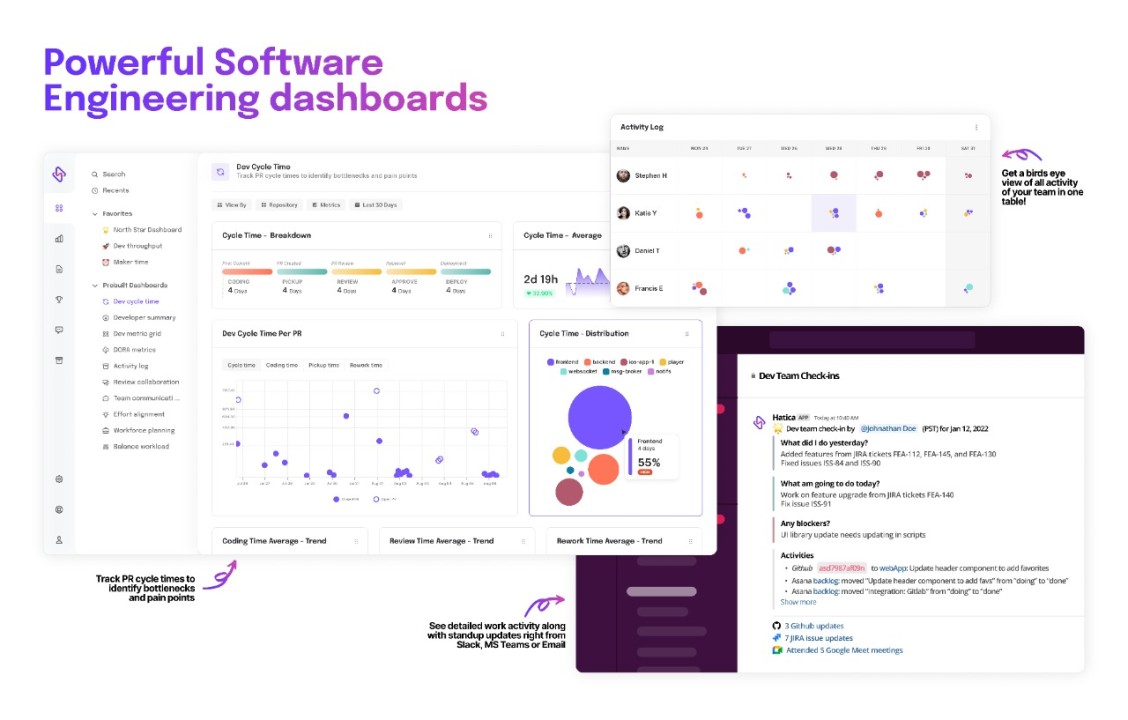
We are happy to back Hatica, as it aligns well with our thesis on developer productivity and the future of work. Hatica has been cofounded by a couple of experienced techies, building a global SaaS tool to provide an engineering analytics platform to boost developer productivity. Embedding the culture of remote work internally, they have built a powerful product to improve engineering efficiency and optimize dev workflows. Hatica has early customers from US, Europe and India. We are thrilled to be part of this journey and believe it has the potential to become one of the top engineering analytics platforms globally.

Future of Work

Historically, every few decades, work got disrupted by major events like the industrial revolution in the 1800s, WWII in the 1940s, the adoption of PCs and the internet in the 1990s, and the pandemic in 2020. The pandemic forced us to reimagine the way we used to work. Last year, it took us by surprise, forcing cities into complete/ partial lockdown to contain the virus. It made the global workforce stand still and forced organizations to rethink the way we work. It forced employers to make changes to enable work without the need to physically come to offices. This led to the adoption of remote work globally. Companies were forced to rethink how they operate, managers had to find ways to manage distributed teams without compromising on productivity and employees had to find tools to collaborate with colleagues/ clients while working remotely.

The pandemic fundamentally questioned the nature of work. Bringing all employers whether MNCs, tech startups, or homegrown businesses to adopt remote work. In some ways, remote work has made our lives much easier. It has removed the hours of commute and the frustration of being stuck in traffic. No need to wake up early, get ready in a suit and leave hours before the office timings to avoid traffic. It gave us the flexibility to work from the comfort of our homes in our jammies or from the Himalayas or from the beach. People got the opportunity to stay with their parents for months. Internet consumption has increased as more people are stuck at home, looking at their mobiles for learning/ entertainment. The gig economy has thrived as people have realized they can earn decent money without a regular 9 to 5 job. The creator economy has grown exponentially in the lockdown, we have seen more creator focussed startups than ever. On the flip side, working from home for months has dissolved the boundary between work and home. People are working more than ever with no real break time with their colleagues/ friends to relax. Employees feel more disconnected, lonely, and dissatisfied leading to anxiety and depression.

From the past couple of months, things are getting back to normal with increased vaccination and a decline in active COVID cases. Cities have started to open up. Even if some employers are ready to get back to offices, employees are apprehensive. More than 3/4th of executives expect the typical core employee to be back in the office for 3 or more days a week, whereas ~3/4th of employees globally would like to work from home for 2 or more days a week, and more than 50% want at least 3 days of remote work, according to a McKinsey survey. This expectation gap might lead to a decline in job satisfaction and higher attrition. According to a McKinsey survey, 40% of workers globally are considering leaving their current employers by the end of the year.

Companies are contemplating whether to keep working remotely or get back to offices. Many companies across the globe are opting for hybrid, which is a mix of remote work and work from office, giving more flexibility to the employees. Google has announced 60% of their workforce will be working together from the office a few days a week, 20% working from home and 20% working in new office locations. Spotify announced the transition to a permanent flexible-work model with its Work From Anywhere policy. Twitter announced that employees can work from home forever if they wish. Uber earlier announced 3 days per week from the office but it received pushback from employees and had to change it to 50% of the time from the office.

People are choosing to leave their job rather than go to the offices. We are a knowledge-based economy and talent is the biggest asset of the organizations. Demand for good talent has skyrocketed recently as it is not only the Indian startups/ MNCs with which you are competing for the talent, you are also competing with the global companies. The workforce has truly become global, dissolving the boundaries of space and time. Tech hiring has become really challenging for early-stage startups. Developers are sitting with multiple offers in hand. Working from home provided the much-needed push for some people to start up or work on a side hustle. It can be seen by the explosion of users on no code low code tools like Bubble and Webflow. It has become very difficult to hire or retain good talent. To attract and retain good talent, you need to be at least as flexible/ hybrid as other companies.

Remote work has brought a global culture shift. Organizations need to make changes to bring more flexibility in the system on when, where, and how people work. The challenge is to decide how to be more flexible, and how to structure the hybrid workforce. There are some functions that can work in remote setup effectively like engineering/ design teams. Other business-focused functions like sales and strategy, where the degree of collaboration is more, might need to physically sync up more often. There are many questions that need to be addressed before going hybrid: How many days of remote/ WFH in a week? Which functions can go completely remote and which functions require some work from office? Deciding on full-time vs contract-based employees. How to ensure collaboration with some employees working from home and others from the offices? How to ensure productivity and innovation along with keeping the safety of employees in mind? Which tools to use to enable inter and intra-team collaboration, engagement, and team culture?

Now, the question is not “whether to go hybrid or not”. The future of work is hybrid. The question now is “how to go hybrid?”

There is no set framework for hybrid. Employers are experimenting to find a balance between their needs and employees’ expectations. Policies, processes, technology, and collaboration softwares need to be in place to make work more flexible. Tech focussed on the future of work is very broad, anything that makes working and collaborating easier whether you are working from physical offices, fully remote, or working in a hybrid setup. We will cover more on different tech platforms building for the future of work in the next article. If you are building software for the future of work or want to have a discussion, please write to veenu@kae-capital.com.

Booming Indian SaaS Ecosystem

Indian SaaS ecosystem is at the cusp of transformation. According to Nasscom, India’s total SaaS revenue breached the $3.5 billion mark as of March 2020, growing at a CAGR of 30% and the SaaS industry has the potential to grow 6X to $13-15 billion by 2025. Indian SaaS has evolved into a multi-billion dollar industry today with startups raising growth capital from both domestic and international VCs. Homegrown B2B companies like Zoho, Freshworks, and Chargebee have become top global companies, which reinstated the confidence of investors in the Indian B2B SaaS business. Indian SaaS startups are now getting valuation multiples at par with global peers.

At Kae Capital, we are very bullish on India’s SaaS potential and have been investing in SaaS since 2012. Around 25% of our portfolio consists of SaaS startups. We were the first institutional investor in SaaS startups like Mayadata, Hippo Video, and Disprz. Our broad thesis on SaaS has remained built from India for the world and founders with unique insights about the market. (Please write to veenu@kae-capital.com or gaurav@kae-capital.com if you are building interesting SaaS businesses and want to have a discussion)

Sales Stack- The pandemic has accelerated the adoption of Remote Selling

Sales stack existed long before the pandemic and the pandemic has only accelerated this evolution. With the advent of remote work globally, we are forced to work from our homes and companies are looking for solutions to work and collaborate with their globally scattered employees. Managers are looking for solutions to onboard, train, monitor and increase the productivity of their remote teams.

The set of softwares have evolved to meet the needs of the sales team. The Sales Stack is a set of softwares that teams can use to ensure that Sales, Marketing and Growth are aligned and able to efficiently work together to maximize revenue.

Pandemic has increased the need for such softwares to manage remote teams efficiently, which has led to evolution of many startups focusing on revenue teams. According to Gartner, by 2025 80% of B2B sales interactions between suppliers and buyers will occur in digital channels and 60% of B2B sales organizations will transition from experience and intuition-based selling to data-driven selling. Sales teams across the globe embraced the new normal and learned to collaborate and sell digitally with the help of different technology solutions.

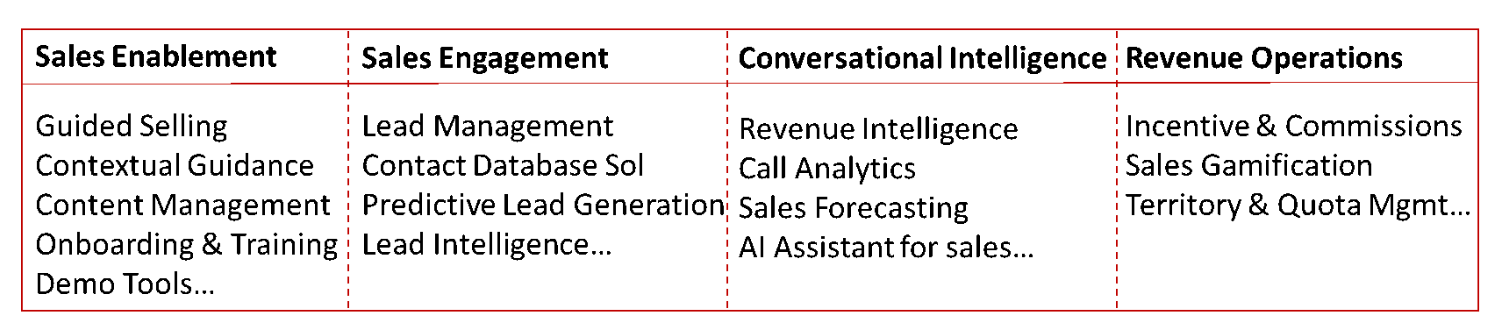
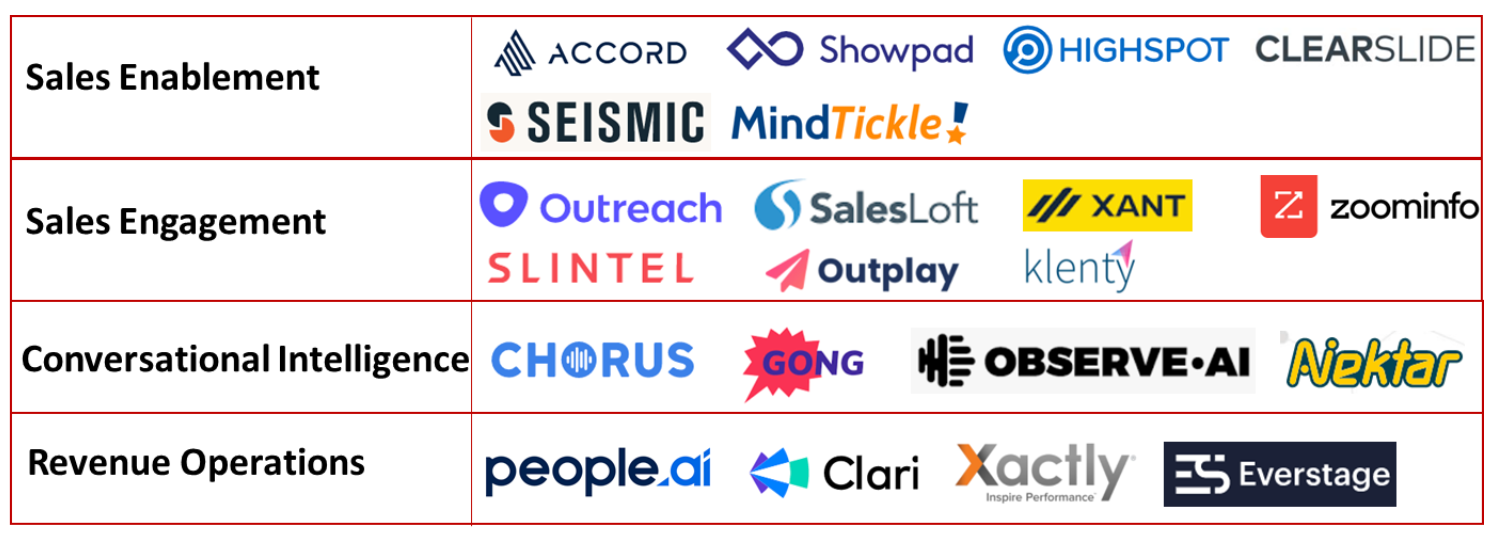
Sales Stack can be broadly categorized into four interconnected functions-

Sales stack works on top of systems of records like CRM and systems of communications/engagement like Zoom, Slack, and LinkedIn.

  1. Sales Enablement– It is the core of the sales stack, it enables the sales team with the content, guidance and training to perform their job effectively. It helps reps understand what to know, say and show to the prospects.
  2. Sales Engagement– It equips sales reps to reach and communicate with customers in a personalized and efficient way. It helps reps send the right information to the customer and keep track of actions on the leads.
  3. Conversational Intelligence– It helps managers monitor and interpret the conversations of reps and prospects. It is helpful in identifying the areas of improvement for reps. Simply put, it helps to listen and learn from sales calls.
  4. Revenue Operations– It is an end-to-end business process to provide transparency across marketing, sales, and renewals. In simple words, it streamlines the processes to align revenue teams, providing them with better visibility of the sales funnel.
We at Kae Capital are very keen on the sales stack. We have been analyzing this space for quite some time, there are many startups that emerged in the last year. Startups are working on land and expand strategy, entering with a piece of problem in the above four core functions with an aim to eventually provide integrated offerings for the entire sales stack. We believe a product-focused team with unique insights about the target category can tap this expanding opportunity. If you are building a sales stack software or intrigued to have a discussion, do write to me at veenu@kae-capital.com