Claim Processing Engines with Healthcare Delivery Networks

The vision to build a seamless link between healthcare delivery and insurance remains the goal

This is a topic which is of great interest in investing circles – health insurance; however, in order to paint a holistic picture, it has to be seamlessly integrated with healthcare delivery. India is notorious for heavy out-of-pocket expenses and a terribly inefficient claim settlement landscape – out of the USD 110bn+ healthcare market in India, IPD spends would amount to around 40-45% of which only USD 5-6 bn are processed in claims, indicating significant headroom for growth; and despite a large chunk of the market spends in OPD, the OPD insurance piece is completely untapped thus far. One of the major pain points to solve for in order to unlock value here is the claim settlement process – the vision is to make every settlement function and feel like a cashless claim.

Private insurance has been growing at 23-25% CAGR over the last few years – people are solving for distribution; however, the claim settlement piece remains to be solved, but this has to be done in tandem with creating a healthcare delivery network at the back

A healthcare provider network is critical to solving for cashless insurance claims while ensuring standardized healthcare delivery in the process. Patients are plagued with a very stressful journey in settling claims – managing documents, bills, and low visibility across the process. Hospitals need fast claim processing with minimum deductions and also suffer from poor visibility on the TPA process. Insurance companies need a broad healthcare delivery network to increase their premiums and lower operational costs during claim processing which is currently very manual.

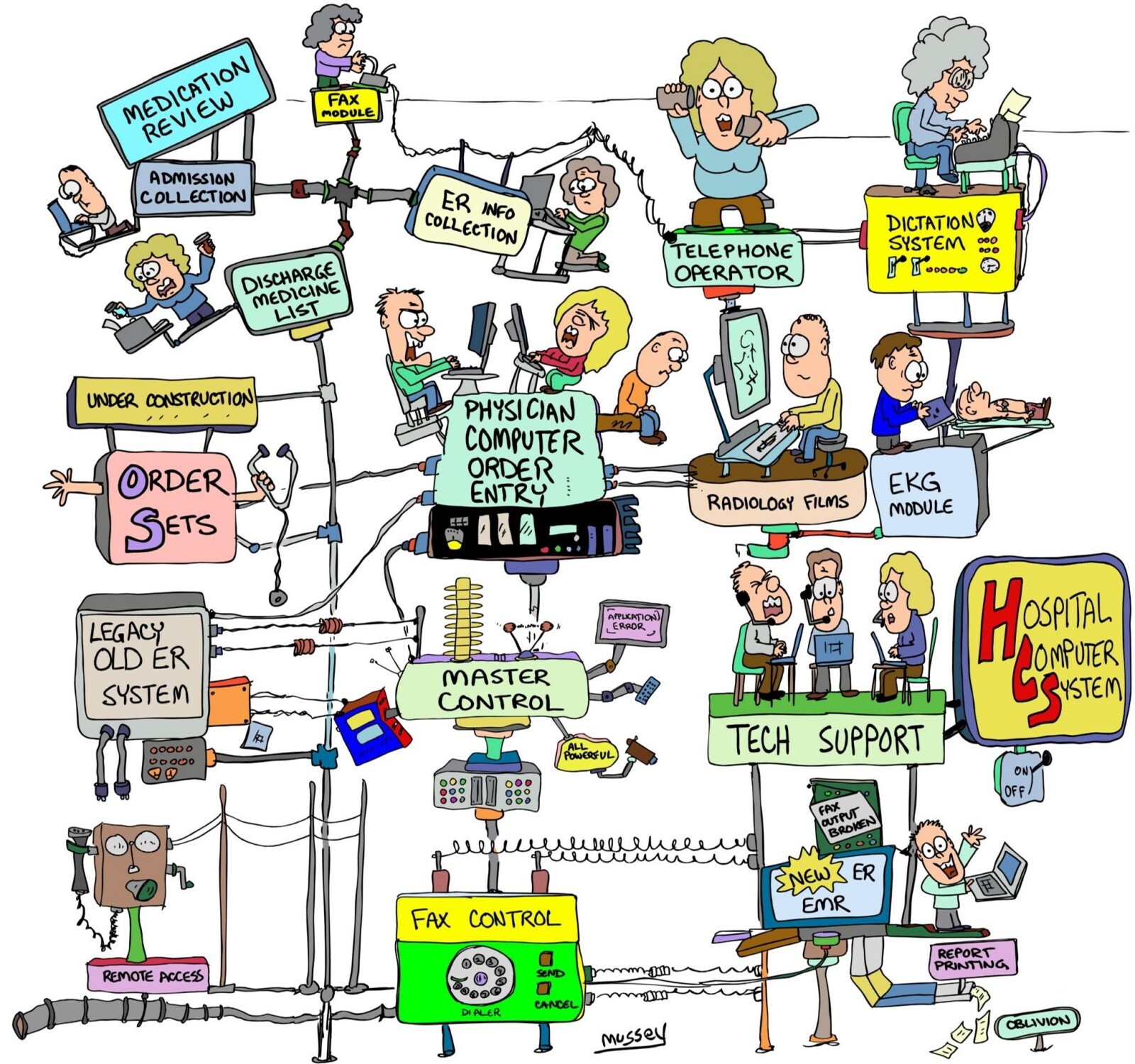
The current workflow in settling claims is severely impaired ->
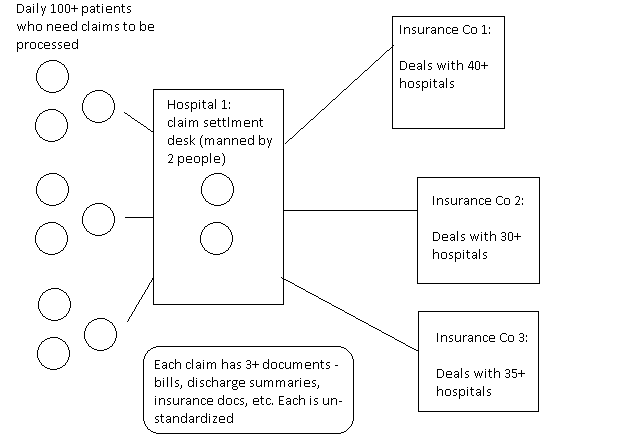
The TPA desk at any hospital is manned by 1 or 2 people who in turn have to address hundreds of unique claims on a daily basis from the customers/patients and have to coordinate this with 30+ TPAs on the other end with each having their own guidelines. Similarly, Insurance cos and TPAs need to reconcile the billing information, discharge summaries, and insurance documents of different hospitals and process the claims manually – neither the hospitals nor patients have any visibility on which stage the claim is at.

There is an urgent need to solve for an automated claim processing engine with seamless information flow between the different stakeholders on a singular platform -> the patient, the hospital and the insurance company so that TATs in claim settlement can be reduced, deductions can be reduced and a patient can have a seamless experience from hospital selection to discharge, the hospitals can settle claims in a speedy fashion and insurance companies get a strong healthcare delivery network to maximize premiums.

Using technology to integrate hospitals and insurance cos on one platform is very difficult and business model positioning is complex
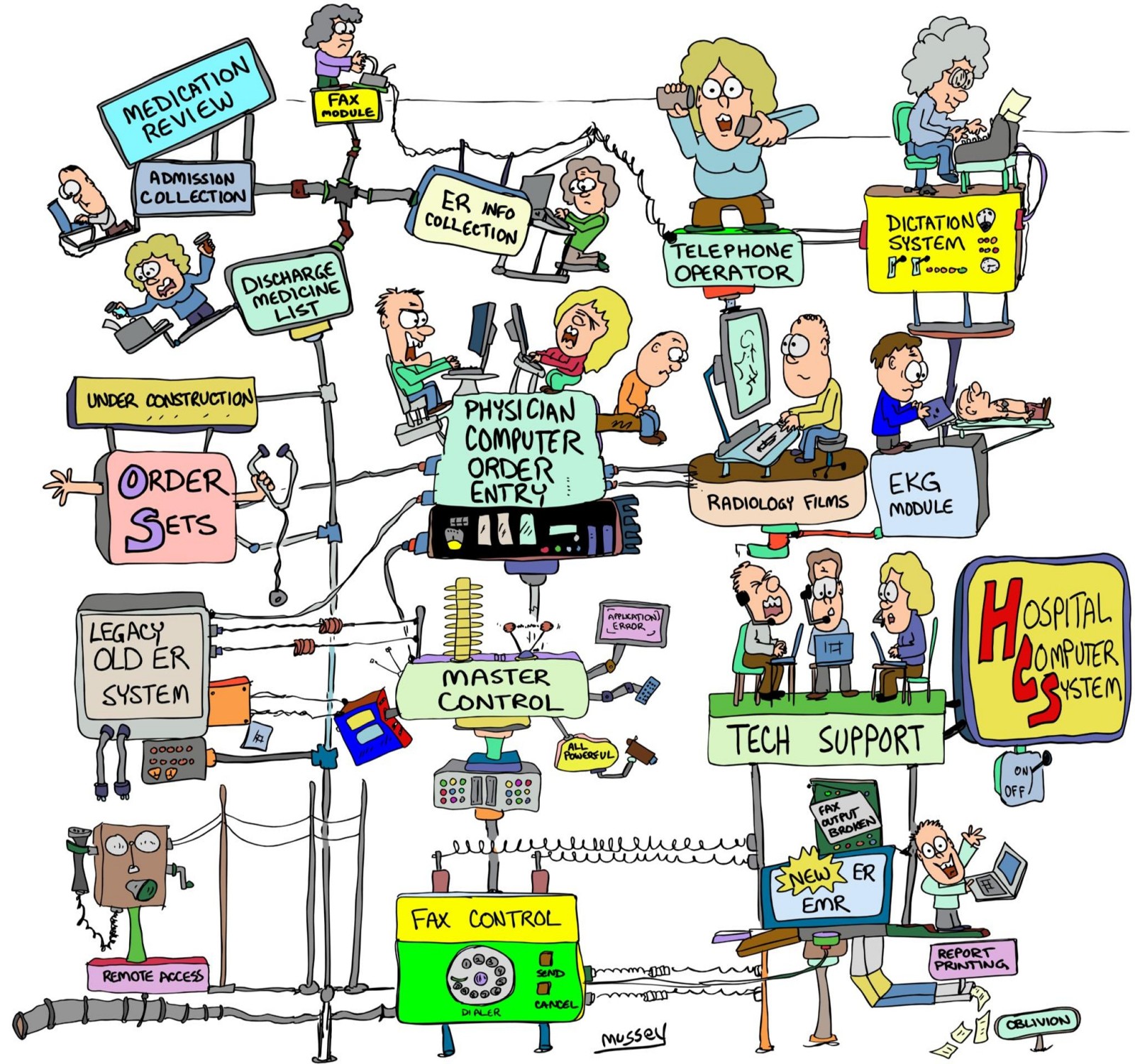
Since it is clear all three stakeholders need to be integrated on one platform for seamless communication and processing, there arise some critical questions which need to be addressed -> Will the start-up be positioned as a claim processing engine with a network of healthcare delivery providers in the backend and if that is the case, who will the core customer be?

By positioning as a claim processing engine with a network of hospitals at the backend, does the business model build a large enough outcome? The odds are that start-ups will charge a take rate for every claim processed. From our research, this seems to draw anywhere between 2-4% take rates which may limit the size of the opportunity, however, there seems to be a case for generating strong leads for hospitals which convert to procedures/tests for the hospital where an 8%+ take rate might work.

We are looking for companies who have unique insight into cracking the technology integration piece across all the stakeholders

Platformization of the communication and processing of claims seems to be plagued with very high adoption friction across stakeholders. The following become possible channels to drive adoption:

· The insurance companies (and TPAs) themselves –There are a limited number of health insurance providers with even fewer having a high willingness to adopt technology – seems like a tough sell on the legacy players; new age players with a tech DNA might be a low-hanging fruit.

· Hospitals – Will be a tough sell whichever way we look at it, it is common knowledge that changing/upgrading HMS systems in hospitals itself is an uphill task – making it a difficult proposition for new-age tech adoption.

Thinking out of the box to crack technology integration

· HMS systems – Since all data integrations with hospitals need to start from the hospital HMS, another viable option may be to tap into HMS cos – a single HMS provider might have access to 5k-7k hospital beds across different hospitals.

· WhatsApp – With initial indications of health start-ups having demonstrated Whatsapp-first approaches to onboarding and activating doctors, there may be a case for interesting claim processing engines being built atop of Whatsapp in a way which seamlessly connects across all stakeholders

With so many questions and such few answers, we feel putting out our thoughts will help us get some closure on the open questions surrounding a unified healthcare and insurance play.

We are on the lookout for a solution which can be adopted with minimum friction and has a scalable monetization model – if you feel you have cracked/or have insight into a stronger business model, we would love to hear it!

Women’s Health – A Massive Whitespace To Solve For

We at Kae are bullish about women’s health and feel large companies can be built out of India.

Women’s health is a pressing need in the Indian healthcare market

It is no secret that the Indian healthcare infrastructure is broken – issues include poor doctor-to-patient ratios, low healthcare/GDP spending, and poor geographic and cost accessibility across the board. These problems further complicate matters for the very critical, yet underserved women of the Indian population.

There is a pressing need for women-centric solutions across multiple verticals like nutrition, sexual and reproductive health, dermatology, and mental health, with existing legacy alternatives being subpar on multiple fronts – stigma, lack of personalized care and outcome-driven thinking have created a gaping trust void.

Why now? – Women’s health stands out as an opportunity to build loyalty through online communities

Over the last few years, women have increasingly come to rely on online channels for most of their health needs as is indicated by the sharp rise in in-bound queries (>100% YoY increase) on both Practo and Google.

All the urban women we spoke to rely on a set of digital communities for their personal health needs – and there has been an increase in the number of such groups in recent times – the plethora of new WhatsApp and Instagram groups are testament to the inherent virality that women’s communities have.


The TAM is large enough to capture the value and build out a venture-scalable business

As VC investors we are on the constant lookout for large monetizable spaces – so it is critical to target those TGs which have a consistent spending capacity with the right hook.

Much like other Indian consumer markets – the majority of the paying capacity lies in Metros and Tier-1 cities. Basis our own research by speaking to potential customers and founders alike – there exists a very high willingness to pay – with the minimum ticket size going upwards of INR 1k per month on average. Our confidence lies in the precedence of women paying periodically for both products – like pads and consumables as well as much higher ticket size procedures and services like laser hair removal, which generates a semi-annual spend of around INR 50k+ easily. Many of the recurring spending categories are must-haves for women.

Most tech solutions today are community and content led, with a paid conversion to a full stack primary care and telemedicine/teleconsult layer with products/tests or procedures on the back to monetize – we believe a sustainable business model in currently available tech platforms will be built on the back of an e-commerce platform to maximise for spend per acquired customer.

We believe the market is ripe to crack the right core customer and hit product and channel fit

The personas in this market are large enough to build out a scalable business – be it a working professional, a homemaker or student to hit PMF. High NPS and customer delight are all about solving for the best value proposition/solution for your niche and this is a question which is very much open to debate with no wrong or right answers.

The niche here we believe will depend on the stage of life the customer is in, and we believe the best way is to look at it as follows –

• 25-35 – issues may range from PCOS, irregular periods, skin and hair, etc.

• 35-45 – issues may be pregnancy-focused, fertility-related, etc.

• >45 – issues may be around menopause, skin, etc.

For each phase of life, the core hooks may vary – from dermatology to reproductive health and fertility; this a question we would love for entrepreneurs to answer!

We are looking for a team that can crack the “trust” factor

Our belief is that unfair advantages will be built around trust and brand recall– most solutions in the market today are still fairly early in their journeys and are on the lookout for weak signals of a potential hockey-stick growth going forward built on deep engagement. We are actively on the lookout for teams with the best insight into building high-engagement communities.

If you have unique customer insight and demonstrated engagement/early indicators of engagement and are confident or even have the slightest inkling that you have cracked or are on route to cracking a scaleable trust-building playbook while offering personalised and empathetic solutions in a standardized manner – we would absolutely, positively love to hear from you – please do write to sarthak@kae-capital.com.

Kae Konnect: Future of Gaming

As part of our Kae Konnect Webinar Series, we hosted Nitish Mittersain, Founder & MD of Nazara, which today is one of the leading gaming companies in India with operations across 60 countries. During the one-hour fireside chat, we deep-dived into the future of gaming and how it will shape up in the next 10 years. Nitish also discussed potential opportunities that are waiting to be unlocked along with some of his key learnings during his journey with Nazara.

If you’d like to see the video for the event, please use the link: https://youtu.be/skIYCF2jbi0

Following were some of the key highlights from the discussion:

Future of Nazara and Covid-19 Impact:

While some of the verticals were impacted negatively due to Covid-19 (eg. fantasy sports etc.), edutainment has done very well for Nazara. Kiddopia (an app focused on kids’ education and entertainment) grew its revenue by 5x during this period. Companies such as Sportskeeda pivoted to double down on e-sports and become the go-to destination for esports content with ~20 Mn users a month.

In the immediate future, Nazara plans to focus on three spaces – e-sports, early learning, and sports simulation – via its companies Nodwin Gaming, Kiddopia and NextWave (owns IPs such as WCC).

Trends in Gaming:

Nitish believes that the intersection of VR and gaming is very interesting – this space is nascent right now but he believes that we will move from 20-minute sessions to a world where it will be very difficult to get out of a VR session. Another key trend is that games will evolve into social platforms. We are already seeing certain trends such as songs being released and concerts being hosted within Fortnite. Gaming will move beyond just the gaming experience per se and deliver more value in terms of engagement and social experiences. A third big trend, Nitish predicts is the gamification of activities in our day-to-day lives. Companies such as Zwift allow users to cycle at home, compete with friends and enjoy a community of enthusiasts – therefore making the entire experience more gamified and engaging.

E-sports in India:

Mobile has been a great leveller for esports. Earlier e-sports was focused on PC and Indian gamers lacked exposure to certain gaming platforms. However today because of games such as PubG, gamers have more avenues to play competitive games and are now able to compete on a global scale. Therefore mobile is an accelerator for esports and strong growth is expected from India and other continents such as Africa. In the last year or so, we’ve seen 100s of live streamers acquire 1Mn subscribers on Youtube – another sign of the growing e-sports ecosystem.

Real Money Gaming in India:

Two success stories have played out in this space i.e. fantasy sports and rummy. Nitish believes there is still more headroom for growth. Companies with differentiated core products can continue to build in this market however founders need to be mindful of regulatory risk in this space.

Monetization of Indian Gamer:

The majority of gaming revenue in India is via real money gaming today (fantasy, card games such as poker rummy, etc.) while the balance revenue is from in-app purchases and advertisements. However, Nitish is seeing green shoots in the second category where Indian users are willing to pay for games. Nitish believes a growth of 10-20x can be expected over the next 2-3 years in in-app purchases.

Being mobile gamers first, most users in India are casual gamers. However, as these users move through their gamer lifecycle, they will eventually move from hyper-casual to casual to mid-core gaming. Indians today have access to some of the best gaming content across the globe, therefore as an Indian gaming studio, you need to build games that are at par with global competitors to pique an Indian user’s interest. Localized content and IP may help grab initial eyeballs however developers need to build strong game mechanics to ensure engagement, retention and monetization. We are starting to see successes such as Ludo King which has strong retention and virality – taking the game to over 50 Mn daily active users.

Metrics in Gaming:

Founders should avoid vanity metrics such as downloads (as users may install the game but delete the game eventually). Companies should focus on metrics such as retention and time spent, as that will determine ARPU from the user. The other key metric founders should focus on is virality. In markets such as India, the propensity for a user to pay is lower, whereas in markets such as the US, users have a higher propensity to pay (therefore the LTV/CAC ratio would be better). To help distribution, game studios should bake virality into their products when building games for India.

Advice to Founders: 

“Float like a butterfly, sting like a bee” – Nitish quotes Muhammad Ali and advises founder to be light-weighted, stay asset-light, debt-free and build strong and clean corporate governance. Nitish has four independent directors and believes that they bring different perspectives and insights to the table and show founders their true picture. Bringing in an independent director early on in a company can add tremendous value to the team.

At Kae, we resonate with Nitish’s excitement in the gaming space and believe multiple massive opportunities are waiting to be unlocked.

If you are building something in gaming, we would love to hear from you. You can drop an email at sarthak@kae-capital.com to discuss your venture.