Rally of New Traders!

The NSE has 19Mn active clients of all stockbrokers combined as on June 30, 2021, an increase from 12Mn on June 30, 2020, a jump of 58% in one year. Zerodha is the largest, accounting for 19% of clients (up from 15% last year), followed by ICICI Securities and Upstox. (Zerodha has ~2Mn Active clients, ~1Mn Inactive clients)

The number of investor accounts with Central Depository Services (India) Limited (CDSL) has more than doubled from 21.2Mn in March 2020 to 46.4Mn in September 2021. In fact, more than half of the additional 25.2Mn accounts — 13Mn — have come in the last six months between April and September 2021. Even NSDL added nearly 27 lakh accounts between April and September 2021.

Okay, but how many of them were retail investors?

In the last year, the number of retail investors has jumped more than 41 percent, data available with BSE showed. More than 70Mn investors were registered with BSE as of July 8.

Retail investor participation continued to grow exponentially in FY21 as well, with almost 4.5 million retail investor accounts being added in just the first two months of the fiscal year. The total number of retail investors increased by an astonishing 14.2 million in FY21, with 12.25 million new accounts being opened on CDSL 1.9 million in NSDL.

The result is that the Indian stock market is now dominated by retail investors. The NSE alone saw retail investors share grow from 33% in 2016 to 45% in 2021

Why will this number grow?

The industry has the potential to cross INR 100 trillion in AUM in the twenties. Reaching the INR 100 trillion vision during the mid-twenties can help the industry become the 11-13th largest asset management industry in the world from its current standing of 17th largest asset management industry. BCG estimates indicate that achieving this growth will require a 5x increase in the investor base from 20Mn in 2020 to 100Mn investors soon.

The problem is that the new investors coming into the market do not fully understand the market. A large number of them are in their 20s and 30s taking massive positions in F&O which is a much riskier asset class. A study by ISB showed that the majority of them tend to exit winning trades quickly and hold on to losing trades longer (A textbook mistake done by rookie traders who half gamble due to lack of understanding of the markets)

This is a gap that the market has not been able to fill so far. New traders are not as savvy as the older ones. While there may be enough YouTube videos or upskilling players helping them pick up the tricks of the trade through theory and a few live trade sessions here and there, the vast majority of them do not follow the basic hygiene of being a trader, i.e Building a solid trade setup.

Now the question is – Are the existing stock brokers available in the market well equipped to provide this service to new traders? 

The answer would be No. New traders need risk management systems, a chart to track their daily earnings or losses, discipline in setting targets, stopping losses, and risk-to-reward ratios, which today is typically done outside of the brokerage platform and on excel sheets.

India, being one of the fastest growing markets for retail investors in the world with a large market still untapped, needs platforms that help regulate and bridge the learning curve for new investors/traders.

After all, investing in financial freedom is the winning bet of them all!

(If you are a company building in this space, do write to us at sarthak@kae-capital.com)
Claim Processing Engines with Healthcare Delivery Networks

The vision to build a seamless link between healthcare delivery and insurance remains the goal

This is a topic which is of great interest in investing circles – health insurance; however, in order to paint a holistic picture, it has to be seamlessly integrated with healthcare delivery. India is notorious for heavy out-of-pocket expenses and a terribly inefficient claim settlement landscape – out of the USD 110bn+ healthcare market in India, IPD spends would amount to around 40-45% of which only USD 5-6 bn are processed in claims, indicating significant headroom for growth; and despite a large chunk of the market spends in OPD, the OPD insurance piece is completely untapped thus far. One of the major pain points to solve for in order to unlock value here is the claim settlement process – the vision is to make every settlement function and feel like a cashless claim.

Private insurance has been growing at 23-25% CAGR over the last few years – people are solving for distribution; however, the claim settlement piece remains to be solved, but this has to be done in tandem with creating a healthcare delivery network at the back

A healthcare provider network is critical to solving for cashless insurance claims while ensuring standardized healthcare delivery in the process. Patients are plagued with a very stressful journey in settling claims – managing documents, bills, and low visibility across the process. Hospitals need fast claim processing with minimum deductions and also suffer from poor visibility on the TPA process. Insurance companies need a broad healthcare delivery network to increase their premiums and lower operational costs during claim processing which is currently very manual.

The current workflow in settling claims is severely impaired ->

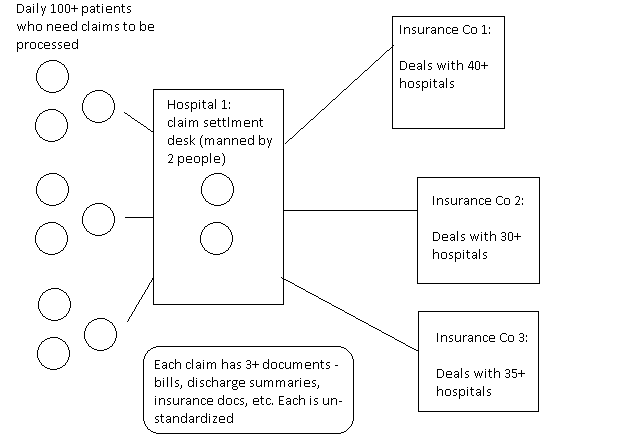
The TPA desk at any hospital is manned by 1 or 2 people who in turn have to address hundreds of unique claims on a daily basis from the customers/patients and have to coordinate this with 30+ TPAs on the other end with each having their own guidelines. Similarly, Insurance cos and TPAs need to reconcile the billing information, discharge summaries, and insurance documents of different hospitals and process the claims manually – neither the hospitals nor patients have any visibility on which stage the claim is at.

There is an urgent need to solve for an automated claim processing engine with seamless information flow between the different stakeholders on a singular platform -> the patient, the hospital and the insurance company so that TATs in claim settlement can be reduced, deductions can be reduced and a patient can have a seamless experience from hospital selection to discharge, the hospitals can settle claims in a speedy fashion and insurance companies get a strong healthcare delivery network to maximize premiums.

Using technology to integrate hospitals and insurance cos on one platform is very difficult and business model positioning is complex

Since it is clear all three stakeholders need to be integrated on one platform for seamless communication and processing, there arise some critical questions which need to be addressed -> Will the start-up be positioned as a claim processing engine with a network of healthcare delivery providers in the backend and if that is the case, who will the core customer be?

By positioning as a claim processing engine with a network of hospitals at the backend, does the business model build a large enough outcome? The odds are that start-ups will charge a take rate for every claim processed. From our research, this seems to draw anywhere between 2-4% take rates which may limit the size of the opportunity, however, there seems to be a case for generating strong leads for hospitals which convert to procedures/tests for the hospital where an 8%+ take rate might work.

We are looking for companies who have unique insight into cracking the technology integration piece across all the stakeholders

Platformization of the communication and processing of claims seems to be plagued with very high adoption friction across stakeholders. The following become possible channels to drive adoption:

· The insurance companies (and TPAs) themselves –There are a limited number of health insurance providers with even fewer having a high willingness to adopt technology – seems like a tough sell on the legacy players; new age players with a tech DNA might be a low-hanging fruit.

· Hospitals – Will be a tough sell whichever way we look at it, it is common knowledge that changing/upgrading HMS systems in hospitals itself is an uphill task – making it a difficult proposition for new-age tech adoption.

Thinking out of the box to crack technology integration

· HMS systems – Since all data integrations with hospitals need to start from the hospital HMS, another viable option may be to tap into HMS cos – a single HMS provider might have access to 5k-7k hospital beds across different hospitals.

· WhatsApp – With initial indications of health start-ups having demonstrated Whatsapp-first approaches to onboarding and activating doctors, there may be a case for interesting claim processing engines being built atop of Whatsapp in a way which seamlessly connects across all stakeholders

With so many questions and such few answers, we feel putting out our thoughts will help us get some closure on the open questions surrounding a unified healthcare and insurance play.

We are on the lookout for a solution which can be adopted with minimum friction and has a scalable monetization model – if you feel you have cracked/or have insight into a stronger business model, we would love to hear it!