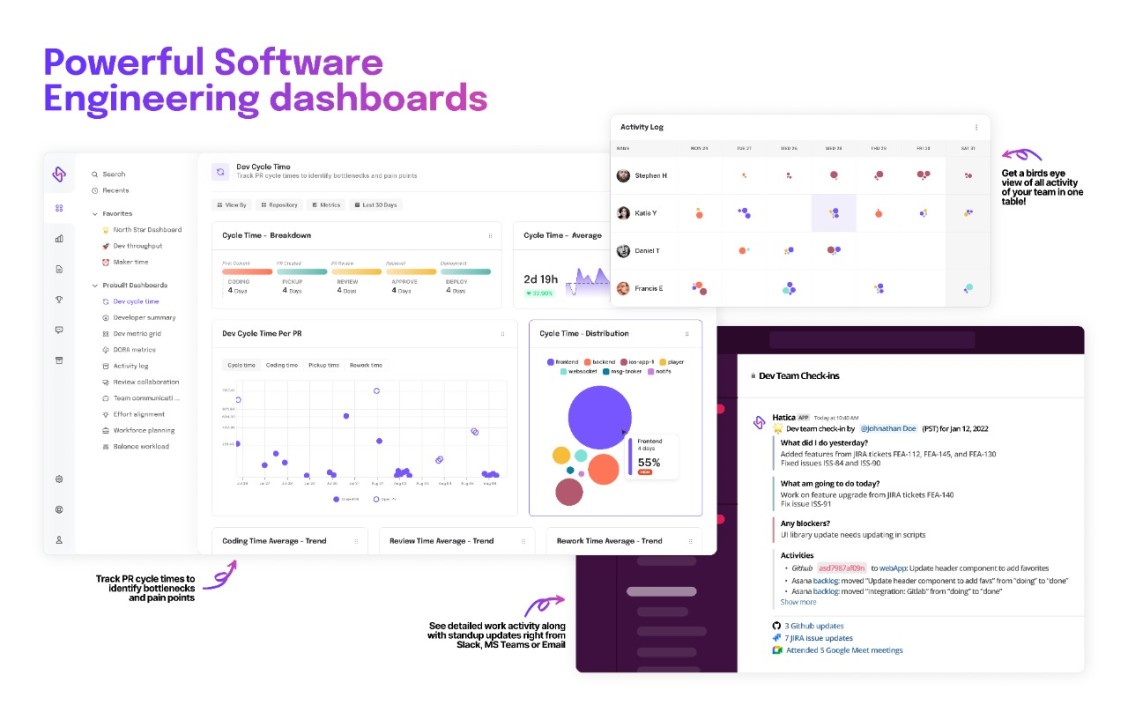
Investment in Hatica: Engineering Analytics to Boost Developer Productivity

The demand for software developers is ever-increasing! Digitisation, cloud adoption and software stack globally are driving this demand, amongst other things, but there is not enough supply. According to the State of the Developer Nation report, in 2021 there were 26.8Mn active software developers in the world and they predict it to reach 45Mn by 2030. This makes it a very large and growing market.

Software developers use multiple tools for their daily work and a lot of precious development time is lost in low-value work of context switching between tools, collaboration, documentation, version control, duct taping the issues etc. There is a developer experience gap. Strong dev tools can bridge this developer experience gap and improve a developer’s experience across the entire workflow.

Dev tools are an array of products focused on developers to help them build, deploy and collaborate on a daily basis. Some of the global leaders in this market are Github, Slack, JIRA, Browserstack, Snowflake, Postman and Datadog. Dev tools have seen massive growth in the last few years. There are more than 73Mn developers on Github, with 16Mn+ developers added in 2021 alone. Snowflake reported stronger than expected Q4 2021, with revenue rising by ~117% to $107Mn. A shift has been witnessed, from a ‘Build and Buy’ decision-making mentality to a ‘Buy and Build’ approach. Developers are now open to buying platforms which can help them decrease the time of development.

This shift is further fueled by remote working. The Dev tools market has experienced tailwinds from this increased digital adoption. The pandemic forced teams to shift remotely, which has further aggravated the problem of collaboration and communication. Many SaaS tools are building for the future of work to make this transition easier, without affecting the productivity of teams. Developers are one of the most expensive resources of a tech startup, and any reduction in productivity is a big loss in terms of money and timeline of projects. According to U.S. News, the median annual salary for a software developer is $101,790, which will bring the cost of the average developer minute to ~$0.81. Therefore, every wasted minute of developers potentially impacts the company’s cost structure and profitability. Companies are now becoming more receptive to dev tools to ensure that most of the developers’ time is spent on actual development.

High-performing engineering teams are essential for the success of companies as they can release products to market faster. There is a need for tools which can empower them to manage their daily tasks- context switching, collaboration, etc. in an efficient way. Developer productivity tools is a massive emerging market to solve this problem.

We are happy to back Hatica, as it aligns well with our thesis on developer productivity and the future of work. Hatica has been cofounded by a couple of experienced techies, building a global SaaS tool to provide an engineering analytics platform to boost developer productivity. Embedding the culture of remote work internally, they have built a powerful product to improve engineering efficiency and optimize dev workflows. Hatica has early customers from US, Europe and India. We are thrilled to be part of this journey and believe it has the potential to become one of the top engineering analytics platforms globally.

What I Learnt With Fynd

The genesis of Fynd – Harsh tells the full story here….but here’s an extract to get you started.

Since Sept 27, 2012 (when addSale was officially registered in Mumbai), we have gone through two industries, two serious potential buyers, three ground-up built teams, three names, five offices, 10 internal and external products, trying to sell in 15 countries, 22 names on the cap table, deployments across 25 cities in 100+ stores and 120+ team members.

Along all of this, we have always remained true to our passion to build products that help people shop.

Our vision was to be at the intersection of technology and retail. We wanted to straddle the gap between the ease, convenience and personalization of digital technology with the instant gratification, touch and feel experience of physical retail.


So how did we become one of the 22 names on the cap table?

I will never forget the meeting with 7 of us crammed in our very tiny conference room in Nariman Point looking at a demo video where Harsh was at a Diesel store mixing and matching looks on a touch screen powered by (then) addSale. The pitch was that retail was going to go digital and in order to stay relevant, physical retailers and brands needed to up their game and introduce digital experiences in-store to enhance sales. While in February 2013, this required a little bit of mind-bending by us. Harsh, Farooq and SMG exuded confidence, conviction, optimism and a real passion for solving for this Physical-Digital divide. That is what we bought into. Their conviction and commitment.

Over the last 6 years, spending time with the founders and the team has been like being in an entrepreneurship boot camp of sorts for me. I have learnt that doing more with less is an art, but building a data-driven organisation is a science. For a founder, knowing and believing in their purpose is central to persevering and ignoring the noise that surrounds them. Brutal honesty and transparency is directly linked to speed of execution.

To paraphrase what Farooq says, “great leaders build great cultures that build great companies”, (read the full blog here for more on Fynd’s culture.) and there are two things that have really stood out for me.

Data-driven has never been a buzzword, it is a religion at Fynd. Every (and I mean every) single person in the company is an expert on all the internal data systems and SQL literate. This means, that everyone can query data and find their own insights that help them take better decisions in real-time. There are giant screens all over the office that are constantly streaming dashboards. Transparency rules here.

The second is their grit. Farooq says “ We have had a fairly difficult fundraising history, but that has never stopped us from thinking big and then executing relentlessly.” It is this ability to never give in to what looks impossible, but to in fact turn that into an advantage that has made the Fynd team and their journey special. It is their infallible grit and grind that keeps them moving forward.

Kae Capital was the first institutional investor in addSale which rebranded to ShopSense and then again in Fynd. We have been privileged to see this journey from its inception to rapid scale to exiting an investor who has big plans for retail in India. We wish the Fynd team the very best on this new adventure of theirs.

We have always backed exceptional founders through good times but especially through bad times and will continue to do that.