Part 2: Decoding GenAI – The Next Revolution in Consumer Experiences in India

While the buzz around Generative AI (GenAI) predominantly highlights breakthroughs in Large Language Models (LLMs), we’re yet to see significant advancements at the application layer in consumer apps.

This piece shifts focus from foundational models to the transformative potential of GenAI in consumer applications, emphasizing how it can both accelerate existing consumer behaviors and foster new ones by mainstreaming interactions with machines in our native language.

The reality behind the hype

GenAI has sparked considerable excitement, especially with applications like ChatGPT, Character.AI, and Replika.AI, but consumer engagement and retention beyond the top few platforms is still surprisingly low.

Ultimately, GenAI is a tool, and its value is realized through thoughtful, contextual implementation. A spate of GenAI-first consumer startups from Y Combinator show promise, yet the Indian market, with its unique economic conditions and consumer behaviors, presents distinct challenges and demands innovative incubation models.

Rethinking GenAI Through Consumer Behavior

The future of consumer GenAI is multimodal and agentic and will include intelligent interfaces.

Traditional segmentation of GenAI applications often focuses on function or sector. In contrast, I’ve put together a behavior-centric framework to squarely focus on how this technology is and will shape consumer behavior.

The application of GenAI in consumer tech can be segmented into distinct behaviors:

  • Companionship: In an era where human reliability wavers, the potential for AI companions that exist continuously in users’ digital lives, remember past interactions and evolve based on user interactions hold strong promise. Films like “Her” offer a glimpse into future possibilities where digital entities become more than tools. The idea of digital companionship is becoming more tangible OpenAI’s latest release, and through startups like Hume and Wysa. Hume is innovating in emotional AI, understanding and interacting with human emotions, while Wysa, a company in our portfolio, is focusing on mental health companionship. Furthermore, applications like Astrotalk are tapping into cultural niches, providing digital companionship through astrology, which is particularly resonant in India.
  • Creative and Intellectual Partnership: Beyond companionship, there’s a vast landscape where AI can enhance human capabilities, especially in creative and intellectual endeavors. This partnership could redefine roles in various professional fields, including education, healthcare, and legal, where AI doesn’t replace but augments human efforts, by acting as a personal assistant to enhance learning and decision-making, offering tailored advice or recommendations based on individual user data. For example, AI-driven platforms like Jasper aid in content creation, while RunwayML facilitates automated video editing. In education, AI tutors that provide personalized learning experiences through platforms like Supernova, another portfolio company, which focuses on English language learning are making significant inroads. In healthcare, platforms like Babylon Health are pioneering AI-driven medical consultations and AI-driven wellness apps are providing personalized health recommendations, mental health coaching, and fitness training, adapting to the user’s progress and changing needs.
  • Interaction & Immersion: As we venture deeper into digital realms, the demand for immersive experiences grows. This involves AI systems that create or modify content in real-time to increase user engagement. Examples include video games that adapt to the player’s skill level, studios building infinite games and increasingly immersive worlds, agentic players or interactive learning platforms that adjust content based on the user’s retention and understanding. Social networks that focus on AI friends and AI influencers are already mushrooming. The next generation of breakout social networks and gaming platforms will likely be AI-first. Immersive learning and personal robotic assistants are other nascent use cases.
  • Personalisation: While heavily emphasized as a use case, personalization isn’t new. We’ve experienced tailored digital interactions for years. The real question is how GenAI can enhance this beyond current offerings to create truly individualized experiences without infringing on privacy. Beyond the familiar terrain of personalized recommendations seen in platforms like Netflix or Spotify, in retail and e-commerce, GenAI can drive sophisticated recommendation engines that predict what products consumers might like, not just based on past purchases but also through the analysis of similar user behaviors and preferences. This extends to services like The Yes and Stitch Fix, which personalize clothing items for consumers.
  • Discovery: GenAI can revolutionize how consumers find information, moving beyond traditional search engines to more intuitive, conversational interfaces that understand context and nuance, such as Perplexity.

A Matrix to Navigate GenAI Applications

The future of consumer GenAI is multimodal and agentic and will include intelligent interfaces. To further explore the implications of GenAI in consumer technology, I’ve put together a matrix to further categorize GenAI applications based on their impact on consumers and the degree of autonomy retained by users.

  • High Autonomy, High Influence: Applications like AI-driven health advisory systems empower users with significant insights yet leave the final decisions to them.
  • High Autonomy, Low Influence: Technologies such as autonomous vehicles take over critical decision-making, requiring high trust from users.
  • Low Autonomy, High Influence: Platforms like Netflix enhance daily leisure with minimal risk, suggesting entertainment options.
  • Low Autonomy, Low Influence: Tools like smart thermostats autonomously manage
    routine tasks, optimizing comfort without direct user interaction.


This framework can help identify how much trust and control users are likely to expect from different types of applications and can guide user interface design, marketing strategies, and feature development. Understanding the balance between autonomy and decision influence also assists in predicting user acceptance and satisfaction, which is crucial for successful product adoption and long-term engagement.

The Indian Perspective

India’s developmental trajectory in technology mirrors early trends seen in the U.S. but is poised to forge its own path due to its unique socio-economic and cultural landscapes as the economy matures. Factors like trust, family dynamics, generational gaps, and varying behaviors across different city tiers necessitate a tailored approach to GenAI applications.

  • Cultural Relevance: Any GenAI solution in India must resonate with local values, traditions, and social norms, acknowledging the shift towards nuclear families and the rise of Gen Z.
  • Economic Diversity: Designing GenAI applications that cater to India’s diverse economic segments — from affluent urban consumers to the emerging middle class in smaller cities — is crucial.
  • Technological Integration: As digital adoption accelerates, GenAI solutions must be seamlessly integrated into everyday lives, enhancing rather than complicating the user experience.

The fusion of AI with vernacular content and multimodal interactions also presents a lot of room for innovation. This evolution is likely to lead to AI becoming a seamless part of daily consumer interactions, evident from the rising engagement in sectors like companionship and productivity, where AI is not just a tool but a companion.

Astrology and faith-based companions, AI matchmakers for arranged marriages could be particularly interesting.

Conclusion

The Indian market presents a fertile ground for deploying GenAI solutions that are globally scalable yet locally adaptable. Ensuring that AI applications are designed with a deep understanding of the user’s behavior, preferences, and needs is paramount.

Challenges such as privacy concerns, the hype surrounding AI capabilities versus their practical impact, and the sustainability of engagement metrics need to be actively managed, but the journey of GenAI in the consumer sector is just beginning, especially in a diverse and complex market like India.

By understanding and innovating according to specific consumer behaviors and needs, there is a monumental opportunity to lead a new wave of technological advancement that is deeply integrated into the fabric of everyday life.

Reach out to me at natasha@kae-capital.com if you’re building in this space, or would like to brainstorm- I’d love to learn more.

Part 1: An Introduction

The last year and a half have been transformative (no pun intended) for the tech industry. The rise of Gen AI as a technology has been meteoric. It took about 7 years from the landmark Google research paper ‘Attention is All You Need’ in 2017 to ChatGPT becoming an overnight success at the end of 2022. The last 1.5 years have seen evolutions of technology, frenzy, hype, and real economic impact at an unprecedented pace. We have gone on from novel text generation/chat usage to multimodal and agentic use cases across the business landscape. As per a talk by Sequoia US, Gen AI companies have reached upwards of $3 Bn revenue run rate in just three years compared to a decade taken by Cloud software companies. 

Even with this progress, the general consensus is that we are in the early stages of this technology shift and there is still a long way before more possibilities emerge and create a huge impact on the global economy. We believe that like any other technological shift in the past, AI is going to be deflationary and will generate a net positive economic impact.

We will discuss some key trends that keep us excited and form most of our thesis-building and brainstorming sessions. 

“GPT 4 is the dumbest model that any of you will have to use by a lot.’’ 

This statement by Sam Altman really hammers the point home that we are still very early in this technology evolution. The pace of technological progress has been tremendous in the last year and a half. While in the start we had OpenAI as the major player in the proprietary model API space, now we have a bunch of companies competing closely with them. Meta joined the party a little late but totally upended the game by open-sourcing a very capable Llama series of models, now open source is a serious option for many enterprises and developers. In less than eighteen months, we have gone from GPT 3.5 scoring a 70 in MMLU benchmarking to Google Gemini now pushing towards human performance at 90 in the same benchmarks. The throughputs and context windows which are important measures for real-life applications have similarly improved tremendously, for example, OpenAI models have gone from a 4k context window (GPT 3.5) to 128k (GPT 4 Turbo) during this period, and we now have 1M context window models also come up. Along with the capabilities, models have improved a lot on cost and latency as well. 

While there have been continuing improvements in LLM capabilities, we are now also seeing some signs of progress on totally different vectors as well. There has been progress across modalities (GPT 4-O is a leap in the multimodal direction), architectures (like Mixture of Experts) and hardware (innovation beyond GPUs). In such an environment of rapid technological progress, entrepreneurs/developers must take a long-term view while building applications, or else the risk of irrelevancy looms large with each tech jump. 

“The king is dead, Long live the king” 

‘Gaurav, what do you think, is SaaS going to be dead in the next 5 years?’ This was the question a VC friend who runs a large growth fund focused on enterprise technology asked me and my colleague Veenu on the sidelines of SaaSboomi. The irony of two SaaS-focused investors discussing this during the biggest SaaS event in the country was not lost on us. Provoking headline aside, we all agreed that this is the biggest transformation that is happening in the software world after the cloud. Software as built, consumed, and distributed will most likely change in the coming decade. 

The biggest change that we believe, is that software will progressively move to outcomes. If you look at the history of software, it went from On-Prem one-time licensing to cloud (SAAS) as the customers started demanding a more value-based pricing model. The way the current software is architected and consumed is to be the ‘productivity enhancer’ for human workers where the pricing evolved to be per user (or per seat). In the last few years, customers have started pushing for more value out of the software which resulted in a move towards usage-based pricing (h/t-Togai) and SaaS value management (h/t- Spendflo). We believe that this trend will continue and software will move towards an ‘outcome-based’ approach. The cloud era was all about the software storing and moving information (data) on demand for the ‘intelligent’ human users; AI will also add another primitive of providing (some form of) intelligence on demand to the user.

2024 has seen a lot of discussions around AI Agents. While still nascent, we are now seeing agents really driving value across different use cases. Our portfolio company SuperAGI has been ahead of the curve and is at the forefront of this shift. Improvement in AI agents will make the capabilities of the ‘intelligent, automated software’ start encroaching on the services territory. Maybe SaaS does evolve into a productized services model, a real ‘software and a service’

“Today’s business models won’t last more than a decade”- Deepinder Goyal

We believe that AI is fundamentally changing the way technology is built, consumed, and distributed, which means the business models will evolve. Everyone is already seeing how the cost of building technology is becoming cheaper with tools like GitHub copilot. We are also now seeing initial signs of AI changing the way products/services are distributed to customers and then serviced. For example, AI is bringing automation and efficiency in marketing/advertisement collateral generation and placements. The sales process is being affected by AI automation and agents. Klarna’s customer support AI agent is already doing work equivalent to 700 human agents bringing the cost of customer support down drastically. 

On the customer side as well, the way someone discovers or buys a product will change. This article by Tomasz Tunjuz on the changing enterprise buying process is a very interesting one. We have seen examples of LLM-based products like Perplexity already driving a decent chunk of traffic on some startup websites. Personal assistants (powered by AI agents can fundamentally change how businesses and individuals find and adopt a product. All the changes like these will trigger innovation in established business models and structures. 

“Promise of AI is no UI”- Naval

We believe that the current UI/UX for tech products will change with AI proliferation. UI has always evolved in sync with new technology (both hardware and software) shifts. In some cases, UI elements have kept continuity during a technological shift (like the QWERTY keyboard which mimics the typewriter), or in other cases newer elements became ubiquitous with the new technology providing a different primitive (Infinite scroll coming along with touchscreen smartphones is a good example). In 2023, there was a lot of talk about chat being the dominant UI for upcoming applications (both for consumers and businesses), while that is a possibility, it is not definitive that this will be the only case. One thing is sure, the UI for technology applications will evolve with AI.

This is an exciting time for builders. AI as technology provides new primitives for entrepreneurs to reimagine businesses and drive change in the global economy. During the next few weeks, we will continue to share our thoughts across different themes/categories for Gen AI like Consumer, B2B, Developer stack, etc. We are super excited about AI and are already investors in AI-native companies like SuperAGI, Fondant, Hippo Video, and Supernova.

If you are building or planning to build with AI, reach out to us: Gaurav Chaturvedi and Natasha Malpani Oswal.

Generating the Future: Transforming SaaS with GenAI

In the last 6 months, the world of generative AI has seen an explosion of interest and hype. There is no denying that GenAI is changing the landscape of software development. GenAI is disrupting the industries, software and the way we work, and it is happening at an incredibly fast pace. Every knowledge worker is playing the game of catching up with so many AI models and sexy tools getting launched every week.

SaaS as an industry is undergoing a complete disruption; nearly all the startups we have evaluated in the last 3 months were using GenAI in some form. The GenAI tech stack has been rapidly evolving, with the emergence of several new models and tools.


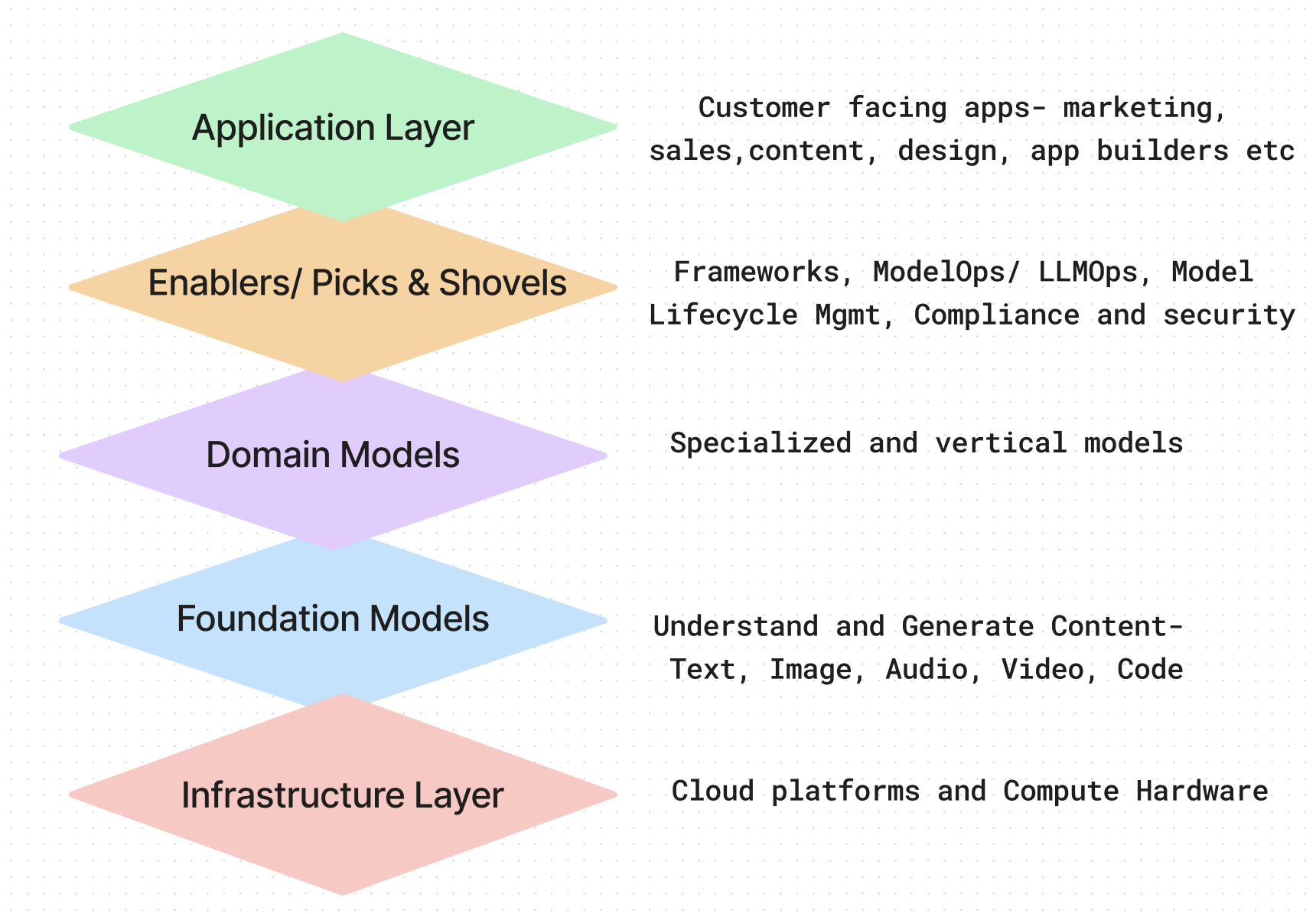
We broadly look at the existing stack in five layers-

Infrastructure layer includes hardware and cloud platforms which provide compute hardware and GPU. This includes companies such as Nvidia, AWS, GCP, Azure.

Foundation Models are GenAI models on top of which the entire stack is being built. They are AI neural networks trained on massive unlabeled datasets, enabling them to perform a diverse range of tasks, including test/ image/ audio/ code generation, text translation, and summarization. GPT-3, PaLM2, LLaMa are the well-known LLMs. Some open-source models trained on much smaller parameters are also getting interest for specific use cases.

Companies are using a combination of different models to increase accuracy and performance. A layer of domain/ vertical-specific models (health, legal, ecommerce, finance etc.) over foundation models has become a well adopted practice.

Next is a layer of tools that enables the use of these models, which we call Enablers. These tools are critical for the rapid adoption of foundation models by developers/ businesses, facilitating the shift where every company large or small is working towards adding GenAI capabilities to their products. Building production-ready AI apps is a challenging task that involves various steps. Starting with infrastructure setup, model hosting, database configuration, data collection and preparation tools, model selection, training or fine-tuning with your data, orchestrating different models based on use cases, integrating with your systems, deployment and maintenance of models, monitoring performance and cost of these models – all are part of this complex process. Hence, the emergence of enablers. Enablers offer capabilities such as orchestration, model management, observability, compliance, security, and more. Pinecone and Langchain are the most popular ones in this layer. Pinecone is a managed, cloud-native vector database with a simple API and no infrastructure hassles. Langchain is a framework for developing applications powered by language models.

Next is the Application layer, where customer-facing applications are built on top of GenAI models. It includes tools like Jasper, Glean, Copy.ai, Rephrase.ai. With GenAI, companies are providing better personalized customer experience, the conversation interface is taking over the clunky software UI and reducing their time to value.

Beyond all the excitement, it’s important to note that building and scaling an AI native tool is not as easy as it looks from all the Twitter chatter. We have spoken to many GenAI founders and tried to understand the challenges they are facing in customer adoption and product building. There are few interesting insights –

  1. Most of the GenAI tools from India are very early. They are seeing a lot of excitement and adoption from the market. Users are trying out different tools, but there is high churn. Prosumers and SMBs are the initial adopters of these products, but founders have to crack the retention and path to monetisation.
  2. Generational and non-critical use cases are seeing more traction. Generational use cases are some kind content generation- text, image, blog, code, audio etc. Non-critical use cases are business use cases where the cost of failure is not high and can work with not-so-high accuracy – sales, marketing, hiring etc. In high value use cases like cybersecurity, there is a cautious adoption of GenAI.
  3. GTM motion for enterprise SaaS remains the same. There is a sense of curiosity among enterprises regarding GenAI and acceptance to use it in their workflow but they are cautious. Their concerns about data privacy, security, and compliance persist, and there is limited trust in public LLMs. We are seeing a trend of building on the client’s VPC, which can increase the time to adoption.
  4. ChatGPT has changed the customers’ expectations. Customers are conversing with tools in natural language, they are not only asking for information or insights from the data, they are expecting end-to-end tasks to be done. The expectation is AGI (Artificial General Intelligence). We spoke with an AI native marketing product from India where customers are spending more than 30 min every session and asking in one single command to look into the data, identify cart dropout and design and send a campaign to them.
  5. There is a lot of adoption of picks and shovels- libraries, tools helping developers build apps for different use cases. Autonomous agents have become very popular. SuperAGI is one of our portfolio companies, which has gained more than 7k GitHub stars in two weeks. It is one of the trending repositories on GitHub. It is a dev-first open-source autonomous AI agent framework, enabling developers to build, manage and run useful autonomous agents quickly and reliably.


Based on our learnings over the last few months, we are more bullish on a few spaces in GenAI where we believe large outcomes from India can be generated:

  1. Picks and Shovels for developers: GenAI tech stack has become fairly complex and it is changing rapidly, only LLMs can’t help with production level use cases. As discussed in the above section, it is a long iterative process and these tools help developers build, experiment, train, and compare quickly. This is a new need that has emerged while developing in GenAI. Vector database, framework, model orchestration layer, autonomous agents are some examples of the types of tools getting created. Pinecone and Langchain fall under this category.
  2. No code enablers for businesses: We have seen copilot (GenAI) in a box model, where the entire AI stack is taken care of by the tool, you just have to integrate with your existing software. This new layer is emerging in the tech stack and it can be an opportunity for new players.
  3. ModelOps/LLMOps:MLOps used to be a not-so-attractive industry until 6 months ago. With GenAI, more models are going into production and none of the existing MLOps were made for that. Existing MLOps companies are adding capabilities and a new set of ModelOps tools are also emerging. ModelOps/ LLMOps tools include model lifecycle management, observability, data security and privacy, and model monitoring.
  4. Autonomous Agents:As discussed above, customer expectation is for AGI which can be provided by autonomous agents. They have the ability to analyze intricate problems, solve them iteratively, and take actions. AutoGPT is the most popular one, it has more than 139K stars on GitHub. In today’s form, it is not easy to use AutoGPT for business use cases. AGI is still in the early phase and will take some time to reach the customers’ expectation levels.
  5. AI native companies: On the application layer, we are keen on these companies. In many use cases, incumbents have the right to win because of distribution advantage. That’s why we believe all the niche use case products will get commoditised as incumbents will launch it as a feature. However, if you are building an AI native software with some vertical focus and data flywheel, then there is an opportunity to deliver better accuracy compared to incumbents.
  6. GenAI-powered Vertical SaaS: Vertical LLMs are trained on curated high-quality data from a specific industry. This allows Vertical LLMs to generate more accurate and relevant results. Legal, health, and finance are among the industries where a lot of knowledge resides in the massive historic data, which is the play of Vertical LLMs. GenAI-powered Vertical SaaS companies are getting popular, such as Hippocratic in healthcare and Evenup and Harvey.ai in legal.


A lot is happening in the GenAI world and we have been continuously learning about the latest developments. Our thesis will keep evolving. We will release a series of articles on GenAI to keep you updated on our learnings. If you are a founder building in GenAI or an enthusiast, we would like to have a discussion. Please feel free to reach out to veenu@kae-capital.com or sarthak@kae-capital.com.