Investment in Onwo

We at Kae Capital are very bullish on India to the world theme. We have already seen an increase in the global software businesses building from India. We believe to see a similar trend in global trade as well.

India is one of the largest agri-product exporters in the world. In FY22, the Indian agri exporters reached $49.6Bn, which is a 20% increase from the previous year. India is an agri commodity hub and one of the largest producers of several agri commodities like rice, sugar, and spices.

Most of the food products are traded as commodities from India with little to no value add. Major value chain margins lie with the outside processors/ buyers. There is a scope for adding value at the source to ensure better margins and value for the Indian manufacturers and sellers. The Government of India is pushing a lot to increase food exports and processing from India. The ministry of food processing industries (MoFPI) is boosting investments across the value chain of the food processing industry. Under PMKSY, GoI is making efforts to develop many mega food parks, agro-processing clusters, food processing units, and cold chain projects across the country. We believe with maturing processing infrastructure, India is at an inflection point to become a processing superpower. India’s food processing sector is one of the largest in the world and is expected to reach the output of $535 Bn by FY26.

The majority of these producers are MSMEs with a broken, unstructured and offline supply chain. Global food supply chains have a lot of intermediaries, inefficiencies and low transparency on the rates and transaction timeline. There is a need for an online platform to bring in trust and efficiencies in the value chain, which is where ONWO comes in.

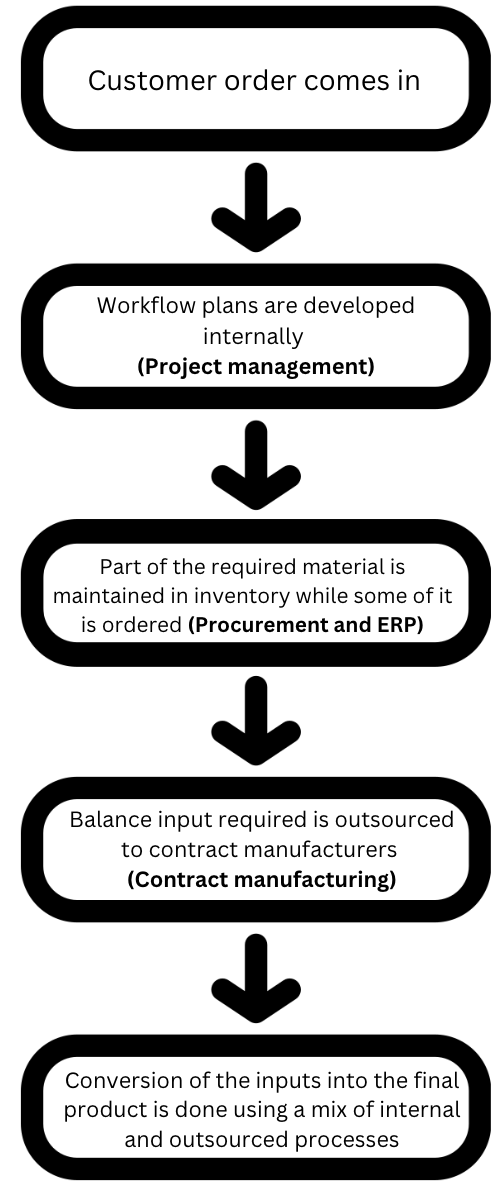
ONWO is at the forefront of reimagining the food export industry using a digital-first approach in an otherwise traditional industry. ONWO’s full-stack solution will help Indian manufacturers and SMEs access the global markets in a fully managed and asset-light model. ONWO is creating a digitized global food supply chain through contract manufacturing and a structured food export segment, allowing Indian manufacturers to ship processed products to the world.

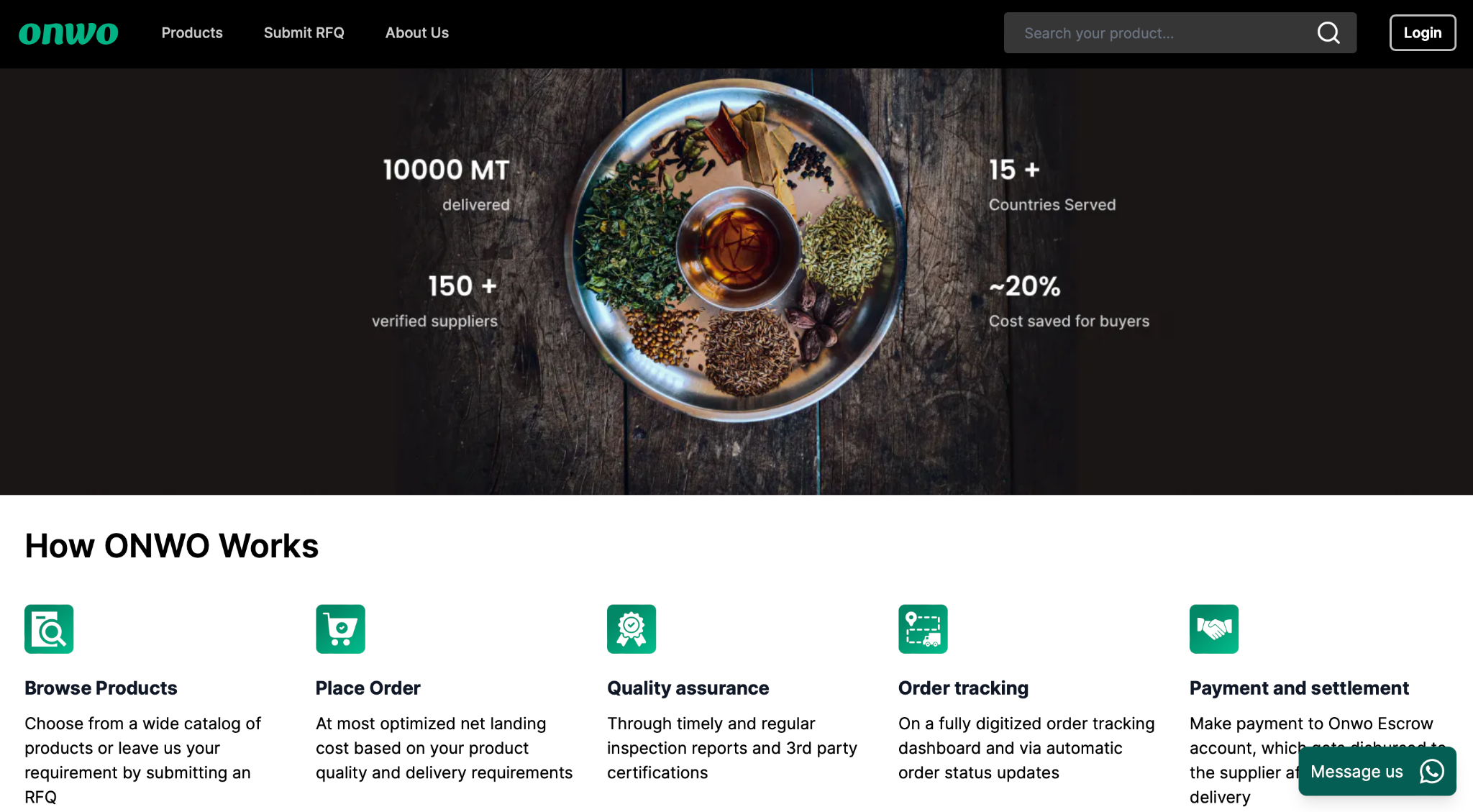
ONWO is a curated marketplace to reliably discover, transact and fulfill orders of processed food products from Indian manufacturers. ONWO offers end-to-end solutions to its customers in a full-stack digital model, involving contract manufacturing and private label solutions, quality assurance and risk management and complete order fulfillment using a cutting-edge technology platform. ONWO ensures better margins and value add for both manufacturers and buyers. The key markets serviced by them are the US, Canada, UAE, Saudi Arabia, Qatar and Oman.

Onwo was started by second-time entrepreneur and former Flipkart executive Bipul Kumar in July 2022. We have known Bipul from his first startup and believed in his vision of transforming India’s food export value chain. Bipul has built an experienced and high-quality team. They have executed well in the last 6 months, exporting more than 10,000 MT of food products, with a high repeat rate of >90%. ONWO has covered more than 15 countries in operations.

ONWO is on a mission to build a solution for this large category. We are very excited to partner with them. It is a massive opportunity and they are a great passionate team with the right skills to build this business.

Understanding the Cross-Border Fintech Market

With over $ 130+ Trillion flowing globally in cross-border volumes, cross-border fintech offers a rare opportunity to create multiple unicorns.  16% of cross-border revenues (not flows) lie in EMEA, 8% in APAC, 5% in LATAM, and 6% in NA (as per EY)

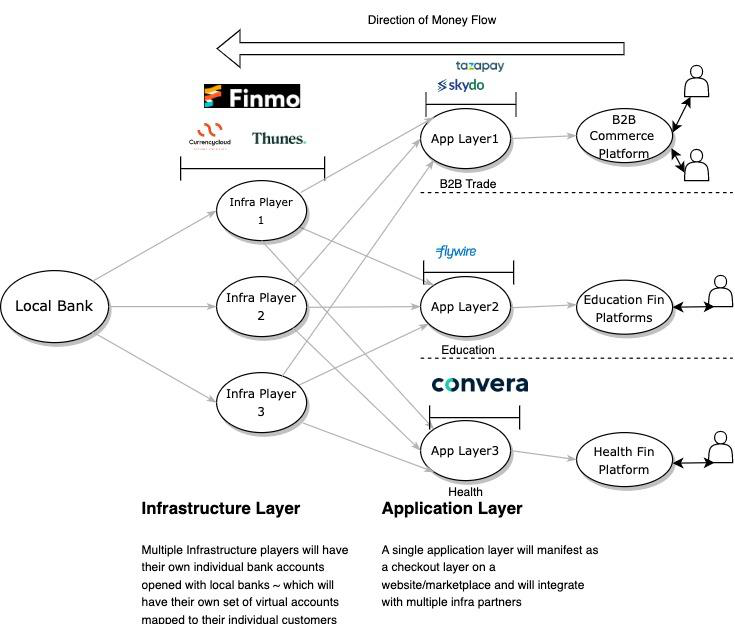
For the purpose of understanding the landscape better, we have divided it into Infrastructure and Application layers

Infrastructure layers help integrate with local banking rails in both/either sender and receiver geographies. They, in turn, integrate with fintechs (Wallet providers for cross-country money transfers, International Money remitters etc.). They solve for:

  • Virtual account creation (which in turn helps them access local payment methods & helps with multi-currency accounts creation)
  • FX rates by buying and converting currency in bulk
  • Reconciliation – This may not be a service offered by all infra players. This depends on the value prop being offered to their customers.
  • Take on average 50 bips on GTV

Application layers own the customer, they may manifest as a checkout page on marketplaces:

  • They acquire and manage customers
  • Solve for customer support and are usually the closest to customers ~ allowing them to build out other higher margin services.
  • The take rates here vary depending on the core use case ~ players can make up to 80 bips as checkout solutions, an additional 20 bips as treasury solutions, and potentially upwards of 1% per month as working capital interest on a monthly basis


Bifurcations between Infra and application are not cut and dry, and often there exist fintech players who are infra providers in one geography, and application layers in other geographies. For eg., they may have local bank accounts (i.e. are directly connected to banking rails) in geographies to solve for collections in that geography but need to work with other infra players (who are integrated with the local banking rails in other geographies) to solve for payouts in those geographies.

In India, payment volumes less than $10k fall within the purview of OPGSP and most players solving for payouts/collections within India are operating within the constraints of this license, for volumes in excess of $10k companies are relying on SWIFT-based bank transfers

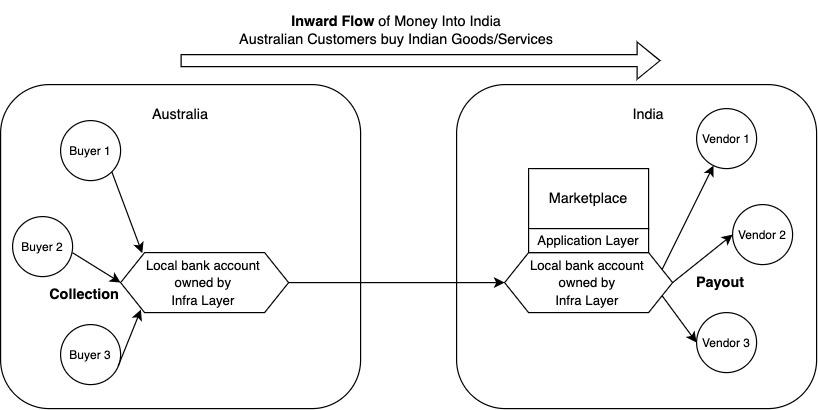
In addition to understanding the value chain, it is pertinent to understand payment flows in a little more detail. Given below is a sample of Inward flow of money from Australia to India ~

Why we choose to make bets in both Infra and Application layers ~

Understanding the market dynamics of payment infra players ~

Infra players will want to have access to as many local bank accounts as possible, and by extension, have access to relevant licenses which allow them the most degrees of freedom, i.e. the ability to send and receive money from multiple geographies. For example, UK’s E-money license (auth. EMI license), Australia’s international remitter license, Singapore’s major payment Institution license, Hong Kong’s Customs and Excise Dept., etc.

There seem to be inherent network effects here, i.e. if I add more geographies solving for both inward and outward payment flow, this will improve the experience of my end customer, i.e., the end customers who will want to send and receive money from as many countries as possible.

Additionally, forex rates are also solved through economies of scale ~ further incentivising market concentration towards only a few infra players.

Having said that, we don’t feel this will be a winner takes all market ~ because each local bank will integrate with multiple infra providers, and we feel that beyond a point forex rates will not be further optimizable, hence commoditizing the FX rates as a differentiator.

So it is our estimate that there can comfortably be more than 3-4 players dominating the global cross-border payment infra market.

With more than USD 130 Trillion flowing through the market, we feel capturing 10 Bn in GTV will ensure a large outcome for us as investors, which we can do by focusing on any one of the several geographic corridors. Additionally, we have seen some infra players start entering the application layer as well.

Understanding the dynamics of Application Layers ~

Infrastructure provides the rails to all kinds of application layers. We can further segment application layers into the following subthemes ~

  • Customer segments ~ B2B, B2C, C2C
  • Flow of money ~ payouts vs collections
  • Use cases ~ B2B trade, health, education, payroll, etc.

Application layers that offer the best customer service/support, and keep expanding their product offerings without compromising on quality will be poised to win. Each use case gives an opportunity to go deeper into specific use cases, for example, education ~ which will allow them to double down on use case specific products like education loans.

We do not think this will be a winner takes all market because there doesn’t seem to be a case for network effects, i.e. the addition of new customers (think marketplaces) will not add additional value to the n+1th customer added on the platform in terms of rates/convenience/etc. Additionally, integration with rails will also not be a differentiator since rails will try and partner with all application layers and we expect this to converge at scale.

We will go after the use cases with the largest TAMs.

Summarizing~

If you are building something in either infra layers or application layers with large vertical TAMs, we would be happy to speak to you!

Investment in Contlo

Global e-commerce is a massive market. Online retail sales are expected to reach $6.5Tn by 2023, according to eMarketer and Statista. The US D2C (direct-to-consumer) sales have crossed $128Bn in 2021 and are expected to reach $213Bn by 2023.

The pandemic has led to unprecedented growth in digital adoption, shifting consumers’ shopping behaviour to online. We have seen an exponential rise of D2C brands from India post-pandemic. According to the Unicommerce report on India’s retail and e-commerce, D2C brands are driving growth in India’s e-commerce with a 45% CAGR and has the potential to reach $ 70Bn in a few years. According to Statista, India’s D2C market is expected to grow by more than 15 times from 2015 to 2025. In 2020, it was around $33Bn and is forecasted to reach $100Bn by 2025.

Globally e-commerce brands are moving away from marketplaces to headless commerce platforms like Shopify. Shopify is an e-commerce platform which enables merchants to set up online stores and has seen massive growth, doubling the number of merchants using Shopify in the two years from 2019. Shopify ARR was around $5.2Bn in Sep 2022, a 24.5% YoY growth. It was $4.6Bn in 2021, 57.4% YoY growth from 2020.

As brands continue to sell online, they struggle with high marketing spending on CAC and customer retention. They want to build direct relationships with consumers on different channels. To build a long-lasting relationship with the consumer, a consumer needs to be engaged at different points in the journey.

At Kae, we have invested in many D2C brands and keep evaluating more D2C brands in different categories. From all our conversations, customer engagement and high marketing spending came across as common areas of concern. The legacy horizontal marketing tools are not built for e-commerce specific use cases. There is a need for a verticalized marketing automation solution for e-commerce.

We are very bullish on vertical SaaS as a theme and believe the next evolution of customer engagement/marketing automation has to be more personalized. This is exactly where Contlo comes in. It is purpose-built for deep e-commerce use cases via seamless integration with leading e-commerce platforms like Shopify, and Magento. We have been in touch with Ishaan and Mukunda, from their early days and have seen their impressive journey of building an AI-led marketing automation for e-commerce.

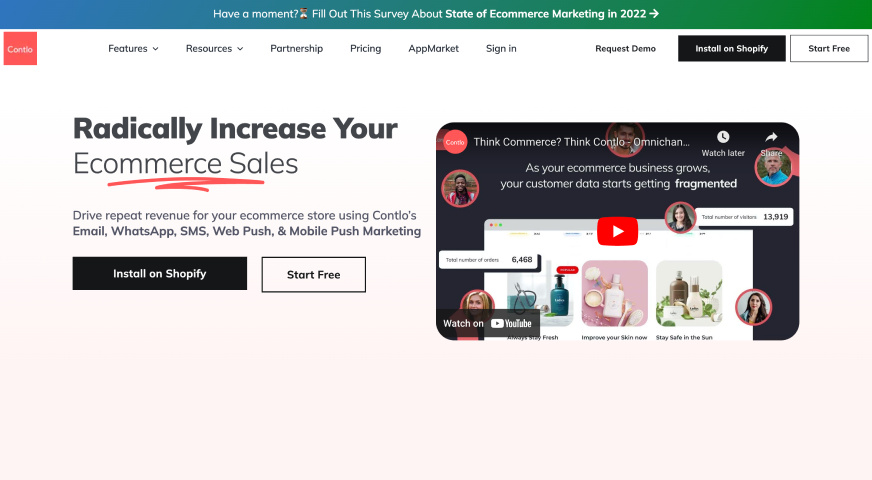
Contlo enables e-commerce and D2C brands to accelerate their sales growth, drive revenue generation and automate personalized experiences for its customers using e-commerce centric omnichannel customer engagement across email, SMS, WhatsApp, mobile and web push. It is leveraging AI to build hyper-personalized commerce experiences for end customers.

Today more than 1000+ brands use Contlo globally. It has witnessed a 50% MoM growth since its inception. It is empowering brands to build direct channels with their consumers, leading to increased retention and LTVs.

Contlo beautifully fits our investing framework for SaaS, leveraging data to build an AI-based vertical SaaS software with a PLG motion.

We at Kae, are thrilled to partner with Ishaan and Mukunda in this journey. They have built a very strong team with a vision to build a world-class AI product. You can find out more about Contlo here.

The Modern Data Stack

Data Sources

Companies generate a lot of data from different sources.

  • OLTP Databases– OLTP (Online transactional processing) systems handle large volumes of transactional data. It consists of user information and operational data generated by users such as e-commerce purchases and online banking. A standard database management system (DBMS) is an OLTP system. Mysql, mongoDB and Postgres are some well-known databases.
  • SaaS tools– Companies use many SaaS tools to run their business such as CRM tools to store sales, marketing and customer success data (Salesforce, Hubspot), payment/billing softwares (Stripe).
  • Event Collectors– Nowadays every possible touch point with the users is recorded as an event, which is used for analysis. It includes recording every click on websites and apps. Segment and Snowplow are popular choices for collecting events.

Extract and Load

All data from different data sources is extracted and loaded to a centralized data warehouse/ data lake. Earlier, the sequence used to be ETL- data is first extracted then transformed and then loaded into the data warehouse. Now, it has evolved to ELT- data is extracted and loaded into the datahouse and later transformed at the warehouse itself.

Data Storage

Ingestion tools stored the data at a cloud data warehouse or data lake. Data warehouse stores structured data (tables) that can be directly queried for analytics. The popular cloud data warehouses are Snowflake, Google Bigquery and Amazon Redshift.

Data Transformation

After storing the data, it is transformed directly in the warehouse into a structure ready for analysis, which is used by the data science and business team to run different analytics and ML models. Dbt, Airflow and LookML are the most popular transformation tools.

Analysis/ Output

The transformed data can used for different purposes-

  • BI/ Visualisation– These tools enable business users to derive insights. They provide a dashboard view with graphs/ pie charts which facilitates business visibility. Tableau, Looker, Power BI are some popular BI tools.
  • Data Workspaces– These tools make it easier for different users to query, visualize and collaborate on data and create dashboards. Some of the emerging data workspaces tools are hex, deepnote, mode, noteable.
  • Data Science, AI/ ML– Data scientists can run ML models on data with help of these tools. Some of the popular tools are Sagemaker, Continual.
  • Reverse ETL– It syncs back the aggregated data to SaaS tools like customer support, sales and marketing to provide full consumer visibility to business users at their primary software. Census and Hightouch are the popular reverse ETL tools.

Data Monitoring and Governance –

We also need to maintain operational data hygiene. There are three major data ops categories of softwares, which help in reducing the risk, operational complexity and cost of the cloud data-

  • Data Observability– Testing and monitoring pipelines are developed to detect and resolve errors or issues. Monte Carlo, Acceldata and Great Expectations are the popular choices.
  • Data Discovery– Data cataloguing, documentation and discovery so that people can discover the right tables for their use. Atlan, Amundsen, and Alation are the popular tools here.
  • Data Security– Access control and data security to safeguard the company’s data. Control which employee has access to which data. Cyral, Immuta are the emerging tools in this category.
  • Introduction of Data lakehouse by databricks and Unistore by Snowflake- Databricks has introduced the data lakehouse. A data lakehouse combines the flexibility, cost efficiency of a data lake with the data management capabilities of a data warehouse. It is an open data management architecture to enable analytics, BI and ML on all data types.
https://www.databricks.com/glossary/data-lakehouse
https://www.snowflake.com/en/data-cloud/platform/
  • Data Marketplace — Snowflake has become a behemoth and is now adopting a platform approach enabling products to develop on top of it. Idea is companies can use the native application framework to build native Snowflake apps that can be distributed through Snowflake Marketplace. Snowflake customers can discover, evaluate and run the apps in their accounts, removing the need to move data, thereby improving privacy and security. It is enabling customers to bring apps to data rather than moving data to different apps. It eliminates the delay and cost of traditional ETL with direct access to ready-to-query data and pre-built SaaS connectors.
https://www.snowflake.com/snowflake-marketplace/
  • MDSaaS– Modern Data Stack as a service. Data Stack is complex and evaluating tools and setting up the entire stack can be a challenging time taking process. There are low/no-code platforms that provide all the tools needed to go from data sources to interactive dashboards. Some of the emerging startups here are Selfr.io, Octolis.

Unravelling the Portfolio: 1K

Brief about 1K

1K is a hyperlocal omnichannel grocery chain focused on fulfilling the aspirations of ‘Real Bharat’. The business was founded in 2018 by Kumar Sangeetesh, Sachin Sharma, and Abhishek Halder. The founders believe that Kirana entrepreneurs will play a pivotal role in building a sustainable channel to deliver wow micro-experiences to aspiring consumers of Bharat. The ultimate goal is to create a seamless flow of goods from brands to consumers and overcome the shortcomings of traditional distribution systems with the help of their in-house technology-enabled platforms and “smart” warehousing.

Vision and Mission

To revolutionise the grocery shopping experience for the non-urban population of Real Bharat.

Building “Bharat’s” first “omnichannel” distribution network that brings consumers’ aspirations closer to them.

Genesis

Two of the co-founders were working together at one of India’s largest logistics companies; they identified that one of the biggest struggles for brands was to reach and distribute their products in smaller towns of the country. Due to broken distribution networks, product availability has always been a massive issue in smaller towns/cities, despite rising customer demand.

Hence, they decided to solve this problem by making an efficient and cost-effective distribution model by aggregating the distribution rights of multiple brands.

Market Opportunity

Less than one lakh people inhabit 65% of towns in the country. There are about 7,000 towns with 5,000 to 100,000 residents. They are trying to serve a market worth a solid USD 150 billion. Their approach is distinctive in that it prioritizes grocery sale purchases, which account for 70% of consumer spending in such markets.

5-year Plan

Over the next five years, they want to increase their market share in these markets by 5%, making them one of the leading retailers in the country. It is crucial to keep in mind that more than 25,000 regional microentrepreneurs will support this as they develop the company and satisfy the customers’ needs in these areas.

Unravelling the Portfolio: TranZact

Brief about TranZact:

TranZact is a freemium digitisation software for 14MN+ SMEs Manufacturers & Traders, empowering them by digitising business workflow right from sales to dispatch.
With scalable distribution and engaging software, they are capturing real transaction data, which becomes the foundation to build a transaction-backed marketplace at scale.

Vision and Mission:

Empowering SMEs owners to grow their business through digitisation.
Building a digitisation platform for 14MN+ SMEs to convert their business data into actionable insights.

Genesis:

TranZact started with the idea of creating digital technologies for 14MN+ SMEs, which are still struggling with very old digital technologies. They felt that in today’s era of digitisation, even though the SME space is often ignored, it remains a very large sector, and if there is specific technology built for this space, the impact will be much larger and deeper.

Market Opportunity:

14MN+ Indian manufacturers and traders

5-year Plan:

Going to build a transaction-backed market network platform with over $500MN in revenue coming from multiple revenue streams like software and transactions.

Wysa secures $20mn to address global mental health demand with AI digital Therapeutics


  • HealthQuad and British International Investment (BII) join earlier investors W Health Ventures, Kae Capital, pi Ventures, and Google Assistant Investments.
  • Funds will enable access to clinically evidenced digital therapeutics (DTx) in the US, UK, India and other global markets.
  • Will enable further reach through multi-lingual support and access via alternative technologies.
  • Follows FDA Breakthrough Device Designation and clinical evidence of a Therapeutic Alliance.

Wysa, the leading AI digital platform for mental health, today announces it has secured $20M in financing. Wysa will use this capital to further expand into the US, UK, India and other global markets across enterprises, payors, and providers as well as improve wider usability through multi-lingual support and easier access via WhatsApp. The round is led by HealthQuad, who along with British International Investment (BII), the UK’s development finance institution, joins earlier investors W Health Ventures, Kae Capital, Google Assistant Investments, and pi Ventures amongst others.

Globally, there is a huge demand-supply gap in the mental health space. One in eight people in the world lives with a mental disorder, according to the World Health Organisation. With high treatment costs and limited access to qualified therapists, employers, healthcare providers and insurers are seeking ways to help people manage their mental health and well-being through clinically proven, cost-effective and scalable solutions.

Wysa uses AI (Artificial Intelligence) to triage users according to their personal needs, guiding them through appropriate, evidence-based CBT (Cognitive Behavioural Therapy) exercises within the app, towards other mental health services or crisis support. Wysa’s platform provides employers and health services insights into usage rates of Wysa and digital well-being tools while maintaining user privacy.

Wysa has achieved FDA Breakthrough Device Designation for its AI-based digital mental health conversational agent for adults with a diagnosis of chronic musculoskeletal pain and associated depression and anxiety. Additionally, clinical trials have validated Wysa’s efficacy and published peer-reviewed results show that therapeutic emotional bonds formed by Wysa are equivalent to human therapist relationships. The company has, to date, achieved a revenue-generating user base of over 4.5 million people across 65 countries. Clients include Accenture, Colgate-Palmolive, Aetna International, Swiss Re, the National Health Service (NHS) in the UK, and the Ministry of Health in Singapore.

Charles Antoine-Janssen, Chief Investment Officer, HealthQuad said: “We are thrilled to be part of the Wysa team. Wysa is developed in India and is marketed globally. The needs for Wysa are present all across, from high-income to low-income countries. Mental health triaging of patients using AI which is fast, effective and non-stigmatising for patients living in unaccepting societies answers a huge need in India, the rest of low-income Asia, Africa as well as the wealthiest countries of the world.”

“Wysa provides help across the care continuum – from the first point of access to digital therapeutics and companion alongside a clinician to ongoing monitoring & routine management thereby democratising access to mental health. FDA Breakthrough Device Designation status, user privacy further validated by Mozilla and real-time AI-CBT support makes Wysa one of the few clinically validated, privacy-focused and personalised solutions built for a global scale” added Ajay Mahipal, Director, HealthQuad.

Srini Nagarajan, Managing Director and Head of Asia at British International Investment added: “Good mental health is a crucial pillar for sound physical health which in turn promotes social and economic development. Through our investment in Wysa, BII is taking a holistic approach to supporting long-term productive economic prosperity by backing an innovative tech-enabled company that is increasing access to mental health services for low-income and rural individuals. We are excited to continue working with Wysa’s team to grow their offering and help improve health outcomes and quality of life for people.”

Ramakant Vempati, Co-founder, Wysa, said: “Wysa has not only been extremely successful as a consumer well-being platform but has also developed into a clinically validated, powerful tool to proactively manage mental health and well-being. Wysa meets people where they are, whether that means a little help with occasional workplace stress, right up to coping with debilitating pain, depression and anxiety. With this funding, we look forward to scaling up further and helping millions of more people.”

Dynamic NFT Enablers

The last few months have seen a rapid rise in all things metaverse and blockchain gaming across the globe. It may be tempting to brush this aside as a fad, but the adoption numbers tell an interesting story – the number of Daily Unique Wallets interacting with Gaming Smart Contracts has grown from 28k in 2020 to 1.3 Mn in 2021.

According to reports, even monetization trends have been strong ~ Blockchain Gaming Quarterly Revenue for Q3 FY22 alone was $ 2.32 Bn vs $ 320 Mn in the whole year of 2020 – which is an 8x growth. At the heart of it, metaverses are interactive ecosystems which use game-level graphics (can also use AR/VR elements) and game engine interactions to solve for user engagement through the game. These ecosystems use a blockchain ledger to build out X2E economies (X – can be “Play”, “Learn”, “Contribute”, etc.) – where a supply of tokens (which run the economy) is released into the ecosystem as more and more users come in. P2E economies have become the most prominent paradigm in blockchain gaming – usual suspects include games like Axie.

Dynamic NFTs (NFTs whose metadata can be updated) form a core piece of the Web3 metaverse and gaming economies. To understand the complexity of such ecosystems – imagine a Pokemon game (read: an Axie-like game) where you start off with 3 pokemon -> A, B, C. Assuming there are approximately 200 players who will want to start with A, 300 with B and 400 with C – we effectively have 900 NFTs (each NFT will have a unique address and unique metadata values at a particular “state” – the metadata here can be experience points or XP/levels, movesets, graphics, etc.). The updated rules can be coded into the smart contract, i.e. if my Pokemon crosses 100 XP (note: here the parameter XP is predefined in the NFT), it will evolve or if the NFT interacts with an external signal – like a sports news feed – it can trigger the update of the NFT, or if you enter a certain zone in the Metaverse, etc.

As the games scale up, i.e. go from sub 500 DAUs, to 10,000 DAUs, there are different elements of the backend which will need to be productized in order to enable deployment of dynamic NFTs at scale across different NFT use cases like upgrading, minting, renting, leasing, fractionalizing, etc.

We have seen challenges with the synchronization of on-chain and off-chain databases – Games/Metaverse often work with both on-chain and off-chain databases. On-chain databases will be used to store the addresses/ownership data. For example, if there’s a fighting game where one can pick up different weapons/items, if one picks up a knife NFT, the ownership vector will now point to that person. Similarly, for the off-chain data, a character’s graphics will get stored on a centralized/off-chain database. As games/metaverses scale, there is a potential to provide a platform for the synchronization, batching of blockchain update requests and updating of various data points in the ecosystem – which games currently build in-house using ineffective alternatives like cron jobs. Companies like Chainlink have been working on this problem.

Currently, no dashboards exist to see the status of active NFTs, and no good tools exist to edit smart contract updating rules. At any given point in time, game developers do not have visibility of the game rules and conditions in one place – for example, if one has 400 unique pokemon – each corresponds to a unique smart contract which determines the rules of NFT updates. With newer games and mechanisms – the NFT ecosystem becomes more complex, for example, of the 400 NFTs, you have 200 NFTs which need to further interact with external stimuli to trigger a smart contract auto-updating/metadata updating. The vision can be to build a no-code dashboard to drag and drop game functionality/game economy functionality – where one can drag a box which changes the game economy rules (eg. changing the prize for a pokemon battle from 1 point to 2 points, etc.)

We have also come across challenges with serum-based NFT updating mechanisms (however, they don’t allow for the preservation of the previously held NFTs). We believe that the TAM will become large enough in the coming few years as Web3 metaverse and gaming companies might share $0.5-$1 per user (approximately $15-20 ARPU), making this an interesting but nascent space to look at.

The NFT ecosystem is rapidly evolving with many exciting new opportunities and challenges – we feel we have just scratched the surface, and there is a lot more yet to come.

Unravelling the Portfolio: Traya Health

Brief about Traya
A one-product approach never works on hair loss or any other chronic condition. Traya combines the best of Ayurveda, Allopathy and Nutrition containing proven results to identify the type of hair loss, stage and the root cause behind it. Based on this, each person gets a doctor-prescribed treatment plan and a hair coach who guides the customer and tracks their progress.

Vision and Mission
Traya was started with just one goal in mind- to deliver visible hair growth results. We did everything from product and process to tech, keeping in mind the efficacy of the treatment. Back in 2019, Traya was sold to the first 55 customers through a basic landing page and they took the proprietary formulations (all-natural herbs + dermatologist prescribed + diet). They were closely observed for 4 months and a good 90% of them started seeing visible results. That is when we decided to launch a brand and seek investment. We knew we had hit a gold mine.

Genesis
Traya is an outcome of the cofounders’ personal journey as a couple. About 3 years ago, co-founder Altaf struggled with a number of health issues including uncontrollable thyroid levels accompanied by accelerated hair loss (he faces genetic male pattern hair loss) and weight gain, which was compounded by his hectic lifestyle. He went from doctor to doctor and couldn’t do much about his situation. We researched more and explored ayurveda and naturopathy diets. The three together changed our lives. Altaf’s hair regrew and his thyroid came under control. Even his endocrinologist was surprised. Even then the cofounders had no intention of starting a company. Almost a year later, by helping a lot of friends and family with chronic health issues including hair loss, they decided to take this space seriously. They realised that both of them were extremely passionate about solving chronic health issues that a millennial faces. On further research, hair loss was chosen as a disease line to begin. It was the most crowded but also the most corrupt. As they researched more on the diseases, its types, they realised nothing out in the market can ever work. The issue is considered cosmetic but it is internal. Thus, they took up the challenge to change the way the hair loss industry works.

Market Opportunity

The current hair fall market in India is broken. Many have a product-centric approach which is clearly not effective in delivering the results. Hair fall is a problem that needs to be addressed holistically and requires customization as per every individual’s root cause of hair fall. Out of the entire serviceable market, 125 million adults in India directly benefit from Traya’s offering and have the ability to afford it. The $12.5 Billion hair loss solutions market is up for grabs and Traya is aggressively growing to capture the entirety of the market while also changing the way a hair fall solution is approached and the results speak for themselves. In addition to the direct solutions to hair fall, Traya is also targeting the next line of products including anti-dandruff and cuticle damage.

5-year plan

We want to be synonymous with the terms hair fall and hair health and be known for our efficacy and honesty. On the product side, we are in research for no side effects and high-efficacy solutions for other hair concerns.

Portfolio Fundraise Update: Foxtale raises $4M in a pre-series A round


Indian D2C skincare brand, Foxtale, has raised $4M in its pre-Series A funding round led by Matrix Partners India with participation from existing investor Kae Capital and some notable angel investors.

The Mumbai-based startup raised its seed round in August last year. The startup launched in December 2021, and found an early product-market fit and a repeat rate of more than 50%, which led to a quick pre-Series A round.

This round of funding will be used in expanding the product range, hiring senior vertical heads and in scaling the business across multiple touch points.

The culture of self-care is still very nascent in India. While skincare brands have existed for a long time, they either fall in the category of herbal and ayurvedic, ineffective yet massy or luxury and expensive. Foxtale wants to bridge this gap between efficacy and affordability, making skincare, and by extension, self-care, accessible to all. To understand what the modern Indian woman is looking for in skincare, the Founder and CEO, Romita Mazumdar conducted interviews with more than 3000 women. From all those insights and the expertise of a team of brilliant chemists and formulators, Foxtale was born.

The brand’s decision to launch with 4 basic products, a cleanser, vitamin C serum, moisturizer and sunscreen, was a bold move, as most other brands rely on starting with a wide range of SKUs. However, Foxtale’s approach to skincare is guided by what its consumers need. It’s these 4 product categories that people use the most and need better formulations for. After perfecting this 4-step routine, Foxtale is now ready to launch more targeted solutions to the users’ skincare issues.

Efficacy is one of the biggest selling points of Foxtale. This is ensured by their formulation team, headed by one of the most lauded names in Indian cosmetics and personal care products, Dr. Ramesh Surianarayanan. He has pioneered many acclaimed products in his previous stints at Himalaya and Unilever and he now extends his expertise to Foxtale. The product development engine at Foxtale keeps its user community at the centre. From identifying which products they should launch, testing them, and finalising the packaging, Foxtale tries to include feedback from their users every step of the way and they only launch products in the market once 97% of their community approves of their efficacy.

Speaking of the funding, Romita Mazumdar, Founder & CEO, Foxtale, said, “A big issue in the Indian skincare industry has been the low customer repeat rates. It was clear that efficacy was a big problem for skincare enthusiasts in India and we had to solve it. Our focus on understanding our customer’s needs & product innovation has enabled us to establish a strong early product-market fit and drive industry-leading repeat rates and customer NPS scores; however, there is still a long way to go. I am very excited to find partners like Matrix and Kae in this journey and looking forward to building Foxtale with them.”

“The beauty and personal care market in India is growing fast and is expected to reach $28B by 2025. We are privileged to partner with Romita and the Foxtale team as they aim to disrupt this market through innovative products and differentiated go-to-market strategies. At Matrix, we continue to be excited about backing new-age consumer brands and Foxtale is our tenth investment in the sector.” commented Rajat Agarwal, Managing Director, Matrix India.

“Foxtale is different from other skincare brands. Its focus on high efficacy and the vigorous testing they conduct before launching a product is unlike any other. Foxtale sources 80% of its ingredients from premiere labs across the globe. We are excited to continue to partner with Foxtale as they build out India’s foremost skincare DTC brand.” commented Sunitha Viswanathan, Partner, Kae Capital.

On the road ahead, Romita said, “Our vision is one – to build a consumer-first brand where growth and product have equal importance. I want to change the perception that self-care should be a luxury restricted to women who have the privilege of time and money while proving that a profitable business can be built with consumers at the centre of the story.”