Unravelling the Portfolio: Hatica

Brief about Hatica
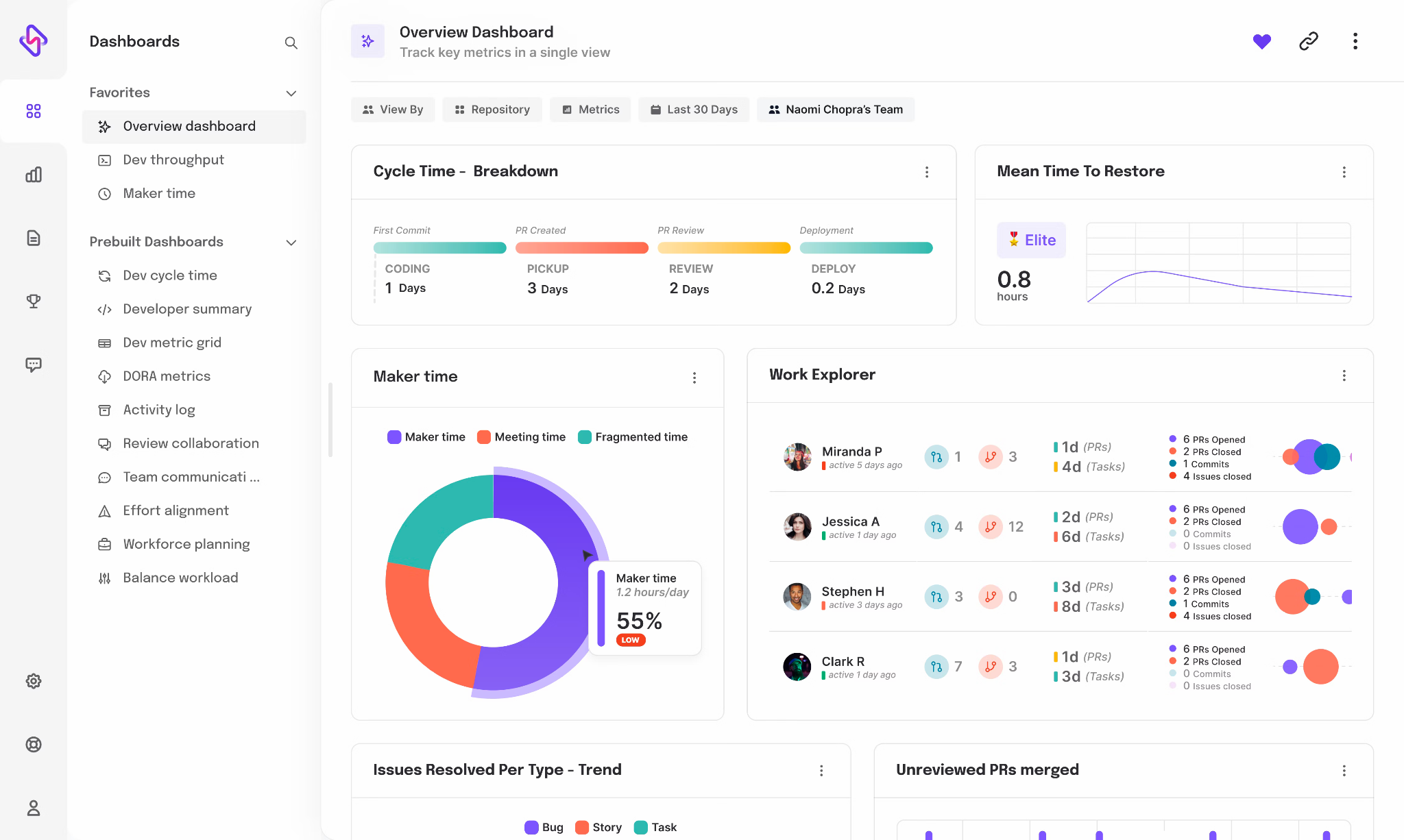
Hatica is a Software Engineering Analytics platform that helps managers and leaders build productive and happy engineering teams.

Vision and Mission
The severe lack of visibility for Engineering managers in a world of distributed teams working across dozens of tools has made the job of engineering management harder than ever before. This naturally results in declining developer productivity and experience.

Hatica’s mission is to equip managers with a comprehensive Engineering management platform to provide them the much-needed visibility and insights into development work activity, processes, and quality to help them drive team productivity while ensuring well-being.


Genesis
The idea came from the founders’ experience of having worked remotely even before the pandemic and having worked through developer productivity challenges before. Followed by countless zoom interviews with engineering leaders, managers, and developers across regions and industries, Naomi and Haritabh completed and launched the first version of Hatica in early to mid-2021.


Market Opportunity
The trend of SaaS sprawl, combined with remote work becoming mainstream, has made engineering management even harder and the problem of developer productivity ubiquitous. This coupled with every organization requiring to be technology-first, driving demand for engineers, has provided us a tremendous pull from the customers with a sizable TAM.

5-year Plan
Go from a sharp Engineering analytics tool to an Engineering Management Platform, empowering every engineering manager and leader out there to drive engineering excellence and wellbeing.

Unravelling the Portfolio: Foxtale

Brief about Foxtale
Foxtale is a community-first skincare brand. Foxtale is building a D2C Brand focused on creating scientifically backed skin care products for women. Foxtale aspires to give a product which is reasonably and affordably priced, while solving for efficacy of the product.

Vision and Mission

The vision is to create a range of products for Indian women of all skin types, belonging to places with diverse climatic conditions, and ensuring that it remains their partner at every stage of life. The mission is to create an INR 1000cr brand that solves skin problems in a scientific manner.

Genesis

After spending years in the Venture capital and finance spaces, I realised that there is a big gap in the skincare market in India. It is heavily dominated by traditional players such as Fair and Lovely, Ponds, etc. and the new-age players have been unable to grab a market share, due to a lack of consistent results. Another problem with skin care for women in India is the changing needs of women every week, based on their biological cycle, their area of residence and the climatic conditions of that specific time. Hence, there was a strong need to have products which can solve for the varying needs of women and at the same time, provide long-lasting results consistently.

Market Opportunity

The total market size of skincare products in India in 2020 – $2 Bn and is projected to reach ~ $3 Bn by 2025. In India, there is a need for players who can deliver consistent results at affordable prices.

5-year plan

The 5-year plan for the company is to expand distribution across India and to command a high repeat rate of 70%-80%. We are building a company that accelerates every year to a revenue of 1000cr in the next 5 years. The company prides itself in understanding women and while our core expertise is skincare, we hope to be every Indian woman’s companion through her self-care journey.

A Guide to Improve and Maximise Developer Productivity: Metrics, Tools, and more


Developers in India are paid INR 410 per hour, on average. It can even touch INR 2000 per hour on the higher side. Despite that, the median code time per developer was found as 52 minutes per day, or four hours and 21 minutes of code time per week

Thus, there is a need for organisations to invest in platforms that help boost developer productivity

Developers have become the biggest ask for tech companies at this point in time. You may be seeing a lot of job openings now, but developers have had the privilege of constant job openings, with or without pandemic woes. The global application development software market is anticipated to reach $733.5 Bn by 2028, expanding at a CAGR of 24.3% from 2021 to 2028, as per Grand View Research, Inc. But while there seem to be so many opportunities for developers, their time presently is not being optimised well. If you want to know how to maximise your developer’s productivity, read ahead!

India’s app developer base is one of the highest in the world with 1.6 Mn jobs in the sector. The resultant websites and apps coming from the sector generated a revenue of $581.9 Bn in 2020.

Inefficient Utilisation Of Developers

The job of a software developer requires them to interact with multiple tools on a regular basis. But the time cost of context switching between tools, collaboration, documentation, version control, and duct taping the issues is quite high. This ends up eating into the employee’s development time.

According to Software’s Code Time Report, the median code time per developer globally was found as 52 minutes per day, or four hours and 21 minutes of code time per week. It was also found that developers spend an additional 41 minutes per day on other types of work such as reading code, reviewing pull requests, and browsing documentation. Thus, there’s a major developer experience gap.

Most companies are ineffectively deploying their developers, throwing various distractions their way. This is supplemented by further disruptions and meetings, as well as system inefficiencies, such as slow reviews, slow builds and bad tools. In order to ensure optimal utilisation of developers, strong dev tools are required. This can bridge the developer experience gap and improve a developer’s experience across the entire workflow.

Importance Of Dev Tools

Dev tools are a range of products focused on developers to help them build, deploy and collaborate on a daily basis. Global companies such as Github, Slack, JIRA, Browserstack, Snowflake, Postman and Datadog have created tools that are used by almost all developers. The dev tools market has made massive strides in the last few years. There are more than 73 Mn developers on Github, with over 16 Mn developers added in 2021 alone.

Snowflake reported stronger than expected Q4 2021 results, with revenue rising by about 117% to $107 Mn. There has been a steady shift from a ‘Build and Buy’ to a ‘Buy and Build’ decision-making mentality. Organisations have become more cognizant of these tools and the value they bring to the table. They are more than willing to invest in platforms that help boost developer productivity. This begs the question, what really caused this perception change?

Impact Of The Pandemic

This slow but steady shift got catapulted by the pandemic. The dev tools market has experienced tailwinds from this increased digital adoption. The pandemic forced teams to work remotely, which deepened the already existing problem of collaboration and communication. Many SaaS tools are being built for the future of work, to make this transition easier. These tools act as a supplement to the present working conditions, thus enhancing productivity.

To get a better understanding of why there’s a need to invest heavily in developers, we need to recognise that while developers have become a staple for tech companies, they are an expensive resource at the same time. On average, developers in India get paid INR 5.2 Lakh per year. This excludes bonuses, profit sharing and commission which are all big components for developers. Calculated on an hourly basis, it comes to INR 410, and even touches INR 2,000 on the higher side. This alone underpins the importance of optimising the developers’ time and helping them.

Thus, there’s a need to back developers and engineers with the right tools. At the same time, there’s a need to have visibility into DevOps. This, when backed by solid numeric data, can give a clear picture of the inefficiencies arising and help in optimising for these specific issues. At the end of the day, high-performing engineering teams are essential for the success of companies as they can release products to market faster.

There is a need for tools that can empower them to manage their daily tasks — context switching, collaboration, etc. in an efficient way. The developer productivity tools market is fast emerging to solve this problem. This would be key to look out for as we go deeper into cross-vertical functions and remote working.

Multi-chain, Cross-chain Interoperability and Composability Explained

Interoperability implies the seamless transfer of assets (fungible or non-fungible) and messages, while composability essentially implies shared infrastructure/effective cloning of dApps.

The Web3 ecosystem has taken off over the last two years. What started off as a whitepaper by the pseudonymous Satoshi Nakamoto back in 2008 has evolved from the first L1 – BTC (a prototype of sorts), to the arrival of the now dominant ETH (Ethereum), which drew the imagination of developers from across the globe with its smart contract functionality.

Now with other L1s like Solana and Avalanche, L2s like Arbitrum and Optimism, and even multi-chain ecosystems like Polkadot, the Web3 space has become massive.

The top 15 blockchains store  $10 billion  in value each, with ETH and BTC together contributing almost $2 trillion.

But these ecosystems are growing in silos –

Ethereum, the largest ecosystem, has the best developer pools. Most programmers are comfortable with ETH UX/UI, languages, and smart contracts but with the current PoW (Proof of Work: requires miners to solve a cryptographic equation by trial and error) mechanism, the chain is suffering from poor scalability due to gas fees.

This is despite having the best security. It is said that ETH 2 with PoS (Proof of Stake: requires miners to stake all or a portion of their coins in order to validate transactions) will be much faster and cheaper.

Solana, which is currently the most prominent Proof of History based (sequence of computations that can provide a way to cryptographically verify the passage of time between two events), non-sharded chain, has high transactions per second (TPS). However, developers are still getting used to Rust, and with the core use cases being built around gaming, it’s becoming another siloed ecosystem

Terra, which aims to become “DeFi Central”, and seems to be doubling down on DeFi use cases with its array of stablecoins and innovative DeFi protocols, is also becoming another fascinating silo.

blockchain

What encompasses interoperability and composability

Interoperability implies the seamless transfer of assets (fungible or non-fungible) and messages, while composability essentially implies shared infrastructure/effective cloning of dApps, meaning one should be able to deploy any dApp on any chain with minimum friction and time.

Each ecosystem has its core strength, core use cases, core set of developer pools and liquidity pools. Just like economies benefit from trade – blockchains benefit from trading functionality, assets, liquidity pools, etc.

The vision is to enable developers to deploy dApps from any chain, onto any other chain in an almost no code format at scale.

This entails the seamless sharing of ecosystem strengths through smart contract calls or even on tools abstracted one layer above the smart contracts themselves.

For example –

  • Computation (think logic and calculations, like those required in gaming) on SOL/AVAX smart contracts (depending on the kind of use cases)
  • Transactions (meaning buying or selling, but not settlement) happening on SOL
  • Finally, settlement occurring on ETH (eg. when someone pays using VISA or Mastercard – that is not a settlement. Settlement comes weeks after that.)

However, interoperability and composability today are broken. The future is not cross-chain vs multi-chain, but cross-chain AND multi-chain, we will need both –

The mode of connecting ecosystems today is cross-chain bridges. This is where we enter murky waters – i.e. the cross-chain vs multi-chain debate, which is at the heart of it all.

With bridge security mechanisms becoming a core piece of debate (bridge hacks leading to stolen tokens – like the Wormhole hack), a large chunk of the population believes cross-chain is not the future. Ethereum founder Vitalik has explained (here) why it is always possible to override consensus on bridges, making them a losing proposition.

This leads us to multichain ecosystems, with the core idea being shared security. For example,  the Polkadot ecosystem is an “internet of blockchains” with shared security, shared virtual machines (think computations, logic) with the concept of creating new chains called parachains.

So not only can the chains communicate with each other seamlessly and transfer assets, the security risk is much lower.

However, even with two  “Internet of Blockchain” ecosystems coming up with their individual shared securities,  they will still need to communicate with each other! Hence, bridges cannot be taken out of the picture altogether unless there is a completely new mechanism to substitute them.

Overall, we want to make bets on infrastructure plays, which will enable a multichain interoperable, composable future. This can include Tooling/Infra or Ether plays on Polkadot (think governance, no code plays, etc.).

This also brings in Protocol based interoperability standards (think cross-chain smart contract enablers, messaging layers, function call layers, interoperability standards, etc.), also containing DAO tooling which allows for multi-chain functioning, etc.

Investment in Hatica: Engineering Analytics to Boost Developer Productivity

The demand for software developers is ever-increasing! Digitisation, cloud adoption and software stack globally are driving this demand, amongst other things, but there is not enough supply. According to the State of the Developer Nation report, in 2021 there were 26.8Mn active software developers in the world and they predict it to reach 45Mn by 2030. This makes it a very large and growing market.

Software developers use multiple tools for their daily work and a lot of precious development time is lost in low-value work of context switching between tools, collaboration, documentation, version control, duct taping the issues etc. There is a developer experience gap. Strong dev tools can bridge this developer experience gap and improve a developer’s experience across the entire workflow.

Dev tools are an array of products focused on developers to help them build, deploy and collaborate on a daily basis. Some of the global leaders in this market are Github, Slack, JIRA, Browserstack, Snowflake, Postman and Datadog. Dev tools have seen massive growth in the last few years. There are more than 73Mn developers on Github, with 16Mn+ developers added in 2021 alone. Snowflake reported stronger than expected Q4 2021, with revenue rising by ~117% to $107Mn. A shift has been witnessed, from a ‘Build and Buy’ decision-making mentality to a ‘Buy and Build’ approach. Developers are now open to buying platforms which can help them decrease the time of development.

This shift is further fueled by remote working. The Dev tools market has experienced tailwinds from this increased digital adoption. The pandemic forced teams to shift remotely, which has further aggravated the problem of collaboration and communication. Many SaaS tools are building for the future of work to make this transition easier, without affecting the productivity of teams. Developers are one of the most expensive resources of a tech startup, and any reduction in productivity is a big loss in terms of money and timeline of projects. According to U.S. News, the median annual salary for a software developer is $101,790, which will bring the cost of the average developer minute to ~$0.81. Therefore, every wasted minute of developers potentially impacts the company’s cost structure and profitability. Companies are now becoming more receptive to dev tools to ensure that most of the developers’ time is spent on actual development.

High-performing engineering teams are essential for the success of companies as they can release products to market faster. There is a need for tools which can empower them to manage their daily tasks- context switching, collaboration, etc. in an efficient way. Developer productivity tools is a massive emerging market to solve this problem.

We are happy to back Hatica, as it aligns well with our thesis on developer productivity and the future of work. Hatica has been cofounded by a couple of experienced techies, building a global SaaS tool to provide an engineering analytics platform to boost developer productivity. Embedding the culture of remote work internally, they have built a powerful product to improve engineering efficiency and optimize dev workflows. Hatica has early customers from US, Europe and India. We are thrilled to be part of this journey and believe it has the potential to become one of the top engineering analytics platforms globally.

Alt Protein: The Next Big Thing

The post-COVID era has changed the way people think of health, nutrition and the environment. With this, a small but promising community of startups have begun India’s chapter of the Alt Protein landscape in the last few years. Over 3Bn USD has been poured into the Alt Protein category in 2020, around the globe. In India, we are at a nascent stage, perhaps right before it reaches the inflexion point. 

How large is the market?

In India, this nascent but promising market of plant-based meat is estimated to be around 200-500Mn USD by 2022 (GFI). The plant-based dairy industry is expected to reach 68Mn USD by 2024 (GFI). However, if adoption ramps up, it has the potential to reach $4Bn in the next 5-7 years. Adoption rates will become clear once commercial production starts for many of the players in the Indian market, who are currently market-testing their products or are in the R&D stage. An observable trend is an increase in the consumption of meat as a by-product of nations transitioning from developing to developed countries. Naturally, as disposable incomes increase, more people are likely to spend on meat consumption which is otherwise seen as a luxury. 

Why is plant-based food important for India?

Contrary to popular belief, we are not a vegetarian nation. Over 70% of consumers in India identify as non-vegetarians, but unlike the West, our frequency of consumption of meat-based products is relatively low. At present, Indian diets are predominantly cereal-based, and 60% of protein is derived from cereals that have poor digestibility and quality. 80% of India is protein deficient.

India is also facing a double burden of malnutrition and an increasing share of global Greenhouse gas (GHG) emissions (6.55%), making it the third-largest contributor to anthropogenic GHG emissions, a lot of which comes from the animal slaughter industry. Analyses of the environmental impact of plant-based meat showed that plant-based meat production uses 72-99% less water and 47-99% less land. Furthermore, it causes 51-91% less water pollution and emits 30-90% less greenhouse gas emissions. 

Process of developing Plant Based food

Recognising that any plant-based food company is a food science tech player first, and then a consumer brand is important. Being a brand is a long-term possibility but should not be the focus in the initial days when consumer adoption is unclear. There is a technical process involved in developing plant-based protein, and getting it to its final form.

Why is Plant-based food expensive?

Protein isolates are available to all players in the market. The basic material, in this case, protein isolate, is available at cheap prices to all, but it’s the additional flavouring, additives and preservatives which go into the final product that makes plant-based food expensive. These additional products are called ingredients and having control over the ingredient formulation is a strong way to have price parity in the long run. For a few players, high prices are also due to the cost of extrusion machines in the supply chain.

The price per kg comparison of the majority of the products across plant-based meat, dairy, and seafood are nearly 2-3x more expensive than their conventional counterparts. There is a significant scope for this to come down in the next 5 years as infrastructure improves.

Challenges and opportunities in this market

Lack of awareness: While Indians are massive consumers of raw plant products like lentils and pulses, processed product awareness and acceptance is prominent among urban consumers only. It is slowly picking up in smaller cities with the support of government campaigns.

Infrastructure challenges: India’s cold chain storage and transportation capacity is still ill-equipped to handle its fresh produce volumes, despite recent government efforts, making intra-state transportation challenging and costly.

Constrained R&D Ecosystem: India’s overall R&D spending as a percentage of GDP is lowest even among BRICS nations. Government institutions are restrained by funding challenges.

Low meat eating: Even people who eat meat in India are primarily vegetarians, who consume meat once or twice a week, whereas in the West, meat eaters consume meat three times a day.

Price elasticity is very high: When it comes to chicken consumption, the prices of Plant-based meat are 2-3x compared to the incumbents

Availability of Talent: Another more fundamental issue with this space is the lack of quality senior-level talent in the industry. The IT sector boom was facilitated by a lot of Indian overseas talent returning, if this happens for this sector as well, we could see faster growth. 

Despite its challenges, the market continues to grow and provides a lucrative opportunity for many players to build for this. In the next 6-12 months, a lot more activity especially on the commercialisation of these products will take place, adding another layer of insights about this space. 

Kae Capital is looking forward to connecting with more startups that are building for this category. 


Rise of New Creator Economy, Powered by Blockchain

India is one of the youngest countries globally and has the second most internet users after China. Post COVID-19, the average time spent on the internet has increased significantly and a large proportion of this time is being spent on social media. The quantum of content created and consumed has grown manifold over the last five years – signalling the advent of a massive creator economy.

The creator economy is built on the back of creators/ influencers monetizing their online content. Online creators are emerging in multiple categories: artists, fashion bloggers, musicians, writers, live game streamers, stock market traders, educators, and business bloggers. There are more than 50Mn creators globally spread across platforms like YouTube and Instagram. There are ~ 10 Mn Instagram accounts in India with over 10k followers and we estimate that approximately ~5 Mn are active/semi-active creators.

This number is rapidly growing year on year with a large number of young Indians entering the fray incentivized by aspirations to be recognised for their passions/hobbies while also getting an opportunity to generate parallel income or in some cases primary income streams. This is a particularly interesting phenomenon given that the revenue streams are still fairly restricted in the Web 2.0 paradigm.

The creator-consumer relationship is one which involves creators sharing content on YT, Instagram which the users can view (images, GIFs), watch (clips, movies) or hear audio where monetization is often restricted to ad-based revenue, or brand contracts where the payment from brands is unpredictable, the terms are often black boxed. Additionally, there is no guarantee on subsequent contracts. The creator economy, both in India and abroad is highly skewed from an earnings perspective – for example in the US – 80% of the earnings come from 20% of the creators.

Within the Indian market – creators earn primarily from Youtube and brand partnerships. Globally, there are 3-4 more sources of earning like Patreon, Onlyfans, etc. But their participation is largely restricted to Western economies. Our internal market sizing (for India) would skew the Indian creator economy significantly towards the top segment of the creators as well.

The creator economy in India is currently constrained by skew, lower ticket sizes and disproportionate bullet payments and manual/unscalable operations. In order to enable creators to drive engagement and retention, some founders have built vertically focused platforms so that UIs and workflows are tailored to specific categories, for eg. Discord started its platform with gaming.

Despite this, the existing platforms are very centralized. In Web 2.0, central social media platforms like YouTube and Instagram decide how much a creator can make based on the views. These platforms own your content and decide the monetization terms and as a result, a major chunk of money is flowing to the top creators and the platform itself.

With existing revenue streams putting a cap on the TAM, we believe Web 3.0 will solve both the earning capacity of creators while also driving higher engagement with the fans – significantly driving up the market size in the coming few years.

Through blockchain and Web 3.0, the earning power goes back into the hands of the creator. Web 3.0 inherently decentralizes value. It is disintermediating these central platforms, allowing creators to have ownership of their work and allowing them to decide the best value for their art. A critical piece of this decentralization is NFTs or non-fungible tokens.

NFT capabilities allow creators to earn in perpetuity through every transaction of their creation. Tools have emerged to convert different content formats into NFTs. Globally, creators are making thousands/ millions of dollars in NFTs. CryptoPunks is one of the earliest NFTs launched and has more than $2.2Bn in total trading volume (https://dappradar.com/nft). Few weeks ago a CryptoPunks NFT was sold for over $500Mn.

NFT marketplaces have received tremendous traction. OpenSea, which is the largest NFT marketplace, has passed a total trading volume of $10Bn in Oct’21. Rally is another platform where creators and communities build their own social tokens. NBA TopShot, where you can own top NBA moments, has facilitated more than $737Mn of total trading volume (https://dappradar.com/nft)

Axie Infinity is an NFT-based game that has grown exponentially and has made more than $3 Bn in total sales since its launch in Mar’18. Its play-to-earn model has created a new category of games. On Axie Infinity, players acquire unique digital pets (Axies) and battle to win in-game currency, which can be traded on exchanges. Even Indian celebrities like Amitabh Bachchan and Salman Khan are also jumping on the NFT bandwagon making it popular in India.

BitClout has enabled creators to form a platform to enable content consumers to share opinions, with each opinion generating a fraction of the Bitcoins which are provided as income to the creators. Creators now have the option of creating their own storefronts – reward point mechanisms and workflows have been developed to incentivize creators and fans alike.

Companies across the globe are planning to build on Web 3.0. Facebook’s (now Meta) decision to move to Metaverse increases confidence in Web 3.0 and encourages more people/ companies to move to Web 3.0. Web 3.0 is redefining the digital world. The creator economy as a whole has a lot to gain from the arrival of the Web 3.0 paradigm.

Rally of New Traders!

The NSE has 19Mn active clients of all stockbrokers combined as on June 30, 2021, an increase from 12Mn on June 30, 2020, a jump of 58% in one year. Zerodha is the largest, accounting for 19% of clients (up from 15% last year), followed by ICICI Securities and Upstox. (Zerodha has ~2Mn Active clients, ~1Mn Inactive clients)

The number of investor accounts with Central Depository Services (India) Limited (CDSL) has more than doubled from 21.2Mn in March 2020 to 46.4Mn in September 2021. In fact, more than half of the additional 25.2Mn accounts — 13Mn — have come in the last six months between April and September 2021. Even NSDL added nearly 27 lakh accounts between April and September 2021.

Okay, but how many of them were retail investors?

In the last year, the number of retail investors has jumped more than 41 percent, data available with BSE showed. More than 70Mn investors were registered with BSE as of July 8.

Retail investor participation continued to grow exponentially in FY21 as well, with almost 4.5 million retail investor accounts being added in just the first two months of the fiscal year. The total number of retail investors increased by an astonishing 14.2 million in FY21, with 12.25 million new accounts being opened on CDSL 1.9 million in NSDL.

The result is that the Indian stock market is now dominated by retail investors. The NSE alone saw retail investors share grow from 33% in 2016 to 45% in 2021

Why will this number grow?

The industry has the potential to cross INR 100 trillion in AUM in the twenties. Reaching the INR 100 trillion vision during the mid-twenties can help the industry become the 11-13th largest asset management industry in the world from its current standing of 17th largest asset management industry. BCG estimates indicate that achieving this growth will require a 5x increase in the investor base from 20Mn in 2020 to 100Mn investors soon.

The problem is that the new investors coming into the market do not fully understand the market. A large number of them are in their 20s and 30s taking massive positions in F&O which is a much riskier asset class. A study by ISB showed that the majority of them tend to exit winning trades quickly and hold on to losing trades longer (A textbook mistake done by rookie traders who half gamble due to lack of understanding of the markets)

This is a gap that the market has not been able to fill so far. New traders are not as savvy as the older ones. While there may be enough YouTube videos or upskilling players helping them pick up the tricks of the trade through theory and a few live trade sessions here and there, the vast majority of them do not follow the basic hygiene of being a trader, i.e Building a solid trade setup.

Now the question is – Are the existing stock brokers available in the market well equipped to provide this service to new traders? 

The answer would be No. New traders need risk management systems, a chart to track their daily earnings or losses, discipline in setting targets, stopping losses, and risk-to-reward ratios, which today is typically done outside of the brokerage platform and on excel sheets.

India, being one of the fastest growing markets for retail investors in the world with a large market still untapped, needs platforms that help regulate and bridge the learning curve for new investors/traders.

After all, investing in financial freedom is the winning bet of them all!

(If you are a company building in this space, do write to us at sarthak@kae-capital.com)

Creator Economy: Music Licensing Marketplace

The creator economy is buzzing now more than ever with YouTubers, Tiktokers, Educators, and entertainers having more influence than one could have ever imagined.

Everyone has been talking about helping creators monetize lately. And there is one such, rather less explored avenue for creators – in this case, Musicians, to make money for their hustle – Music Licensing.

What are we talking about?

Whatever music you hear in Public i.e inside restaurants, pubs, clubs, cafes, or live performances, everything is being paid for by someone licensing it. Someone created it, someone has to pay to use it. Makes sense right? Let’s even call it Music as a Service.

This must seem like a bizarre concept for most people in India, who think it is legal to casually play certain soundtracks at weddings, gatherings, parties etc. without paying for it!

Let’s get some statistics and a back story out of the way first before we deal with what Music Licensing is and if this can work in India.

The revenue from the recorded music industry in India is <INR1500 cr. and for the film industry is ~INR19K cr. Despite the direct relationship between the film industry and the music industry, the difference is stark. (Source: Deloitte | IMI reportIMI)

Why?

Archaic laws 

It’s estimated that around 2016 cr. to 2791 cr. annually is lost by the recorded music industry due to obsolete laws. And of course, piracy is an issue. They lose about ₹1,000 crore a year due to piracy, which, makes up for 67% of the market — (for context) the global piracy average is 27% (Source: 2019 International Federation of the Phonographic Industry (IFPI) – Indian Music Industry (IMI) Digital Music Study)

All right, so we are losing money in the recorded music industry, which means Musicians especially independent creators must be struggling as well!

Cue IPRS. The IPRS was formed in 1969. It is a non-profit making organization that issues the license for the usage of music and literary work.

So why exactly is the IPRS important?

Because this is a central body in India that collects all royalties from artists for their musical work. There are two types of royalties – musical lyrics a.k.a underlying works royalty and then there is the royalty from the recorded music a.k.a masters. The masters are what labels like T-series own and the IPRS collects the underlying works royalty.

Now, this is where it gets interesting. This allows for a marketplace to be built that allows creators a channel to monetize their music and recover all this lost revenue!

Most upcoming independent music artists are making music from their studios, bedrooms or studios in bedrooms!

For each track made – there is someone who would be willing to pay for it if it serves their purpose. One side would-be creators of music and the other side would be buyers of soundtracks (Agencies, media houses, a YouTuber making an unboxing video, etc.)

That’s what a music licensing marketplace is. Epidemic Sound is the global leader in this at US$1.4Bn valuation after closing a US$450Mn round in March this year. (Read here)

But, there is an issue with this in India. To explore that, let’s look at how music creators today monetize. There are 3 things to note here – Medium. Scale. Payouts

Medium

Most creators make or attempt to make money today via YouTube, Facebook, TikTok, Instagram or Twitch. In India, homegrown startups like MX Takatak and ShareChat have a corpus of ~13.5Mn each for creator payouts. (Source)

Scale

Globally, SignalFire splits creators into amateurs (46.7 million) and professionals (2 million +). Closer home, in India, there are about 100Mn creators in all. The active content creators would be about 10% of this lot ~ 10Mn.

Payouts

This is where the challenge comes.

YouTube is the largest platform for creators in India today in terms of payouts (revenue from ads, subscribers, likes, comments etc).

So for the sake of simplicity, let’s explore creators using mainly YouTube as the primary source of revenue – via ads. In this model, YouTube charges 55% while giving back 45% of the ad revenue to creators.

The irony is that most of the world is trying to skip ads or paying a premium to get an ad-free experience.

So a creator needs a lot of views before they earn anything substantial.

The end result is that 97.5% of YouTubers don’t make enough money (to even reach the U.S. poverty line, $12,140) Therefore, YouTube creators need to find other ways to supplement their advertising income.

YouTube India’s payouts to creators are easily less than $500Mn per year, which translates to $50 a year per creator (For easy calculation, assuming that most of the revenue gets evenly distributed among 10Mn active creators)

In fact, the topmost Indian YouTuber earn 70% less than their US counterparts.

So with such minimal earnings, the primary pain point to solve for the creator economy is to provide channels to earn revenue that consumers are today willing to pay for. 

A few companies have come and tried to do so but quickly pivoted models when they realized that there is an intent to monetize from the creators’ side, but a fairly low willingness to pay from the consumers’ side for most content – except for content on edtech, onlyfans or gaming platforms.

Music licensing marketplaces could have been an interesting channel in India but it seems like until the earnings per year per creator increases, this model will not scale beyond a point. Influencer marketing is another interesting space for this.

While globally, companies like Epidemic Sounds have become billion-dollar businesses through this, closer home, it may still be early.

Hopefully, with payouts rising and/or more channels of monetization emerging, it is likely that this ratio will correct itself in the next few decades.

The opinions expressed here are those of the author. They do not purport to reflect the opinions or views of the Fund or its members.

Hitting the Right Metrics is the Bedrock of Building a Sustainable Startup: Summarizing the Playbook

  • Solve for the right market
  • Find your customer
  • Hit product and channel market fit
  • Hit monthly and quarterly growth milestones

Strong metrics underlie the whole journey.

Strong leading metrics are a must-have, and startups are setting themselves up for failure if they don’t hit those benchmarks

Revenue numbers lag strong leading indicators. If there is a PMF, leading indicators will inflect first and become critical to track (not more than 3) to gauge product love.

Our goal through this post is to set good benchmarks for consumer startups based on learnings from our portfolio.

Genesis of metrics – and identifying healthy startup growth

The success of young consumer startups hinges on LifeTime Value (LTV) and acquisition costs.

LTV is the total value derived from a customer through their engagement with your product/solution. Growth is driven by new revenue (acquiring new customers and making them spend) and repeat revenue (repeat purchases made by previously acquired customers). High LTVs are driven by healthy repeat behaviour. Hubspot forms a great case study of how they  used LTV (with CAC) to diagnose unprofitable growth and double down on better channels (1)

Is there a case for high ticket size, low-frequency markets? There is, if such markets (wedding services, home design marketplaces etc.) drive enough value from that single transaction that justifies the customer acquisition costs. Further, they are more outliers than the norm. Most businesses need to drive repeat behavior to become sustainable.

With the overall theme being set, let us dive straight into some of the relevant models –

Consumer Tech

Most consumer tech plays are apps that involve people performing some action on the app – browsing, playing, placing orders, messaging, etc. which translates into having them spend time on the app.

High engagement/time spent leads to better monetization through in-app purchases, payment renewals, etc. which leads to higher LTVs – you don’t have to keep acquiring new users to fuel growth.

DAU/MAU* OR WAU(Weekly)/MAU become critical metrics to gauge product performance – and it is generally one of the most preferred measures to understand how well the product is solving for the demand.

DAU/MAU gives the % of monthly users who use the app daily. (Similarly for WAU/DAU)

Are your users finding a need to open the app frequently? Think of the number of times you open WhatsApp or Chrome in a day. This makes it critical to monitor DAU/MAU (or WAU/MAU) religiously.

On average, DAU/MAU should range between 10-20% depending on the natural frequency of use as per Sequoia’s ‘14 benchmarks, with truly engaging apps posting a 20%+ DAU/MAU.

The benchmarks below are global, and we use them depending on the category.

Twitter – 30%

Facebook – 50%

WhatsApp – 70%

Gaming apps would typically trend over 30-40%.

Over the last few years, more social/community-driven apps have entered the market and enjoy higher engagement values.

Referring to a16z’s social app benchmarks – the social consumer tech categories like social shopping, discovery platforms and communities on an average rank between 30-50%, read here (2)

D2C/Internet first Brands:

Internet brands tap into fast-growing high-frequency categories through online discovery and purchase.

Transaction Models

We want to tap categories with high LTVs – built through strong repeats. Repeats are the best indications of PMF for brands – measured as the % of monthly customers who buy again. The timeline of the repeat purchase depends on the category, but we feel the following benchmarks will be healthy bets to indicate strong product love.

Our experience from our D2C portfolio indicates that good repeats range anywhere between 40-60% with all of our most successful brands tracking in those ranges and some shooting over 70% too.

Categories falling into high-frequency consumption – ideal repeat % should be between 50-60% – these include products like skin care, hair care, sanitary pads, cosmetics, casual clothing, etc.

If we are looking at lower frequency purchases like ethnic Indian clothing, we should aim for 40%-50%.

Subscription Models

Subscription brands also track retention, measured for a cohort.

Brands who have hit PMF would track at 3-month retention upwards of 50-60%.

We have seen 90-day retention exceeding 80% within our Portfolio, exceeding the global gold standard of consumer subscription businesses, Dollar Shave Club, which claims to have a 60% 3-month retention. (3)

Conclusion

LTV is at the heart of profitable growth –

  • For D2C brands, high LTVs are a result of strong repeats and a healthy repeat % will be between 40-60%
  • For consumer subscriptions – strong LTVs are driven by strong retention -50-60% 90-day retention indicates strong retention
  • For DAU/MAU – strong app engagement measured by DAU (or WAU)/MAU drive good LTVs and in our opinion, strong consumer apps should try and exceed 25%

Usage/Engagement and Repeats drive sustainable venture growth and will continue to do so in any variation of the digital economy.

If you feel you are hitting such numbers – please write in at – sunitha@kae-capital.com and sarthak@kae-capital.com . We would love to hear from you!