E-commerce enablers: Manufacturing and distribution

The Indian e-commerce landscape has witnessed multiple changes over the last decade. While back in the early 2010s, most Indian consumers were only getting acclimated to the idea of e-retail, today the skepticism has given way to widespread adoption. It was in 2020, when the pandemic marked a true inflection point for e-retail adoption, where we saw a surge in online usage. From online food delivery to quick commerce, a new form of commerce was set afoot, and today, we cannot imagine a world without being able to purchase anything digitally.

There are over 230M Indian online shoppers spread across diverse segments. A large part of Indian shoppers come from Tier 2+ cities and GenZ has become a key micro-segment. Multiple factors such as rising internet penetration due to access to cheap data, high smartphone penetration and increasing per capita GDP have all been drivers of this e-commerce surge.

While the story above looks good and e-commerce penetration in India has been on an uptick, it remains relatively low when compared to other countries. Online spending in India is 5-6% of total retail, while it’s 25% in USA and 35% in China. This shows the massive headroom for growth. To fuel this growth, a new age of startups has cropped up known as e-commerce enablers. They are a form of service providers that mitigate the inefficiencies in the current e-commerce landscape and improve the potential that can be achieved. India will need models that help businesses scale, and cater to the varying needs of its diverse shopper base – with different price sensitivities, language requirements, quality expectations and delivery timelines.

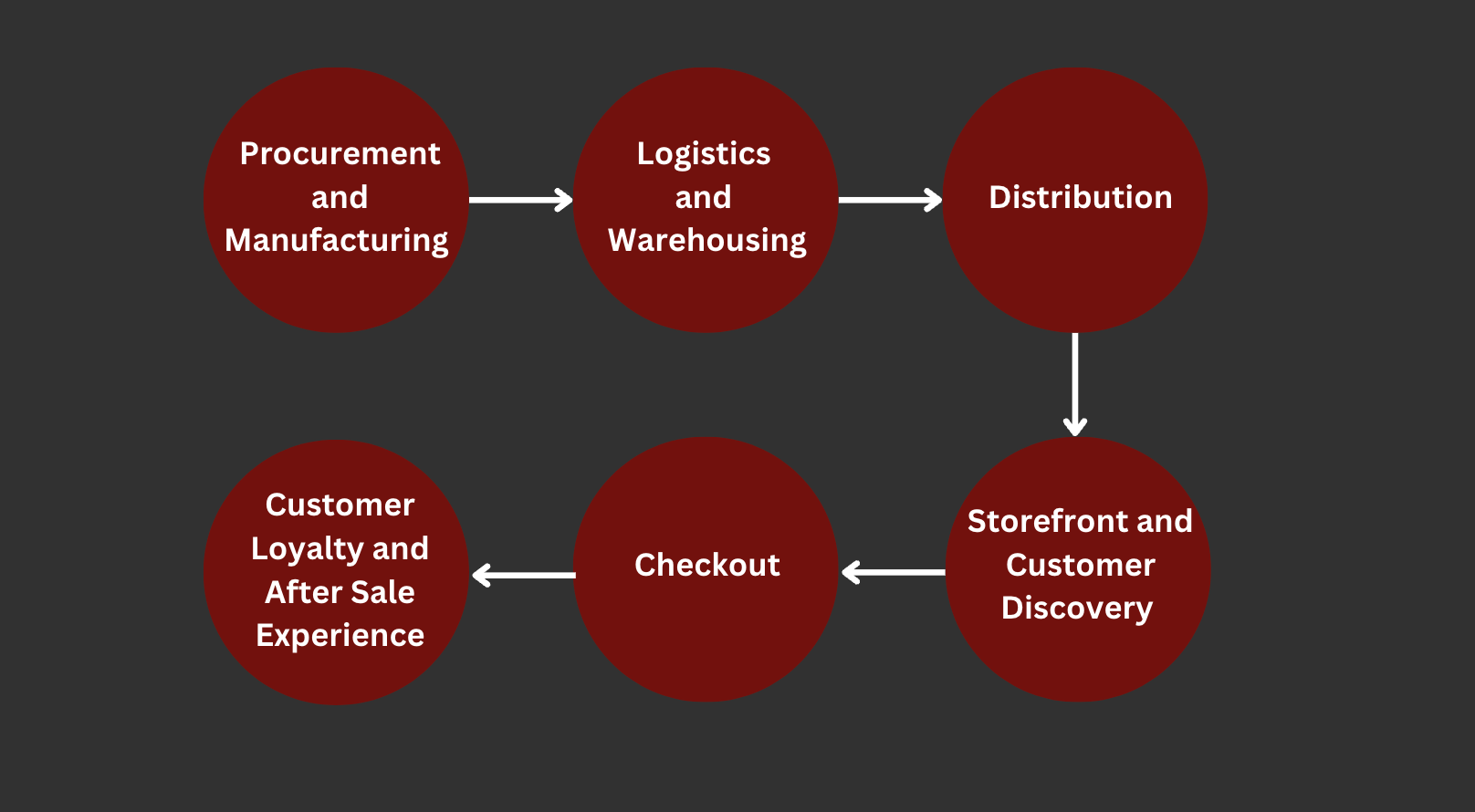
If we look at the entire value chain from the procurement of raw materials until the product reaches the consumer, multiple checkpoints and stakeholders are involved. Below is a brief visual of the value chain.

In this blog, we dive deeper into 2 parts of the value chain – manufacturing and distribution


Manufacturing

Manufacturing is the first step in the supply chain.

The need: Gone are the days when large segments of the population were making do with brands that were available at the nearest store. The segmentation was mostly done on price points and it was a distribution-led era. Today, Indian consumers comprise more granular segments, each with its own preferences. Over the last few years, there has been and will continue to be a proliferation of brands to cater to such segments that are primarily online first. These brands will be at a relatively smaller scale and will need more agile and responsive manufacturing facilities; that can offer good quality products at low (minimum order quantity) MOQs, at low cost and quick turnaround time (TAT). In addition, global commerce has become more decentralized and countries look at different hubs to source and manufacture critical components.

Where we are: While the Indian manufacturing industry has been growing quickly and is amidst rapid transformation, there are still multiple points of friction that persist. The manufacturing sector contributes ~5% to the GDP and India’s export contribution to global trade is only 1.6%. While the government has been pushing to revitalize the sector with initiatives for what is known as modern manufacturing, the infrastructure around it remains mired in the industrial age. However, with multiple tailwinds, India has an opportunity to emerge as a global manufacturing hub; not only are multiple Indian companies looking at manufacturing in their homeland but also international companies are shifting their manufacturing bases here. Electronics manufacturing could expand by 21% to touch $604B by 2032.

The gaps: Many manufacturers still rely on old technology and traditional production methods that lead to inefficient production processes. Most new-age D2C brands require agile manufacturing, with small batches to meet constantly changing consumer preferences and in order to keep up with a highly competitive landscape. Production methods are capex intensive, and to cover costs, manufacturers operate with high volumes, while brands have to struggle to deal with high inventory and long working capital cycles. Outdated machinery and high dependence on manual labour lead to delayed production timelines and inconsistent quality. Limited use of modern technology inhibits the manufacturers from adequate resource planning, monitoring machinery utilisation or inventory planning. This results in longer lead time and therefore lost sales / high inventory for their customers (brands). These are only a few of the multiple bottlenecks that prevent the manufacturing sector from operating productively.

Emerging whitespaces: Today, primary innovation has been on different modes of mechanization and automation. A convergence of digital, biological, and physical innovations, is transforming the entire value chain. It integrates digital technologies like IIoT, AI, cloud computing, advanced industrial robotics and 3D printing with various sectors, enhancing on-ground manufacturing, quality management, supply chain, maintenance, and customer service. These changes in the manufacturing sector have also been tagged under the next revolution of Industry 5.0.

We have identified various segments within the manufacturing value chain that have seen innovation over the last few years and will continue to do so:

  1. Capacity utilisation: Technologies that increase the efficiency of the factory operations and maximise resources at hand such as digital assembly mechanisation, AI-powered process controls, remote production optimisation, energy consumption prediction and collaborative robotics.
  2. Capacity maintenance: Real-time asset monitoring and predictive maintenance to ensure timely maintenance and repair for the long-term durability of factory equipment and machinery.
  3. Quality Management: IOT-led quality management to bring about standardisation within quicker timelines.
  4. Capacity modernisation: New form of manufacturing such as on-demand manufacturing, with lower MOQs and precision machinery to ensure capacity efficiency.
  5. Automated designing and product development: Predictive analytics for product demand, AI-enabled designing, cobot-led product development for sampling and resource planning
  6. Automated fulfilment support: Predictive planning for warehousing and logistics, delivery vendor network management.


We have had the opportunity to speak to different startups across this space such as startups building nano factories with production bots to industrial software providers using AI and IOT devices. We have understood that there is a large scope to optimize manufacturing functions, enabling the factories to build for India and the world. However, few challenges remain around being able to build large outcomes, as key stakeholders in the manufacturing industry are often reluctant to adopt new technologies. We are hopeful that the multiple tailwinds such as high computational connectivity, government-led initiatives, and the influx of AI-ML technologies make it the correct time to build and solve for the inefficiencies in the sector. While it may be a challenging sector to enter, identifying a relevant problem and building with a clear GTM will allow for a compelling new-age startup.


Distribution

The need: Over the past decade, e-commerce has grown from a niche market to a global powerhouse, reshaping traditional distribution strategies and blurring the lines between online and offline retail. As businesses learn to navigate this e-commerce revolution, they must adapt and embrace the changing dynamics of distribution. While multiple start-ups have been set up across various segments of the logistics industry from aggregator to last-mile delivery, in this blog, we focus on the transition between offline and online distribution.

Where are we: The India logistics and distribution market is huge and has undergone significant transformation over the years. Boom of e-commerce, government reforms, changing consumer preferences and evolving tech infrastructure have been propellers of this change. India’s logistics sector would expand at a CAGR of 10%+, from $200 billion in early 2020 to at least $320 billion in 2025. While till a few years back, most distribution channels were offline, it was during the pandemic the different channels of facilitating e-retail took shape. However, today, most businesses are recognizing that customers not only shop online but also want the experience of “touch and feel”. Many online first brands are exploring the offline route. The likes of BigBasket, Lenskart, Nykaa, and MamaEarth have redirected their efforts towards offline channels in a significant departure from their established digital dominance.

The gaps: Offline presence is not merely about brick-and-mortar stores, but also about personalised experiences to their customers. However, strategically establishing their offline presence either via owned stores or shop-in-shop experiences, online-first brands are trying to navigate this new territory. Offline distribution is expensive and brands struggle with successfully identifying the correct distributor, their sales channels, and retailer outlets. Large brands such HUL or P&G have the scale to work with individual distributors and can dictate their final outcome regarding which retailers they want to sell at. However, smaller brands with less than INR 100 crore in revenue have lesser negotiating power and the end-to-end operating costs to get distribution can be as high as 35-50% of their revenue. Getting efficacy from their sales force to get the retailers to stock products and manage the sales force churn are other major issues. Further, there is a demand generation problem, as fighting for visibility in a new environment where there are no targeted advertisements as in the digital world, becomes tough.

Retailers on the other hand have low bargaining power and are left at the hands of the distributors in deciding what products to keep in stores and the amount of inventory to stock. Additionally, the Indian retailer landscape has also evolved – from small brick-and-mortar stores to modern shopping malls, brands can choose multiple avenues to reach their customers. Innovative formats like hypermarkets, luxury boutiques, and shop-in-shop have also gained popularity, further enriching the offline shopping experience.

Emerging whitespaces: Here we have identified a few spaces we feel have the potential to solve for:

  1. Access to new brands for retailers: Allows brands to discover new retailers and even allows access to niche retailers in new geographies. These platforms which work with multiple brands can often club the distribution channels for different brands and help brands select the right retailers thereby reducing costs and achieving higher margins. However, churn of brands may be a potential challenge.
  2. Listing on demand platforms (ONDC): Brands can take advantage of listing through ONDC distributors, especially for products with high AOV and high frequency  .
  3. Additional services: Other services for brands such as payment reconciliation, surplus product disposal, store set-up for modern trade, and improvement of footfall conversion to name a few
  4. Hyperlocal delivery: As a form of replacement for local retailers. Many players have entered this space, especially focusing on grocery.


We have spoken to multiple startups in the aforementioned segments. There have been platforms that look at facilitating brands setting up shop-in-shop outlets and upselling their products, as well as startups that help create SKU bundles and sell the entire basket of products to retailers. While some might focus on a particular segment such as electronics or only T2+ cities, some are more widespread and look at an array of product types or geographies. While building out an early-stage startup in this space, it is key to not only help brands expand their offline presence, reduce inventory held and thereby bring down their distribution costs, but also help with additional services such as vendor management, GNR generation, payment reconciliation etc. Further, the team needs to have strong ops experience and a clear GTM strategy to be able to execute correctly.


Our view

We at Kae, are bullish about the e-commerce enabler system and feel there is vast potential that lies beneath it to tap. With the advent of online marketplaces, mobile shopping apps, and secure payment gateways, consumers have been provided with unprecedented access to a vast array of products and services from the comfort of their homes or on the go. The change has been nothing short of remarkable and has given a host of opportunities for other new-age exciting startups to be created.

We will follow this up with more blogs that trace the development of other enablers along the product value chain. If you’re building in this space, feel free to reach out to me at urvashi@kae-capital.com

Founder-Investor Fit

A startup’s early days are focused on only one thing, getting to ‘Product-Market fit’. Savvy investors talk about looking for ‘Founder-Market fit’, which they believe is key to getting ‘Product market fit’. Along with these two, I have been thinking about the concept of ‘Founder-Investor Fit’, which is not talked about much in the ecosystem. During the last few years, we have had multiple discussions with founders (both in our portfolio and outside) about how having (or not having) the right fit between investors and the company (or the founders) has been so positive (or catastrophic) for the company.

One of the triggers for this post was a blow-up that happened a few months back. A very well-known and respected investor got into legal tangles with a portfolio company. This portfolio company was founded by a college dropout, considered a maverick, second-time founder. Now, I do not know the founder too well to be able to comment on him or judge the situation, but I know the investors well, and they have been great partners to us and various founders over the years. I have to say, I do not know much about the issues here, and so, in no way trying to pass any judgment. In one of the media articles, it was mentioned that the relationship between the investor and founder broke down once the founder was trying to raise more debt without aligning the investor and also that the investor was not getting the financial reports on time. The moment I read it, my first thought was that this was never going to work for this investor. I know personally that they are not a fan of raising debt until needed and also are sticklers for financial reporting being done in the right way (we also agree with both, I must add). Beyond any other issues, this was clearly a case of not having a ‘Founder-Investor fit’.

So how should you think of ‘Founder-Investor fit’? Same as how you would think of fitment for an employee – you check for skills and cultural fitment. It is the same as a founder would do it for the next hire.

Let us first start with the ‘skill fitment‘.

In the case of investors, skill fitment will essentially mean that this investor usually invests at your stage and also has experience in your space. A very smart founder/operator, while discussing with me, had compared startup building to a relay race where investors and management keep giving reins to the ‘right’ next set of people. I find this to be quite a useful analogy. The ecosystem has seen many cases where things have not worked out ideally if the founders have not partnered with the ‘right investors’ for that ‘specific stage of the business’.

Similarly, investors with experience in your category will be more likely to have better insights and networks for the business. However, I believe that the right ‘stage fit’ is much more critical compared to ‘space fit’, as there have been a lot of companies where investors with no experience in the category have proven to be the most helpful.

What about ‘cultural fitment’?

We see that founders give a lot more thought to the ‘Skill Fitment’ while deciding their investor partners, but barely any thought goes into checking the ‘Cultural Fitment’ (or its equivalent). This is more critical in our view and here is how we would advise the founders to think about this:

1) Shared goals success metric: For a long-term successful partnership, be it a CXO, any other employee or even an investor, medium-term to long-term goals and the definition of ‘success’ should be the same for all parties. For example at Kae, our stated mission is to help entrepreneurs build enduring companies. If for an entrepreneur, success is to build and sell a company quickly, while this could be very rewarding financially (we get a lot of proposals with ‘you will get 5x in two years’ for your investment and the likes), is not in alignment with our definition of success. We prefer founders to go for building enduring businesses that outrun our time with the company multiple times, instead of building for a quick exit. Similarly, if a founder is looking to build a small/medium-scale but highly profitable and low-risk business, it would not be matching the goal of a large venture fund where the fund’s success is predicated on an outlier, multibillion-dollar outcome.

2) Alignment on success metric: Along with goals, how you measure success is another crucial consideration. When we work with early-stage portfolio companies, we ask them to identify ‘ICP’ and the right ‘success metric’. This is the same exercise that a founder should do, the right success metric for the short, medium, and long term has to be aligned with for good relationship between founders and investors. Just think about this, if a founder is chasing profit (say EBITDA) and the investor is only looking for topline (Or vice versa)- the board room will have two different languages being spoken in the review meetings. A right success metric aligns everyone to one clear north star and short-term milestones.

One of my portfolio companies recently did an alignment exercise in a board meeting, I found it very useful and recommend it to other founders regularly. Similarly, while evaluating a company some time back, the founder spent one full in-person meeting with me only asking me what success looks like to me for her business! I wish a lot more founders do it this way (Maybe not the full meeting, but you get the point)

3) Same core values: After alignment on goals/success metrics, it is very important to see if the founder, employees of the organisation, and investors align on key ‘core values’. A lot of investors are not very vocal about their core values (especially in India) but if you spend enough time with different people in the fund (and also ask), you can get a decent idea of what are the core pillars of their culture. It is then critical to see if there is a broad alignment between the company’s core values (which are mostly driven by the founders’ value system) and the investor’s core values. In our (Kae’s) case, we have ‘respect for all’ and ‘accountability to each other’ as two of our core values- we generally match very well with founders who also embrace these. There are a lot of investors who are very understated/ low-key (as it is part of their culture), if they end up investing in a very high profile, media-loving, flashy founder (or company), there is a good chance of not having a great relationship and outcome.

4) Discussing ‘Non-negotiables’: This is probably the most important alignment to seek and it flows from the values of the investors and founders. It is so critical that if needed, both sides should be upfront and explicit about it. For a lot of investors (including us) integrity is non-negotiable. Similarly, compliance and doing things by the book are the topmost priorities at every stage for a lot of funds. This requires an explicit check, that those non-negotiables are clear to both parties from the start and forever. By the way, this is very much binary- For example, there is nothing like being 90% compliant or integrity in 80% situations. This should be on top of the mind for all the relevant stakeholders at all times.

5) At the end of the day, It is all very personal: While investment funds are tight-knit teams and are aligned around their core values, goals, and procedures, the founder-investor relationship also has a lot of personal nuance to it. Different individuals at any fund usually have different preferences/expectations from the founders and a different way of engaging/working together, which is usually shaped by their individual values/persona and also their investing experience. A good match of personal values (and expectations) and the way of working together is very critical. This is what people usually bucket into great ‘chemistry/vibes’.

Even with all the points written above, it is still not easy for founders to figure out the right founder-investor fit. One of the key reasons is that we VCs are not known to be very transparent and articulate about our way of working and especially our core values. In such a scenario, the existing investors usually become the guide for the founders as they might know the other investors better. Beyond relying on the existing investors, founders should also talk to as many people as they can about the prospective new investors. We usually recommend our portfolio founders to do reference calls with other founders (and help them connect with too), who have gone through tough times in partnership with a particular investor. As they say, your value system and character are most clearly revealed when the going gets tough.

The idea of ‘Founder-Investor fit’ is very important for the investors as well and a lot of times it plays up in the evaluation process. The cost of getting it wrong however is much lower for investors compared to the founders. We were recently discussing the importance of checking for cultural alignment in a new hire with a portfolio company. I always use this statement by the legendary Vinod Khosla about investors with new founders- ‘Think of investors as an employee, whom you can’t fire’. When the founders think so much about cultural alignment with a potential hire, it is very obvious that this should be given more importance in the case of an investor.

I fully understand and empathize with the founders as finding a ‘right fit’ investor is not equivalent to choosing a culturally fit employee, especially as in a capital-scarce market, the relationship can be very asymmetric. However, it is still a very critical aspect of organization building and can be and could prove to be one of the most important factors in the success or failure of a venture.

Planning your startup journey

What do cricket and marathons have in common? The sportsmen need to pace themselves and develop strategies for smaller periods of time to be able to win eventually. For example: In cricket, if it is a one-day game, the batsmen plan in 5 over stretches – say 20 runs without losing a wicket or playing out a bowler, etc. In case a few early wickets fall, they rework the plan accordingly. Now, will this be the same game plan for test cricket and 20-20? No, the plans change according to the game that they are playing. Maybe a session-by-session plan for a test match and a 2-3 over plan for 20-20. But they all plan for interim goals. Short-term planning is easier, more concrete and helps keep things simple instead of a grand strategy for achieving the final objective.


Breaking the journey into smaller slots with near-term goals

Break up your start-up journey into interim stations. Set up near-term targets along the way and align the team towards them. Fundraises offer a natural breakpoint to plan for. Fundraises should always give you a runway of a minimum of 18 months. It gives you a clear 12 months to execute without worrying about the next round. Let’s use these as stages (stations) in this article.


What do short-term goals look like?

Each stage should have de-risked or proven something towards building a large sustainable business. To reiterate – this derisking is not just the scale of the business – but multi-directional in nature, enabling the business to become large and sustainable. It could be the proven value proposition for each stakeholder, bench strength of the second-tier team, identified channel to scale, unit economics, margin expansion etc. Let’s break this down and look at a framework:

Note: It is difficult to have a common plan across different business models – such as marketplaces, brands, SaaS, consumer products, and social networks. So we have kept this a bit broad.


StageWhat to achieve with the runway from the funding round
StartPre-Product Market fit (Pre-PMF), large Total Addressable Market (TAM), strong founders, small team.
SeedPM fit achieved, monetization experiments (in some business models), small stable team. Very low spend on marketing; Do not scale before PM fit is reached (maybe use the superhuman survey to evaluate this)
Series ADeepening value proposition for customers. Clear monetization with positive gross margins. Scalable Go-to-market (GTM) strategy identified. Directionally, Customer Acquisition Cost (CAC) is trending in the right direction. Cohorts are looking encouraging. Potential moats identified. Gaps in CXO are mostly filled. Systems designed and are being set up to ensure high customer satisfaction. Scaling 4X – 10X
Series BFalling CAC. Stronger customer satisfaction leading to improved retention, cohorts indicate CAC to Customer Lifetime Value (CLTV) about to be achieved. Moats are beginning to appear – Switching costs becoming higher for customers and entry is not so easy for newer companies. Full panel CXO; Tier II teams being built. Margins expand for marketplaces or D2C (Direct to consumer) brands. Positive Contribution Margin 1 (CM1). Growing at 3-4X YoY
Series CContinue scaling fast. Contribution Margin 2 (CM2, post marketing) positive and trending towards profitability. Full teams. TAM expansion projects. Strong moats, growing at 2.5- 3X YoY
Series DMoney for growth only. Profitable, growing at 2X YoY. TAM expanded
Series ENew lines to unlock value found. Growth slows


The above is just a framework and WILL change based on business models. For example: if you are in commerce – monetization is visible on day one. If you are a content platform, the preference will be on PMF, which is showcased in engagement and retention. Founders should be thoughtful about how they plan the interim goals and what they are derisking at every stage.


As an example of one such journey – here is a startup that I invested in the content space and how they went about it:


Pre-Seed:

Before the seed round, the company had strong engagement with its core audience [Time spent per day per Daily Active User (DAU)] which showcased a good value proposition. But they had lower than expected long-term customer retention (D30 – % of users who used the app on the 30th day after opening the app for the first time ever). The low retention indicated that the offering was nice to have for some time, but the value proposition couldn’t be sustained over a long period of time. As the customer churn is high, this creates a leaky bucket problem, which is not sustainable.


Seed Stage:

  • The goal for the seed round is to achieve PMF (Product Market Fit). They first identified the audience segment that resonates with their offering (Ideal Customer Profile or ICP, you can read our pieces on this: Part 1 and Part 2). Once they identified the ICP, they worked on the product and content strategy around this segment to ensure that the value proposition stays strong over a longer period of time (Product Market Fit).
  • They hired a small core team for roles in product and technology and to manage the creator community. They had focused on product improvements such as better onboarding experience, notifications to entice the listener back etc. They also understood that their ICP prefers a particular category of content and that episodic content worked better in longer-term retention.
  • Over the next 12 months, they spent less than $150K on marketing. They spent time on getting the right set of content onto the platform so that the ICP could have depth in this category.
  • Marketing spends were minimal to keep a minimum threshold of daily traffic on the platform – while they worked on the experiments towards PM fit. Over the next 12 months, the total spend was less than $150K while the long-term retention improved by more than 60%. They didn’t try monetization in the seed stage as the offering was not meaningful yet.


Summary: Identify your ICP and get to PM fit. Don’t try to scale too much (large team hiring, high spending on marketing) before achieving PM fit. We’ve written about the path to PM fit through the use of a Minimum Viable Product here.


Series A:

The company raised the next round about 18 months later. The goal for this stage was multifold.

  • Strengthen the team: The company added to the content, tech, and product teams to make them stronger.
  • Deepen the value proposition and improve retention: The company started expanding into a new genre of content for its ICPs that is closer to the first genre. They started creating audio shows (in a scalable way leveraging creators) to improve content quality and make it more predictable. Retention improved by about another 50% during this round.
  • Identify scalable GTM channel: They identified Google and Facebook as scalable ways to acquire customers, in addition to the organic (SEO, sharing) methods.
  • Try monetization models: Some monetization experiments were performed with premium content.
  • Start building moats: They have been able to successfully leverage technology to bring together teams of creators who are in different parts of the country with varying skills to be able to create high-quality content in a decentralised manner. This network of content creators and leveraging tech to rapidly create more content has helped them create diversified content (multiple genres + depth in each genre) at a low cost. This is a big moat for any content company.


Series B:

The company raised Series B funding 16 months later

  • Lowering the CAC (customer acquisition cost): The company continued to work on its CAC by leveraging the organic channels. With more Word-of-mouth (WOM) marketing, the CAC reduced over a period of time by 30%.
  • Stronger moats leading to higher switching costs: The company was able to scale the content quickly using its managed decentralized model of content creation by leveraging technology. The product also started offering multiple genres and a personalized content recommendation engine which helped in improving customer experience.
  • Tier II teams were built across all key functions.
  • Monetisation continues with CAC to CLTV improving.


The company is currently at this stage. Here is how I see the next few rounds panning out


Series C:

With this capital, the company can focus on the following:

  • Teams  – Full CXO teams are built
  • CAC < CLTV proved with this capital
  • The contribution margin post marketing becomes positive and will start covering some of the fixed costs.
  • TAM expansion experiments into newer markets
  • Stronger moats
  • Growth continues at 3-4x YoY


Series D:

  • Capital raised for growth only.
  • To become profitable before the next round
  • Still growing at 2.5x-3x YoY
  • TAM expanded with a new source of revenue clearly established


Series E:

  • New lines to unlock value found
  • Growth slows a bit to 2x per year


I hope this article helps you provide a framework towards planning your own journey. For more information, you can reach out to me here: krishna@kae-capital.com

The Indian SMB Story

The SMB (small and medium business) story is not a new one in India. Contributing to over 30% of the Indian GDP, the MSME sector is the bedrock of aspirational India. Incumbents like Tally, IndiaMART, and Zoho solved for various key organisation activities (like accounting/bookkeeping, vendor/buyer discovery and CRM respectively), paving the way for a wave of mobile-first technology tools.

We saw the first wave between 2014-18 which saw the emergence of mobile accounting/bookkeeping solutions like Khatabook, OkCredit, storefront solutions like Dukaan and miscellaneous business op solutions (which include ERPs/CRMs). The same period saw the emergence of B2B marketplaces like Udaan which solved for procurement and eventually the emergence of managed service marketplaces like Zetwerk and OfBusiness. The emergence of commerce necessitated the emergence of financing solutions (anchor-led and non-anchor-led) such as Mintifi, Rupifi, etc.

The perennial question remains, where do sustainable profit pools lie? Please note the key term sustainable profit pools – which implies profit pools backed by non-commoditized offerings and protected margin profiles. Is it in financial services? Is it in software + financial services? Is it in commerce (which includes credit by extension)? Where is the gap in the market? What use cases are yet to be solved? With models like Zetwerk and Mintifi turning operationally profitable, we are seeing signs that rapid scale and profitability can be achieved in tandem by tapping into SMB spending.

After having spoken to a few hundred founders solving for the Indian SMB space, we wanted to get a pulse from the SMBs themselves. We spoke to SMBs with the aim of understanding their day-to-day activities, motivations, which services they consider critical and which ones they don’t. We brainstormed with them to understand what they would build in-house and what they would prefer to outsource, what is critical and what isn’t.


Understanding the general workflows in manufacturing and services –

A sample manufacturing workflow (and key bottlenecks/ key points of disruption which can be solved using technology have been mentioned in brackets) can be as follows:


Procuring Financing at various stages is also critical to the entire workflow.

Services workflows are more varied – they differ significantly from logistics service providers to restaurants/hospitality service providers to construction services. However, the core workflows can be abstracted out as follows  – discovery (finding customers), financing, procurement and project management.

Beyond the above-mentioned key activities, there are several compliance-related pain points/activities which are industry-specific. For example, pollution control is critical for textile printing businesses.

“Pollution is a big headache – factories are across the state. Water pollution is an issue for textiles across the board. Water needs to be treated well, current solutions are not satisfactory.”
–  Small business (Textile printing)

“Our main problem is dealing with so many policies, every state has a different required label with different MRPs, different warnings to be put- logistically it’s a lot of extra effort for the company”
– Large business (Alcohol) 


Software solutions
 seem to be attracting attention as well, however, we are uncertain of the underlying profit pools.

“ If a software comes up that allows us to manage our projects more efficiently, we’d be willing to pay for it. Labour shouldn’t be occupied in things like accounting.”
–  Residential Business construction, small business (Construction)

Automation solutions are in demand for large SMBs (think INR 100 Cr+)

“Limitation of lower levels of automation is that the Indian scale of industrial manufacturing of companies like ours is 5x lower than abroad.”
– Large company (Industrials)


Sharing a market map which highlights all the core use cases and some of the models solving for the same –


Our attempts to neatly map unsolved use cases onto parts of the workflow yielded interesting insights:

SMBs can be broken down by size and sector. In our study, we broke down our sample by size of business (< INR 5 Cr, 5- 20 Cr, 20 Cr – 100 Cr, 100 Cr+) and by sectors of businesses [manufacturing – which includes electricals, industrials, chemicals, construction, etc.; services – logistics, hospitality, etc.]

However, the goals of the promoter are what stood out as a key insight. Most businesses’ intent to adopt technology (and pay for solutions) seems to be a function of their desire to grow. For example, we spoke to a business which was < INR 5 Cr and grew to over INR 20 Cr year-on-year. The promoters were excited about growing the business to an INR 100 Cr+ size and were thinking actively about their expansion strategy. They were open to adopting technology-enabled solutions which would not be efficiently solvable in-house, i.e. their existing supplier/vendor base was not enough or they did not have the necessary personnel/know-how to pull it off.

While they have a sense of where they want to reach from a scale standpoint, there are several unanswered questions on how to get there. Often, promoters do not have a clear idea of the challenges they will face going forward as they scale their business and seem to be broadly open to new technology solutions and financing options.

Larger businesses (INR 150 Cr+) with growth-centric founders tend to be more keen on building everything in-house (including technology).

“We tried using Salesforce, but it was not specific to our sector and the licensing fees were very high. Now we have created an in-house integrated ERP (CRM +ERP) which we’re building for commercial sale and use as well.”
– Mid-sized company (Industrials)


Discussions with promoters on technology adoption irrespective of size boil down to a build v/s buy debate.

Small businesses (<5Cr) have the highest friction to technology adoption and don’t tend to do so unless there is a compliance need OR their anchor customers/vendors make them adopt the tech. Small businesses (<5Cr) which are more than a generation old tend to remain in status quo with little incentive for the promoter to adopt tech solutions or want to grow.


ImportanceINR 1 – 35 Cr INR 35 – 100 CrINR 100 Cr +
Procurement/InputsLow-MidMidMid
Project/Workflow ManagementLowMidMid
Automation SolutionsLowMidHigh
ERP/CRM SaaS SolutionsLow-MidMidMid – High

(would prefer company company-specific solution)

Payment Recon/B2B Payments and collection (Fintech SaaSMid/HighMid/HighMid
Financing + Fintech SaaSMidMidMid
ComplianceHighHighHigh
OthersIndustry dependentIndustry dependentIndustry dependent


Despite the challenges, we feel the Indian SMB story is a promising one

If you feel you are building in the space, please do reach out to us!

Customer Feedback Loops

During the early days of company building, getting continuous feedback from the customers about the product and iterating on the received feedback is critical. This is what defines the product and business roadmap and pushes a start-up to that elusive ‘product market fit’. In this piece, we will talk about how to create effective customer feedback loops for the product teams.

Feedback from the customers is not even half as useful if the learnings and actionables don’t percolate to the product team. Additionally, it is also important to loop back to customers on their feedback/ issues after working on it. A ‘closed-loop process’ would be something like below and if done well, would turn into a virtuous cycle or a flywheel propelling the product forward.


Collecting the feedback

Any customer feedback loop has to start first with a tight feedback collection process. Most of the time customers give feedback to frontline teams like Customer success or customer support. In the early days of the company, there might not be specific teams for customer success/support and this might have been done by the sales/product teams directly. In both cases, collecting user feedback is a critical part of the frontline teams. Most of the time, user feedback can be bucketed into three channels:

a) Inbound feature request: This channel is the most obvious one and most companies should have a mechanism/structure around it in place from the early d Customer feedback can be a feature request, bug or something else. The channels for this feedback can be multiple, like Customer communication platforms (eg. intercom), email, helpdesk tickets, phone calls etc.

b) Proactive outreach: This is a mechanism that we strongly suggest founders to put in place from the early days. Best frontline teams do not wait for customers to give feedback but proactively reach out to them. The most efficient way to go about it is to do proactive outreach on the basis of product/feature usage. There are product analytics and customer health tools like Mixpanel, Gainsight, Totango  which can be helpful for this. Our portfolio company Hiver, for example, keeps track of product usage through Gainsight PX and reaches out to customers where the product usage dips or is not in line with their benchmarks. The channel for communication here is usually Phone/Email Outreach.

c) Churned customers: Product feedback from a churned customer (or a customer who has stopped using the product) is a very important piece of information. Product teams in some of the more successful companies give a lot of weightage to the feedback from churned customers as it helps them shape the product roadmap and stop future customer churn.


Funnelling the feedback to product teams

The second and arguably more important step after the collection of feedback is to funnel it to the product team. This is a critical step as this is where the interfacing of the front line and product team happens along with the sharing of feedback. Value derivation of the customer feedback (as issue resolution or feature roadmap for the product) correlates directly with how seamless/organised the feedback funnelling to product teams is. At the core of funnelling to product teams is:

a) Sharing the feedback with theproduct team: Most of the time, frontline teams like support and CS get a lot of actionable feedback which requires some action from product/development teams. A good practice is to use internal collaboration tools where feedback can be put in front of the product teams directly. Our portfolio companies for example use specific channels on tools like Slack (customer feedback/ feature request) for this. This is the fastest and most efficient way to get the attention of relevant folks and loop them in on the actionable.

b) Involving product teams with customers: In quite a few cases, Support/CS teams need help from product teams to deeply understand a customer feedback/request. It is best to involve the product team directly to speak with the customers in such cases. Product teams proactively engaging with the customers helps in a more aligned product roadmap and also helps in resolving customer issues and queries faster. We have seen that the best companies have both processes and culture to actively get the product teams in the Our portfolio company Hiver, for example, has quantitative targets for the frontline teams to arrange customer calls with product teams. Another portfolio company, TranZact, for example, has similar targets for everyone in the company to ensure that they speak with at least one customer directly every month.

c) Organizing and actioning on the feedback: This is a part which, if not organized well, can break things the most. Goes without saying that unless the teams organize the feedback well and take action on them, it will not result in effective growth. It is important for the frontline teams, product teams and the leadership to have a clear process on how to organize and action the collated feedback. Best practices that we have seen include using tools which ensure that the feedback is recorded well. It is also important to have a clear process on how to segregate the feedback, rank it for importance and make sure that it is on record for action. We have seen Trello boards used quite well for something like this.


Looping back to customers

It wouldn’t be a feedback loop if you don’t go back to the source, the customers. What needs to happen is that you tell the customers about taking their feedback to the product team and keep them updated on how it is being worked upon.

This, while intuitively not the most important thing for a lot of back-end teams, is arguably the one that kicks the virtuous cycle in motion. It ensures that the customers are happy and tuned in to give more feedback, which shapes the organization’s product roadmap and growth path. Key things to keep in mind here are:

a) Frontline teams to be kept in the loop on actionable: The CS teams need clarity and have to be on the same page about what is being done about the customer request/feedback. This ensures that while they are empowered to close the loop with the customer, they don’t end up overcommitting/setting up unreasonable expectations with the customers. It is a good idea to keep the CS teams looped in the relevant Trello boards/Jira tickets (both are good products) so that they are on top of any updates on the product side.

b) Closing the loop back with the customers: CS teams should be closing the loop with the customers proactively and keep them posted on how the company is actingon their feedback.

In the cases, where the requested feature is put in the roadmap, to close the loop with customers, we have seen companies also giving the customer a peep at the internal product roadmaps. This helps reassure the customers and promotes transparency.

After the issue with the customer feedback is closed, it is even more important to close the loop. Best companies do it very proactively. In case a customer is fine even without using the feature that they had asked for, it is good to just inform them ‘Hey we worked on what you asked for and this feature is out, please go and check it out’. Customer education initiatives like webinars on new features or in-product nudges/guides are also very helpful for closing the loop properly.

A tight and continuous customer feedback loop is the foundation for the ‘Zero to One’ journey of a company. If a product is not getting feedback or not acting on the customer feedback, it is always going to be stagnant. A well laid-out customer feedback loop ensures that the organization collects proper feedback and that the product team doesn’t miss out on the feedback and actions on it. It also ensures that the customers feel that they are being heard.

Minimum Viable Product (MVP)

A Minimum Viable Product (MVP) is one with just enough basic features to be shared with early adopters for their feedback. In the early days of a startup, getting proper guidance is essential in order to get the product right. With an MVP, you can ship a product with your core ideas, in order to refine it further based on early adopters’ feedback. It is much more cost-effective than building out the entire product and then making tweaks, and helps validate your ideas regarding your product. In this blog, we will discuss the strategy of launching an initial version of the product and getting customer feedback. Often, founders are conceiving and perfecting the product internally without testing what customers want. This blog will help you break that cycle and get customer feedback at the earliest.

We will break this phase into four steps:

  1. Validate
  2. Build
  3. Launch
  4. Measure


Step 1: Validate

It is important to first talk to potential customers even before building any version of your product. This initial set of customers you speak with can come from your own personal and professional network. The goal is to not spend months or years doing research but to identify a common pain point soon.

Speak to 20-30 customers and ask them questions like:

“What are the problems you are facing?”,
“How are you addressing them?”,
“Why is this solution still not working for you?”

Try to connect the dots on common problems that you are hearing. The key is to only listen and understand the problems that customers are facing without talking to them about your potential solution. Try to build a deep understanding of the problems your user is facing. We are only attacking the problem in this step.

Typical Team Composition: Given this is still early in the journey, your team should ideally comprise only the founders. You should drive all these conversations since that sets the foundation for the next step, building your product.


Step 2: Build

After you have spoken to initial customers and identified a common pain point, it is time to get to the drawing board. The goal here is to get the first version of the product out of the door to test out the initial hypothesis. While as a founder, you are always striving for excellence and want to over-architect the product, you will need to stay disciplined here. The aim is to not create the perfect product, but the minimum viable product to validate your hypothesis. 

This is just the first version of the product and it is bound to undergo several changes subsequently. Also, we are not suggesting that you ship any product, but ship a product from which you can learn. Formulate your hypothesis from Step 1 and build a product in the shortest time from which you can learn the maximum. Do not try to build to solve all the problems that you heard from your users but the top ones that matter to the user. Solve the most pressing issues where you can make a difference.

Typical Team Composition: Your team has now grown beyond the founders. Ideally, you should have hired a couple of developers (Full stack engineers preferably to help build the first version of the product quickly).  


Step 3: Launch

Now that you have built the first version of the product, you need to cross the hurdle of launching and getting it live in front of potential customers. Refer to our blogs on ICP for more details on whom to target first. (Part 1) (Part 2)

This is the phase where you learn how the customer is interacting with the product:

“Do they see value in it?”,
“Are they happy with the design?”,
“Are they responding in the way we intended?”

This will help you derive valuable feedback. Your main takeaway here should be to get the product out of the door.

Typical Team Composition: At this stage, you may want to add a sales/ customer outreach representative. If it’s B2B sales, you are likely driving most of it and a mid-junior level resource is probably supporting you. For B2C sales, you need to spend inordinate amounts of your time on performance marketing. Again, you could use a consultant or an in-house resource to support you.


Step 4: Measure

Once you have launched the product and seen customers using the product, you should now speak to the users and unearth what truly matters to them. You will be surprised by the feedback you get from the customers. Features you thought would delay the product launch may not even matter to the user. On the other hand, features you had planned to delay rolling out may be what they are seeking right away. Do not skip this step, since it helps in aligning the team internally on what to prioritise.

Collect all feedback by asking the same questions. You need to be extremely methodical in your user interviews. Ask open-ended questions so that you get more answers from the user. Ensure the questions you ask will help you in building the next version of the product. We will dive deeper into this topic in a separate piece.

Typical Team Composition: You are now expanding your team by adding people on the engineering side and sales/marketing functions. Do not hire ahead of the curve till you hit PMF since you are still in discovery mode.  


Conclusion 

Your chosen methodology may require tweaks or multiple consultations with your early adopters, however, this framework will help you set a foundation for getting the most answers accurately. Conducting this activity early on ensures that once your product is out for public consumption, it fulfils the needs of a majority of your customers and reduces the scope for major red flags coming up, which is always a great sign in the early days.

Additionally, be prepared to pivot, if you receive sufficient feedback to do so. It is a very normal part of this process and is much better to sooner than later.

In case you are a tech-driven business and are building something that excites you, feel free to reach out to our Investment Team here.

Understanding Ideal Customer Profile (ICP) Part 2: Refining the ICP

In the first part of this two-part series, we defined the ‘Ideal Customer Profile’ (ICP) and how you can go about defining it. In case you missed that, you can check it out here. In the second part, we shall look at refining your ICP to be able to use it for optimising your target audience.

After you have iterated and zeroed in on an initial ICP, it is time to work on other key aspects of the go-to-market (GTM) strategy. We suggest doing the following:

1) Positioning statement: A good way to start on the GTM is to come up with a clear and concise positioning statement. This positioning statement should be able to articulate your value proposition for an ideal customer. A typical format for this would be like below 

 For (Target Customer) that (Needs/Cares about), (Company/Product/Service) is a (Category/Solution) that (Benefit). Unlike competitors,(Company/Product/Service) is (Unique Differentiator) 

           Examples of positioning statements:

    • Avis: For business people who rent cars, Avis is the company that will provide the best service because the employees own the company.
    • Amazon: For consumers who want to purchase a wide range of products online with quick delivery, Amazon provides a one-stop online shopping site. Amazon sets itself apart from other online retailers with its customer obsession, passion for innovation, and commitment to operational excellence.


Another very good way to think about this is to have an analogy positioning. This is when you tether your values with another successful/iconic brand and make the value proposition very easy to understand.

 For eg. Superhuman: Tesla for e-mails

2) Building user/buyer personas and creating personalized messaging:While B2C messaging is often personalised, It is very easy to forget sometimes that even B2B customers are humans, and the messaging needs to connect with them on a personal level to make a buying decision. This is where building personas (user/buyer) becomes important. What you want to be able to do is identify more things about your customers beyond the segmentation of ICP. You are looking for subtle but important things like ‘What key value are they really looking for?’, ‘What emotional trigger really makes them take a decision?’, ‘Do they have any cognitive biases?’, etc.

Identifying and enhancing your customer’s human behavioral traits and fleshing them out as personas such as a ‘Sales Stuart’ who is looking for the best price or ‘Developer Dave’ hunting for optimum productivity can help you sharpen the messaging and channels strategy. Continue iterating on these personas as and when you collect more information and data.
 

Validating and reiterating the ICP
 
As the business progresses and you add customers, you should continue periodically validating and reiterating the ICP. This can be done by:

  1. Looking through your customer segment mix
  2. Looking through metrics/indicators/evidence of value derivation by different segments
  3. Reiterating the ICP

 
A few ways to measure the value derivation would be:

  1. Usage/Engagement metrics:How are different segments using/adopting the product
  2. Customer retention/churn data:Segment-wise customer churn or retention data. This directly translates to the Lifetime value of the customer
  3. Customer Satisfaction (CSAT)/Net Promoter Score (NPS) data:Segmented NPS/CSAT data gives a lot of insights into the ICP segments.
  4. Sales data: Insights on segment-wise Sales cycles and conversions also give indications on the ICP.


Another way of visualizing this would be to break up personas through usage patterns – engagement and retention metrics:

SegmentsEngagement/Usage Metrics Retention MetricsCSAT/NPSSales Cycles/Conversion
Segment 1    
Segment  2    


The ideal customer group should be doing much better compared to other segments and should have average metrics on most of the above KPIs. If that is not the case, it is time to reiterate the ICP.


Aligning Efforts towards ICP

Once you have clarity on the ICP, it is important that you make maximum efforts towards that segment. The following questions help in that direction:

  1. What percentage of your customer base (by numbers and revenue) is your ICP?
  2. What are some things that you have done/ are going to do to strengthen the value proposition towards your ICP?
  3. How are you planning to align your Sales and Marketing efforts towards the core customer group? 


Firing your customer

Firing your customer is perhaps as important as, if not more important than defining your core customer. The following questions will help you understand how focused your organization is. It is important that you let go of the customers who are far away from your ICP segment.

  1. Which customers have you fired in the last months and why?
  2. Which customers (Non-ICP) are you firing in the next 6 months?


Conclusion

Thus, clearly defining your ICP and being regular with this exercise can do wonders for the efficiency of your business by helping you reach the right consumers with the right messaging. The important point to note here is that this exercise is not a one-time effort and does require constant updating to maximise your business’ output.

Understanding Ideal Customer Profile (ICP) Part 1: Defining the ICP

This article talks about the importance of defining an Ideal customer profile in the initial days (when you have none or very few customers) and provides a framework for doing so.

Founders are often tempted to capture as much value (or revenue) as possible from different types of customers. To do this, they often wastefully spend their energies and resources on capturing multiple types/avatars of customers and therefore lose sight of the company’s core value proposition and focus. As a founder, you must identify and focus your energies on the customers who are going to be most successful for you- the ‘Ideal Customers’

First of all, it is important to expand on the term ‘Ideal Customer Profile (ICP)’. An ICP is not the customer that gives the most revenue, it is also not only the customer with the easiest sale potential. An ideal customer is one who is deriving the maximum value from your offering and whom you can serve best (compared to alternatives). This translates to:

  1. Easier Sale and lower cost of acquisition
  2. Better retention and higher Lifetime Value
  3. Customer Advocacy and referrals


You should also not confuse ICP with customer/buyer personas (‘marketing Michelle’ or ‘HR Harvey’). A buyer/user persona comes after you have defined a broader ICP and is used to create messaging that helps you connect best with different personas in that ICP group. An ICP defines Who to sell to, while a persona defines How to convey the value proposition of your offering to this customer.

Your ICP is a clear, common, objective definition of who the ideal buyers and users of your product are. A well-defined ICP lays the groundwork for your positioning, messaging, pricing, GTM, and even product roadmap. Once you have clarity and validation of your ICP, everything else ties into it. An important point to note is that the ICP definition is not stationary, it keeps on evolving along with the organization. As you keep on acquiring and learning about more and more customers, the ICP definition will keep changing and becoming sharper.


Defining the ICP

A good way to define your ICP in the very early days is to look at the broad market that you are trying to solve for and look for a common subset where you believe you are best positioned to serve that customer group. Look at the overall landscape of customers and competitors. You are looking for a large opportunity which primarily can be because of:

  1. A gap in the market– There is a gap in the market and a large customer segment is underserved.
  2. Better product/experience– There is an opportunity to serve the customers in a much better way compared to the current alternatives. A low NPS/Retention for the current alternatives points in this direction.
  3. Opening of the market– There is a latent need in the market or the customer behaviour is changing rapidly for a new offering to come in and disrupt.


You should then speak with your best customers (or do surveys with prospects if the product/service is yet to be launched) and list down their attributes.


For B2C Businesses

For a consumer-focused(B2C) business, the following attributes are a good start

    1. Demography
      • Age group
      •  Gender
      •  Religion, Race and Ethnicity
      •  Occupation
      •  Income
      •  Relationship/Family status
      •  Geography


  1. Psychographic and behavioural traits
    • Values
    •  Interests
    •  Hobbies
    •  Aspirations and Fears
    •  Social media behaviour
    •  Buying behaviour


A few iterations using customer surveys/research will lead you to your ICP.


For B2B Businesses

For B2B businesses, the following attributes are a good start

    1. Target Company
      • Industry
      • Customer base/Business model- For example ‘B2B company serving SMBs and mid-market customers’
      • Size- Very Small/Small Medium/Mid Market/Enterprise Businesses
      • Geography
      • Maturity/other differentiators- For example, ‘fast-growing startups’ or ‘more than 20 people development team’


  1. Target customer profile
    • Profile- Ex Sales Development Representative/VP Marketing/Engineering Manager
    • Key goals of the customer
    • What is the core problem?


Put your target group into different segments and think through your value proposition from the perspective of the following parameters. The attractiveness of your solution (compared to the alternatives) for a segment will drive you towards your ICP:

  1. Problem intensity– The problem you are solving can be severe and (or) frequent. Pain point intensity usually is different in different kinds of companies. It relates strongly to the industry, size, and maturity of the company.
  2. Awareness and urgency– How aware is the customer of the pain point? Is it a need (urgent) or good to have?
  3. Ability to pay– Does this customer segment have the ability to pay the right value for your solution? This usually relates to the size and industry of the company.
  4. Ability to sell and serve efficiently– How efficiently can you acquire customers of one segment? How equipped are you to serve them? Geography and size of the company are the most important variables for this parameter.
  5. Competition/Advantage over the competition– Are there any other solutions for this customer segment? Is your solution much better than the current competition? Is there a gap/underserved market segment that you can go for? Usually, this parameter relates strongly to size and geography. It is probably the most critical parameter which gives direction to a possible whitespace or possibility of disrupting incumbents.


A few iterations using customer surveys/research will lead you to your ICP. Articulate it very clearly. Try to be as specific as possible and use more nouns/verbs than adjectives.

Example: Hull.io ICP definition- “Post Series-A (scaling) SaaS startups with more than $5 million in annual revenue, who use Salesforce & Redshift.”

After nailing the ICP statement, to plan and sharpen your go-to-market (GTM) strategy, we suggest that you put together the following as well:

  1. Success metric for the customer– What is the metric that the customer is likely to look at to validate that your solution is proving to be successful? (eg. it can be the lowering of churn or increasing of NPS)
  2.  Success metric for you– What is the metric that you would track to validate that your customer is deriving value from your solution? (eg. it can be the number of emails sent or tickets closed)
  3. Value Metric– What is the metric/unit that the customer is likely to measure that correlates with the perceived value? (eg. it can be the number of users or GBs of data storage)
  4.  Time to value– How much time does it take for the customer to start realising the value of your solution?


This way, you can approach the problem of defining your ICP, depending on the kind of customer profile and end goals you are targeting.

In part 2, we will talk about steps taken, post defining your ICP.

Generating the Future: Transforming SaaS with GenAI

In the last 6 months, the world of generative AI has seen an explosion of interest and hype. There is no denying that GenAI is changing the landscape of software development. GenAI is disrupting the industries, software and the way we work, and it is happening at an incredibly fast pace. Every knowledge worker is playing the game of catching up with so many AI models and sexy tools getting launched every week.

SaaS as an industry is undergoing a complete disruption; nearly all the startups we have evaluated in the last 3 months were using GenAI in some form. The GenAI tech stack has been rapidly evolving, with the emergence of several new models and tools.


We broadly look at the existing stack in five layers-

Infrastructure layer includes hardware and cloud platforms which provide compute hardware and GPU. This includes companies such as Nvidia, AWS, GCP, Azure.

Foundation Models are GenAI models on top of which the entire stack is being built. They are AI neural networks trained on massive unlabeled datasets, enabling them to perform a diverse range of tasks, including test/ image/ audio/ code generation, text translation, and summarization. GPT-3, PaLM2, LLaMa are the well-known LLMs. Some open-source models trained on much smaller parameters are also getting interest for specific use cases.

Companies are using a combination of different models to increase accuracy and performance. A layer of domain/ vertical-specific models (health, legal, ecommerce, finance etc.) over foundation models has become a well adopted practice.

Next is a layer of tools that enables the use of these models, which we call Enablers. These tools are critical for the rapid adoption of foundation models by developers/ businesses, facilitating the shift where every company large or small is working towards adding GenAI capabilities to their products. Building production-ready AI apps is a challenging task that involves various steps. Starting with infrastructure setup, model hosting, database configuration, data collection and preparation tools, model selection, training or fine-tuning with your data, orchestrating different models based on use cases, integrating with your systems, deployment and maintenance of models, monitoring performance and cost of these models – all are part of this complex process. Hence, the emergence of enablers. Enablers offer capabilities such as orchestration, model management, observability, compliance, security, and more. Pinecone and Langchain are the most popular ones in this layer. Pinecone is a managed, cloud-native vector database with a simple API and no infrastructure hassles. Langchain is a framework for developing applications powered by language models.

Next is the Application layer, where customer-facing applications are built on top of GenAI models. It includes tools like Jasper, Glean, Copy.ai, Rephrase.ai. With GenAI, companies are providing better personalized customer experience, the conversation interface is taking over the clunky software UI and reducing their time to value.

Beyond all the excitement, it’s important to note that building and scaling an AI native tool is not as easy as it looks from all the Twitter chatter. We have spoken to many GenAI founders and tried to understand the challenges they are facing in customer adoption and product building. There are few interesting insights –

  1. Most of the GenAI tools from India are very early. They are seeing a lot of excitement and adoption from the market. Users are trying out different tools, but there is high churn. Prosumers and SMBs are the initial adopters of these products, but founders have to crack the retention and path to monetisation.
  2. Generational and non-critical use cases are seeing more traction. Generational use cases are some kind content generation- text, image, blog, code, audio etc. Non-critical use cases are business use cases where the cost of failure is not high and can work with not-so-high accuracy – sales, marketing, hiring etc. In high value use cases like cybersecurity, there is a cautious adoption of GenAI.
  3. GTM motion for enterprise SaaS remains the same. There is a sense of curiosity among enterprises regarding GenAI and acceptance to use it in their workflow but they are cautious. Their concerns about data privacy, security, and compliance persist, and there is limited trust in public LLMs. We are seeing a trend of building on the client’s VPC, which can increase the time to adoption.
  4. ChatGPT has changed the customers’ expectations. Customers are conversing with tools in natural language, they are not only asking for information or insights from the data, they are expecting end-to-end tasks to be done. The expectation is AGI (Artificial General Intelligence). We spoke with an AI native marketing product from India where customers are spending more than 30 min every session and asking in one single command to look into the data, identify cart dropout and design and send a campaign to them.
  5. There is a lot of adoption of picks and shovels- libraries, tools helping developers build apps for different use cases. Autonomous agents have become very popular. SuperAGI is one of our portfolio companies, which has gained more than 7k GitHub stars in two weeks. It is one of the trending repositories on GitHub. It is a dev-first open-source autonomous AI agent framework, enabling developers to build, manage and run useful autonomous agents quickly and reliably.


Based on our learnings over the last few months, we are more bullish on a few spaces in GenAI where we believe large outcomes from India can be generated:

  1. Picks and Shovels for developers: GenAI tech stack has become fairly complex and it is changing rapidly, only LLMs can’t help with production level use cases. As discussed in the above section, it is a long iterative process and these tools help developers build, experiment, train, and compare quickly. This is a new need that has emerged while developing in GenAI. Vector database, framework, model orchestration layer, autonomous agents are some examples of the types of tools getting created. Pinecone and Langchain fall under this category.
  2. No code enablers for businesses: We have seen copilot (GenAI) in a box model, where the entire AI stack is taken care of by the tool, you just have to integrate with your existing software. This new layer is emerging in the tech stack and it can be an opportunity for new players.
  3. ModelOps/LLMOps:MLOps used to be a not-so-attractive industry until 6 months ago. With GenAI, more models are going into production and none of the existing MLOps were made for that. Existing MLOps companies are adding capabilities and a new set of ModelOps tools are also emerging. ModelOps/ LLMOps tools include model lifecycle management, observability, data security and privacy, and model monitoring.
  4. Autonomous Agents:As discussed above, customer expectation is for AGI which can be provided by autonomous agents. They have the ability to analyze intricate problems, solve them iteratively, and take actions. AutoGPT is the most popular one, it has more than 139K stars on GitHub. In today’s form, it is not easy to use AutoGPT for business use cases. AGI is still in the early phase and will take some time to reach the customers’ expectation levels.
  5. AI native companies: On the application layer, we are keen on these companies. In many use cases, incumbents have the right to win because of distribution advantage. That’s why we believe all the niche use case products will get commoditised as incumbents will launch it as a feature. However, if you are building an AI native software with some vertical focus and data flywheel, then there is an opportunity to deliver better accuracy compared to incumbents.
  6. GenAI-powered Vertical SaaS: Vertical LLMs are trained on curated high-quality data from a specific industry. This allows Vertical LLMs to generate more accurate and relevant results. Legal, health, and finance are among the industries where a lot of knowledge resides in the massive historic data, which is the play of Vertical LLMs. GenAI-powered Vertical SaaS companies are getting popular, such as Hippocratic in healthcare and Evenup and Harvey.ai in legal.


A lot is happening in the GenAI world and we have been continuously learning about the latest developments. Our thesis will keep evolving. We will release a series of articles on GenAI to keep you updated on our learnings. If you are a founder building in GenAI or an enthusiast, we would like to have a discussion. Please feel free to reach out to veenu@kae-capital.com or sarthak@kae-capital.com.

Crafting a compelling pitch deck

The pitch deck helps in communicating the company’s story to external stakeholders. This could be to raise capital or bring in customers and partners. This blog will focus on crafting a pitch deck for early-stage founders to sell their vision to investors.

Slide 1

What do you do?

A 1-line blurb, which should communicate who you are. The common misconception is that it is best to go for an “X for Y” positioning ~ for eg. a “Thrasio for Apps”, which might not always be the best option.

Sometimes, it is best to provide a line on the model and TG that you are targeting. A sample could be “SaaS enabled B2B Marketplace (business model) for Pharmacies (TG)”.
Eg. Zetwerk is India’s largest on-demand manufacturing network, serving customers in every major industry.

Slide 2

The team slide

Who is in the founding team, along with backgrounds (organizations you have worked in, along with your alma mater) and whom you have hired outside of the core founding team form the basis of investors’ judgement. At the early–stage, investors are primarily backing the founding team, so this slide must be given importance in your presentation’s hierarchy

Slides 3-4

Problem and Status Quo

It is important to succinctly explain the problem you are going after, which can be best explained through a user journey and point of discomfort at present for all stakeholders. Feel free to use diagrams/charts to explain the journey, but make sure to do it across all stakeholders.

‘Status quo’ defines how things are being done presently. The problem gets fleshed out better when all the other alternatives to solve it are highlighted, post which it becomes a matter of making an argument as to why your solution is the best.

Eg. If you are evaluating an IoT-based vending machine to be placed in corporate offices ~ you need to think about it holistically.

The fundamental problem is to get a meal at lunch ~ it may be tempting to lay out the status quo as the office canteen. However, this paints an incomplete picture, as you have alternatives like food delivery apps, restaurants in your vicinity, a dabbawalla, or perhaps your nearby multi-purpose store, which typically has ready-to-eat meals.

It is pertinent to understand why a vending machine (IoT-enabled or not) will be the best solution to offer lunch to office-goers.

Slides 5-6

Market Size and Trends

Large markets can be seen in two ways ~ either you sit on existing spend pools which are getting organized/digitized ~ for example, gold lending is a $140 Bn market, however, $90 Bn is unorganized, making this a large opportunity. Sometimes, markets are nascent but fast-growing – for example, in blockchain gaming between 2020 and 2021, the number of active wallets interacting with gaming smart contracts exploded. If it’s not large now, why do you think this will become large in the future?

Investors want to understand this market, broken down into volumes and pricing. These are revenue pools/spend pools, of which you wish to capture a segment at scale.

Market trends answer the ‘why now’ question, which refers to tailwinds or recent inflection points which incentivize adoption. At the early stage, investors prefer to see bottom-up calculation over referring to industry reports to size the market.

Slide 7

Competition

While in ‘Status Quo’, broad solutions are addressed, the next step is to go one level deeper into the competition, which should include both direct and indirect competitors, covering their scale, your differentiation and positioning.

While most founders end up putting out a checkbox chart where they benchmark the features and functionalities with other competitors, which is important, it alone doesn’t answer the core question. Investors look for something that will be difficult to replicate for other founders, and if so, why.

Slide 8

Traction, cohorts/engagement, and usage metrics

Investors want to see how you have grown over the last few months, how sticky your customer is, how often they use your product and for what. Showing steady month-on-month growth in toplines is a helpful metric to share. Alongside this, having stable or growing margins and good usage metrics make for a strong case for fundraising. You should go for pre-series A/series A fundraises when you have strong metrics.

However, at the pre-seed/seed stage, traction becomes a good to have, not necessarily a must-have. If you don’t have traction, investors will index more on the team and look for deep insights – what you have gleaned speaking to customers, how deeply you think about the market, competition, etc.

Slides 9-10

Roadmap and Funding

Investors want to know your roadmap – which customers you will target, through which channels/GTM strategies, how this will evolve at scale, and how much capital will it take to get there.

They look for clear thoughts on what are the kind of toplines and margins you look to hit over the next 24 months, and what resources will you need to get there.

In summary, this is a bare-bones structure to highlight the key questions that investors are trying to get answered when they hear your pitch. The deeper your insights outside of the general framework, the better your discussion will be!

If you are building something interesting and need further help in crafting a pitch deck, reach out to sarthak@kae-capital.com